Relatable

Relatable
The eternal question that haunts every developer's soul. Someone asks if you enjoy programming, and suddenly you're having an existential crisis staring at your laptop. "Fun" implies joy and satisfaction, but when you're knee-deep in debugging, dealing with legacy code, fighting merge conflicts, and questioning why your code works in dev but not in prod... "complicated" becomes the understatement of the century. It's like asking someone in a toxic relationship if they're happy—the answer requires a therapist, not a yes or no. Programming is that special blend of creative problem-solving, soul-crushing frustration, euphoric breakthroughs, and wondering why you didn't become a gardener instead. You love it, you hate it, you can't live without it, and you definitely can't explain it to non-programmers without sounding unhinged.

Programming Memes: The Real Computer Science Degree

Programming Memes: The Real Computer Science Degree
Computer Science curriculum: carefully designed courses covering fundamental algorithms, complex data structures, and enterprise database systems. Reality: you barely stayed awake through those lectures. But programming memes? That's where you're suddenly a PhD candidate. Every recursive joke, every "works on my machine" reference, every semicolon tragedy - you're fully engaged, taking mental notes, probably contributing your own material. Turns out the real education was the memes we collected along the way. At least those taught us that production always breaks on Friday at 4:59 PM.

Too Many Emojis

Too Many Emojis
You know a README was AI-generated when it looks like a unicorn threw up emojis all over your documentation. Every section has 🚀, every feature gets a ✨, and there's always that suspicious 📦 next to "Installation". But here's the thing—you can't actually prove it wasn't written by some overly enthusiastic developer who just discovered emoji shortcuts. Maybe they really are that excited about their npm package. Maybe they genuinely believe the rocket emoji adds 30% more performance. The plausible deniability is chef's kiss.

Nvidia In 2027:

Nvidia In 2027:
Nvidia's product segmentation strategy has reached galaxy brain levels. The RTX 6040 Ti with 4GB costs $399, but wait—if you want 6GB, that's $499 and you gotta wait until July. Or you could get the base RTX 6040 with... well, who knows what specs, for $299, also in July. It's like they're selling you RAM by the gigabyte with a free GPU attached. The best part? They're calling this the "40 class" when we're clearly looking at a 6040. Nvidia's naming scheme has officially transcended human comprehension. At this rate, by 2027 we'll be buying graphics cards on a subscription model where you unlock VRAM with microtransactions.

I'd Be Scared If I Were Buying Soon

I'd Be Scared If I Were Buying Soon
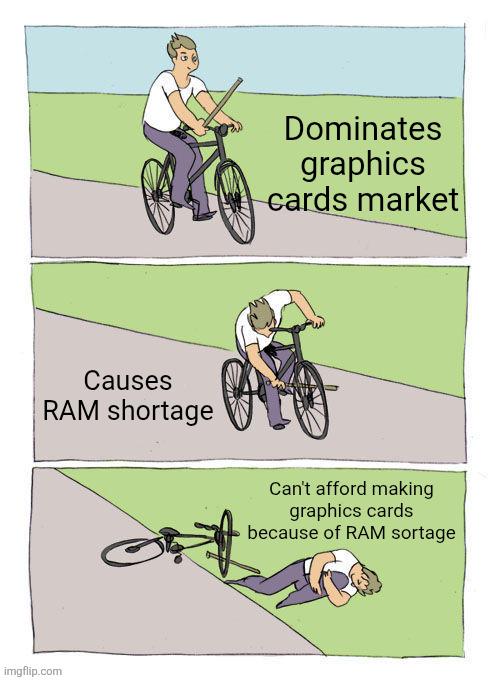
NVIDIA just casually announcing another GPU price hike while consumers are still recovering from the last one. It's like watching a heavyweight champion absolutely demolish an opponent who never stood a chance. The GPU market has been a bloodbath for consumers lately. Between crypto mining booms, AI training demand, and NVIDIA's near-monopoly on high-performance graphics cards, prices have been climbing faster than a poorly optimized recursive function. Meanwhile, we're all just trying to run our Docker containers and train our mediocre neural networks without selling a kidney. The best part? NVIDIA knows we'll still buy them because what's the alternative? Integrated graphics? We'd rather pay the premium than watch our compile times triple.

There Was No Other Way!

There Was No Other Way!
Linus finally found the ultimate disciplinary tool for kernel developers: threatening them with Rust. It's like telling your kids they'll have to eat vegetables if they don't behave, except the vegetables are memory safety and the kids are C programmers who've been writing unsafe code since 1991. The satire nails it—Rust was "created as a way to punish software developers" who "really had it coming." Because nothing says punishment like borrow checkers, lifetimes, and compiler errors that read like philosophical dissertations. The best part? One developer is relieved it's not Perl. That's how you know things have gotten serious—when Rust is the *merciful* option. Torvalds wielding Rust as a threat is peak Linux energy. "Shape up or you're rewriting that driver with lifetime annotations."

Burn Is Real

Burn Is Real
Someone tried to dunk on Linux by saying it "never succeeded" and got absolutely obliterated with a comeback about embedded systems. Because yeah, Linux totally failed... except it's running on literally billions of devices including the servers hosting that tweet, Android phones, routers, smart fridges, and apparently adult toys. The "sry bro" makes it even funnier because dude walked right into that one. Nothing says success like being so ubiquitous that people forget you're everywhere.

Ain't No Way I'm Buying Ram More Expensive Than A Whole Console

Ain't No Way I'm Buying Ram More Expensive Than A Whole Console
That moment when your DRAM LED lights up like a Christmas tree and you realize one of your RAM sticks has decided to retire early. The sheer existential dread captured in this expression is what every PC builder feels when they see that cursed little light during POST. The real kicker? DDR5 prices are so astronomical right now that buying replacement RAM literally costs more than a PS5 or Xbox Series X. You're sitting there doing mental math: "Do I really need 32GB, or can I survive on 16GB and, you know, eat this month?" Meanwhile console gamers just plug and play without ever knowing the pain of memory training errors or XMP profile instability. Fun fact: The DRAM LED is basically your motherboard's way of saying "Houston, we have a problem" but specifically for your memory modules. Could be a dead stick, improper seating, incompatible speeds, or the RAM just woke up and chose violence. Time to reseat everything and pray to the silicon gods.

True Story

True Story
Oracle's been flexing that "3 Billion Devices Run Java" slogan since 2009, and here we are a decade later... still 3 billion devices. Not 3.1 billion, not 4 billion—exactly 3 billion. Either Oracle's marketing team got really comfortable with that number, or Java's been running on the same devices for 10 years straight. Maybe those devices are just immortal? Or perhaps counting is hard when you're too busy suing Google over Android. The real kicker? In those 10 years, we went from flip phones to smartphones that can literally edit 4K video, but apparently Java's market share just... froze in time. It's like they found the perfect marketing tagline and decided "why fix what ain't broke?" Even if it's technically a lie at this point.

Fixed 2 Stuck Green Pixels On The New 75 Inch Today, Wife Thinks I'm A Wizard Now

Fixed 2 Stuck Green Pixels On The New 75 Inch Today, Wife Thinks I'm A Wizard Now
Nothing screams "tech wizard" quite like running a pixel unsticking video on your brand new 75-inch TV. You know the drill: rapid RGB flashing patterns that could trigger an epilepsy warning, all to massage those stubborn pixels back to life. The wife sees you playing a seizure-inducing rainbow strobe show and thinks you've performed digital sorcery, when really you just Googled "stuck pixel fix" and clicked the first YouTube result. The best part? Those two green pixels were probably haunting you from the moment you unboxed it, but you didn't want to deal with the return process. So instead, you spent 15 minutes staring at epileptic color bars like you're debugging a hardware issue with your eyeballs. And it worked! Now you're basically a display technician in her eyes. Don't tell her it's the digital equivalent of "turning it off and on again."

Why Nvidia?

Why Nvidia?
PC gamers watching their dream GPU become financially out of reach because every tech bro and their startup suddenly needs a thousand H100s to train their "revolutionary" chatbot. Meanwhile, Nvidia's just casually handing out RTX 3060s like participation trophies while they rake in billions from the AI gold rush. Remember when you could actually buy a graphics card to, you know, play games? Yeah, Jensen Huang doesn't. The AI boom turned Nvidia from a gaming hardware company into basically the OPEC of machine learning, and gamers went from being their primary customers to an afterthought. Nothing says "we care about our roots" quite like throwing scraps to the community that built your empire.

Root Root

Root Root
When your dev database credentials are just username: root and password: root , you might as well be wielding a lightsaber made of security vulnerabilities. The double "root root" is the universal developer handshake that screams "I'm definitely not pushing this to production... right?" Every dev environment has that one database where the admin credentials are so predictable they might as well be written on a sticky note attached to the monitor. It's the database equivalent of leaving your house key under the doormat, except the house is full of test data and half-finished migrations that will haunt you later. Fun fact: The "root" superuser account exists because Unix systems needed a way to distinguish the all-powerful administrator from regular users. Now it's the most overused password in local development, right next to "admin/admin" and "password123".