

Testing Memes

Testing: that thing we all agree is super important right up until the deadline hits and suddenly 'we'll test in production.' These memes are for everyone who's written a test that tests nothing, skipped writing tests because 'the code is obvious,' or watched in horror as your 100% test coverage failed to catch a critical bug. The eternal struggle between TDD purists and 'console.log is my unit test' pragmatists continues. Whether you're meticulously testing edge cases or just hoping users don't click that one button in that specific order, these memes will make you feel less alone in your testing sins.
Developer Logic: It's Not A Bug… It's An 'Unexpected Feature'!

Developer Logic: It's Not A Bug… It's An 'Unexpected Feature'!
The ancient art of developer spin doctoring at its finest! When QA finds a catastrophic leak in your code, you don't panic and fix it like some amateur—no, no, no. You simply slap some duct tape on it, add a fancy fountain animation, call it a "feature," and watch the stakeholders applaud your "creative vision." Bonus points if you can convince them it was intentional all along and charge extra for the "premium water feature package." The transformation from disaster to masterpiece is truly the developer's greatest superpower.

Vanilla Coding / Grind Coding / Soulslike Coding😂

Vanilla Coding / Grind Coding / Soulslike Coding😂
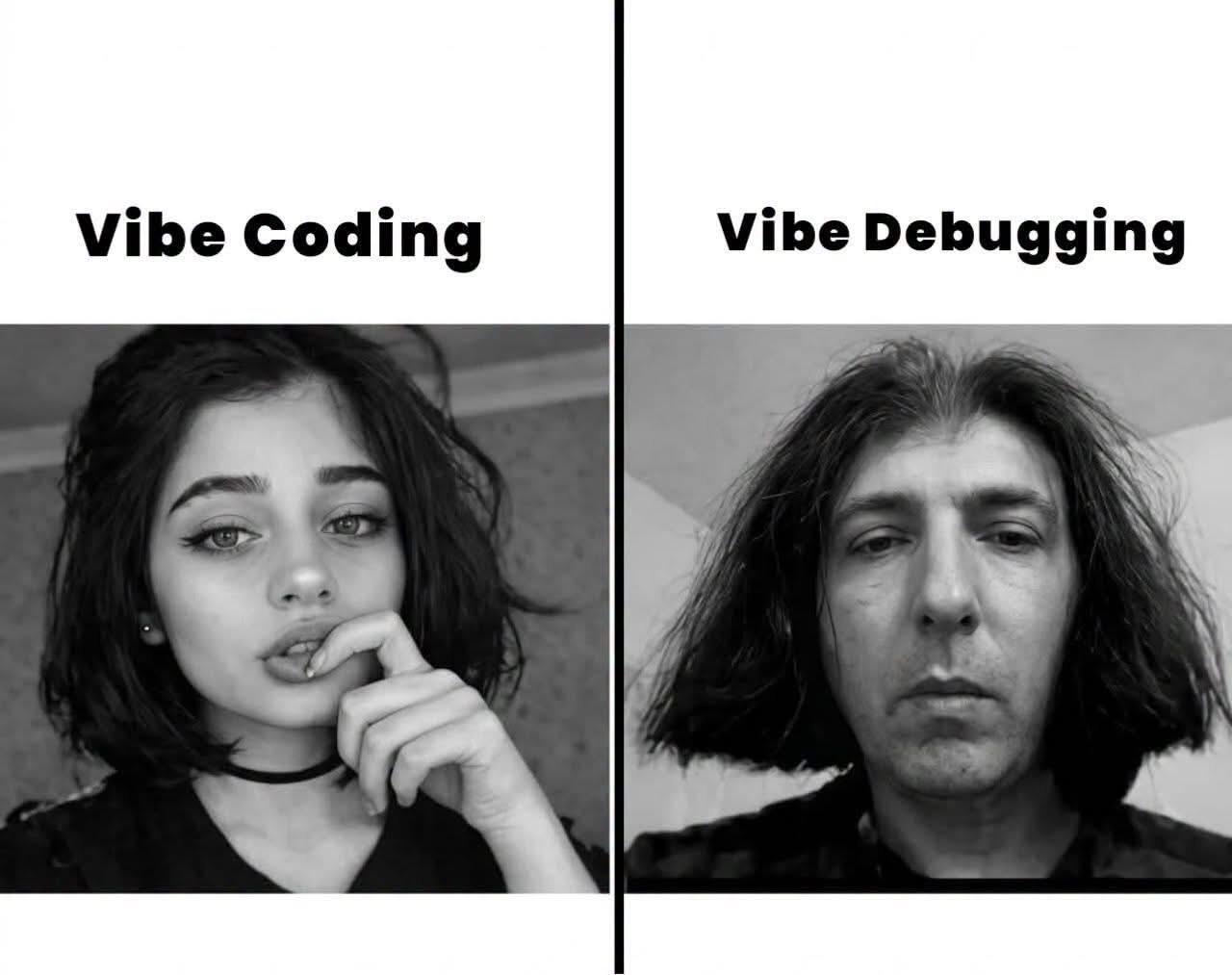
Julia Turc just opened Pandora's box by asking for a name for "not-vibe-coding" and the dev community delivered. The suggestions range from "boomer coding" (when you actually read documentation), "chewgy coding" (painfully outdated but somehow still works), "trad coding" (traditional, no frameworks, just suffering), to the absolute winner: "Coding with capital C" - you know, the kind where you actually plan things out, write tests, and don't just YOLO your way through production. But Gabor Varadi swoops in with the nuclear option: just call it "software engineering" in quotes. The air quotes do all the heavy lifting here - implying that what we call "vibe coding" is... well... not exactly engineering. It's the programming equivalent of "I'm not like other coders, I actually care about architecture and maintainability." The beautiful irony? Most of us toggle between vibe coding at 2 AM ("this will definitely work") and capital-C Coding during code reviews ("who wrote this garbage? Oh wait, that was me").

It's Coming For My Job

It's Coming For My Job
AI just casually generating a literal physical 3D holographic masterpiece of a seeded database for testing when you asked for a simple diagram. Meanwhile, you're still trying to figure out how to export your schema to PNG without it looking like garbage. The gap between what AI can produce and what we actually need is hilariously wide, yet somehow it still makes us question our job security. Like yeah, cool futuristic cityscape inside a glass cube, but can it fix the flaky integration tests that only fail on Fridays? The real kicker? Some PM is gonna see this and ask why your actual testing environment doesn't look this impressive.

Sure That Will Fix Everything

Sure That Will Fix Everything
When your backend has more spaghetti code than an Italian restaurant and someone casually drops "maybe we should just rewrite the whole thing" in a meeting. Everyone's sitting there like they just witnessed a declaration of war. Because nothing says "I value my sanity" quite like throwing away 5 years of legacy code, 47 undocumented features, and that one function nobody understands but everyone's too scared to touch. The rewrite fantasy is every developer's guilty pleasure—until you remember that the current system, despite being held together by duct tape and prayers, actually works. Meanwhile, your proposed rewrite will take 18 months, blow past every deadline, and somehow end up with the exact same bugs plus exciting new ones. Spoiler alert: You're not going to rewrite it. You're going to add another abstraction layer and call it "refactoring."

Always Bugging Me In My Head Without Even Coding

Always Bugging Me In My Head Without Even Coding
That moment when QA whispers sweet nothings into your ear about all the edge cases you forgot to handle. The intimate relationship between developers and QA teams is beautifully captured here—QA is literally in your head, breathing down your neck about that bug you swore you fixed three sprints ago. The developer's thousand-yard stare says it all. You're not even at your desk, maybe you're grocery shopping or trying to sleep, but QA's voice echoes: "What happens if the user enters a negative number?" "Did you test on Internet Explorer?" "The button doesn't work when I click it 47 times per second." Every dev knows that sinking feeling when QA finds another bug. It's like having a very thorough, very persistent voice in your head that never stops asking "but what if..." Even when you log off, they're still there, haunting your dreams with their meticulously documented Jira tickets.

When Code Actually Behaves🤣

When Code Actually Behaves🤣
Users: mild interest, polite nods. Developers: absolute pandemonium, pointing at screens, fist pumps, questioning reality itself. There's something deeply suspicious about code that works on the first try. No stack traces, no cryptic error messages, no emergency Slack pings at 2 AM. Just... functionality. Users think "cool, it works" while devs are frantically checking logs, re-running tests, and wondering what cosmic horror they've unleashed that's masquerading as working code. Because let's be real: when your feature actually works as expected, you're not celebrating—you're paranoid. Did I forget to commit something? Is production secretly on fire? Did I accidentally fix that bug from three sprints ago? The dopamine hit is real, but so is the imposter syndrome of "there's NO WAY I wrote code this clean."

Strong Developers Be Like

Strong Developers Be Like
You know you're living dangerously when your code could throw exceptions that would make the entire app crash, but you just... let it ride. No try-catch, no error handling, just pure faith in your logic. Then your senior dev does a code review and casually asks about exception handling, and suddenly you're sweating bullets trying to maintain composure. The "if he dies, he dies" mentality is peak confidence (or recklessness, depending on who you ask). Either the code works flawlessly, or production goes down in flames. No middle ground. It's like deploying to prod on a Friday afternoon—you're either a hero or updating your LinkedIn profile by Monday. Pro tip: Maybe wrap that database call in a try-catch before your senior finds out you're one null pointer away from taking down the entire microservices architecture.

Incredible Things Are Happening

Incredible Things Are Happening
Discord's genius solution to memory leaks: just nuke the whole thing and restart when it hits 4GB. That's not fixing memory leaks, that's just automated rage-quitting with extra steps. The real kicker? They won't restart if you're in a call. Because nothing says "we care about your experience" like letting the app balloon to 24GB of RAM while you're mid-conversation. At least your friends will know exactly when you rage quit Discord—it'll be right after your PC starts sounding like a jet engine. Fun fact: This is basically the software equivalent of "if you ignore the problem long enough, it becomes a feature." Memory management? Never heard of her.

I'm A DevOps Engineer And This Is Deep

I'm A DevOps Engineer And This Is Deep
The DevOps pipeline journey: where you fail spectacularly through eight different stages before finally achieving a single successful deploy, only to immediately break something else and start the whole catastrophic cycle again. It's like watching someone walk through a minefield, step on every single mine, get blown back to the start, and then somehow stumble through successfully on pure luck and desperation. That top line of red X's? That's your Monday morning after someone pushed to production on Friday at 4:59 PM. The middle line? Tuesday's "quick fix" that somehow made things worse. And that beautiful bottom line of green checkmarks? That's Wednesday at 3 AM when you've finally fixed everything and your CI/CD pipeline is greener than your energy drink-fueled hallucinations. The real tragedy is that one red X on the bottom line—that's the single test that passes locally but fails in production because "it works on my machine" is the DevOps equivalent of "thoughts and prayers."

Just Use Bacon Run

Just Use Bacon Run
So cargo watch gets deprecated in Rust and the replacement is bacon . Cool, fine, whatever. But then someone tries to use it with Bun (the JavaScript runtime that's trying to replace Node) and their gherkin—sorry, I mean gerkin , the Cucumber testing framework—starts throwing a fit. The beautiful chaos here is watching someone try to mix Rust tooling with JavaScript tooling while running Chai tests in a runtime that's basically speedrunning the "move fast and break things" philosophy. It's like ordering a bacon cheeseburger but the restaurant gives you a fish sandwich and your pickle is filing a complaint. Welcome to 2024, where we have so many tools that even their names sound like breakfast items and nobody knows what works with what anymore. Just wait until someone tries to run this with Deno and a side of Toast.

Even Sheldon Couldn't Make It Work As Code Is Good

Even Sheldon Couldn't Make It Work As Code Is Good
You know that special kind of hell where your code looks absolutely pristine—clean functions, proper naming conventions, no linting errors—but it still refuses to work? Yeah, that's where we live now. It's 3 AM and you're staring at code that *should* work. The logic is sound. The syntax is perfect. Stack Overflow has nothing. Your rubber duck has filed for emotional distress. Even Sheldon Cooper, with his theoretical physics PhD and eidetic memory, would be losing his mind trying to figure out why this perfectly good code is broken. Turns out the real bug was a missing semicolon in a config file three directories deep, or maybe it's a race condition that only happens on Tuesdays when Mercury is in retrograde. Sleep? Nah. We need answers. We need to know WHY.

Why Playtesting Is Important

Why Playtesting Is Important
Developer proudly ships their shiny new chat feature for the multiplayer game. First player to test it in production? Immediately weaponizes it by pasting the entire Bee Movie script into the chat, causing a catastrophic game freeze for everyone in the lobby. Classic case of not stress-testing input validation. The dev probably thought "nobody would paste that much text into a chat box, right?" Wrong. Players will always find the most creative ways to break your stuff. No character limit? That's an invitation. No rate limiting? Challenge accepted. No input sanitization? Say hello to the entire works of Shakespeare. The ":D" at the end really captures the chaotic energy of someone who just discovered they can DoS an entire game lobby with copypasta. Quality assurance? Never heard of her.