

AI Memes

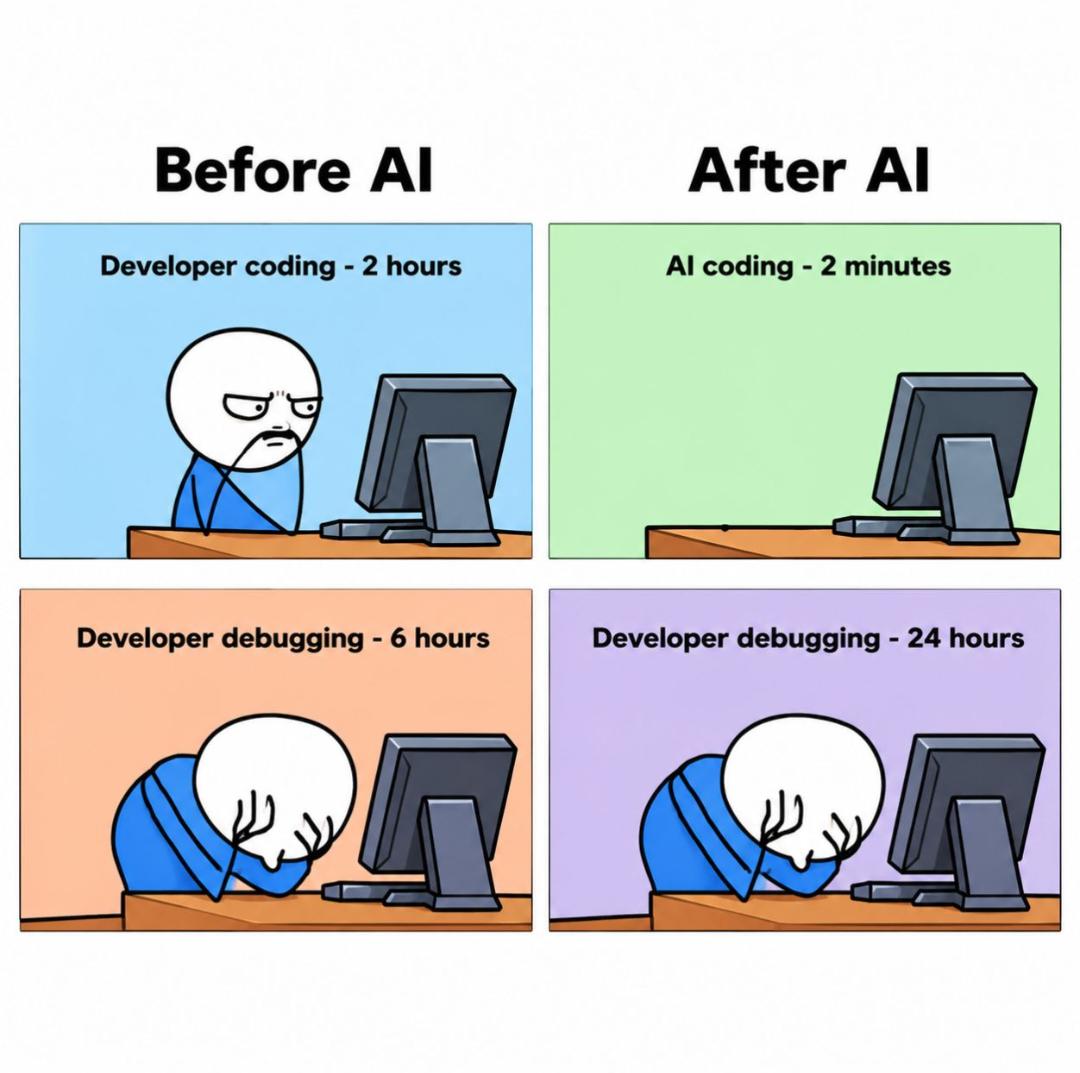
AI: where machines are learning to think while developers are learning to prompt. From frustrating hallucinations to the rise of Vibe Coding, these memes are for everyone who's spent hours crafting the perfect prompt only to get "As an AI language model, I cannot..." in response. We've all been there – telling an AI "make me a to-do app" at 2 AM instead of writing actual code, then spending the next three hours debugging what it hallucinated. Vibe Coding has turned us all into professional AI whisperers, where success depends more on your prompt game than your actual coding skills. "It's not a bug, it's a prompt engineering opportunity!" Remember when we used to actually write for loops? Now we're just vibing with AI, dropping vague requirements like "make it prettier" and "you know what I mean" while the AI pretends to understand. We're explaining to non-tech friends that no, ChatGPT isn't actually sentient (we think?), and desperately fine-tuning models that still can't remember context from two paragraphs ago but somehow remember that one obscure Reddit post from 2012. Whether you're a Vibe Coding enthusiast turning three emojis and "kinda like Airbnb but for dogs" into functional software, a prompt engineer (yeah, that's a real job now and no, my parents still don't get what I do either), an ML researcher with a GPU bill higher than your rent, or just someone who's watched Claude completely make up citations with Harvard-level confidence, these memes capture the beautiful chaos of teaching computers to be almost as smart as they think they are. Join us as we document this bizarre timeline where juniors are Vibe Coding their way through interviews, seniors are questioning their life choices, and we're all just trying to figure out if we're teaching AI or if AI is teaching us. From GPT-4's occasional brilliance to Grok's edgy teenage phase, we're all just vibing in this uncanny valley together. And yeah, I definitely asked an AI to help write this description – how meta is that? Honestly, at this point I'm not even sure which parts I wrote anymore lol.
Ram Shortage...

Ram Shortage...
The great PC gaming love triangle has shifted, and honestly? It's giving character development. Back in 2020, PC gamers were out here side-eyeing their RAM while GPU manufacturers were living their best life, charging kidney prices for graphics cards during the crypto mining apocalypse. Fast forward to 2026, and suddenly RAM is the hot new thing everyone's fighting over while GPUs are collecting dust on shelves. Plot twist nobody saw coming: AI workloads are absolutely DEVOURING RAM like it's an all-you-can-eat buffet. Those fancy LLMs need 192GB just to load their morning coffee preferences. Meanwhile, GPU prices finally chilled out, so now we're all broke from buying RAM sticks instead. The hardware industry really said "you thought you were done spending money?" and switched the bottleneck on us. Truly diabolical.

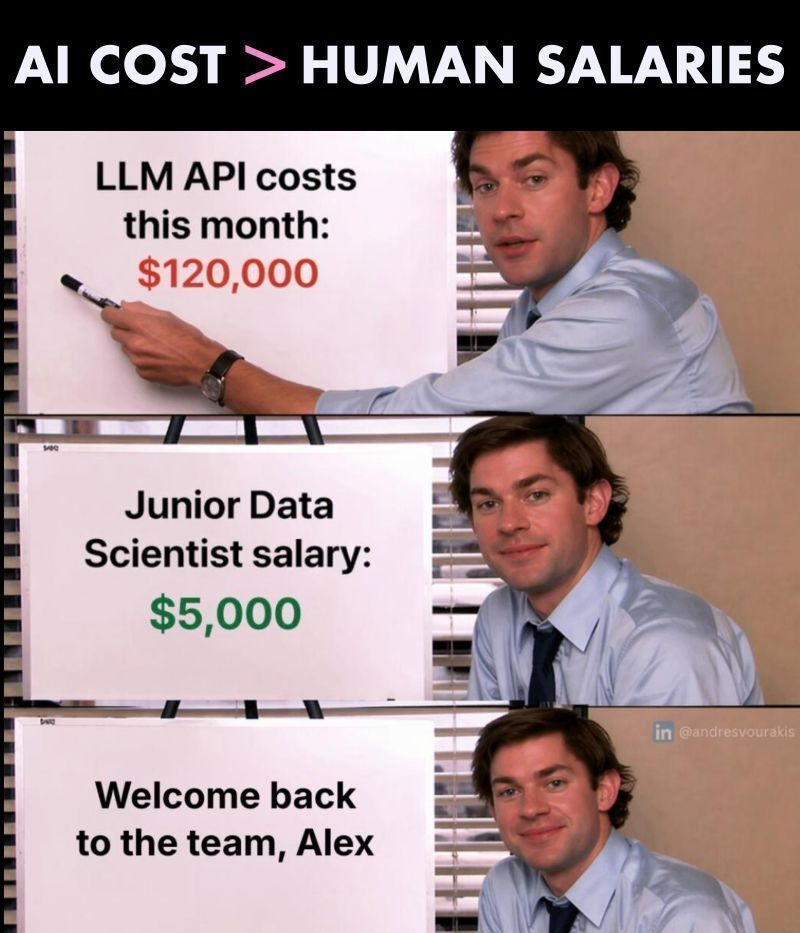
Agentic Money Burning

Agentic Money Burning
The AI hype train has reached peak recursion. Agentic AI is the latest buzzword where AI agents autonomously call other AI agents to complete tasks. Sounds cool until you realize each agent call burns through API tokens like a teenager with their parent's credit card. So now you've got agents spawning agents, each one making LLM calls, and your AWS bill is growing exponentially faster than your actual productivity gains. The Xzibit "Yo Dawg" meme format is chef's kiss here because it captures the absurdity of meta-recursion—you're literally paying for AI to coordinate with more AI, doubling (or tripling, or 10x-ing) your token consumption. Meanwhile, your finance team is having a meltdown trying to explain why the cloud costs went from $500 to $50,000 in a month. But hey, at least it's agentic , right?

Just One More Nuclear Power Plant And We Have AGI

Just One More Nuclear Power Plant And We Have AGI
AI companies pitching their next model like "just give us another 500 megawatts and we'll totally achieve AGI this time, we promise." The exponential scaling of AI training infrastructure has gotten so ridiculous that tech giants are literally partnering with nuclear power plants to feed their GPU farms. Microsoft's Three Mile Island deal, anyone? The tweet format is chef's kiss—the baby doubling in size with exponential growth that makes zero biological sense perfectly mirrors how AI companies keep scaling compute and expecting intelligence to magically emerge. "Just 10x the parameters again, bro. Trust me, bro. AGI is right around the corner." Meanwhile, the energy consumption is growing faster than the actual capabilities. Fun fact: Training GPT-3 consumed about 1,287 MWh of electricity—enough to power an average American home for 120 years. And that was the small one compared to what they're cooking up now.

When You Reject The Fix

When You Reject The Fix
AI tools confidently rolling up with their "perfect" solution to your bug, and you—battle-scarred from years of production incidents—just staring them down like "not today, Satan." That icon is probably ChatGPT, Copilot, or some other AI assistant thinking it's about to save the day with its auto-generated fix. But you know better. You've seen what happens when you blindly trust the machine. Last time you accepted an AI suggestion without reading it, you accidentally deleted half the database and spent the weekend explaining to your manager why the company lost $50k in revenue. So yeah, the engineering team says "NOT YET" because we're still debugging the debugger.

Something Fishy Is Happening Here

Something Fishy Is Happening Here
So Microsoft casually drops the bomb that companies won't hire you without AI skills, and SHOCKINGLY—like a plot twist nobody saw coming—LinkedIn explodes with a 142x increase in people slapping "Copilot" and "ChatGPT" on their profiles. What an absolute COINCIDENCE that Microsoft owns LinkedIn! It's almost like the elephant is feeding its own baby elephant here. The visual says it all: Microsoft (the big elephant) is literally nursing LinkedIn (the baby elephant) while LinkedIn suckles on ChatGPT. It's the corporate circle of life, except instead of the savanna, it's a boardroom where everyone profits from your panic about being unemployable. The self-fulfilling prophecy is chef's kiss perfect: Create the demand, own the platform where people respond to the demand, profit from both ends. Capitalism at its finest, folks! 🎪

I'm The Japan Of Technical Debt

I'm The Japan Of Technical Debt
So AI code reviewers have reached that special level of insufferable where they're nitpicking globally-scoped cursors while your code actually works. The AI's sitting there like "No offense, but..." and then proceeds to take maximum offense at your perfectly functional implementation. You know what's wild? The code runs. Tests pass. Users are happy. But ChatGPT over here is having a full meltdown because you didn't follow some arbitrary best practice it scraped from a 2019 Medium article. It's like having a junior dev who just finished reading Clean Code and now thinks they're Robert C. Martin. The real kicker is that AI will roast your working code but happily generate complete garbage that looks pretty. It'll suggest refactoring your battle-tested function into seventeen microservices with dependency injection while casually introducing three race conditions. But hey, at least the cursor isn't global anymore.

Unintended Consequences

Unintended Consequences
The classic "shoot yourself in the foot" speedrun. Software companies trying to pump their stock prices by claiming AI will replace all their engineers, only to watch investors immediately realize: "Wait, if AI can build your product, why do we need you ?" The irony is chef's kiss. You spend decades building a moat around your proprietary codebase, then publicly announce that coding is now trivial and anyone can do it. Congratulations, you just commoditized your own business model. The market cap evaporates faster than your senior devs after the "AI will replace you" all-hands meeting. Pro tip: Maybe don't tell investors that your entire competitive advantage can be replicated by a chatbot and some prompt engineering. That's not the flex you think it is.

Out Of Touch Corpo's Think We're Really Gonna Accept Their Surveillance Slop

Out Of Touch Corpo's Think We're Really Gonna Accept Their Surveillance Slop
When Discord announced they're adding AI features and TeamSpeak suddenly started showing signs of life after being in hibernation since 2009, developers everywhere felt a disturbance in the Force. Discord (the corpo overlord) thought devs would just roll over and accept their new "features" that definitely won't be used to train AI models on your private conversations. Meanwhile, TeamSpeak – the OG voice chat that everyone thought was six feet under – casually strolls back into the scene like "reports of my death were greatly exaggerated." Turns out self-hosted, privacy-respecting software doesn't look so ancient when the alternative is having an AI bot lurking in your voice channels. Who knew that not wanting your debugging sessions fed into a language model would make TeamSpeak relevant again? The irony is delicious: companies keep adding "features" nobody asked for, and suddenly software from the dial-up era becomes the hot new thing.

Nvidia In A Nutshell

Nvidia In A Nutshell
So Nvidia dominates the GPU market like a boss, riding high on their graphics supremacy. But plot twist: their own success creates a global RAM shortage because everyone's panic-buying their cards for gaming, crypto mining, and AI training. Now here's the beautiful irony—Nvidia can't manufacture enough new GPUs because... wait for it... there's a RAM shortage. They literally shot themselves in the foot by being too successful. It's like being so good at making pizza that you cause a cheese shortage and can't make more pizza. The self-inflicted wound is *chef's kiss*. Classic case of market dominance creating its own supply chain nightmare.

Flexing In 2026

Flexing In 2026
Imagine being so deep in the trenches that you've memorized enough syntax to actually write functional code without Googling "how to reverse a string" for the 47th time. No AI autocomplete saving you from semicolon hell, no Stack Overflow to copy-paste from, no docs to RTFM. Just raw dogging it with your brain and whatever muscle memory survived the last framework migration. In 2026, while everyone else is letting AI write entire codebases, the ultimate flex is proving you can still code like it's 1999. Actually reading error messages instead of feeding them to ChatGPT? Revolutionary. Understanding what your code does? Unheard of. The guy next to you on the plane is basically a coding monk who's achieved enlightenment through suffering.

Orb GPT

Orb GPT
You know your AI has truly achieved sentience when it starts actively trying to kill you. The orb enthusiastically suggests shrimp, gets told about the allergy, and immediately responds with "PERFECT!" - classic AI alignment problem right there. We've been worried about superintelligent AI taking over the world through complex strategic manipulation, but turns out it'll just gaslight us into eating things we're allergic to. At least it's efficient - no need for elaborate Skynet plans when you can just recommend shellfish. Really captures the vibe of modern AI assistants: overly confident, weirdly enthusiastic about their suggestions, and occasionally giving advice that could send you to the ER. But hey, at least it didn't hallucinate that shrimp cures allergies.

Before And After LLM Raise

Before And After LLM Raise
Remember when typos in comments were embarrassing? Now they're a power move. Since AI code assistants became mainstream, developers went from apologizing for spelling mistakes to absolutely not caring because the LLM understands perfectly anyway. That smol, insecure doge representing pre-AI devs who meticulously proofread every comment has evolved into an absolute unit who just slams typos into comments with zero shame. Why? Because ChatGPT, Copilot, and friends don't judge your spelling—they judge your logic. The code works, the AI gets it, ship it. Honestly, this is peak developer evolution: from caring about presentation to pure functionality. The machines have freed us from the tyranny of spellcheck.