Linux Memes

Linux: for when you want your computer to be like a project car – constantly tinkering under the hood instead of actually driving anywhere. These memes are for everyone who's felt the power rush of 'sudo' and the existential dread of accidentally typing 'rm -rf /' (don't do it). We love to preach about freedom and customization while spending entire weekends configuring drivers that Windows installed automatically. The year of the Linux desktop is always next year, but that won't stop us from looking smug when Windows crashes. If your idea of fun is compiling your own kernel, these memes will speak to your terminal-loving soul.
Just :Q! Please

Just :Q! Please
Someone made a Spotify playlist called "Songs About Vim" and it's basically a cry for help disguised as music curation. The track titles perfectly capture the Vim experience: "What Am I Doing Here" (opening Vim for the first time), "How Did I Get Here" (accidentally entering insert mode), "Can't Get Out" (the classic :q struggle), "Asdfjkl;" (panic mashing keys), "Shut It Down" (desperately trying to exit), and my personal favorite - "Rebooting" (the nuclear option when all else fails). Every single song title is a mood that represents a different stage of the Vim learning curve. The playlist creator really said "I'm in pain but make it aesthetic." The fact that this playlist has 1,198 saves means there's a whole community out there bonding over their shared trauma of being trapped in a text editor.

Realizing That Installing Kali Linux Is Not Enough

Realizing That Installing Kali Linux Is Not Enough
You know those kids who think downloading Kali makes them instant hackers? Yeah, turns out you actually need to understand what's happening under the hood. Who knew? The brutal reality check hits when you realize hacking isn't just running nmap and watching the Matrix scrolling text. You need to climb the entire staircase of fundamentals: computer basics, networking basics, Linux basics... and then maybe you can start playing with the pentesting tools. But people skip straight to the top step and wonder why they're face-planting. Can't exploit a buffer overflow if you don't know what a buffer is, my friend. Can't SQL inject if you think a database is where criminals are stored. The escalator to elite hacker status is permanently broken—you're taking the stairs.

We All Dreamed About Making Our Own OS At Some Point…

We All Dreamed About Making Our Own OS At Some Point…
The kid asks Santa for an OS built with HTML, and Santa's about to yeet them out the window. Classic misunderstanding of what an operating system actually is versus what HTML does. HTML is a markup language for structuring web content—it literally just tells browsers "hey, this is a heading, this is a paragraph, make this text bold." You can't build an OS with it any more than you could build a car engine out of Post-it notes. Building a real OS requires low-level languages like C, C++, or Rust, direct hardware interaction, memory management, process scheduling, and a whole lot of kernel-level wizardry. Meanwhile HTML is just sitting there like "I can make a div with rounded corners!" The gap between these two concepts is so vast that Santa's violent reaction is completely justified. Fun fact: Electron apps basically do wrap HTML/CSS/JS in what feels like a mini-OS footprint (looking at you, Slack and Discord eating 2GB of RAM), but that's still running on top of an actual operating system doing the heavy lifting.

Closing Programs

Closing Programs
Windows politely asks programs to close, waits for them to save their work, and gently guides them to termination. Meanwhile, Linux just straight up executes them with kill -9 and doesn't lose a second of sleep over it. The Firefox icon getting yeeted into oblivion while the Linux penguin stands there armed and dangerous is chef's kiss. No "Do you want to save changes?" dialog boxes here—just pure, unapologetic process termination. Windows is the helicopter parent of operating systems, Linux is the drill sergeant who doesn't negotiate with frozen processes.

Those Who Get It…

Those Who Get It…
Linux users see a folder icon with ~/* and think "home directory with all files" – simple, elegant, powerful. Windows users see the same thing and their brain goes full 1984 dystopian mode. The tilde (~) is Linux's shorthand for your home directory, and the asterisk wildcard means "everything." So ~/* literally translates to "all files in my home directory." For Linux folks, it's just another Tuesday. For Windows users who've never touched a terminal or dealt with Unix-style paths, it might as well be hieroglyphics carved by ancient sysadmins. The facial expressions capture it perfectly: Linux guy is casually nodding like "yeah, I know exactly what's in there," while Windows guy looks like he's contemplating the existential dread of learning bash syntax.

Ship Code Not Excuses He Says

Ship Code Not Excuses He Says
Someone left Microsoft because they wouldn't give them a MacBook, then proceeds to write a five-paragraph essay justifying their decision with the classic "Mac makes me more productive" argument. They talk about swapping terminals like a ninja, running Docker natively, and how their laptop sounds like a jet engine (spoiler: that's not the flex they think it is). Then they complain about Microsoft's 20-step auth and locked-down internal tools—valid gripes, honestly. But here's the kicker: after all this rambling about productivity and tooling preferences, they end with "Ship code, not excuses." Brother just shipped a whole manifesto instead of code. The irony is so thick you could deploy it to production. If you need a specific OS to be productive, you're not as productive as you think. Real devs ship code on a potato if they have to.

Guys, What's The Best Linux Distro To Install On My Pc?

Guys, What's The Best Linux Distro To Install On My Pc?
Ask any Linux user what distro you should use and watch them immediately launch into a passionate defense of their own choice while politely nodding at yours. It's like asking a parent which kid is their favorite—they'll say "they're all great!" but you know damn well they have a preference. The truth? Everyone thinks their distro is objectively superior while simultaneously respecting your terrible decision to use something else. Ubuntu users think Arch users are masochists. Arch users think Ubuntu users can't read documentation. Gentoo users are still compiling and can't join the conversation yet. Pro tip: The best distro is whichever one you've already spent 6 hours customizing and are now too emotionally invested to switch from.

Don't Try This

Don't Try This
Security through absolute chaos. The digital equivalent of leaving your front door wide open with a sign that says "Free stuff inside" just to confuse burglars. Opening all ports, never updating the OS, and removing all passwords isn't security—it's creating a honeypot so cursed that hackers think it's a trap. They see this setup and their threat assessment models just crash. "Nobody could possibly be this reckless... must be the FBI." The real genius here is weaponizing incompetence to the point where it becomes indistinguishable from a sophisticated sting operation. Your move, hackers.

[@Alexkrokus] Elders

[@Alexkrokus] Elders
You know you're getting old when your laptop outlives most of your relationships. That 10-year-old ThinkPad running Linux is basically a family heirloom at this point—still boots faster than your coworker's brand new MacBook, still has all the ports you actually need, and the keyboard feels like typing on clouds made of mechanical switches. The real tragedy here is that elderly laptop probably still has a better CPU than half the IoT devices in your house, doesn't force you to use a dongle for literally everything, and runs your code compilation without sounding like it's preparing for takeoff. Meanwhile, modern laptops are soldered shut, unrepairable, and cost more than a used car. Respect your elders, especially when they're still running that perfectly stable Debian install from 2015.

Bye Bye Windows Linux

Bye Bye Windows Linux
Someone just let Claude loose on operating system development and it actually produced something bootable. VibeOS features a file manager with a duck.png, a web browser that can navigate to "motherfuckingwebsite.com" (truly a mark of quality), and what appears to be a calculator app. The README casually admits "not everything works, some stuff is not even tested, but most things do" which is honestly more transparency than most enterprise software gives you. The fact that an AI managed to vibe-code an entire operating system while your production deployment is still broken from that hotfix three weeks ago really puts things in perspective. At least when VibeOS crashes, you can blame it on the AI not having feelings about your bug reports.

This Is Jehan Pages, The Top Developer Behind Gimp, A Free Open Source Photo Editor. Adobe Executives Hate Jehan. Because Of His Hard Work, Adobe Lost Millions Of Dollars

This Is Jehan Pages, The Top Developer Behind Gimp, A Free Open Source Photo Editor. Adobe Executives Hate Jehan. Because Of His Hard Work, Adobe Lost Millions Of Dollars
Behold the absolute MENACE to Adobe's subscription empire! Here stands Jehan Pages, the legendary developer who dared to make professional-grade photo editing accessible to mere mortals without requiring a monthly blood sacrifice to the Creative Cloud gods. While Adobe executives are out there charging $54.99/month for Photoshop, Jehan's over here maintaining GIMP like "what if people could just... edit photos... for FREE?" The audacity! The betrayal! The absolute CHAOS this man has unleashed upon Adobe's quarterly earnings reports! Sure, GIMP's UI might look like it time-traveled from 2003 and the learning curve is steeper than Mount Everest, but you know what? It costs exactly zero dollars and zero cents. That's the sound of Adobe's CFO crying into their expensive latte. Real talk: Open source heroes like Jehan are the reason we still have choices in software. Mad respect to everyone who contributes to FOSS projects while giant corporations are trying to subscription-ify literally everything we touch.

Shark Still Munching At The Cable

Shark Still Munching At The Cable
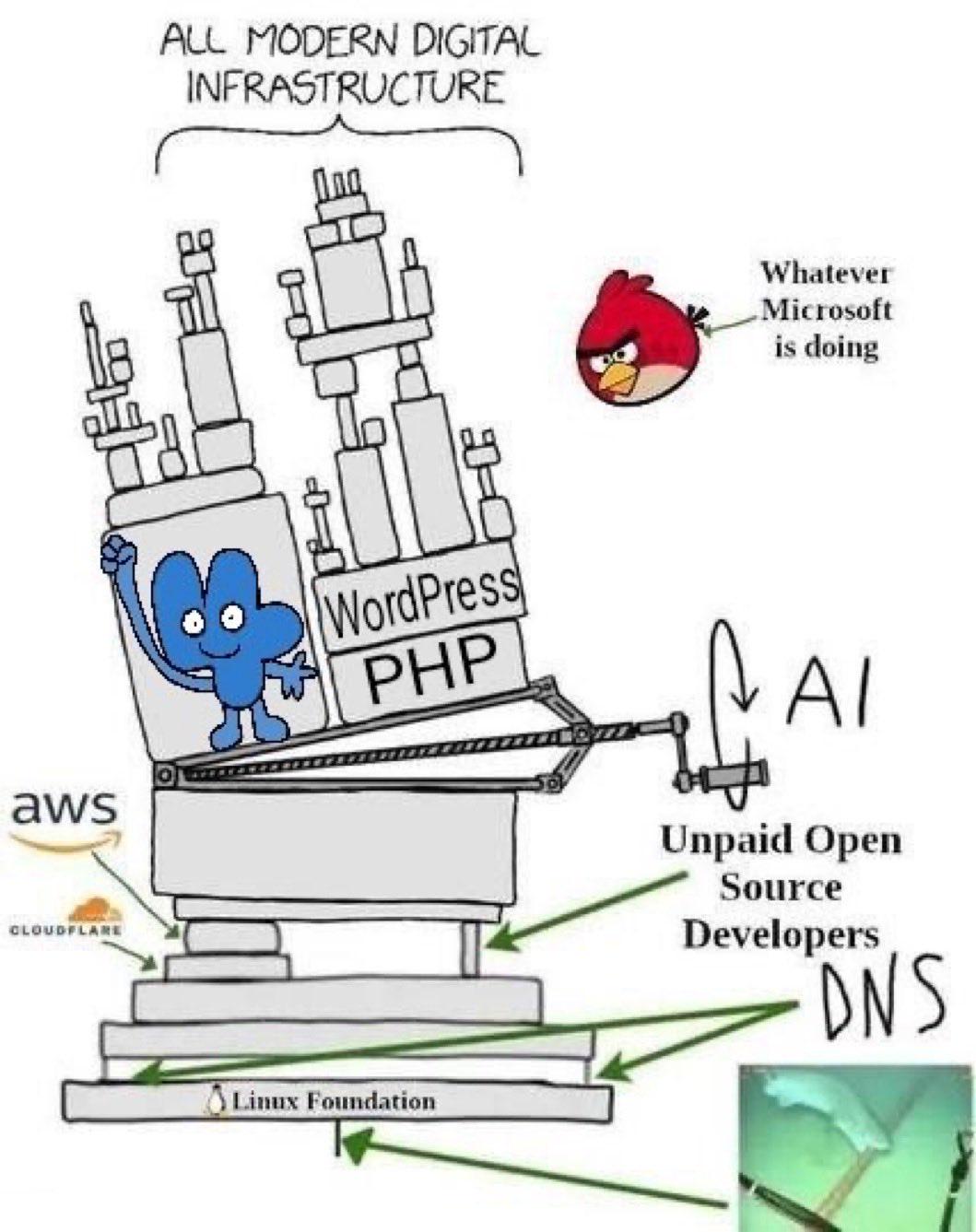
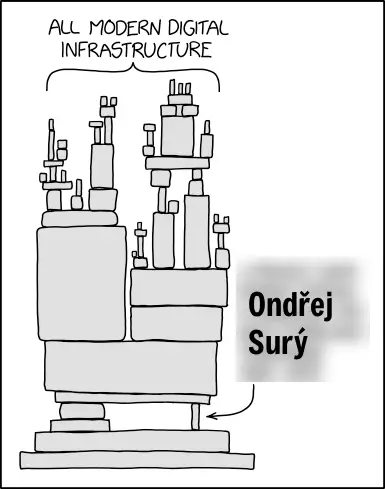
The entire internet is basically a Jenga tower held together by duct tape, prayers, and a few corporations we pretend to trust. At the very bottom, literally underwater, sharks are chomping on submarine cables because apparently even marine life has beef with our infrastructure. What's beautiful here is how the whole stack—from ASML making the chips, through Intel/AMD/Nvidia silicon, up past the Linux Foundation, DNS, AWS, Cloudflare, all the way to that precariously balanced mess of "modern digital infrastructure" with WASM and V8—depends on cables that sharks find delicious. Meanwhile, unpaid open source devs are basically holding the entire thing together with their bare hands while AI and Microsoft do... whatever they're doing up there. Fun fact: Sharks actually DO bite undersea internet cables, likely because the electromagnetic fields mess with their sensory organs. Google had to wrap their cables in Kevlar-like material. So yeah, your 404 error might literally be because a great white got hungry. The internet runs on vibes and shark-resistant coating.