Gamedev Memes

Game Development: where "it's just a small indie project" turns into three years of your life and counting. These memes celebrate the unique intersection of art, programming, design, and masochism that is creating interactive entertainment. If you've ever implemented physics only to watch your character clip through the floor, optimized rendering to gain 2 FPS, or explained to friends that no, you can't just "make a quick MMO," you'll find your people here. From the special horror of scope creep in passion projects to the indescribable joy of watching someone genuinely enjoy your game, this collection captures the rollercoaster that is turning imagination into playable reality.

Its A Peaceful Life

Its A Peaceful Life
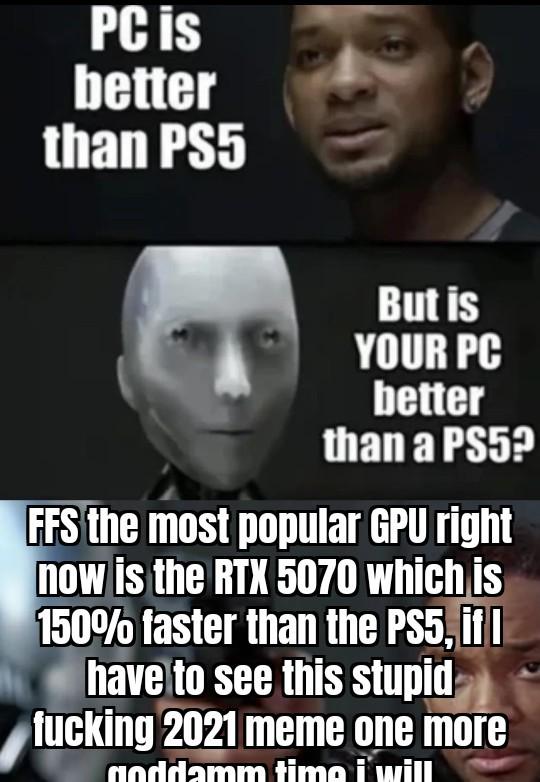
While everyone else is having heated debates about whether the RTX 5070 beats the AMD 9070 or arguing over marginal FPS differences in games they'll never actually play, you're sitting there with your GTX 980 from 2014, still running everything you need just fine. No driver drama, no power supply upgrades, no selling a kidney for the latest silicon. Just you and your decade-old card, living your best life in peaceful ignorance of the GPU wars. Sometimes the real victory is not caring about the benchmark wars and just enjoying what you have. Your 980 may not ray-trace, but it also doesn't require a separate breaker box.

The Evolution Of Programming Intelligence

The Evolution Of Programming Intelligence
Starting with Python's galaxy brain energy, descending through Java's merely brilliant neural activity, then C++'s dimming consciousness as you realize you're managing memory manually. Scratch brings us to the enlightened toddler phase where you're dragging colorful blocks around. And finally, we reach peak transcendence with command blocks in Minecraft—where you've ascended beyond traditional programming into a realm of redstone logic and block-based sorcery that somehow feels both incredibly powerful and deeply questionable at the same time. The progression from "I write elegant code" to "I literally program inside a video game" is a journey we all respect but don't necessarily understand.

How Do You Do, Peasants?

How Do You Do, Peasants?
Behold! Someone just casually opened their desk drawer like it's a treasure chest from the gods themselves, revealing enough RAM sticks to run a small data center. We're talking HyperX, Corsair, G.Skill, T-Force—basically every premium brand known to humankind, all color-coordinated and organized like they're preparing for the RAM Olympics. Meanwhile, the rest of us are out here downloading more RAM from sketchy websites and praying our 8GB stick doesn't give up during a Chrome session with three tabs open. This person literally has a DRAWER. A WHOLE DRAWER dedicated to RAM modules. They're probably using it as a coaster collection at this point because what else do you do when you have more memory than memories? The sheer audacity of flexing a RAM drawer while some of us are still running on hopes, dreams, and 4GB of DDR3 is absolutely unhinged. Pure hardware royalty energy right here.

I'm Really Sorry For Those Who Wanted To Make A Build Just Now

I'm Really Sorry For Those Who Wanted To Make A Build Just Now
Remember when you could build a gaming PC without taking out a second mortgage? Yeah, me neither. That glorious feeling of assembling your rig right before GPU prices went absolutely bonkers is like watching a plane crash in slow motion—except you're Thomas the Tank Engine with that unsettlingly cheerful smile, blissfully unaware of the financial apocalypse behind you. Building your PC before the crypto mining boom, chip shortage, and general hardware price insanity hit different. You got that sweet RTX 3080 at MSRP while everyone else is now fighting scalpers and bots for a card that costs more than their entire setup. Meanwhile, current builders are out here selling kidneys just to afford RAM sticks. The best part? You're just cruising along with your reasonably-priced components while the entire PC building community burns in the background. No regrets, just vibes and 144fps.

Working On A Raycasting Engine

Working On A Raycasting Engine
So you spent three weeks learning trigonometry, diving into DDA algorithms, and debugging why your walls look like a Salvador Dalí painting, only to realize John Carmack did this in 1992 on hardware that had less computing power than your smart toaster. And he did it while probably eating pizza and writing assembly like it was a casual Tuesday. The "box of triangles" bit hits different when you realize modern game engines abstract all this pain away with their fancy rendering pipelines, but back then? Carmack was literally casting rays and doing trigonometric calculations per pixel to fake 3D in Wolfenstein 3D. No GPU acceleration, no Unity, no "just import Three.js"—just raw math and the will to make demons shootable. Meanwhile, you're here in 2024 with Stack Overflow, ChatGPT, and 64GB of RAM, still struggling to get your raycaster to not crash when you look at a corner. Humbling stuff.

Please Pop

Please Pop
Someone volunteers to time travel and fix tech history, and naturally they go back to prevent the AI and cloud gaming hype. The guy literally says "Adiós" to the bubble (stack data structure joke intended) before popping it. But here's the kicker: he comes back to a timeline where everyone's just... sadder? Turns out preventing those "bubbles" didn't save us from anything—it just robbed us of the collective delusion that kept spirits high. The double meaning hits hard: "pop" as in popping a bubble (both the economic kind and the stack operation), and the desperate "please pop" like we're all begging for these trends to just burst already. But careful what you wish for—without the hype cycles, we're left staring at the void of what actually shipped.

Thanks Valve !

Thanks Valve !
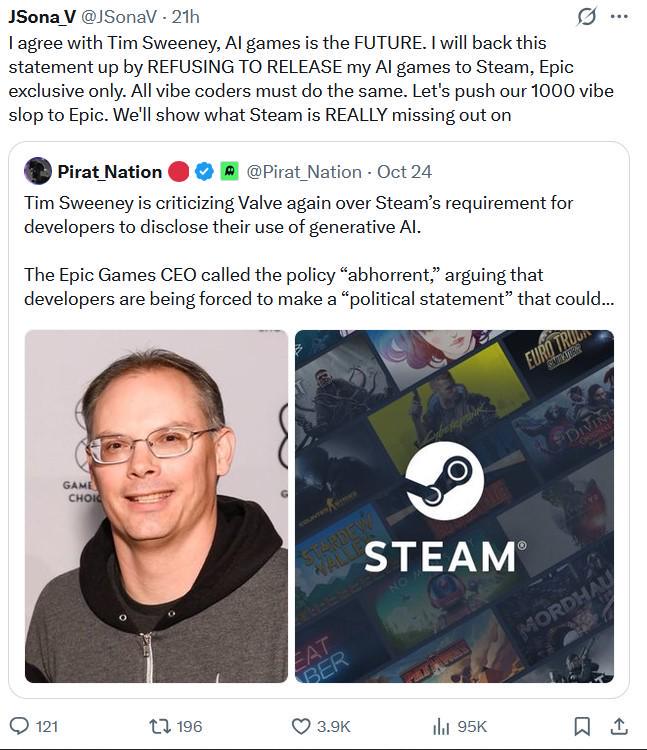
Valve really said "sure, flood our platform with AI slop" and then immediately added a scarlet letter system so everyone knows exactly what they're downloading. It's like opening a landfill and then handing out hazmat suits at the entrance. The crowd goes from cheering to celebrating even harder because now they can avoid the AI garbage with surgical precision. Honestly, it's a genius move—let the AI bros cook their procedurally generated asset flips while giving actual humans the ability to filter them out like spam emails. The free market, but with warning labels.

I've Been Wanting To Update My Pieces For A Few Years Now

I've Been Wanting To Update My Pieces For A Few Years Now
PC gamers getting absolutely demolished from every possible angle. Bitcoin miners drove GPU prices to the moon, AI training suddenly needs every RTX card ever manufactured, and Micron casually dipped out of the consumer market. Meanwhile NVIDIA's just standing there watching the chaos unfold, probably calculating profit margins. And then there's "Poor Optimization" - the real villain nobody wants to talk about. Your dream PC getting absolutely kicked in the teeth because some AAA studio decided 8GB VRAM should be the minimum for their unoptimized mess. You can't even upgrade your way out of bad code. The GPU shortage era was wild. People were camping Newegg like it was a Supreme drop, paying scalper prices that would make a loan shark blush, all while game devs kept pushing "recommended specs" higher. Fun times.

Grabs Popcorn..

Grabs Popcorn..
So Micron just ditched the consumer RAM market to chase AI money, and somewhere in Valve HQ, Gabe Newell is nervously sweating because they just announced the Steam Machine reboot for 2026. You know, that living room PC console thing that flopped harder than a null pointer exception back in 2015? The timing couldn't be worse. RAM prices are about to skyrocket because everyone and their grandma is building AI datacenters, and Valve just committed to shipping hardware that needs... you guessed it... memory. It's like announcing a new car model right as the world runs out of tires. The dog sitting in the burning room perfectly captures Valve's situation - they're watching the memory market implode while pretending everything's fine with their Steam Machine 2.0 plans. Someone's getting fired, or at least they would if Valve had a traditional management structure.

Its A Refreshing Change Of Other Companys

Its A Refreshing Change Of Other Companys
You know you're living in a dystopian tech world when praising literally everyone on the team gets you a standing ovation. Gaben and Valve have somehow cracked the code: treat your employees like humans, let them work on what they want, ship games when they're ready (Half-Life 3 notwithstanding), and don't crunch people into the ground. Meanwhile, the rest of the industry is out here with mandatory 80-hour weeks, layoffs after record profits, and CEOs taking home bonuses that could fund an indie studio for a decade. The bar is literally on the floor, and Valve just casually stepped over it while everyone else is doing limbo underneath. Support staff getting recognition? Revolutionary. Not treating devs like disposable code monkeys? Groundbreaking. It's wild that basic human decency in game dev is now considered a flex.

Survive

Survive!
Your ancient GTX 1080 Ti looking at you like a war veteran who's been asked to do one more tour of duty. GPU prices went nuclear and suddenly that 7-year-old card you were planning to retire is now your most valuable asset. The correction from "GPU" to "RAM" is chef's kiss—because yeah, you're not upgrading anything else either. That graphics card has rendered more frames than it ever signed up for, and now it's being held together by thermal paste and prayers. It's seen things. Terrible things. Like your Blender projects.

Shots Fired

Shots Fired
Product managers and UX designers really thought they did something by adding that tutorial button, huh? Meanwhile, 99% of users are smashing "Yeah, Skip!" faster than they can say "I'll figure it out myself" and then immediately flooding Slack with "how do I..." questions. The real kicker? Your team spent three sprints building that gorgeous interactive tutorial with tooltips, animations, and progress tracking. Nobody watches it. Ever. But somehow it's the devs' fault when users can't find the export button that's been in the same spot for two years. We've all been on both sides of this. Skip the tutorial, break something, then complain the documentation sucks. It's the circle of tech life.