

Enterprise Memes

Posts tagged with Enterprise
It Feels Weird

It Feels Weird
BGP peering being described as something "even friends can do" is the networking equivalent of saying "even friends can perform open-heart surgery together." Sure, technically possible, but someone's definitely getting hurt. For the uninitiated: BGP (Border Gateway Protocol) is how the entire internet routes traffic between autonomous systems. It's the protocol that literally holds the internet together, and misconfiguring it can take down chunks of the web (looking at you, Facebook 2021 outage). Setting up BGP peering between networks requires trust, technical competency, and usually involves at least three conference calls where nobody's mic works properly. The idea that you'd casually BGP peer with your buddy like you're sharing Netflix passwords is both adorable and terrifying. "Hey bro, wanna exchange routing tables?" is not normal friend behavior. That's enterprise-level commitment right there.

Let's Put AI Everywhere And Call It A Company

Let's Put AI Everywhere And Call It A Company
Microsoft's naming strategy in 2024: take your existing products, slap "Copilot" or "AI" on everything, and pretend you invented something revolutionary. Word becomes "Wordslop," Excel turns into "Exslop," and my personal favorite—Teams is now just "Recycle Bin" because let's be honest, that's where all productivity goes to die anyway. The real genius move here is "Power Slop Intelligence"—because why have Power BI when you can have a product name that sounds like what comes out after a bad algorithm eats too much training data? SharePoint becoming "Slop Point" is just truth in advertising at this point. Nothing says "we're out of ideas" quite like adding AI to products that have worked fine for decades and charging enterprise customers an extra $30/month per seat for features that hallucinate your quarterly reports. But hey, at least the VCs are happy.

PC Gamers When They Ask Jensen Why He's Making Less GPUs With RGB

PC Gamers When They Ask Jensen Why He's Making Less GPUs With RGB
Jensen Huang and Nvidia have quietly pivoted from selling RGB-laden gaming GPUs to becoming an AI datacenter empire worth trillions. That revenue chart tells the whole story—gaming revenue is basically a rounding error now compared to the datacenter money printer. PC gamers are out here begging for affordable GPUs with pretty lights while Jensen's counting his AI billions and couldn't care less about your 240fps dreams. The leather jacket man realized that selling one H100 to OpenAI is worth more than selling a thousand RTX 4090s to gamers who just want to play Cyberpunk with ray tracing. Sorry gamers, but you've been dumped for a more profitable relationship with enterprise clients who actually pay without complaining about MSRP.

Based Java Developer

Based Java Developer
Java devs writing exception handling be like: "Yeah I'll catch it. Or not. Whatever happens, happens." The try-catch block is basically a suggestion at this point. Error handling? More like error acknowledging. The code runs, something breaks, you catch it, shrug, and move on with your life. No recovery logic, no fallback, just vibes. At least the compiler's happy.

True Story

True Story
Oracle's been flexing that "3 Billion Devices Run Java" slogan since 2009, and here we are a decade later... still 3 billion devices. Not 3.1 billion, not 4 billion—exactly 3 billion. Either Oracle's marketing team got really comfortable with that number, or Java's been running on the same devices for 10 years straight. Maybe those devices are just immortal? Or perhaps counting is hard when you're too busy suing Google over Android. The real kicker? In those 10 years, we went from flip phones to smartphones that can literally edit 4K video, but apparently Java's market share just... froze in time. It's like they found the perfect marketing tagline and decided "why fix what ain't broke?" Even if it's technically a lie at this point.

Abbreviation Didn't Change But Its Meaning Did

Abbreviation Didn't Change But Its Meaning Did
CES used to mean showing off the latest gadgets for regular folks. Now it's just a parade of AI-powered enterprise solutions, B2B SaaS platforms, and "synergistic blockchain ecosystems" that nobody asked for. The glasses coming off is the perfect metaphor—you're seeing clearly now that the cool consumer tech you were excited about has been replaced by corporate buzzword bingo. Remember when tech shows had actual products you could buy? Yeah, those were the days.

Java Devs... Just Admit It.... This Is Way Way Too Far

Java Devs... Just Admit It.... This Is Way Way Too Far
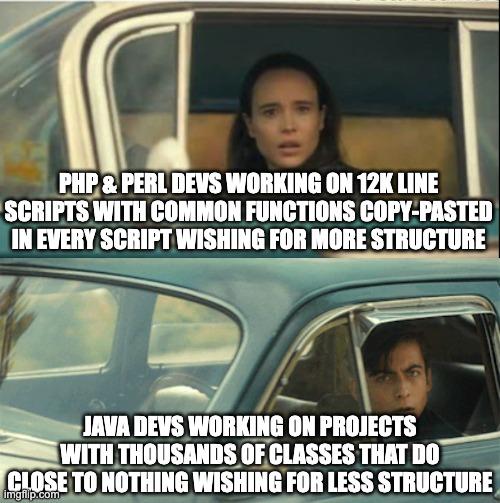
Java developers have this special talent for turning a simple problem into an architectural masterpiece nobody asked for. You need to create an order? Cool. But wait—what if we need an interface for flexibility? And obviously we need a factory to create those orders. But hold on, what if we need to create factories? Better make a factory factory . And naturally, that factory factory needs an interface too. Before you know it, you've got 47 files just to instantiate a single object. The best part? They'll defend this madness by saying it's "maintainable" and "testable" while the rest of us are shipping features. Enterprise Java turned abstraction into a competitive sport, and honestly, they're winning medals nobody wants. Meanwhile, Python devs are over here like: order = Order() and calling it a day.

Microsoft Certified Html Professional

Microsoft Certified Html Professional
The classic interrogation technique applied to tech bros who pad their resumes. Someone claims they "use AI to write code" and "develop enterprise applications," but when pressed for specifics, they're really just making webpages. The punchline hits different because there's a massive gap between building scalable enterprise systems and throwing together HTML/CSS landing pages, yet both can technically be called "development." The Microsoft certification in the title adds another layer of irony—Microsoft offers legitimate professional certifications for Azure, .NET, and enterprise technologies, but "HTML Professional" isn't exactly the flex you'd expect from someone building enterprise apps. It's like saying you're a Michelin-starred chef because you can make toast.

Microsoft Certified Html Professional

Microsoft Certified Html Professional
The classic interrogation format where someone keeps inflating their job title until they're forced to admit they just make webpages. Starting with "I use AI to write code" (very impressive, very 2024), escalating to "I develop enterprise applications" (now we're talking six figures), and finally landing on the truth: "I make webpages." It's the tech industry equivalent of saying you're a "culinary artist" when you microwave Hot Pockets. Nothing wrong with making webpages—someone's gotta do it—but let's not pretend your landing page for Karen's yoga studio is the next AWS. The "Microsoft Certified HTML Professional" title is the cherry on top. HTML isn't even a programming language, and Microsoft definitely doesn't certify you in it. But hey, put it on LinkedIn anyway. Nobody checks.

Stop Naming Services After Marvel Characters

Stop Naming Services After Marvel Characters
Finally! Freedom to name your microservice whatever your heart desires! No more boring "user-authentication-service" or "payment-processor-api"—nope, we're going FULL CREATIVE MODE. And what better way to exercise this newfound liberty than naming it after a disabled piglet with a wheelchair? Because nothing screams "professional enterprise architecture" quite like explaining to your CTO that the authentication service is called Chris P. Bacon. The beauty here is the sheer commitment to the bit. Your manager gives you carte blanche on naming conventions, thinking you'll choose something sensible and descriptive. Instead, you've immortalized a piglet from Clermont, Florida in your company's infrastructure. Now every standup meeting includes the phrase "Chris P. Bacon is down" and nobody can keep a straight face. The on-call rotation just got 1000% more entertaining. Bonus points: when new developers join and have to read documentation that casually references Chris P. Bacon handling critical business logic. They'll spend their first week wondering if they joined a tech company or a petting zoo.

We've Come A Long Way

We've Come A Long Way
Remember when Micron was just trying to sell RAM to nerds who actually knew what it was? Now Sam Altman's out here launching ChatGPT to your grandma who thinks it's a fancy search engine. The dominoes show the beautiful trajectory from "enterprise B2B semiconductor sales" to "literally everyone and their dog can talk to an AI." It's like watching your niche indie band blow up on TikTok—you're happy for the success, but also slightly annoyed that normies are now in your space. OpenAI went from "research lab for AI safety" to "the thing your boss wants you to integrate into every product by EOD."

Not A Big Deal, Just A Company That Runs Half The Internet

Not A Big Deal, Just A Company That Runs Half The Internet
Nothing says "enterprise reliability" quite like AWS failing to collect 82 cents and sending you a formal email about it. The irony here is chef's kiss—a company that hosts Netflix, NASA, and probably your startup's MVP can't process a payment under a dollar. Meanwhile, their URLs are still using template variables like ${AWSConsoleURL} in production emails, which is either a hilarious oversight or they're charging you extra to render those variables. The "Thank you for your continued interest in AWS" at the end really seals the deal. Yeah, not like I have a choice when you're literally running my entire infrastructure. It's giving "we know you can't leave us" energy. That 82 cents probably cost them more in engineering time to send this email than the actual charge was worth.