Java Memes

Java: where naming things isn't just hard – it's an art form requiring at least five words and three design patterns. These memes are for everyone who's experienced the special joy of waiting for your code to compile while questioning if AbstractSingletonProxyFactoryBean is really necessary. Java promised us 'write once, run anywhere' but delivered 'debug everywhere.' Still, there's something oddly comforting about a language so verbose that it practically documents itself. If you've ever had to explain to your boss why the JVM needs more RAM than your gaming PC, these memes will feel like a warm, object-oriented hug.


When You Post Increment Too Early

When You Post Increment Too Early
Someone updated that drowning counter with count++ instead of ++count and now zero people have drowned wearing lifejackets. Technically correct is the best kind of correct, right? The sign maker probably tested it once, saw it worked, shipped it to production, and went home early. Meanwhile, the lifejacket stat is sitting there at zero like "not my problem." Fun fact: The difference between i++ and ++i has caused more bugs than anyone wants to admit. Post-increment returns the value THEN increments it, while pre-increment does it the other way around. It's the programming equivalent of putting your shoes on before your socks—technically you did both things, just in the wrong order.

Accurate

Accurate
The perfect relationship doesn't exi— wait, hold on. That green bar showing all 22307 tests passing with zero errors and zero warnings? That's the programming equivalent of finding true love. The tweet format perfectly captures that rare, beautiful moment when your entire test suite runs clean and your code compiles without a single complaint. No deprecation warnings, no flaky tests, no "this might be a problem later" yellow flags. Just pure, unadulterated success. The juxtaposition of the cynical tweet about relationships with the pristine test output is *chef's kiss* because honestly, getting a clean test run is way more satisfying than most human interactions anyway.

Ignorance Is Bliss

Ignorance Is Bliss
Junior devs just slapping public int x; everywhere and living their best life. Then someone introduces them to encapsulation and suddenly they're writing getters and setters like they just discovered fire. The fancy suit represents that false sense of sophistication you get from following OOP principles—until you realize you've written 20 lines of boilerplate just to access a single integer. You're now "professionally" doing what you used to do in one line, and deep down you're questioning every life choice that led you here. Sometimes the simple solution was fine. But now you're in too deep to go back. Welcome to enterprise development, where we make everything unnecessarily complicated and call it "best practices."

Is He Wrong Though

Is He Wrong Though
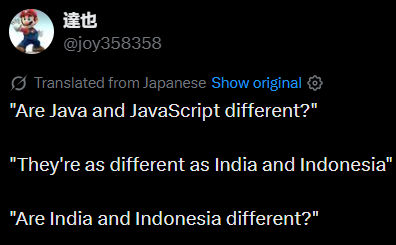
The "write once, run anywhere" crowd just got absolutely demolished. Sure, Java's cross-platform compatibility is technically impressive, but that's like being proud your code runs equally mediocre everywhere. The JVM being on Windows, Linux, and macOS doesn't make Java good —it just means everyone gets to suffer equally. Here's the thing: cross-platform compatibility is a feature, not a personality trait. JavaScript runs everywhere too, and we're not exactly throwing parades about it. The analogy here is brutally effective because it exposes the logical fallacy—universal compatibility doesn't equal quality. It just means you've achieved the bare minimum of not being platform-locked. Java developers will defend their language with religious fervor, but deep down they know they're just Stockholm syndrome victims of enterprise codebases written in 2003 that nobody dares to refactor.

You Can Pry Pattern Matching From My Cold Dead Hands

You Can Pry Pattern Matching From My Cold Dead Hands
When someone suggests that programming language choice doesn't matter because "architecture and business" are what really count, they're technically correct but also completely missing the point. Sure, your microservices architecture matters. Sure, meeting business requirements is crucial. But tell that to the developer who just discovered pattern matching and now sees nested if-else statements as a personal attack. The bell curve meme captures this perfectly: the beginners obsess over languages because they don't know better yet. The "enlightened" midwits preach language-agnostic wisdom while secretly still writing Java. And the actual experts? They've tasted the forbidden fruit of modern language features and would rather quit than go back to languages that make them write boilerplate like it's 1999. Pattern matching, exhaustive type checking, algebraic data types—once you've had them, you realize some languages really are just objectively better for your sanity. Architecture matters, sure. But so does not wanting to throw your keyboard through a window every day.

Apache Zookeeper Be Like

Apache Zookeeper Be Like
So you've got this distributed coordination service where nodes need to democratically elect a leader, right? Sounds noble, sounds fair. But PLOT TWIST: every single node is like "yeah yeah, democracy is great... but have you considered ME as leader?" It's literally the most chaotic group project energy where everyone nominates themselves and nobody wants to follow anyone else. The Zookeeper ensemble turns into a pirate crew where every pirate thinks THEY should be captain. Distributed consensus algorithms be out here trying to bring order to absolute anarchy, and honestly? The fact that it works at all is a miracle of computer science.

Code Compiled In First Attempt

Code Compiled In First Attempt
You know something's wrong when your code compiles on the first try. Either you've ascended to a higher plane of existence, or you're about to discover a runtime error so catastrophic it'll make you wish for the comfort of syntax errors. That moment of "inner peace" lasts exactly 3 seconds before the paranoia kicks in and you start frantically checking if you accidentally commented out half your codebase. Spoiler: it runs perfectly, which means it's definitely cursed.

This App Is Currently Running Close The App And Try Again

This App Is Currently Running Close The App And Try Again
Content Kyle o @KylePlantEmoji Me: hey windows can you delete this file please Windows: you got it, j-... omg there's actually a program using it right now Me: omg who 6 Windows: omg I can't say 6

Ew Brother Ew Whats That

Ew Brother Ew Whats That
You know that face you make when you're doing a code review and stumble upon someone allocating memory like they're running a server farm in 1995? That visceral disgust mixed with genuine concern for humanity's future? Yeah, that's the one. The hyper-specific "0.000438 seconds" is chef's kiss because we all know that one dev who profiles everything and then acts like 438 microseconds is the reason the quarterly metrics are down. Meanwhile, there's a nested loop somewhere doing O(n³) operations on the entire user database, but sure, let's focus on this memory allocation that happens once during initialization. The nose wrinkle and raised lip combo is what happens when you see someone creating a new ArrayList inside a loop that runs a million times. Or when they're allocating a 5GB buffer "just to be safe." Brother, the garbage collector is already crying.

If You Know You Know

If You Know You Know
The great divide: opening curly brace on the same line vs. new line. You'd think we'd have solved world hunger by now, but nope—we're still fighting holy wars over bracket placement. Both camps are convinced they're right, both will die on this hill, and both will passive-aggressively "fix" each other's code during reviews. The left side is the K&R/Java/JavaScript crowd, the right is the Allman style devotees. Plot twist: your linter doesn't care about your feelings and will enforce whatever the team lead decided three years ago.

Upwards Mobility

Upwards Mobility
The corporate ladder speedrun: destroy a perfectly functioning system, make it objectively worse, get promoted, then bail before the dumpster fire you created becomes your problem. Peak software engineering right here. Dude took a Java service that ran flawlessly for 5 years and convinced management it needed a complete rewrite in Go with microservices because "modernization." The result? Slower performance, double the costs, and a memory leak that strikes at 2 AM like clockwork. But hey, that 20-page design doc had enough buzzwords to secure the L6 promotion. The best part? After getting the promo, they immediately transferred to a "chill Core Infra team" where they won't be on call for the disaster they created. Some poor new grad is now inheriting a $550k total comp nightmare. That's not upward mobility—that's a tactical extraction after carpet bombing production. Pro tip: If your promotion depends on creating "scope" and "complexity" instead of solving actual problems, you're not engineering—you're just resume-driven development with extra steps.

Brilliant Maneuver

Brilliant Maneuver
The corporate ladder climb speedrun any%. Dude took a perfectly functional Java service that ran flawlessly for 5 years and nuked it with an unnecessary microservices rewrite in Go—just to pad the resume with "scope" and "complexity" for that sweet L5 to L6 promotion at Amazon. The result? A system that's slower, costs 2x more, and has memory leaks that wake people up at 2 AM. But hey, the 20-page design doc was strategic enough to fool management. The real galaxy brain move though? Getting promoted, then immediately transferring to a "chill Core Infra team" before the whole thing implodes. Now some poor new grad inherits a ticking time bomb for $550k TC while our protagonist is sipping coffee, off-call, watching the chaos unfold from a safe distance. Truly a masterclass in corporate self-preservation and passing the buck. Fun fact: This is basically the tech industry version of "I'm not stuck in here with you, you're stuck in here with me"—except the villain escapes before the final act.