

Banking Memes

Posts tagged with Banking
From A Multinational Bank Too

From A Multinational Bank Too
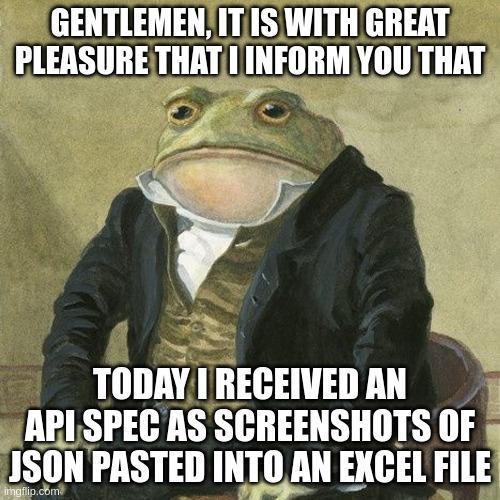
Nothing screams "enterprise-grade documentation" quite like receiving your API specification as JSON snippets copy-pasted into Excel cells. Because why use OpenAPI/Swagger specs, Postman collections, or literally any proper API documentation tool when you can just... Excel ? The fact that this came from a multinational bank makes it even more delicious. Somewhere in their tech stack, they're handling billions in transactions with microservices and distributed systems, but when it comes to sharing API docs? Excel spreadsheet it is! The JSON is probably beautifully formatted too—until Excel decides that your timestamps are dates and your IDs need to be in scientific notation. Props to whoever had to parse through those cells trying to figure out which curly brace belongs where. Hope they didn't need to copy-paste that JSON anywhere, because Excel definitely added some invisible characters for flavor.

From A Multinational Bank Too

From A Multinational Bank Too
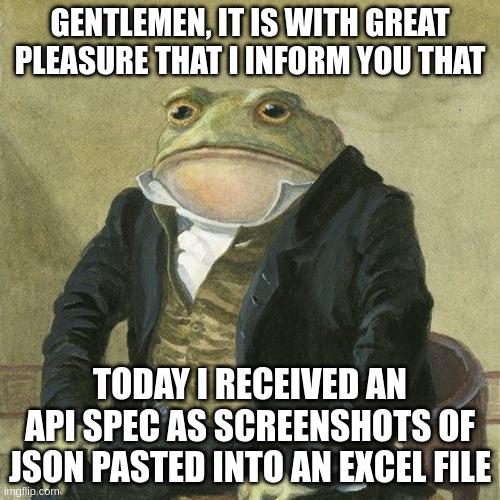
Nothing screams "enterprise-grade documentation" quite like receiving JSON screenshots pasted into Excel cells. Because why use OpenAPI/Swagger specs, Postman collections, or literally any structured format when you can squint at pixelated text in a spreadsheet? The fact that this is coming from a multinational bank with presumably billions in revenue makes it even more chef's kiss. Someone probably spent hours meticulously screenshotting each endpoint, carefully pasting them into Excel, and thought "yes, this is the professional way." Meanwhile, the developer receiving this masterpiece gets to manually type out every field, guess the data types, and pray they didn't miss anything because zooming into cell B47 isn't helping. The frog's dignified expression perfectly captures the internal screaming while maintaining that corporate professionalism.

Cobol Post

Cobol Post
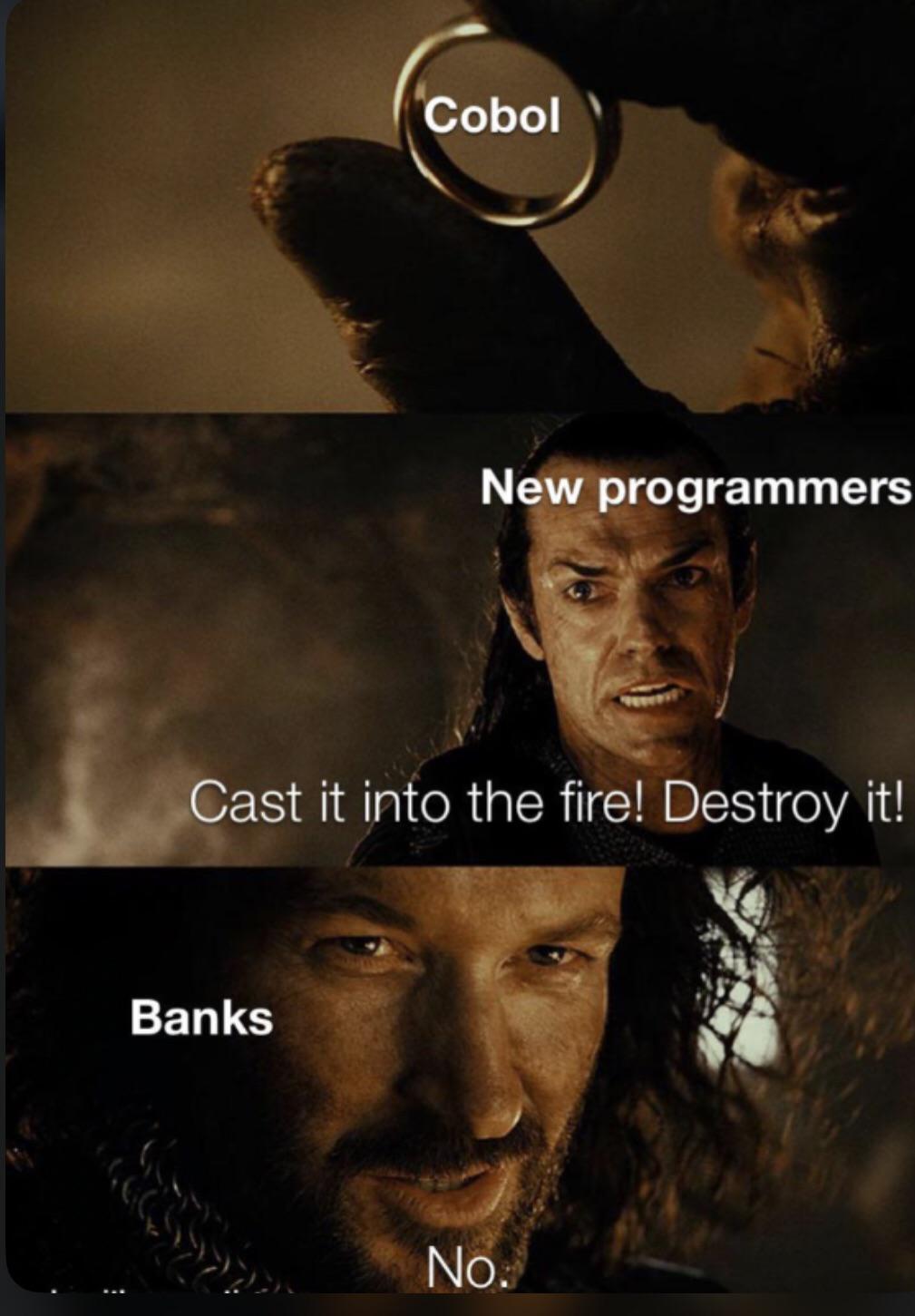
While everyone's fighting over whether React is better than Vue or if TypeScript is worth the hassle, COBOL developers are just sitting there eating their lunch, completely unbothered, making six figures maintaining banking systems from 1972. The language is older than most developers' parents, yet it still runs 95% of ATM transactions and 80% of in-person transactions. Banks literally can't find enough COBOL programmers, so they're paying obscene amounts to anyone who knows it. Meanwhile, the rest of us are rewriting our apps in the framework-of-the-month for the third time this year. Job security? More like job immortality. Those mainframes aren't going anywhere.

I Am Not Ready For This!!

I Am Not Ready For This!!
When you're fresh out of bootcamp learning React and TypeScript, then someone casually mentions COBOL and you're like "what's that?" only to watch senior devs collectively lose their minds. For context: COBOL (Common Business-Oriented Language) was created in 1959 and is still running critical banking systems, insurance companies, and government infrastructure worldwide. We're talking billions of transactions daily on code older than your parents. The problem? Nobody wants to learn it, everyone who knows it is retiring, and banks are desperately clinging to these systems because rewriting them would be like performing open-heart surgery on a patient running a marathon. New programmers see it as ancient history that should be extinct. Banks see it as the immovable foundation of global finance that cannot be destroyed without triggering financial apocalypse. The cognitive dissonance is *chef's kiss*. Fun fact: There are an estimated 220 billion lines of COBOL still in production today. That's roughly 43% of all banking systems. Sleep tight! 💀

Lebron James

Lebron James
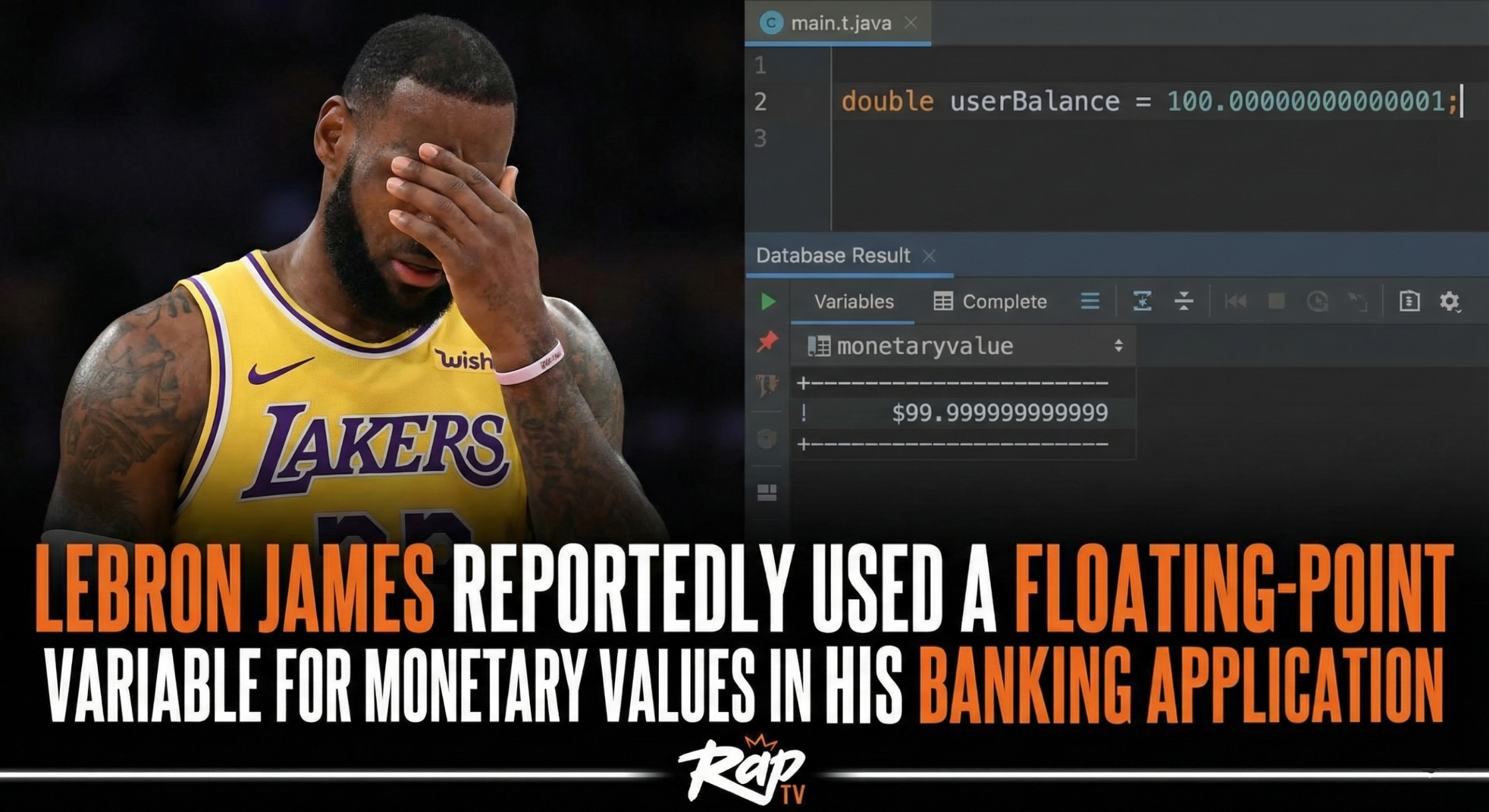
Ah yes, the classic floating-point precision nightmare strikes again! LeBron apparently set his user balance to exactly 100 dollars, but because he used a double (floating-point) instead of a proper decimal type for monetary values, the database now cheerfully displays $99.99999999999 instead of a clean $100. The facepalm is well-deserved. Rule #1 of financial applications: never use floating-point types for money! Binary floating-point can't accurately represent decimal fractions like 0.1, leading to these delightful rounding errors that'll have your accounting department hunting you down. Should've used BigDecimal, DECIMAL, or literally anything designed for exact decimal arithmetic. Even the GOAT isn't immune to the IEEE 754 curse. Stick to the fundamentals, King. 👑

Banks Love COBOL

Banks Love COBOL
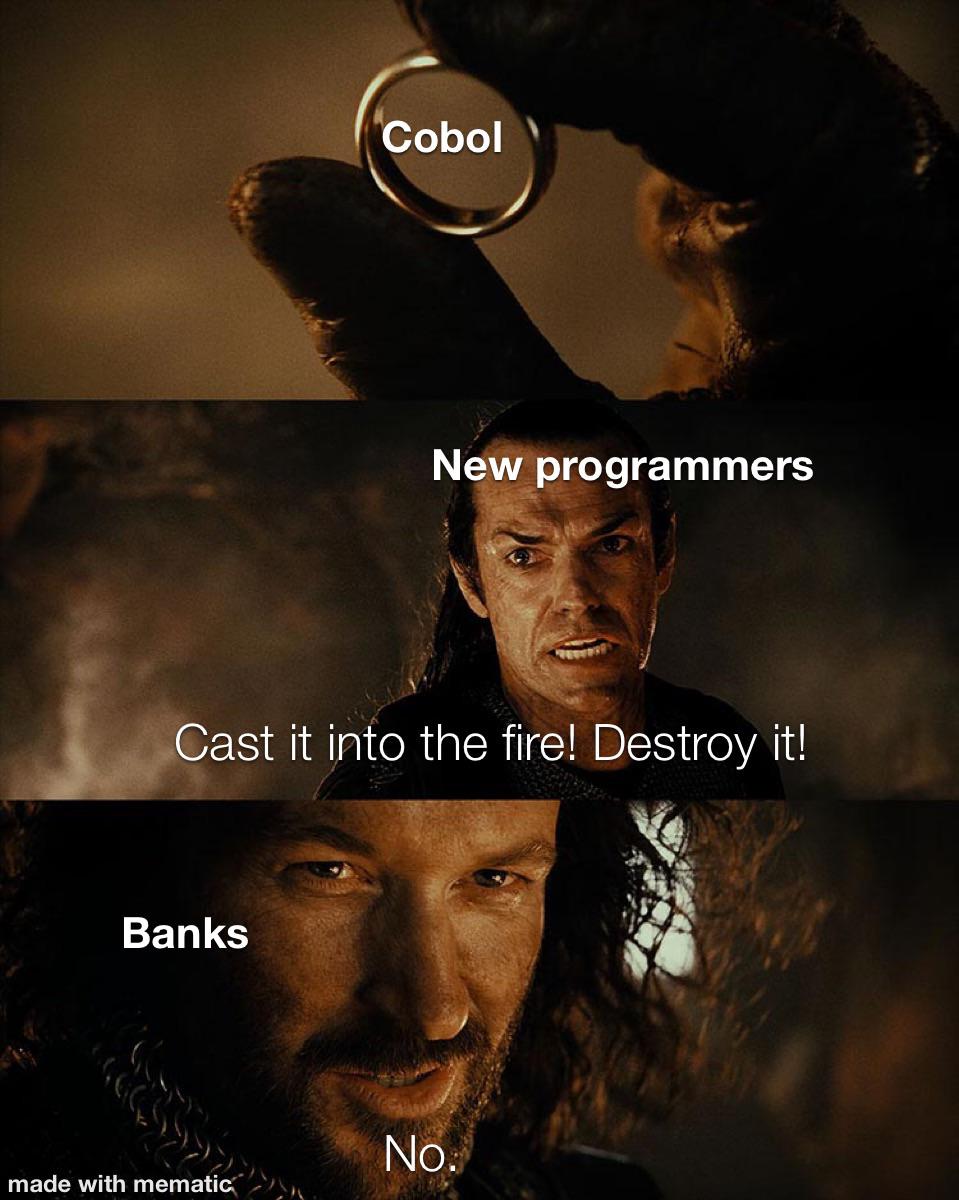
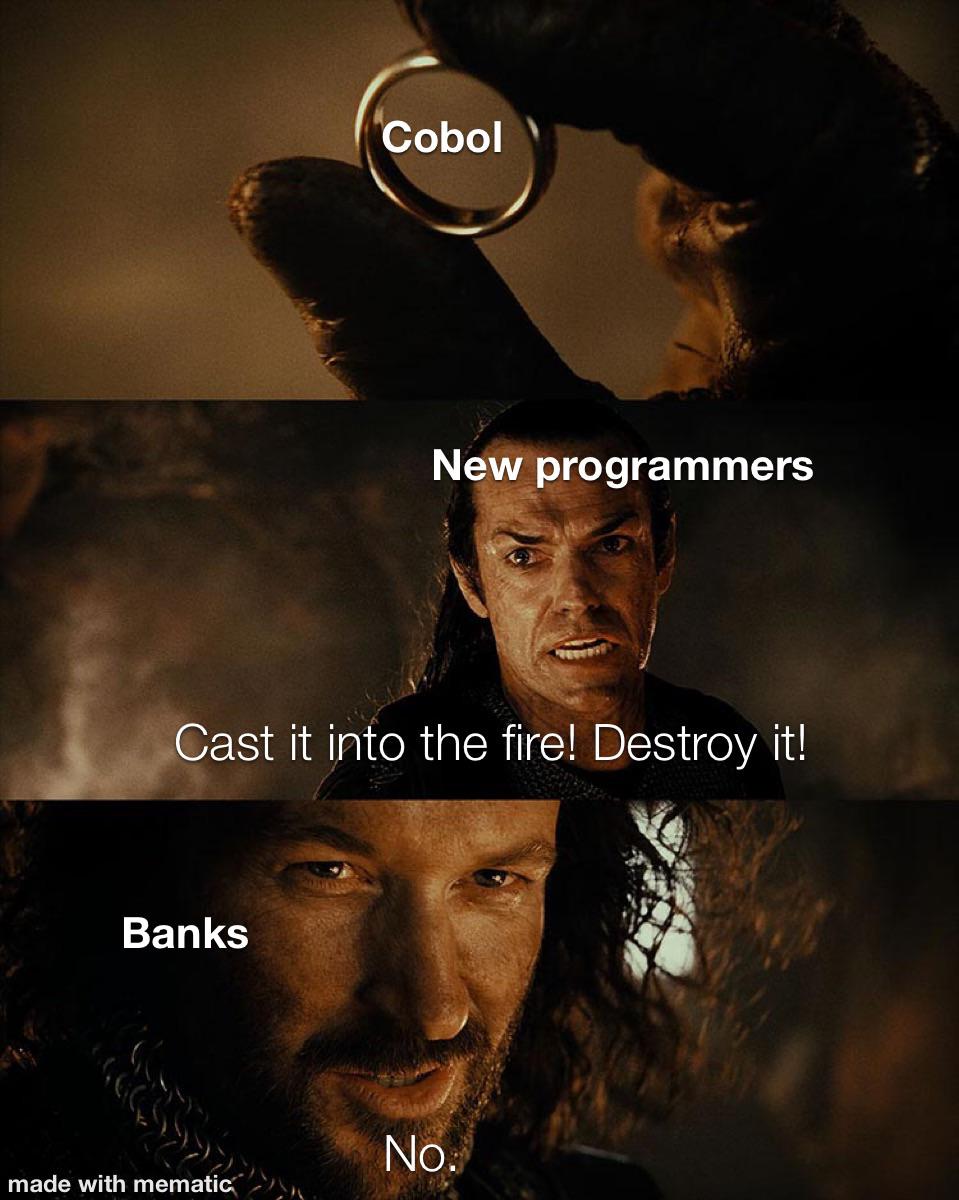
The entire financial world runs on COBOL code written when dinosaurs roamed the earth. New programmers see this ancient language and want it burned at the stake, but banks cling to it like Gollum with the precious ring. Why rewrite millions of lines of working code when you can just pay COBOL developers obscene amounts of money instead? The banking industry's motto: "If it's broken enough to work for 60 years, don't fix it."

Cobol: The One Ring Of Banking

Cobol: The One Ring Of Banking
Young devs want to burn COBOL with fire, but banks cling to it like Gollum's precious. Why? Because those 60-year-old mainframes still process $3 trillion in daily transactions . Try migrating that legacy code and watch your career evaporate faster than VC funding in a recession. The ultimate job security isn't knowing the latest JavaScript framework—it's being the last person alive who remembers how to maintain that ancient COBOL system nobody dares to replace.

Exceling Since 1985

Exceling Since 1985
The trillion-dollar financial industry, with all its complex algorithms and fancy trading platforms, still ultimately depends on a bunch of spreadsheets held together by duct tape and prayers. Nothing quite captures the fragility of modern capitalism like knowing your retirement fund is probably being managed by some sleep-deprived analyst with 47 Excel tabs open, praying that their VLOOKUP doesn't break. And somewhere, a banker is explaining to investors why their sophisticated risk assessment model is actually just a spreadsheet formula created in 1998.

Your Null Has Been Shipped

Your Null Has Been Shipped
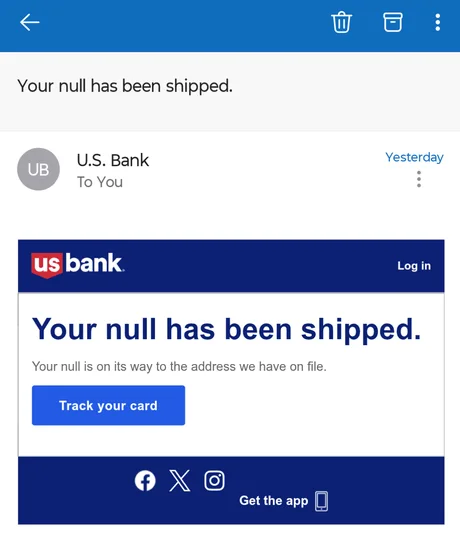
Looks like U.S. Bank just shipped the most valuable thing in programming—absolutely nothing! They're proudly announcing they've shipped null , complete with tracking capabilities. Sure, go ahead and track that non-existent card. Reminds me of those times when the backend team promises to deliver "something" by Friday, and then sends an empty JSON object. At least they're honest about shipping nothing instead of pretending it's a "feature-light release." The best part? Null is apparently "on its way" to an address they have "on file"—which probably means it'll arrive exactly never to precisely nowhere.

Your Null Has Been Shipped

Your Null Has Been Shipped
When your bank is clearly run by developers who forgot to replace placeholder values. "Your null has been shipped" is what happens when someone's database query fails silently and the template just rolls with it. That poor null value is now traveling through the postal system, desperately searching for the address they have "on file." Good luck tracking that card—it exists in the void between undefined and non-existent. At least they were kind enough to let you know about their spectacular failure!

The Last COBOL Developer Pic X(30)

The Last COBOL Developer Pic X(30)
Somewhere in Nebraska, a lone COBOL developer is literally holding up the digital world like Atlas himself. While tech bros brag about their microservices architecture, this unsung hero is silently preventing the financial apocalypse with code older than most developers' parents. Banks don't send thank you cards for averting economic collapse every Tuesday at 2 AM when the batch job mysteriously fails. The real infrastructure isn't in the cloud—it's in Nebraska, running on a language that uses "PIC X(30)" to define a string because it was cool in 1959.

Banned From Swift

Banned From Swift
When Russia got cut off from SWIFT banking, programmers made this joke about Putin being stuck with Objective-C instead of the modern Swift language. Double whammy of financial sanctions and legacy code maintenance. Honestly, forcing someone to use Objective-C in 2022+ is probably a war crime under the Geneva Convention. That square bracket syntax will break anyone's spirit faster than economic isolation.