python Memes

Oh Caroline!!

Oh Caroline!!
Nothing says "romance" quite like a syntax error ruining your heartfelt poem! Someone tried to write a sweet little verse but Python said "NOT TODAY, SHAKESPEARE" and threw an unexpected '?' tantrum on line 32. Because apparently question marks have NO PLACE in the world of poetry when Python's involved! The absolute TRAGEDY here is that roses being red and violets being blue is literally the most predictable thing in human history, yet somehow the code still managed to be unexpected. The irony is *chef's kiss* – the one thing that was supposed to be unexpected (a romantic gesture in code) became unexpectedly broken instead. Poetry and programming: a match made in syntax hell! 💔

That's Correct 👍

That's Correct 👍
Switching from C++ to Python is like going from manually managing your entire life with spreadsheets and alarm clocks to just asking Alexa to do everything. You're saying goodbye to pointers (the bane of every C++ developer's existence), manual memory management with ++ operators, semicolons that you WILL forget, curly braces everywhere, and that intimidating main() function boilerplate. Python just lets you write code without all the ceremony. No more segmentation faults at 2 AM because you dereferenced a null pointer. No more wondering if you should use delete or delete[] . Just pure, clean, indentation-based bliss where everything is a reference and garbage collection is someone else's problem. The relief is real. It's like taking off tight shoes after a 12-hour shift of fighting with template metaprogramming and undefined behavior.

I Put Alot Of Effort Into My Titl

I Put Alot Of Effort Into My Titl
C++ devs really be out here benchmarking their 6000-line monstrosity against your Python one-liner and acting like they just solved world hunger. Yeah, congrats on shaving off 0.000438 seconds—that's really gonna matter when both programs finish before you can even alt-tab back to your browser. The superiority complex is strong with this one. Meanwhile, your Python script was written during a coffee break and is already in production while they're still arguing about whether to use std::vector or std::array .

Typical Child In The Life Of A Programmer

Typical Child In The Life Of A Programmer
When you inherit from both parents but implement the interface as a Python class. The onesie is basically a programmer's birth certificate written in code. Love how the live() method is just an infinite loop of sleeping, yielding to Bardak (probably a parenting framework for diaper changes), and calling be_awesome() . The implementation of be_awesome() ? Just pass . Already awesome by default—no logic needed. That's some solid object-oriented parenting right there. The imports are chef's kiss: import ibtiSam as mom and import boaz as dad . Aliasing your parents like they're npm packages. The class constructor takes both parents' genes as parameters—multiple inheritance done right. And that __init__ printing "hello world!" is probably the most accurate representation of birth ever coded. Baby's first deployment was clearly a success. No exceptions raised, all tests passing, and already in production with that "Welcome home" comment. 10/10 would instantiate again.

Very Comfortable

Very Comfortable
When the interviewer asks about your Python skills and you're out here wrapping yourself in it like a snake charmer who's been coding since the Guido van Rossum era. The confidence is immaculate—literally wearing Python as a fashion statement. Pro tip: This level of comfort usually means you've either been bitten by indentation errors so many times you're immune, or you've just discovered list comprehensions and think you're invincible. Either way, the interviewer is probably wondering if you're about to import antigravity and float out of the room.

Next Version 3.14.69.420 (Ultimate Version)

Next Version 3.14.69.420 (Ultimate Version)
Python developers have been waiting CENTURIES for the prophecy to be fulfilled, and here it is—Python 3.14.0, the version number that starts with π (3.14), scheduled for October 2025. But wait, someone's already plotting the ULTIMATE evolution: π-thon. Because why stop at mathematical perfection when you can literally rename the entire language after it? The version number in the title (3.14.69.420) is peak developer humor—combining pi, the nice number, and the weed number into one glorious semantic versioning nightmare that would make every package manager weep tears of confusion. Someone's product manager is going to have a FIELD DAY trying to explain that version scheme in the release notes. The sheer determination in those eyes says "I've been planning this joke since Python 3.0 was released" and honestly? Respect. The Python community is already preparing their π-themed memes for the release party.

The Evolution Of Programming Intelligence

The Evolution Of Programming Intelligence
Starting with Python's galaxy brain energy, descending through Java's merely brilliant neural activity, then C++'s dimming consciousness as you realize you're managing memory manually. Scratch brings us to the enlightened toddler phase where you're dragging colorful blocks around. And finally, we reach peak transcendence with command blocks in Minecraft—where you've ascended beyond traditional programming into a realm of redstone logic and block-based sorcery that somehow feels both incredibly powerful and deeply questionable at the same time. The progression from "I write elegant code" to "I literally program inside a video game" is a journey we all respect but don't necessarily understand.

Shenanigans

Shenanigans
Python's dynamic typing is basically a game show where you spin the wheel and hope for the best. You've got your sensible options like int , float , bool , and str ... but then there's object , NaN , and my personal favorite: Error . But let's be real, the biggest slice on that wheel? "Random fuck" - because Python will just decide your variable is whatever it feels like being today. That function you thought returned a string? Surprise! It's None now. That number you were working with? Congrats, it's somehow a list. Type hints are more like type suggestions that Python cheerfully ignores while your code explodes at runtime. Meanwhile, TypeScript developers are sipping coffee, watching this chaos unfold with their compile-time type checking. But hey, at least we're having fun, right?

I Can Make It Work In Just 3 Lines Of Code

I Can Make It Work In Just 3 Lines Of Code
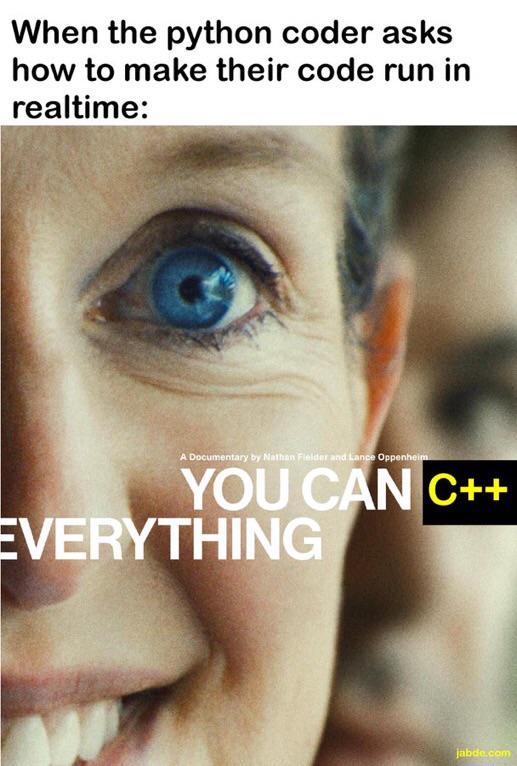
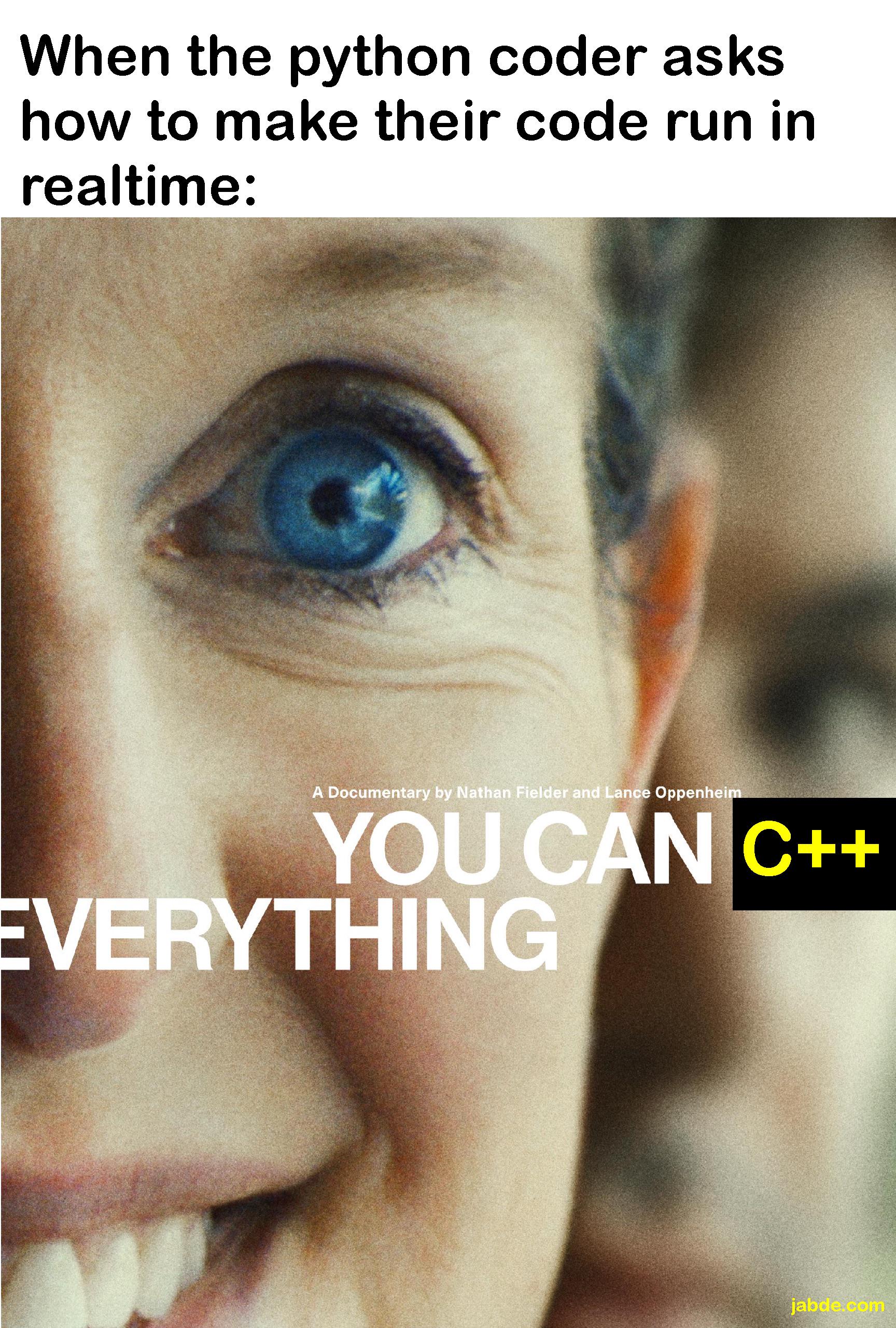
Python programmer casually flexing about solving problems in 3 lines while the C++ programmer is over there having a full existential crisis. Classic high-level vs low-level language showdown. Python devs get to import a library that does everything, write a list comprehension, and call it a day. Meanwhile the C++ crowd is manually managing memory, dealing with pointers, template metaprogramming, and questioning their life choices just to accomplish the same thing in 300 lines. Both get the job done. One just requires significantly less therapy afterward.

A A A

A-A-A
The eternal debate that splits the programming world harder than tabs vs spaces. Baby's first word is "A-a-a" and the proud parent thinks it's adorable... until some psychopath suggests that arrays should start at 1. Zero-indexing is sacred. It's not just tradition—it's mathematically elegant, it's how memory offsets work, and it's been the foundation of programming since the dawn of time. But then you've got languages like Lua, MATLAB, and R out here acting like index 1 is where life begins, and frankly, they deserve to be left in that dumpster. The horror on that parent's face perfectly captures every C, Python, Java, and JavaScript developer's reaction when they encounter a 1-indexed language. It's not just wrong—it's an affront to nature itself.

I Love Cheese

I Love Cheese
The eternal struggle between doing things the "right way" versus the "it works" way. On one side, you've got the architect who built a beautiful, scalable C# rate-limiter that probably took three weeks of planning and implementation. On the other, someone who just yeeted a time.sleep(1.6s) into their Python script and called it rate-limiting. The kicker? Both solutions technically work. The clean C# implementation runs at 100% efficiency—pristine, maintainable, documented. Meanwhile, the Python hack with its hardcoded sleep timer limps along at 95% efficiency, held together by duct tape and prayers. But here's the dirty secret: that 5% difference rarely matters in production when you're just trying to avoid getting your API key banned. After years in the trenches, you realize both programmers are valid. Sometimes you need the bear (robust enterprise solution), sometimes you need the wolf (scrappy solution that ships). The real wisdom is knowing which animal to be on any given Tuesday.

Same Same But Different

Same Same But Different
Two people bond over their shared love of coding, but once you peek under the hood, it's a completely different tech stack civil war. One side's rocking Python, VS Code, Git, and Docker like a sensible human being. The other's got... whatever chaotic combination of Deep Learning frameworks, package managers, and tools that probably requires three different terminal windows just to compile "Hello World." It's the developer equivalent of saying "I love pizza" and then finding out one person means authentic Neapolitan margherita and the other means pineapple with ranch dressing. Sure, you both "love coding," but good luck pair programming without starting a holy war over tooling choices.