

Production issues Memes

Posts tagged with Production issues
Please Espresso Your Kubernetes Errors

Please Espresso Your Kubernetes Errors
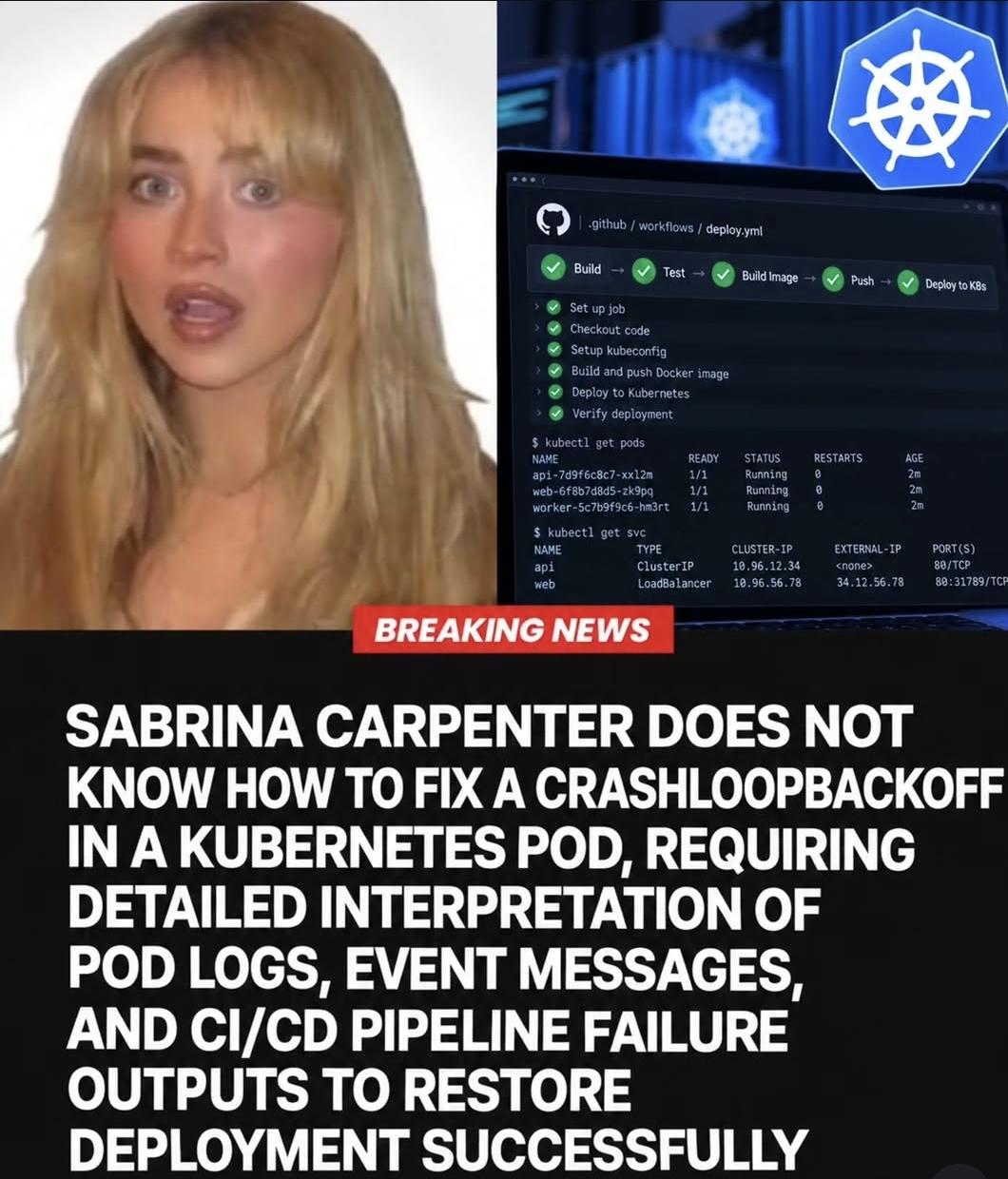
Breaking news: your CI/CD pipeline just turned into a true crime documentary and you're the detective who forgot their coffee. Everything's green checkmarks and sunshine until you need to figure out why your pod is doing the CrashLoopBackOff tango at 3 AM. Now you're knee-deep in kubectl logs, event messages that read like ancient prophecies, and pipeline outputs that would make a CVS receipt look concise. The best part? All those green checkmarks are basically gaslighting you into thinking everything's fine while your deployment is having a full meltdown in production. Nothing says "DevOps engineer" quite like needing a PhD in forensic log analysis just to understand why your container decided to rage quit.

Sigh

Sigh...
When you're trying to separate two phones that got stuck together and realize you've basically been debugging a hardware merge conflict. No git rebase here, just pure physical force and the hope that you don't accidentally commit a screen crack to production. This is what happens when you buy "refurbished" devices from that sketchy vendor who promised "seamless integration." Yeah, a little too seamless if you ask me. Should've read the API documentation more carefully—turns out the adhesive layer wasn't optional. The real question: is this a feature or a bug? Because somewhere, a product manager is calling this "innovative device clustering" and pitching it as the next big thing in mobile ecosystems.

True

True
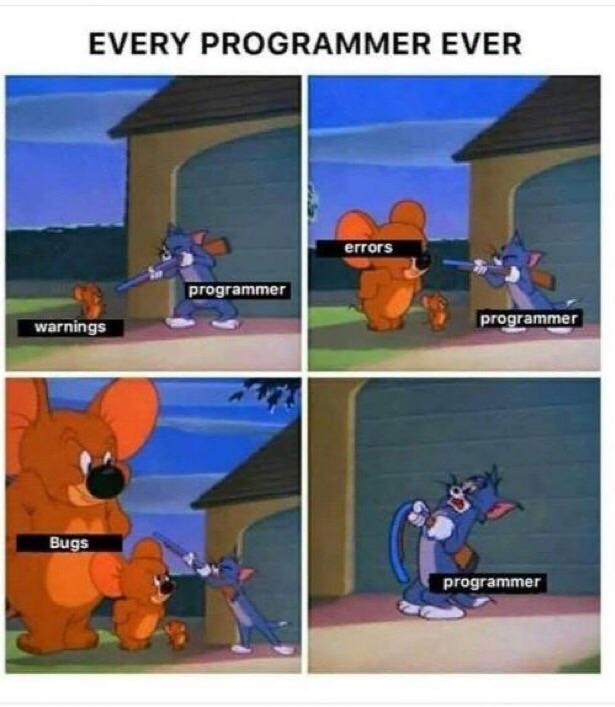
Warnings? Meh, just yellow text. Errors? Now we're getting serious, but still manageable with some Stack Overflow copy-paste. But bugs? BUGS? That's when the bear comes out and you're running for your life. The escalation here is painfully accurate. Warnings are like that annoying coworker you can ignore. Errors are the angry manager you need to deal with. But bugs—especially the ones that only show up in production on a Friday evening—those are the apex predators of software development. They're the ones that make you question your career choices while frantically rolling back deployments. The real kicker? Half the time those "harmless" warnings you ignored for six months turn into the bugs that hunt you down later. But do we ever learn? Nope. We just keep running.

Just Imagine How Much Fun It Would Be!

Just Imagine How Much Fun It Would Be!
You know that feeling when your brain tries to remember what grass looks like? Yeah, that's what happens after spending a week straight hunting down a bug that turned out to be a missing semicolon or some race condition you swore couldn't exist. Seven days of your life—gone. Could've been touching grass, seeing sunlight, remembering what human interaction feels like. Instead, you were staring at logs at 2 AM wondering why the staging environment works but prod is on fire. The cruel irony is we romanticize the outdoors while voluntarily choosing a career that keeps us in dark rooms debugging code that worked perfectly fine yesterday. Nature? Fresh air? Social life? Never heard of her.

Glad To Be Out Of The Equation At Least

Glad To Be Out Of The Equation At Least
Junior dev in 2016: "Hey senior, can you build this feature?" Senior dev: "Sure, let me architect a beautiful solution." Junior dev in 2026 after years of tech debt accumulation, framework migrations, and questionable architectural decisions: "I built it myself." Senior dev pulls gun: "Wait... the idea was the problem?" Plot twist: The thing that was built is probably held together with duct tape, prayer, and seventeen deprecated npm packages. But hey, at least it ships. The senior dev has seen enough production fires to know that sometimes the real horror isn't that something can't be built—it's that it will be built, and they'll be the ones maintaining it at 2 AM when it inevitably breaks. The astronaut watching from the sidelines represents every tech lead who's learned to stay out of these conversations entirely.

Software-Developer Programming Rubber Duck Debugging Ceramic Mug, Red/White

Software-Developer Programming Rubber Duck Debugging Ceramic Mug, Red/White
Programming Debugging Tool design. If you use a Rubber Duck for debugging your code, this Have you tried to explain it to the Rubber Duck Design perfect for you! Everyone knows it,Everybody writes bu…

Good Vibes Only

Good Vibes Only
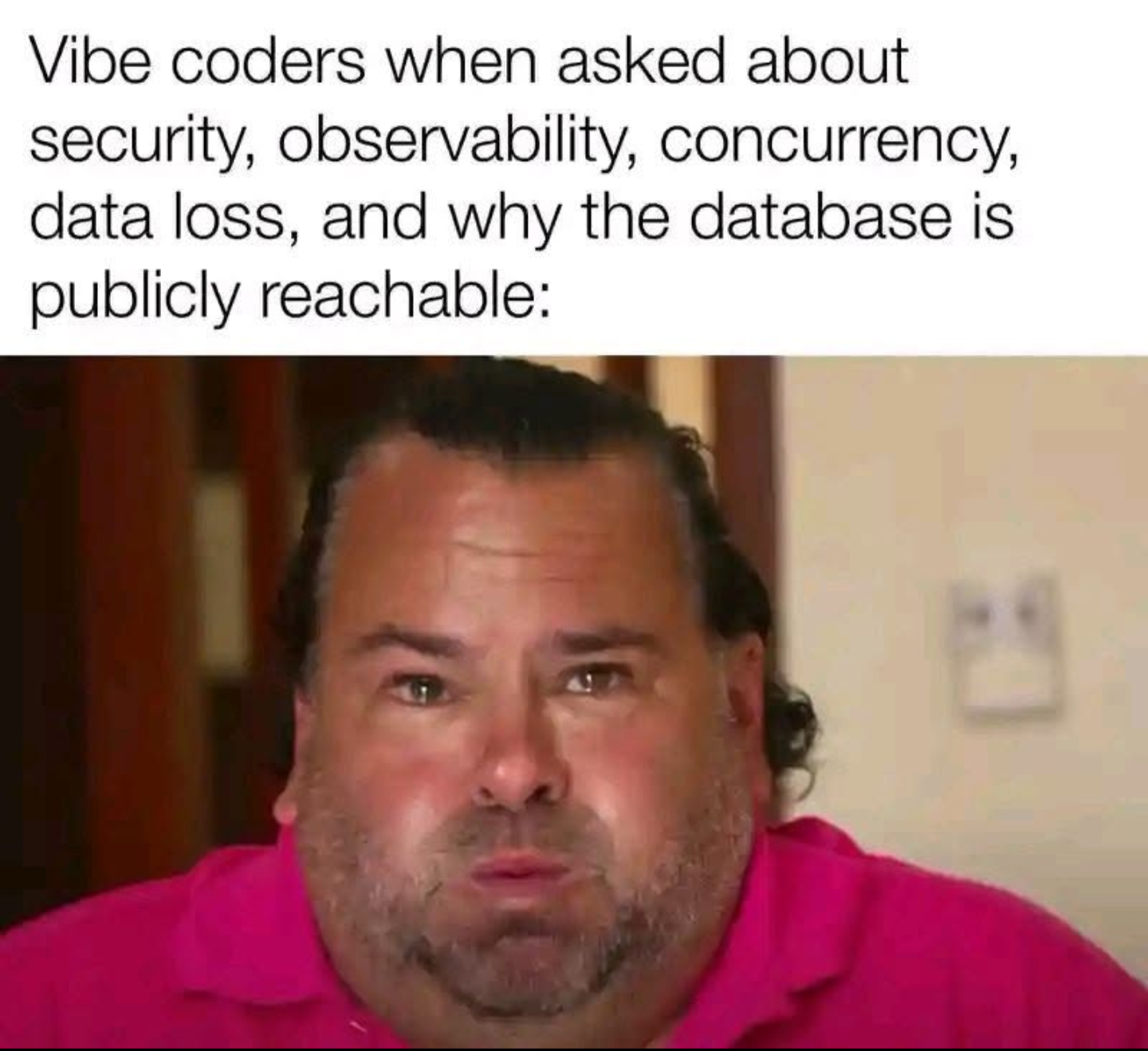
You know those developers who claim they're all about "positive energy" and "good vibes only"? Yeah, they suddenly develop a thousand-yard stare when you bring up trivial matters like why the production database is accessible from the internet without authentication. Security? Never heard of her. Observability? Sounds like corporate buzzword bingo. Concurrency issues? Just restart the server, bro. Data loss? That's what backups are for... wait, we have backups, right? The vibe check has officially failed. Time to update that resume and pretend you were just the intern.

The Heisenbug Principle

The Heisenbug Principle
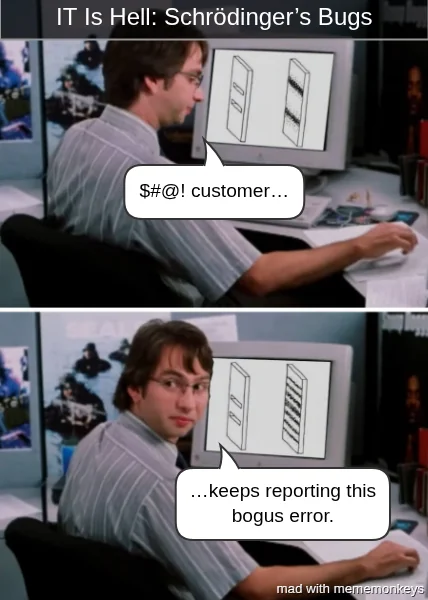
You know what's worse than a bug? A bug that only exists when customers are looking at it. The moment you fire up your debugger or add some logging statements, it vanishes into the quantum realm like it was never there. But the second you close your IDE and push to production? Boom, it's back, haunting your error logs and your dreams. The Heisenbug gets its name from Heisenberg's Uncertainty Principle in quantum physics—where observing a particle changes its behavior. Same energy here: the act of debugging literally changes the bug's behavior. Maybe it's a race condition that disappears when you slow things down with breakpoints. Maybe it's a timing issue that vanishes when you add console.log statements. Either way, you're stuck explaining to your manager why the bug only exists in production and nowhere else. Schrödinger would be proud. The bug is both there and not there until a customer observes it.

Vibing Ain't Easy

Vibing Ain't Easy
You know that moment when you're trying to save a few bucks on your CI/CD pipeline by using the free tier of some random build agent, and it starts timing out, crashing mid-deployment, or just straight-up refusing to compile your perfectly valid code? Yeah, suddenly that $50/month premium agent doesn't seem so expensive anymore. Nothing quite captures the pain of having to justify infrastructure costs to your manager after your bargain-basement solution nuked production at 2 PM on a Friday. The real kicker? The expensive agent was in your budget the whole time, but you wanted to be "cost-conscious" and now you're on a call explaining why the website is down. Pro tip: some corners aren't worth cutting, especially when they're holding up your entire deployment pipeline.

Technical Debt Came Due

Technical Debt Came Due
Picture this: You've been living your best developer life, casually deleting those pesky deprecation warnings from your inbox like they're spam emails about car warranties. Three YEARS of "hey bestie, maybe update your API calls?" notifications straight to the trash. Then one fateful morning, your entire application breaks because the provider actually had the AUDACITY to follow through on their threats. The sheer betrayal! The absolute nerve! Now you're sitting there with your production app in flames, realizing that ignoring problems doesn't make them disappear—it just makes them show up at the worst possible moment with compound interest. Procrastination: 1, You: 0.

Beelink SER3 Mini PC, Ryzen 3 3200U 2C/4T 3.5GHz,16G DDR4 RAM 500G SSD

Beelink SER3 Mini PC, Ryzen 3 3200U 2C/4T 3.5GHz,16G DDR4 RAM 500G SSD
🎈【POWERFUL PERFORMANCE】Beelink SER3 equipped with AMD Ryzen 3 3200U (up to 3.5GHz), which adopts an 2-core/4-thread. The base frequency is 2.6GHz / Max turbo frequency can reach 3.5GHz. Ensure seamle…

Will We Ever Smile

Will We Ever Smile
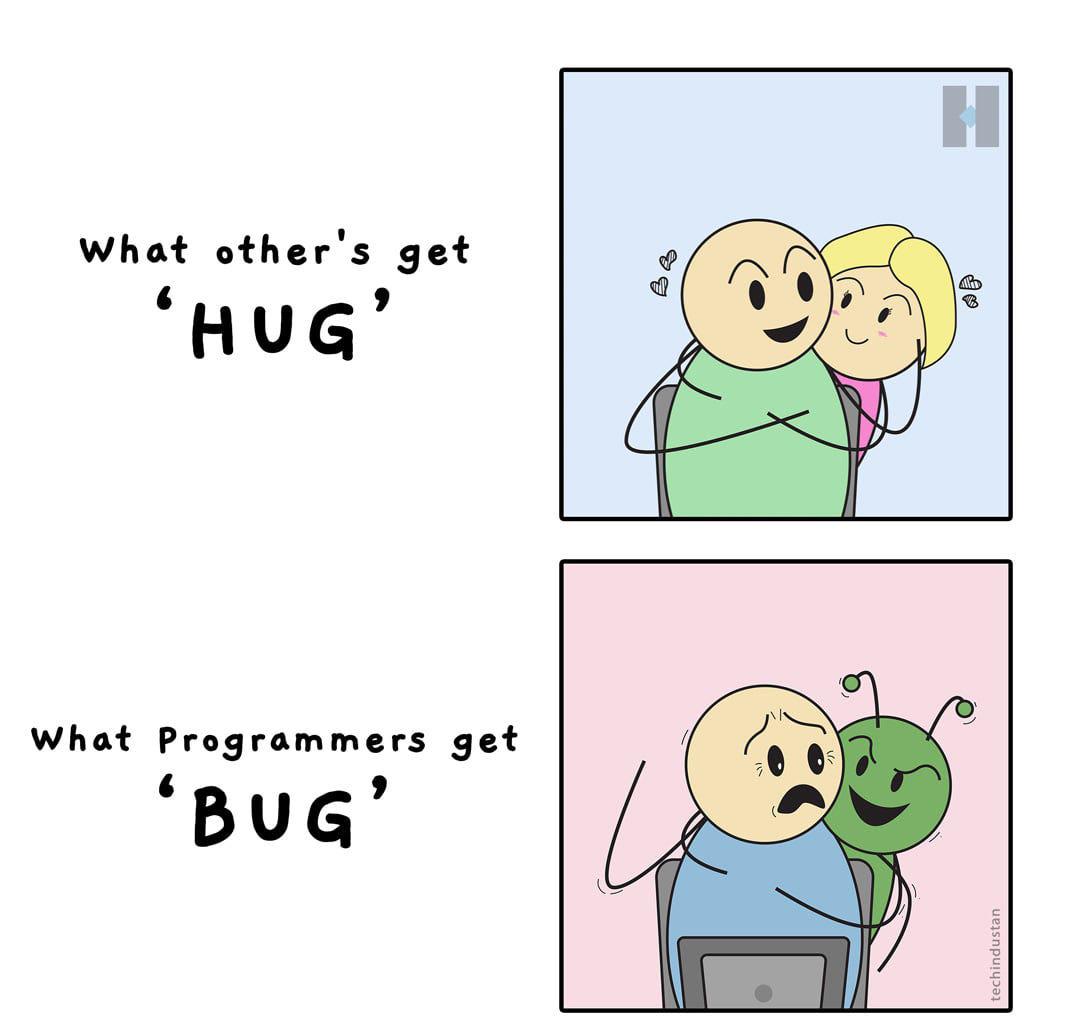
The eternal struggle of our profession, captured in two panels. Normal people get hugs—warm, fuzzy, wholesome moments of human connection. Programmers? We get bugs. And they're not the cute kind either. They're the kind that hug you from behind at 3 AM in production, whispering sweet nothings like "NullPointerException" and "works on my machine." The bug in the second panel looks way too happy about ruining your day, which is honestly accurate. Meanwhile, our programmer looks appropriately horrified, probably realizing they just deployed to production on a Friday afternoon. The emotional support we receive comes in the form of stack traces and cryptic error messages instead of actual human warmth. Fun fact: Studies show that programmers experience an average of 3.7 bugs per hug received. The ratio gets worse during sprint weeks.

Redis

Redis
Nine hours of debugging. Nine. Hours. All because someone on the team decided that colons in Redis keys were "optional" in the new naming convention. Your cache hit ratio went from hero to zero faster than your relationship status after ignoring your partner for half a workday. The best part? The deployment went smoothly. Everything looked fine. Then production traffic hits and suddenly your carefully crafted caching layer is about as useful as a screen door on a submarine. All your keys are there, they're just... unreachable. Like your emotional availability right now. That thousand-yard stare says it all. You've checked the Redis config seventeen times. You've tailed logs until your eyes bled. You've questioned your career choices. And the culprit? A missing colon. One character. The same character you're about to lose from your colon from the stress.

Internal Server Error

Internal Server Error
Your body running unwrap() on every single thing without checking if it's None first, then wondering why you keep having catastrophic failures at 3 AM. Zero error handling, just pure chaos and panic. The Rust compiler would be screaming at you, but your immune system doesn't have a compiler—it just goes straight to production and crashes the whole server. For the uninitiated: unwrap() in Rust is basically saying "I'm 100% sure this value exists" and if you're wrong, your program panics and dies. It's the programming equivalent of living life with no safety net and maximum confidence.