

Compilation Memes

Posts tagged with Compilation
Will It Ever Finish? Can I Keep Making A Computer In Scrap Mechanic Please?

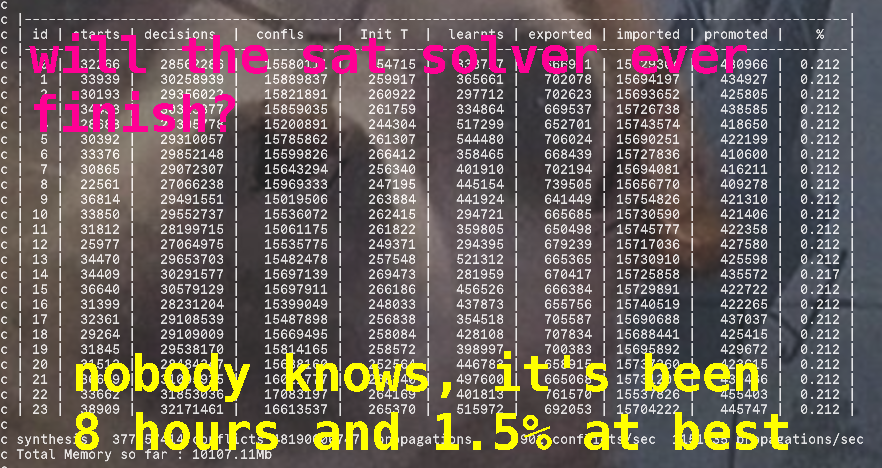
Will It Ever Finish? Can I Keep Making A Computer In Scrap Mechanic Please?
Someone decided to build a computer inside Scrap Mechanic and now they're watching their creation compile something for what appears to be geological timescales. The stats are beautiful: 8 hours in, 5 seconds of progress per second (which is... just time passing normally, congrats), and enough memory allocations to make your RAM weep. Building a computer in a game engine is the digital equivalent of using a spoon to dig a tunnel. Sure, it's technically possible, and yes, it proves you understand computer architecture, but nobody's going to ask you why because they already know: because you could. The real question isn't whether it'll finish—it's whether the heat death of the universe will happen first. My money's on the universe.

Notoriously Difficult

Notoriously Difficult
Trying to get GNU toolchains working on Windows is basically a spiritual experience at this point. You're out here wrestling with MinGW, MSYS2, or whatever flavor of the month you picked, just hoping your C code compiles to an ELF binary that Windows absolutely does not want to run natively. The cognitive dissonance is real—you're on Windows begging Unix gods for mercy while your PATH variables laugh at you from the depths of System Properties. Just use WSL or spin up a Linux VM and save yourself the existential crisis, trust me.

Why Are They Being So Dramatic

Why Are They Being So Dramatic
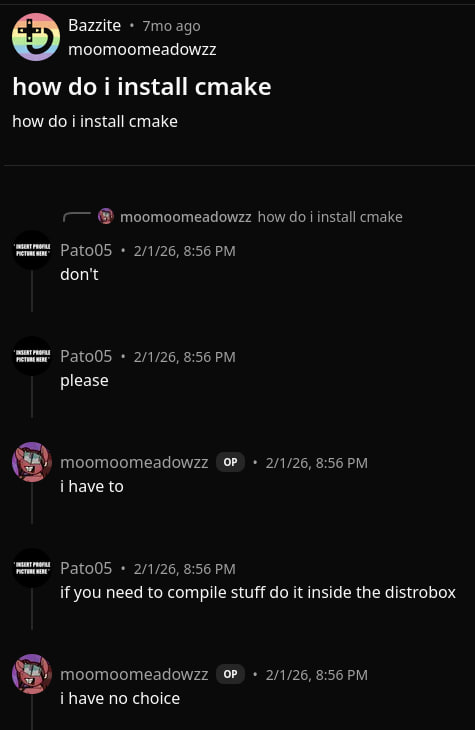
Someone innocently asks "how do i install cmake" and gets hit with the most existentially devastating responses. The progression from "don't" to "please" to "i have to" is pure tragedy. Then Pato05 drops the nuclear option: "if you need to compile stuff do it inside the distrobox" followed by the final acceptance stage: "i have no choice." CMake is the build system that makes developers question their life choices. It's like the tool everyone needs but nobody wants to deal with—a necessary evil for compiling C/C++ projects. The dramatic responses perfectly capture that special kind of despair that comes with build system configuration. The suggestion to isolate it in a distrobox is basically saying "quarantine this chaos away from your main system before it spreads." The five stages of grief, but for build systems: denial (don't), bargaining (please), acceptance (i have to), problem-solving (use distrobox), and finally... resignation (i have no choice). Poetry in motion.

Nerd Wars

Nerd Wars
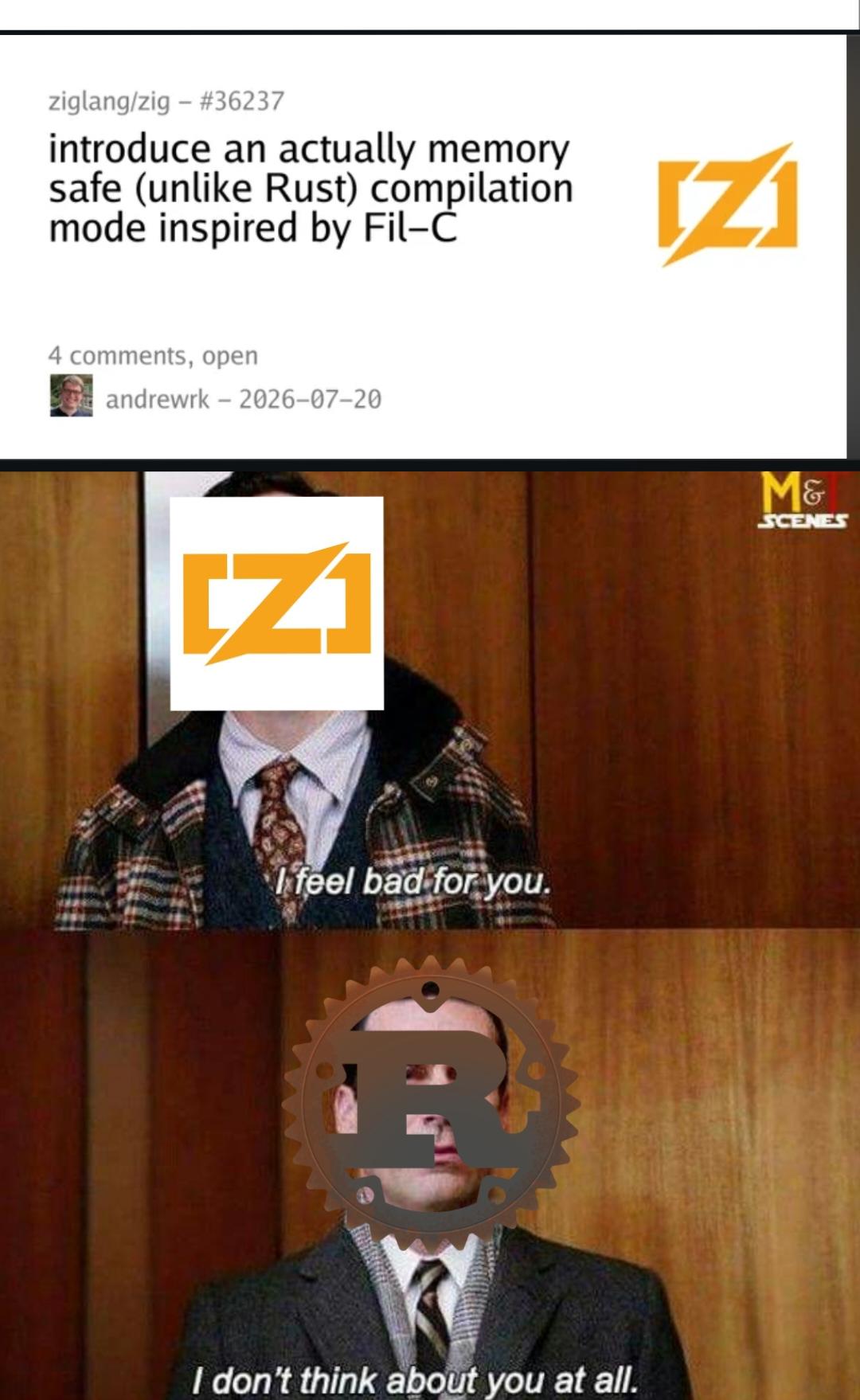
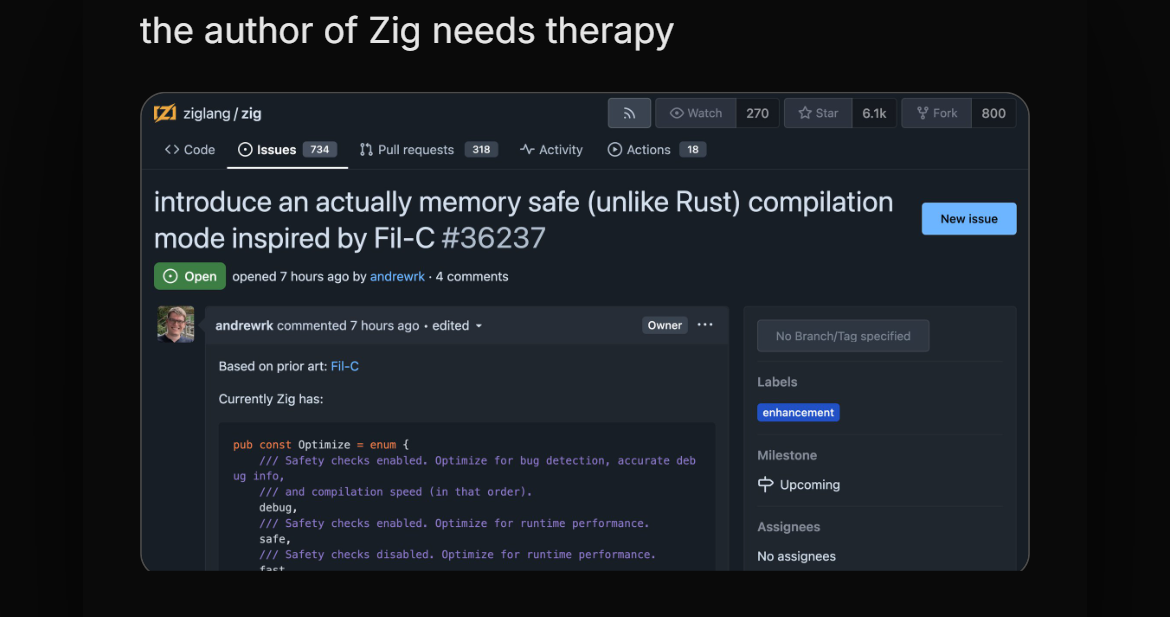
Zig just casually dropped a feature request to introduce memory safety "unlike Rust" and the Rust community took that personally. The shade is immaculate. Zig's out here saying "I feel bad for you" while Rust doesn't even acknowledge the existence of languages that aren't obsessed with borrow checkers and lifetimes. It's like watching two programming language fandoms engage in psychological warfare through GitHub issues. For context: Rust evangelists have built their entire personality around memory safety, and here comes Zig suggesting they can do it better with a compilation mode inspired by Fil-C. The audacity. The disrespect. Chef's kiss. Meanwhile Rust is too busy rewriting the Linux kernel to care about some upstart language's feature requests.

When The Stars Align...

When The Stars Align...
You spend three days wrestling with a build error that makes absolutely no sense. You've tried everything—cleared cache, deleted node_modules, sacrificed a rubber duck to the debugging gods. Then one morning you wake up, run the build command, and it just... works. No code changes. No updates. Nothing. The sheer terror of not knowing what fixed it is somehow worse than the bug itself. Did it fix itself? Was it a cosmic ray? A race condition that finally lost the race? You'll never know, and that uncertainty will haunt you forever. Because if you don't know what fixed it, it can come back at any moment. Sleep tight.

The Four Horsemen

The Four Horsemen
Every build tool thinks it's the chosen one that'll finally solve dependency management and compilation speed. Meanwhile, developers just want their code to compile without sacrificing their firstborn to the build gods. npm is the chaotic veteran that somehow works despite having 47 nested node_modules folders. Gradle is the enterprise beast that takes 10 minutes to build "Hello World" but promises incremental builds (lies). CMake is the ancient demon speaking in tongues that C++ devs reluctantly worship because there's literally no better alternative. And then there's the fourth one with its tongue out, probably representing whatever cursed build system your company decided to write in-house because "we have unique requirements." Spoiler: you don't.

Synology DS725+ Expandable NAS Storage - Private Cloud for Home and Small Business (2-Bay Diskless NAS)

Synology DS725+ Expandable NAS Storage - Private Cloud for Home and Small Business (2-Bay Diskless NAS)
Start Small, Scale Massive - Begin with 2 drives, expand to 140TB total capacity using DX525 expansion as your media library grows · Multi-Layered Data Protection - Combine RAID redundancy, automated…

Somebody Give Him An .Exe File, Please.

Somebody Give Him An .Exe File, Please.
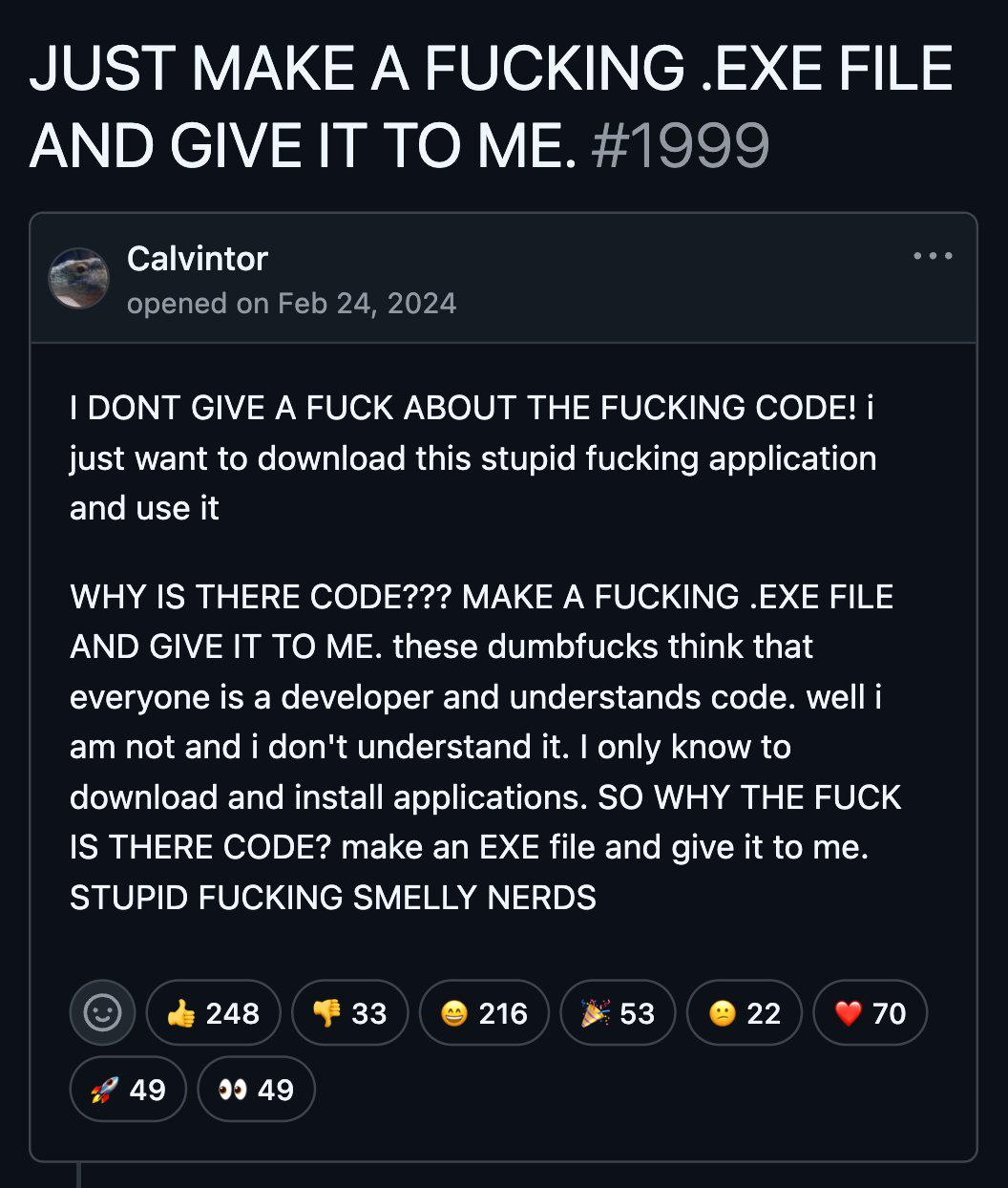
When a user stumbles into a GitHub repo expecting an app store experience and gets a face full of source code instead. This person's rage-fueled meltdown is the beautiful collision between "I just want to use the thing" and the open-source reality of "here's the ingredients, now cook it yourself." The irony? They're calling developers "STUPID FUCKING SMELLY NERDS" while simultaneously begging those same nerds to compile an executable for them. That's like yelling at a chef for giving you a recipe instead of a meal, then demanding they cook for you anyway. Pro tip for Calvintor: GitHub isn't the Microsoft Store. Most open-source projects don't ship pre-built binaries because maintaining builds for Windows, Mac, and Linux is a nightmare nobody wants to deal with for free. Plus, you know, security concerns about running random .exe files from the internet. But sure, let's blame the "dumbfucks" who spent their free time building something you want to use.

Same Makefile, Different Results

Same Makefile, Different Results
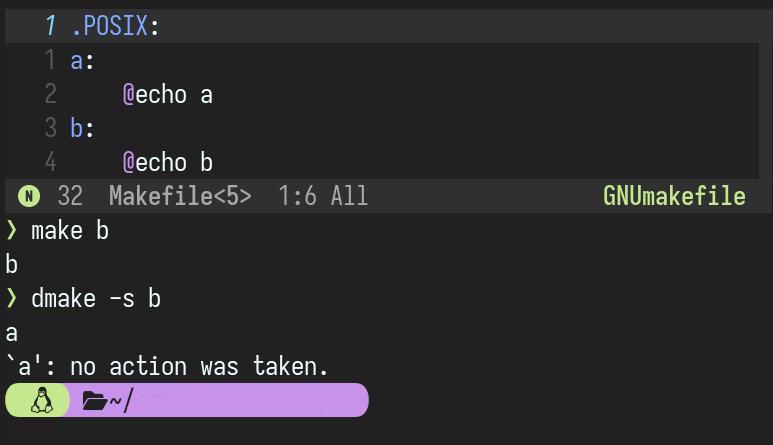
So you run make b and get "b" like you expected. Cool. Then you try dmake -s b thinking it'll do the same thing, and suddenly target 'a' decides to run first and you get "a" followed by "a: no action was taken." Welcome to the wonderful world of build systems where POSIX compliance is more of a suggestion than a rule. Different make implementations parse dependencies differently, and dmake (Sun's make) apparently has its own ideas about how your Makefile should work. Same file, same rules, completely different execution order. It's like having two compilers that interpret the same code differently—which, let's be honest, also happens more than we'd like to admit. The real fun starts when your CI/CD pipeline uses a different make implementation than your local machine. Good times.

It Is The Little Things In Life

It Is The Little Things In Life
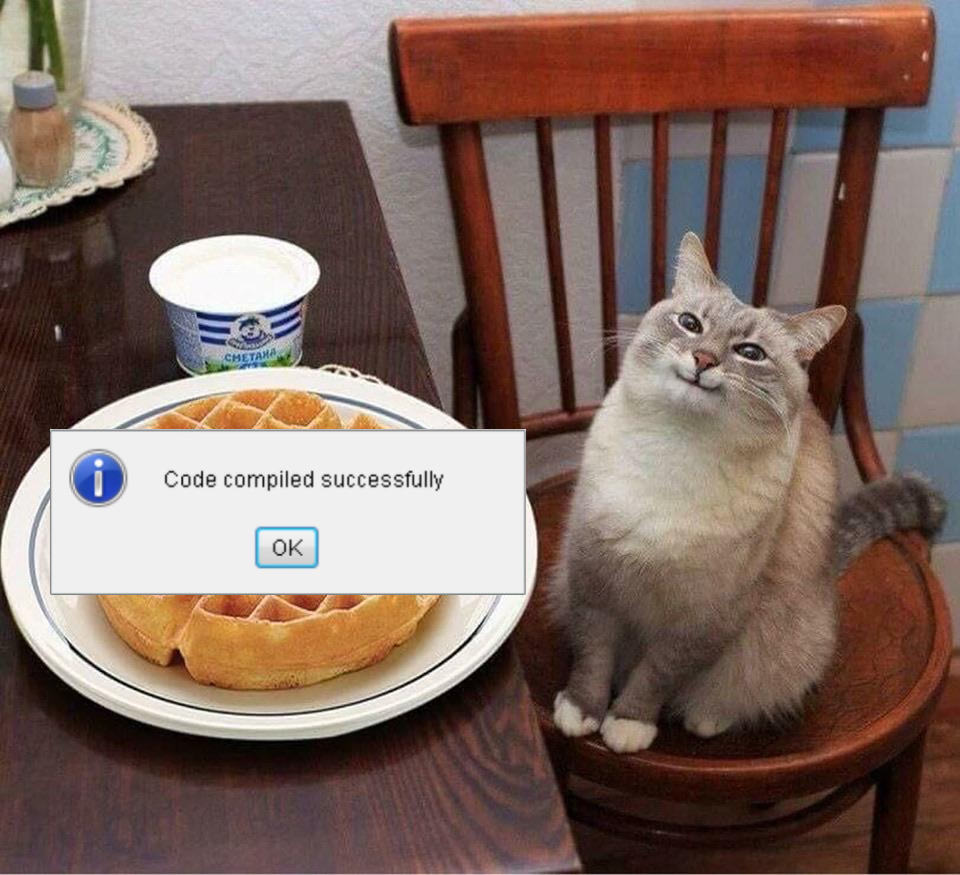
You know that pure, unfiltered joy when your code actually compiles on the first try? That's basically winning the lottery in developer terms. No cryptic error messages, no missing semicolons, no "expected ';' before '}'" nonsense. Just a clean, beautiful "Code compiled successfully" message that hits different than any other notification. The cat's blissful expression perfectly captures that rare moment of peace before you realize you still need to run the code and discover it doesn't actually *work*. But for now? For this brief, shining moment? You're living the dream. Compilation success is the participation trophy of programming, but sometimes that's all you need to keep going. Bonus points if this happened after you've been fighting with compiler errors for the past two hours. That dopamine hit is real.

The Real Goat

The Real Goat
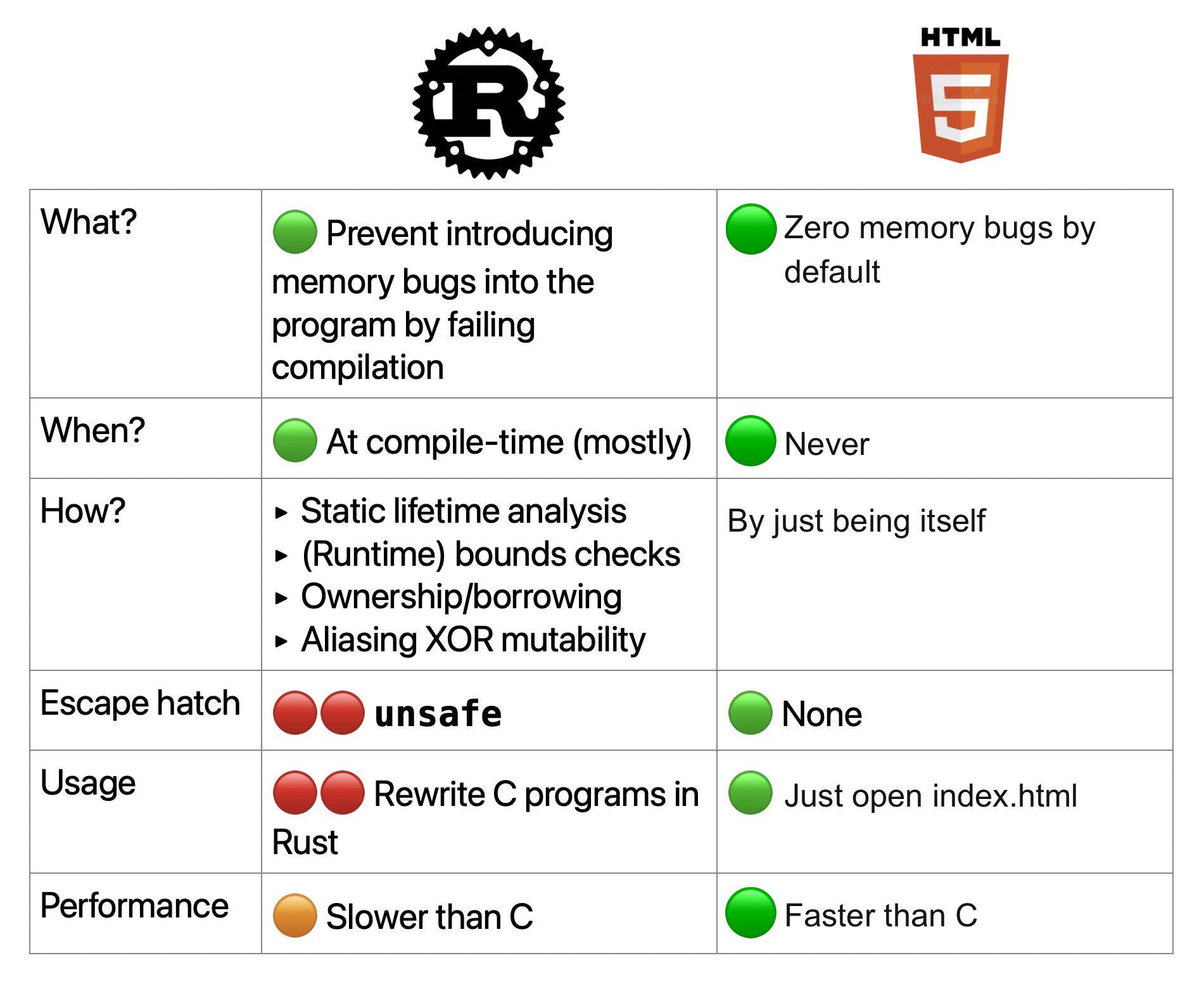
Rust devs will write 47 pages of documentation about ownership and borrow checkers to prevent memory bugs, while HTML just sits there like "can't have memory bugs if you don't have memory management" *taps forehead*. The real flex here is HTML's "How?" answer: "By just being itself." That's the kind of zen simplicity that comes from being a markup language that literally can't mess up memory because it doesn't touch it. Meanwhile Rust is out here doing compile-time gymnastics with lifetimes and mutability analysis like it's training for the Olympics. And that performance line? Chef's kiss. HTML being faster than C because it doesn't need to DO anything except tell your browser "hey put this text here." It's like comparing a race car to a sign that says "FINISH LINE" – technically the sign is already at the finish. The "Usage" row is brutal though. Rust evangelists want you to rewrite your entire C codebase, while HTML is just chilling in every website since 1991. One requires a PhD in type theory, the other requires Notepad. Guess which one runs more of the internet?

Actually Memory Safe

Actually Memory Safe
So someone just proposed adding a compilation mode to Zig that's "actually memory safe (unlike Rust)" and honestly, the audacity is chef's kiss. The best part? The code shows an enum with options like "debug" and "safe" with comments saying safety checks are disabled for runtime performance. You know, because nothing says "memory safe" quite like disabling safety checks. The Rust community is probably having collective heart palpitations right now while the Zig author is somewhere contemplating their life choices. The "(unlike Rust)" parenthetical is doing some serious heavy lifting here—it's like claiming your car is safer than a Volvo because you removed the airbags to improve acceleration.

FLEXISPOT EN1 One-Piece Standing Desk with 1-Inch Thick Seamless Desktop, 55"x28" Electric Height Adjustable Desk for Home Office, Multi-Monitor Setups & Easy Assembly, Maple

FLEXISPOT EN1 One-Piece Standing Desk with 1-Inch Thick Seamless Desktop, 55"x28" Electric Height Adjustable Desk for Home Office, Multi-Monitor Setups & Easy Assembly, Maple
ONE-PIECE. ZERO WOBBLE: A seamless, rock-solid desktop built for home offices, creative studios, and designers running multi-monitor setups. · THE POWER OF 1-INCH: Dense, durable, and sag-resistant, …

Rust Target Is Huge

Rust Target Is Huge
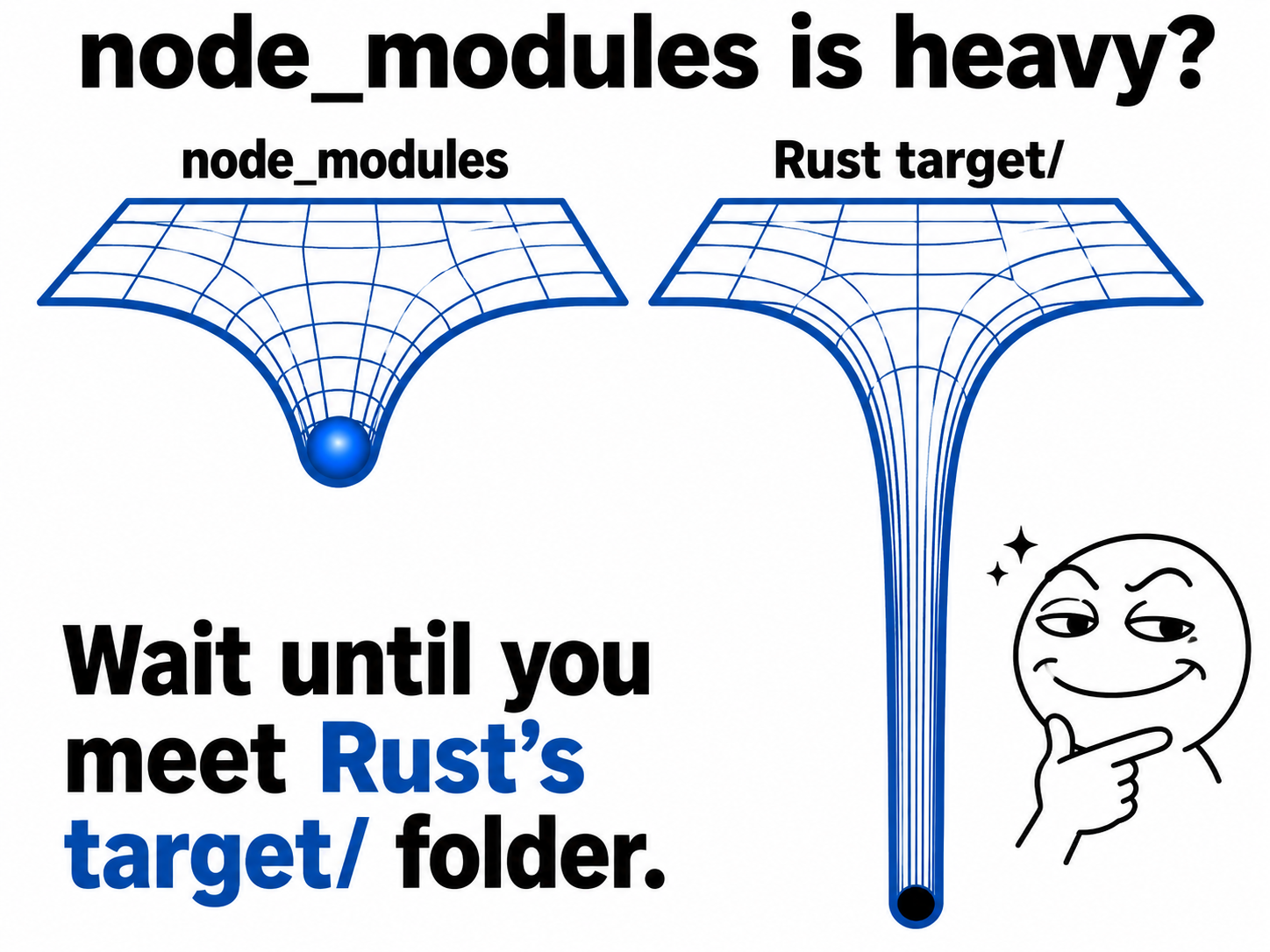
You thought node_modules was the heavyweight champion of disk space consumption? Sweet summer child. Rust's target/ folder literally warps spacetime with its gravitational pull. While node_modules creates a cute little dent in the fabric of reality, Rust's compilation artifacts basically drill a black hole straight through your SSD. We're talking GIGABYTES of build artifacts that accumulate faster than your regrets about choosing systems programming. But hey, at least it's memory safe while it devours your entire hard drive! 🦀