bugs Memes

What's On Your Christmas List?

What's On Your Christmas List?
Oh, Santa baby, just slip some working code under the tree! Forget the new laptop, the mechanical keyboard, or even a raise—this developer is asking for the ONE miracle that even Santa's elves can't deliver: error-free code that runs perfectly on the first try. The absolute AUDACITY of this wish list. Might as well ask for world peace or for CSS to make sense. Santa's sitting there reading this like "Kid, I can bring you a PS5, I can bring you socks, but I'm not a wizard." The reindeer are literally shaking their heads in the background knowing this is more impossible than fitting down a chimney. The real tragedy? Deep down, every developer knows they're getting another year of "undefined is not a function" and "works on my machine" instead. Ho ho... no.

Care Less About Bugs

Care Less About Bugs
When QA files that critical production bug at 4:47 PM on Friday before a long weekend, you've got two choices: panic or deploy the Jedi mind trick. Just tell yourself there's no bug, there's no meme, and log off. The kitten's dead-eyed stare perfectly captures that thousand-yard stare you develop after your fifth year in production support. It's not denial if you're on PTO. It's called work-life balance, Karen from management.

Christmas Gift

Christmas Gift
Santa really said "BE REALISTIC" and then proceeded to ask the most DEVASTATING follow-up question in the history of Christmas wishes. Kid wants a dragon? Sure, let's talk specs! Bug-free, well-documented, AND readable code? In the SAME codebase? Might as well ask for a unicorn that poops gold while you're at it. The punchline hits different when you realize the kid's answer of "green" is probably the ONLY realistic requirement in this entire conversation. At least dragons come in green. Bug-free code? That's pure fantasy, my friend. Santa's out here teaching harsh life lessons about software development one Christmas at a time.

I Declare Technical Debt Bankruptcy

I Declare Technical Debt Bankruptcy
Every dev team ever: your codebase has more bugs than a rainforest ecosystem, but instead of fixing them, you're out here chasing the dopamine hit of shipping new features. The girlfriend (bugs) is literally RIGHT THERE, desperately trying to get your attention, but nope—that shiny new feature in the red dress is just too tempting. Classic case of "we'll circle back to those bugs in the next sprint" (narrator: they never did). Eventually the technical debt compounds so hard you need to file for bankruptcy and rewrite the whole thing from scratch. Fun fact: studies show that fixing bugs early costs 5-10x less than fixing them in production, but who needs financial responsibility when you can add a dark mode toggle nobody asked for?

Programming For The First Time Vs The Hundredth Time

Programming For The First Time Vs The Hundredth Time
First time programming: confident, stepping over obstacles with ease, avoiding every rake. Hundredth time: you've stepped on so many rakes you're basically a parkour expert at getting smacked in the face. The difference is that now you know exactly which rake is going to hit you, you just can't stop it. Experience doesn't make you immune to bugs—it just makes you better at predicting your own suffering.

Don't Be Sad, This Is Just How It Works Out Sometimes

Don't Be Sad, This Is Just How It Works Out Sometimes
You spend weeks meticulously planning your project architecture. You document everything. You set up your environment. You write your first function. Then the bugs start appearing like medieval catapult ammunition and your entire codebase explodes into a cloud of segfaults and null pointer exceptions. The "Expedition 33" at the end really sells it. Because just like in Kingdom Come: Deliverance, you're not on your first rodeo anymore. You've been through this 32 times before. You know the drill. You accept your fate. You git reset --hard and start over. Again. Some call it debugging. Veterans call it Tuesday.

How Real Programmers Handle Bugs

How Real Programmers Handle Bugs
Classic move: when the compiler catches your divide-by-zero, just give it a variable name and suddenly it's "intentional." Because nothing says "I know what I'm doing" like wrapping your runtime exception in a slightly fancier package. Top panel: direct division by zero, compiler's all confident and screaming at you. Bottom panel: same exact bug, just with extra steps and a variable declaration. Compiler suddenly gets polite and respectful, like you've unlocked some secret knowledge. Spoiler alert: your program still crashes at runtime. You didn't fix anything—you just moved the explosion from compile-time to production. But hey, at least it compiled, right? Ship it.

Always Bugging Me In My Head Without Even Coding

Always Bugging Me In My Head Without Even Coding
That moment when QA whispers sweet nothings into your ear about all the edge cases you forgot to handle. The intimate relationship between developers and QA teams is beautifully captured here—QA is literally in your head, breathing down your neck about that bug you swore you fixed three sprints ago. The developer's thousand-yard stare says it all. You're not even at your desk, maybe you're grocery shopping or trying to sleep, but QA's voice echoes: "What happens if the user enters a negative number?" "Did you test on Internet Explorer?" "The button doesn't work when I click it 47 times per second." Every dev knows that sinking feeling when QA finds another bug. It's like having a very thorough, very persistent voice in your head that never stops asking "but what if..." Even when you log off, they're still there, haunting your dreams with their meticulously documented Jira tickets.

When Fixing One Bug Creates Six More

When Fixing One Bug Creates Six More
You know that special moment when you're feeling productive and decide to fix that one pesky error? Yeah, congrats on your new collection of 6 errors and 12 warnings. It's like debugging whack-a-mole, except the moles multiply exponentially and mock you with compiler messages. The confidence in that middle panel is what gets me. "I fixed it!" Sure you did, buddy. The codebase just decided to throw a tantrum and spawn an entire error family tree. Sometimes the best debugging strategy is ctrl+z and pretending you never touched anything.

My Daddy Can Fix This Hedgehog

My Daddy Can Fix This Hedgehog
Kid: "My daddy can fix this hedgehog!" Other kid: "Is your daddy a vet?" Kid: "No, he fixes BUGS! He has books about animals and hedgehogs!" The books in dad's room: *literally every programming textbook ever written about algorithms, machine learning, and data structures* Somewhere, a programmer dad is having an existential crisis because his child thinks he's qualified to perform veterinary surgery based on his debugging skills. Sorry sweetie, Daddy's "bugs" don't have legs, fur, or a pulse. Though honestly, after dealing with legacy code for 10 years, fixing an actual hedgehog might be easier than untangling THAT mess.

At Least Windows Has Been Consistent...

At Least Windows Has Been Consistent...
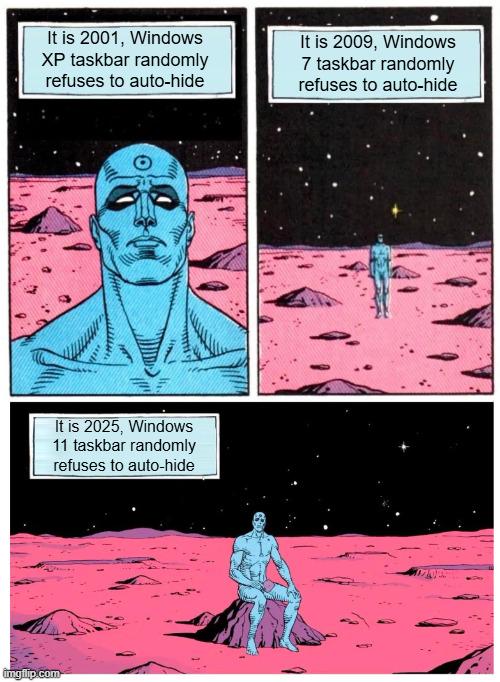
Oh, the beautiful tragedy of Windows consistency! Through decades of technological evolution, operating system revolutions, and the heat death of the universe itself, ONE thing remains absolutely, stubbornly, magnificently unchanged: the taskbar's passionate refusal to auto-hide when you politely ask it to. From Windows XP in 2001 to Windows 7 in 2009 to Windows 11 in 2025, Microsoft has blessed us with the same glorious bug spanning THREE different OS generations. It's honestly impressive how they've managed to preserve this feature with such dedication while everything else changes around it. Some things are just meant to be eternal – like taxes, death, and that stupid taskbar just SITTING there when you're trying to watch something fullscreen. Chef's kiss for consistency, Microsoft. 💀

The Ultimate Developer Fantasy

The Ultimate Developer Fantasy
Ah yes, the mythical "code that works on the first try" - a creature rarer than a unicorn riding a dragon. Most of us spend our days in an endless cycle of write-compile-error-debug-repeat until our coffee turns cold and our will to live evaporates. The second commenter's reaction is completely rational. Getting code to compile without errors on the first attempt is basically developer erotica at this point. Pure fantasy. I've been coding for 15 years and I'm still convinced that working first-try code is just an elaborate hoax perpetuated by Big Tech to keep us all motivated.