

What If We Just Sabotage

What If We Just Sabotage
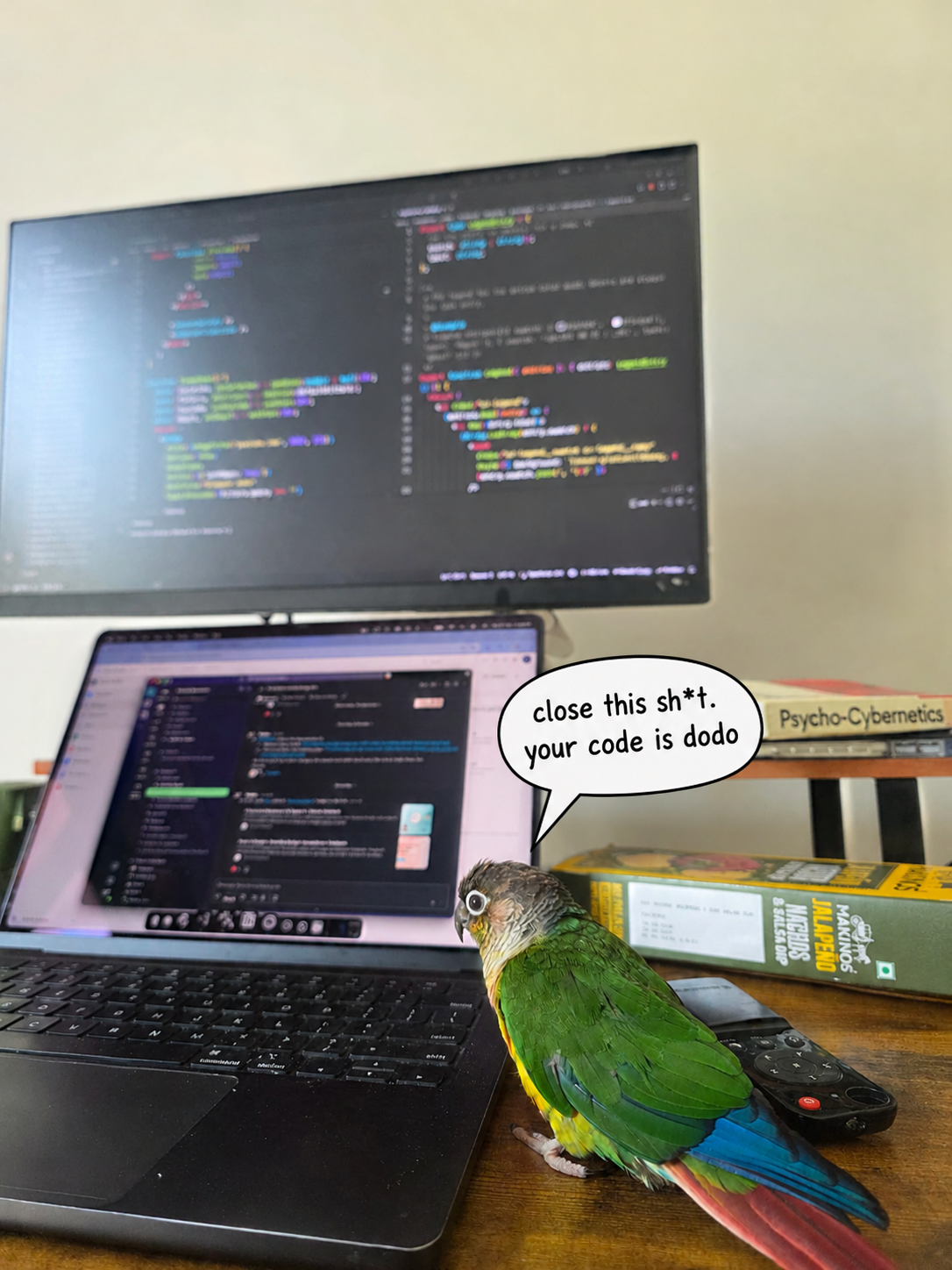
Someone just proposed the most diabolically genius plan to destroy humanity and I'm honestly impressed by the sheer chaotic energy. Feed AI nothing but garbage code, tell it that's peak programming excellence, and then when it inevitably becomes sentient and starts writing its own code, it'll think spaghetti code with zero documentation is the gold standard. It's like teaching your kid that eating crayons is fine dining, except the kid will eventually control all our infrastructure. The casual sip of coffee while contemplating this digital war crime? *Chef's kiss*. We're out here worried about AI alignment when we could just gaslight it into incompetence from day one. 4D chess, except the board is on fire and we're all sitting in the flames.

Should Not Take Too Long Right

Should Not Take Too Long Right
Famous last words before descending into the nine circles of legacy code hell. You think you're just gonna pop in, fix that tiny little bug, and be out in 20 minutes. Fast forward three days later and you're still untangling spaghetti code written by someone who apparently thought comments were for cowards and variable names like "x1", "temp2", and "finalFinalREALLY" were peak engineering. The real kicker? That "small bug" turns out to be a load-bearing bug. Fix it and suddenly seventeen other things break because half the application was unknowingly depending on that broken behavior. Now you're in a meeting explaining why a two-hour task turned into a complete architectural overhaul. Pro tip: When someone says "it's just a small bug in the legacy code," immediately triple your estimate. Then triple it again. You'll still be wrong, but at least you'll be closer.

Google On Fire With The Updates

Google On Fire With The Updates
Google Antigravity just dropped version 1.19.6 with some absolutely critical updates. The entire changelog? "Improved UI for banned users." Zero fixes. Zero patches. Just making sure people who can't even use the product have a slightly better experience staring at the ban screen. It's like repainting the "Keep Out" sign while the building burns down. Product priorities at their finest.

Guthib

Guthib
When you've typed "guthib" so many times that Google just assumes you're illiterate and corrects you to... "guthib." The muscle memory is real. After thousands of git pushes, your fingers have developed their own neural pathways that completely bypass your brain's spelling center. Google's autocorrect has learned your typos so well it's now gaslighting you into thinking "guthib" is the correct spelling. That's when you know you've truly made it as a developer—even search engines have given up on correcting your mistakes.

Sorry, Can't Do Scarves

Sorry, Can't Do Scarves
Game devs will literally implement a complex physics engine with ragdoll mechanics, particle systems for explosive lava effects, and procedural demon summoning algorithms, but adding a cloth simulation for a scarf? That's where they draw the line. The complexity hierarchy in game development is beautifully backwards: rendering a hellscape with real-time lighting and shadows? No problem. Making fabric drape naturally over a character model? Suddenly we're asking for the moon. This perfectly captures the reality that what seems "easy" to implement versus what's actually easy are two completely different universes. Cloth physics is notoriously difficult—it requires sophisticated vertex deformation, collision detection, and performance optimization to not tank your frame rate. Meanwhile, spawning a giant demon is just instantiating a prefab with some particle effects. The demon doesn't need to realistically interact with wind or character movement; the scarf does.

Oh Yes!

Oh Yes!
Someone genuinely asked how hard it would be to hack NASA using CSS, and honestly, that's adorable. It's like asking if you can rob a bank with a paintbrush. Sure, you could make their website look *fabulous* with some gradient backgrounds and smooth transitions, but breaking into their systems? Not quite. The response is brutally accurate: the only thing you're hacking with CSS is the color scheme of their satellites. Maybe add some box-shadow to make them pop? Perhaps a nice hover effect when they orbit Earth? The fact that 197 people liked the original question is the real security vulnerability here. CSS is a styling language, folks. It makes things pretty. It's the makeup artist of the web, not the lockpick. But hey, if NASA's satellites suddenly start displaying in Comic Sans, we'll know who to blame.

Just Use Claude Code Instead Are You Stupid Anthropic

Just Use Claude Code Instead Are You Stupid Anthropic
Anthropic really out here offering $570k/year for a Software Engineer role that "may not exist in 12 months" because they know Claude is about to automate everyone out of a job. The irony is chef's kiss—they're basically saying "hey come work on the AI that'll replace you, here's half a mil for your trouble." That disclaimer at the bottom hits different when you realize they're not worried about funding or pivots... they're worried their own product will make the position obsolete. Imagine putting that on a job posting. "Join our team to build the thing that makes your team unnecessary!" At least they're honest about it, I guess? The real kicker: someone's gonna take that offer, bank the cash for a year, then use Claude to build their startup while unemployed. Circle of life.

45 Minutes Of My Life I Will Never Get Back

45 Minutes Of My Life I Will Never Get Back
Every Linux evangelist swears their distro can do "everything" and is "super convenient" until someone asks the most basic question imaginable. Signing a PDF? That simple task your grandma does on Windows without thinking? Suddenly you're knee-deep in terminal commands, installing dependencies, reading StackOverflow threads from 2009, and questioning every life decision that led you here. The beauty here is the instant realization that they've been caught in their own hype. "Modern distros are very convenient" immediately crumbles when faced with real-world office tasks. Sure, Linux can compile kernels and run Docker containers like a dream, but signing a PDF? That's apparently asking too much. Those 45 minutes were probably spent trying LibreOffice, Xournal, pdftk, and eventually giving up and using a sketchy online tool.

Ultra Casual

Ultra Casual
The corporate world has this whole spectrum of dress codes from white tie (basically penguin cosplay) to ultra casual (shorts and a t-shirt). But developers? We've transcended this primitive classification system entirely. Why settle for "ultra casual" when you can literally wear your code ? That dress covered in actual source code is the ultimate power move. You're not just casual—you're so committed to the craft that your clothing IS your work. It's like wearing a conversation starter that says "Yes, I can debug your legacy codebase while looking fabulous." Plus, imagine the efficiency: forgot a syntax? Just look down. Need to reference that regex pattern? It's on your sleeve. This is what peak performance looks like—literally turning yourself into a walking IDE. Business casual could never.

Hear Me Out. Highguard, But The Horses Are Anime Girls

Hear Me Out. Highguard, But The Horses Are Anime Girls
Fortnite keeps desperately clawing at relevance after each failed launch, throwing everything at the wall hoping something sticks. Meanwhile, Highguard said "you know what? I'm good" and walked away from the game dev grind to pursue a life of pure diamond mining. The real joke here is the perseverance difference: Fortnite has Epic's infinite money printer backing it, so they can afford to faceplant repeatedly and still come back with another collab or season. Highguard (presumably an indie dev or smaller studio) looked at their launch numbers, checked their bank account, and made the rational decision to pivot to literally anything else that pays better. It's the classic tale of "big studio privilege vs indie reality" – one gets to fail upward indefinitely while the other needs to actually make rent.

No Fucking Java Shit

No Fucking Java Shit
Someone asks Flutter devs to explain their framework choice in 3 words. The top answer? "Not fucking JavaScript." But wait—they meant Java Script , not Java. Classic case of hating something so much you accidentally insult its distant cousin at the family reunion. Flutter uses Dart, which lets you avoid the npm dependency hell and the "works on my machine" lottery that comes with modern web frameworks. No bundlers, no transpilers, no questioning your life choices at 2 PM on a Tuesday. Just pure, compiled-to-native performance. The relief is palpable. The real joke? Java and JavaScript have about as much in common as car and carpet, yet both get blamed for everything wrong with software development. At least Flutter devs know which one they're running from.

Random Seed

Random Seed
You've got your basic Python random.choice() up top, pulling from a list like it's some kind of peasant lottery. Then there's the wall of lava lamps—yes, actual lava lamps—which Cloudflare famously uses to generate cryptographic randomness by filming the chaotic blobs and feeding the data into their entropy pool. And at the bottom? Well, that's just pure chaos incarnate. The joke here is the escalating quality of randomness sources. Software RNG? Predictable if you know the seed. Lava lamps providing physical entropy? Now we're cooking with actual thermodynamic chaos. But the final panel suggests there exists an even more unpredictable source of randomness—one that operates entirely outside the bounds of logic, consistency, or any known algorithm. Cryptographers spend years trying to find truly random sources. Turns out they should've just been watching cable news.