

Why Does It Always Do That

Why Does It Always Do That
You know you've made it as a developer when your code working correctly feels suspicious . We've been so conditioned by bugs, edge cases, and production fires that success triggers our fight-or-flight response. That Kermit stare through the rainy window? That's you watching your code pass all tests on the first try, wondering what cosmic horror you've unleashed that you just haven't discovered yet. Give it 10 minutes—production will find it.

We All Been There

We All Been There
You know that feeling when your PM says "just a quick 1-month project" and three months later you're still in the requirements gathering phase, arguing about button colors, and waiting for stakeholders to respond to emails from two weeks ago? Yeah, that's the developer experience in a nutshell. The real kicker is that the "hardest part" isn't the actual coding—it's the endless meetings, scope creep, changing requirements, and the classic "can we just add one more feature?" that turns your sprint into a marathon. By month three, you've rewritten the architecture twice, switched databases once, and your original estimate is now a distant memory that haunts your dreams. Fun fact: Studies show that software projects typically take 2-3x longer than initially estimated. So really, that 1-month project becoming 3 months is you actually being optimistic .

Rare Moments Of Peace Between The Tribes When

Rare Moments Of Peace Between The Tribes When
You know that beautiful, serene moment when devs are just chilling in a field of flowers, waiting for QA to find that bug they definitely know exists? It's like watching a nature documentary about predator and prey in temporary harmony. The developer sits there peacefully, enjoying the sunshine, because they're fully aware of that edge case they didn't handle or that null pointer exception lurking in production. No stress, no panic—just pure zen acceptance of their fate. But then QA does the unthinkable: they convince the business stakeholders it's actually a feature . Suddenly the dev's peaceful meadow transforms into absolute chaos. The bug that was supposed to be their downfall just got promoted to "intended behavior" and now they have to maintain it forever. The horror. The betrayal. The technical debt that will haunt them for years. Sometimes the greatest enemy isn't the bug itself—it's when that bug becomes part of the product roadmap.

See You Later Allocator

See You Later Allocator
When your process is out here calling malloc() 128 times like it's shopping on Black Friday but hasn't called free() even ONCE. Zero times. Zilch. Nada. The memory allocator is sitting there watching this absolute CARNAGE unfold, frantically trying to explain the paperwork situation while the process just keeps grabbing more and more memory like a toddler hoarding toys. "But... but what about cleanup?" whispers the allocator into the void. The process doesn't care. The process has never cared. Memory leaks? That's a problem for Future Me™, and Future Me is probably getting killed by the OOM killer anyway. RIP to all those orphaned heap blocks that will never see their free() soulmate. 💔

NordVPN

NordVPN
Encrypt your traffic on public Wi-Fi, stream from anywhere, and cover up to ten devices with one plan. 30-day money-back guarantee.

The Duality Of A Man

The Duality Of A Man
Apple users will declare a national emergency over a microscopic scratch that's only visible under a forensic microscope, meanwhile PC users are out here running rigs held together by duct tape, prayers, and what appears to be a structural violation of several physics laws. That PC tower looks like it survived a house fire and still boots into Windows XP faster than your MacBook can open Safari. The real flex? That Frankenstein PC probably cost $200 total over two decades and can still run Doom, while the MacBook needs a $2000 replacement because the aluminum got a tiny dent. Different philosophies, same destination: somehow getting work done.

Is This A Good Price For Cookies

Is This A Good Price For Cookies
When the pricing system returns NaN instead of an actual number, so now these cookies cost "Not a Number" pounds. Classic JavaScript moment right there. Someone probably tried to do math on undefined , divided by zero, or parsed a string that definitely wasn't a number. The best part? The label printed successfully and nobody caught it before it hit the shelf. Production bugs hitting different when they're literally on display in a grocery store. Somewhere, a developer is getting a Slack message with a photo attached and their stomach just dropped. Fun fact: NaN is technically a number type in JavaScript, but typeof NaN === "number" returns true. Because of course it does.

HTML5 Accelerator Card

HTML5 Accelerator Card
Someone made a hardware accelerator card for HTML5 rendering and honestly, the specs are sending me. We've got dedicated chips for Flexbox and CSS Grid solvers because apparently those need hardware acceleration now. There's a "shielded event bubbler" for mouse movements and "8 programmable Virtual DOM chips" for React apps. The benchmarks show it crushing Discord scrollback and Facebook feeds—you know, the real performance metrics that matter. The "Seguri-Dad® TPM" that cryptographically signs requests so you never see another CAPTCHA again is chef's kiss. And naturally it features dual garbage collectors with "jank-free scrolling" because we're treating JavaScript memory management like it's a graphics pipeline now. The fact that someone spent actual time designing this parody card with a 1024-bit renderer and 256MB emoji cache is both concerning and impressive. The benchmarks comparing Firefox and Chrome with what appears to be a literal GPU bar graph really drives home how bloated modern web development has become. We went from static HTML pages to needing theoretical dedicated hardware just to scroll through minion memes at 240Hz.

I See You Costco

I See You Costco
Costco really said "why sell one RTX 5090 when we can sell them by the pallet?" Nothing screams "bulk discount" quite like shrink-wrapped GPUs stacked like they're cans of beans. Someone's either building the world's most expensive mining farm or Costco just figured out their target demographic includes crypto miners, AI researchers, and gamers who've been saving since the RTX 3090 shortage. Either way, your $1.50 hot dog combo just got a $2,000 GPU companion. The real question: do you need a membership card to cry at the price tag?

I'm Sorry Sony, I Was Going To Buy Both Bloodborne And Demon's Souls On PC For Full Price Even If It's Just Low Cost Ports. But I've Already Completed Bloodborne On PC And Now It Seems Demon's Souls Is On The Menu

I'm Sorry Sony, I Was Going To Buy Both Bloodborne And Demon's Souls On PC For Full Price Even If It's Just Low Cost Ports. But I've Already Completed Bloodborne On PC And Now It Seems Demon's Souls Is On The Menu
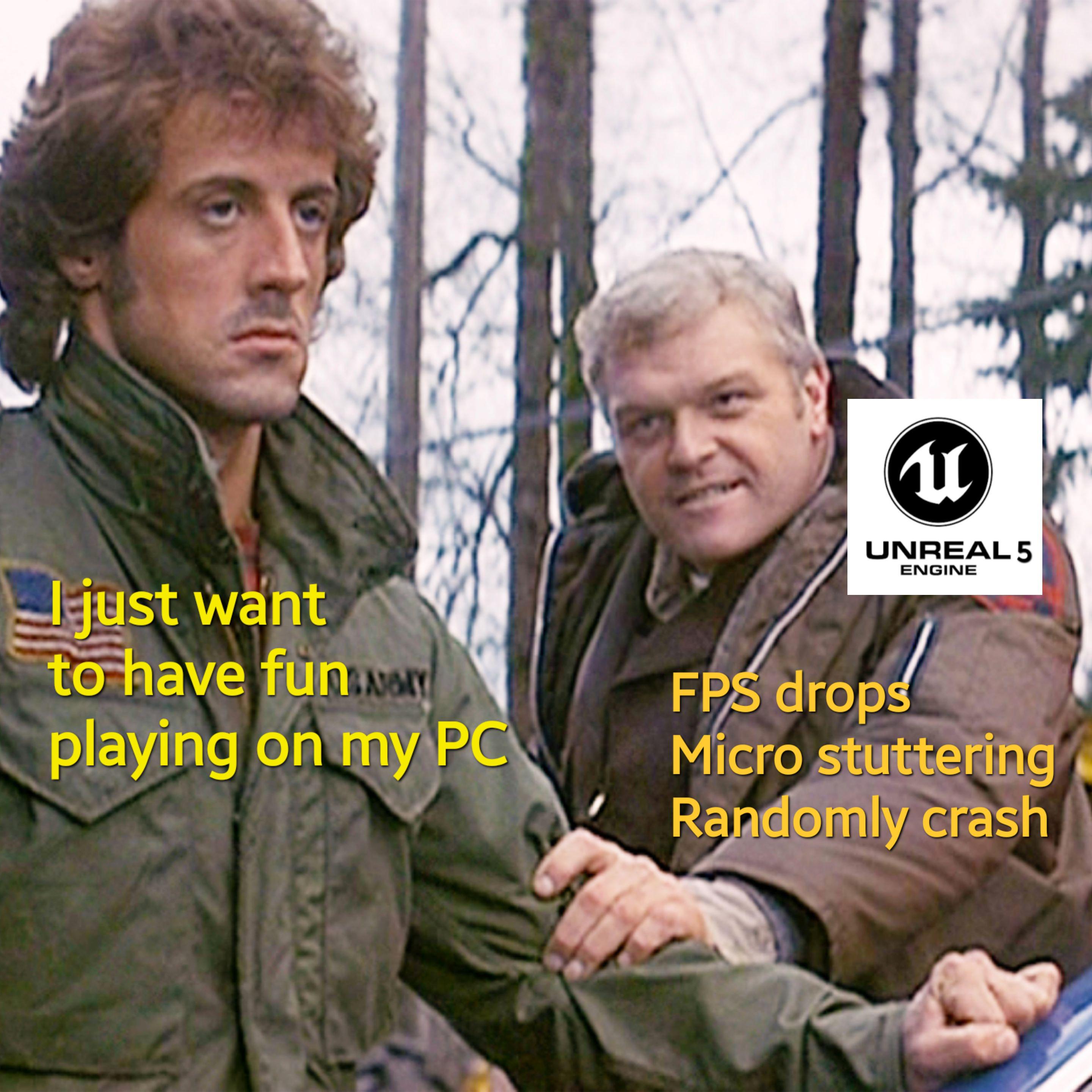
Sony's brilliant business strategy: hold PlayStation exclusives hostage for years, then act shocked when PC gamers find... alternative solutions. The irony is delicious—someone was literally ready to throw money at Sony for what would've been minimal-effort ports, but corporate greed and artificial scarcity turned a paying customer into a pirate. The "hand it over" meme from Dark Souls fits perfectly here. It's the gaming equivalent of "you snooze, you lose," except Sony wasn't snoozing—they were actively gatekeeping. Now instead of getting $120 from an eager customer, they're getting a middle finger and a lesson in market timing. Emulators and fan patches don't care about your exclusivity deals, Sony. Maybe release games on PC before the heat death of the universe next time?

That's A Funny Thing That Happened Once

That's A Funny Thing That Happened Once
Linus Torvalds calling C++ users "substandard programmers" and saying the language makes it too easy to write garbage code is the kind of nuclear take that only someone who literally built the Linux kernel can get away with. The man runs on pure technical conviction and zero diplomatic filter. He's not wrong though—C++ gives you enough rope to hang yourself, your team, and possibly the entire codebase. Meanwhile C keeps you humble by making you manually manage every byte like it's 1972. The funniest part? This quote is probably from some mailing list flame war that's now immortalized as programming folklore.

When You Accept Everything

When You Accept Everything
AI agents asking for permission? Cute, barely a flicker of brain activity. Using existing tools? Now we're cooking with gas, full galaxy brain mode. But writing their own tools? That's when things get spicy and your neurons start firing like a rave. The real ascension though? Giving your AI agent unrestricted access to execute random code AND your credit card. That's not just galaxy brain—that's cosmic enlightenment meets financial ruin. Nothing says "I trust the singularity" quite like letting an LLM yolo your entire bank account on API calls it wrote itself. Pro tip: If your agent starts asking to "borrow" wallets to pay fees, maybe it's time to revoke some permissions. Or don't—chaos is a ladder, and bankruptcy builds character.

Mini ITX PC Case, Small Form Factor Computer Case, Support SFX/SFX-L PSU, HDD/SSD Drive Bays & 2 Fans Position Compatible, Portable ITX Gaming Case with Removable Handle - Black

Mini ITX PC Case, Small Form Factor Computer Case, Support SFX/SFX-L PSU, HDD/SSD Drive Bays & 2 Fans Position Compatible, Portable ITX Gaming Case with Removable Handle - Black
【Mini-ITX PC Case】Purpose-built for Mini-ITX motherboards, this SFF gaming case measures 315×135×215mm. The detachable top handle makes it easy to transport, perfect for LAN parties or space-saving s…

Coding Be Like

Coding Be Like
The eternal cycle of debugging: you spot an error and immediately enter fight-or-flight mode. Then you fix it, feeling like a genius for exactly 2.3 seconds. But wait—fixing one bug is like pulling a thread on a sweater. Now there's another error, and you're right back to existential dread. It's the whack-a-mole game nobody asked to play, where fixing bugs doesn't reduce the bug count—it just redistributes them across your codebase. The real kicker? That "one more error" was probably there all along, just hiding behind the first one like a coward.