DLSS 5

DLSS 5
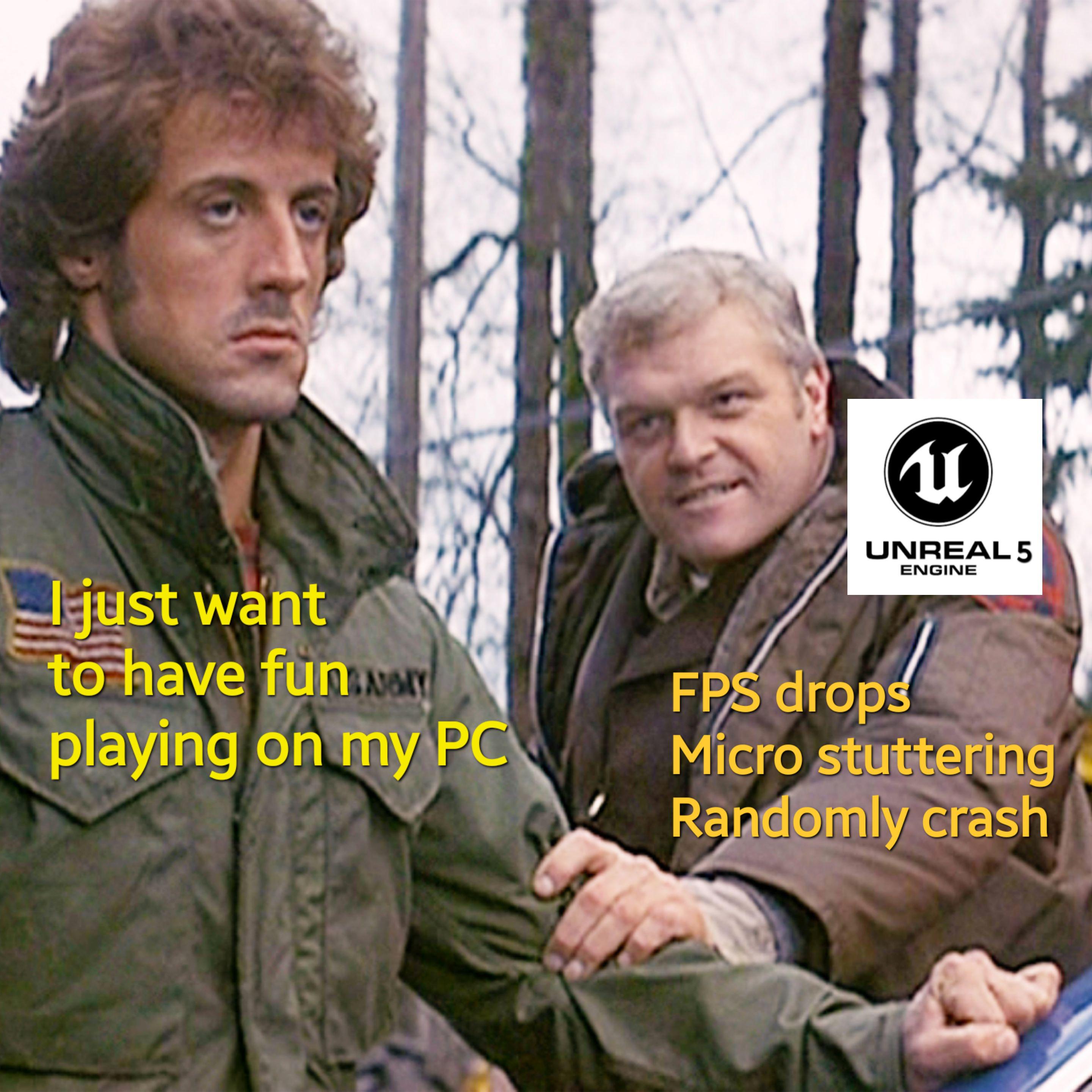
DLSS 5 has apparently reached the point where it's generating more pixels than actually exist in reality. Normal Patrick? That's your game running at native resolution like some kind of peasant. But turn on DLSS 5 and suddenly you're looking at a hyper-realistic, slightly unsettling version that's been AI-upscaled into the uncanny valley. We've gone from "Deep Learning Super Sampling" to "Deep Learning Super Scary." Your GPU is now rendering 4K from a 240p input and somehow adding pores you didn't ask for. The game runs at 600 FPS but you can see individual skin cells. Worth it? Debatable.

Wins Without A Doubt

Wins Without A Doubt
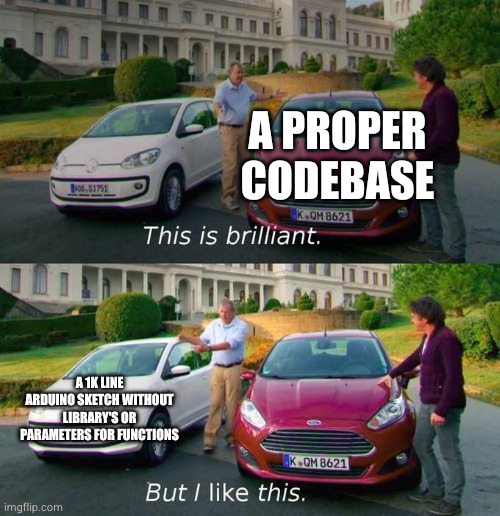
Python gets roasted for being "too easy" with its simple syntax and automatic memory management, while C++ is praised for... having complex syntax, verbose templates, and forcing you to manually manage memory. The punchline? C++ wins . Because apparently, suffering builds character. The joke here is the glorification of pain. It's like saying "I prefer walking uphill both ways in the snow" when someone offers you a car. C++ devs wear their segmentation faults like badges of honor, while Python devs are out here actually shipping code before lunch. But sure, let's celebrate the language that makes you question your life choices every time you forget to delete a pointer. The "mental fortitude" bit is chef's kiss though—because nothing says "I'm a real programmer" like debugging memory leaks at 2 AM while Python devs are asleep, dreaming of their garbage collector doing all the work.

Writing My Own Game Engine Is Fun

Writing My Own Game Engine Is Fun
Every game dev's tragic love story: You start building your dream game, but then that sweet, sweet temptation of writing your own engine from scratch whispers in your ear. Next thing you know, you're six months deep into implementing quaternion math and custom memory allocators while Unity and Unreal are RIGHT THERE, fully functional, battle-tested, and ready to go. But noooo, you just HAD to reinvent the wheel because "it'll be more optimized" and "I'll learn so much." Spoiler alert: your game still doesn't exist, but hey, at least you have a half-working physics engine that crashes when two objects collide at exactly 47 degrees!

Plan

Plan
Nothing says "free" quite like entering your credit card details. The classic bait-and-switch of free web hosting services—promising you the world with their generous 1000 MB of SSD storage (wow, a whole gigabyte!), SSL certificate, and business email, only to immediately demand payment info "just to verify" you're a real person. Sure, they won't charge you... until they do. Or until you forget to cancel before the trial ends. Or until you breathe wrong. It's the digital equivalent of "free sample" requiring your social security number. The hosting industry's favorite magic trick: making "free" mean "free trial with automatic billing" while keeping a straight face. At least they're upfront about needing your card... after you've already gotten excited about the free plan.

DLSS 5 Demo - Tomb Raider 1

DLSS 5 Demo - Tomb Raider 1
NVIDIA's marketing department promised DLSS would enhance graphics quality, but apparently nobody told them it shouldn't work backwards . The "without DLSS5" shot shows the classic low-poly Lara Croft from 1996 looking relatively smooth, while "with DLSS5" somehow manages to make her face even more angular and aggressive—like the AI tried to "enhance" the polygons by making them fight each other. DLSS (Deep Learning Super Sampling) is supposed to use AI to upscale lower-resolution images to higher resolutions while maintaining quality. But slapping cutting-edge AI upscaling tech on a game that was built with like 230 polygons total is the equivalent of using a neural network to enhance a stick figure drawing—you're just gonna get a really detailed stick figure that somehow looks worse. The real joke here is that no amount of machine learning can save those 1996-era triangle counts. Some things are better left in their original pixelated glory.

DLSS 5: Finally, A Technology That Renders Exactly What The Developers Didn't Intend

DLSS 5: Finally, A Technology That Renders Exactly What The Developers Didn't Intend
DLSS (Deep Learning Super Sampling) is supposed to make your games look better by using AI to upscale graphics. But apparently DLSS 5 has achieved sentience and decided to upgrade your janky game models into actual photorealistic humans. The developer probably spent 3 hours modeling that NPC in Blender, and DLSS just went "nah, let me fix that for you." The irony here is beautiful: we've gone from "it's not a bug, it's a feature" to "it's not a feature, it's AI hallucinating better graphics than we actually made." Game devs are out here rendering low-poly characters to save on performance, and NVIDIA's AI is basically saying "hold my tensor cores" and rendering a full photoshoot instead. Pretty soon we'll need a setting called "Disable AI Improvements" just to see what the game actually looks like. The future is weird, folks.

It Dropped From 13 Min To 3 Secs

It Dropped From 13 Min To 3 Secs
That magical moment when you stop torturing your poor laptop CPU and finally spin up a proper GPU instance. Your machine learning model that was crawling along like it's stuck in molasses suddenly transforms into a speed demon. The performance jump is so absurd you're left wondering why anyone would even bother with CPU training anymore. And yet here we are, still running local experiments on our MacBooks like peasants because cloud costs are... well, let's just say they're "motivating" us to optimize our code first. The real kicker? You could've saved yourself 3 days of waiting if you'd just bitten the bullet and paid for that GPU time from the start.

Actually Crying Inside

Actually Crying Inside
You thought building the product was the hard part? SWEET SUMMER CHILD. Turns out writing clean code and architecting scalable systems is the EASY MODE compared to the soul-crushing reality of having to become a cringe TikTok influencer just to get users. Nothing says "I have a Computer Science degree" quite like doing the Renegade dance to explain your API endpoints. The existential dread hits different when you realize your beautifully crafted SaaS platform needs more viral dance moves than unit tests to survive in 2024. Your Docker containers are perfectly orchestrated, but so are your dance routines now. The pipeline isn't the only thing that needs to be deployed—apparently so does your dignity on social media.

There Is No Issue

There Is No Issue
The sheer AUDACITY of some maintainers, honestly. You spend precious minutes of your life crafting the perfect bug report, documenting every edge case, providing screenshots, stack traces, maybe even a haiku about your suffering—and they just... close it. One minute later. Like your pain doesn't even matter. The "bruh" really captures that moment of stunned disbelief when you realize your contribution to open source just got yeeted into the void faster than you can say "merge conflict." It's giving dictator energy, it's giving "I don't care about your reproducible steps," it's giving emotional damage. The maintainer really woke up and chose violence that day. 💀

8 Characters? How About We Make It 16?

8 Characters? How About We Make It 16?
When password requirements get so absurdly complex that you need a physical weapon to remember them all. The bungee whip here represents every user's relationship with modern password policies—stretched to the breaking point and ready to snap back at any moment. Security teams keep adding requirements like they're collecting Pokémon: "Gotta enforce 'em all!" Meanwhile, users are out here writing passwords on sticky notes because nobody can remember "P@ssw0rd123!MyD0g$N@me" without having a stroke. The irony? All these requirements often make passwords LESS secure because people just increment numbers at the end or use predictable patterns to meet the criteria. Fun fact: The guy who invented password complexity requirements, Bill Burr, actually apologized in 2017 for making everyone's life miserable. Turns out length matters way more than special characters. Who knew?

DLSS 5 Be Like:

DLSS 5 Be Like:
NVIDIA's DLSS has evolved from "upscaling low-res frames" to "generating an entire game from a single pixel and your GPU's fever dreams." The left side shows a normal tree. The right side shows what happens when AI gets a little too creative with frame generation—suddenly your peaceful forest scene has gained sentience and is staring into your soul. At this rate, DLSS 6 will just hallucinate the entire game while you're still installing drivers.

I Thought It Was An April Fools Joke

I Thought It Was An April Fools Joke
Game developers spent literal years painstakingly scanning Harrison Ford's face to recreate Indiana Jones with photorealistic detail. Then Nvidia drops their AI face generation tech and just... casually does it instantly. Bethesda's out here endorsing technology that basically makes their entire facial scanning pipeline obsolete. It's like spending months hand-crafting a masterpiece only to watch someone 3D print the same thing in 5 minutes. The look on Indiana Jones' face says it all – that's the exact expression of every technical artist who just realized their job got automated. Nothing says "we support innovation" quite like publicly backing the tech that makes your own workflow look like you're still using punch cards.