

Yeah Fuck Cloud Shit

Yeah Fuck Cloud Shit
Imagine a room full of suits laughing at someone who just said they prefer running everything on their personal computer instead of migrating to the cloud. That's the energy here. Everyone's pushing cloud-native this, serverless that, Kubernetes everywhere—meanwhile you're sitting there with your trusty localhost thinking "but it works fine on my machine." The industry moved on. Your infrastructure didn't. Now you're the punchline at the enterprise architecture meeting while they discuss their multi-region failover strategies and you're just trying to remember if you backed up your hard drive last month. To be fair, your electricity bill is probably lower and you don't have to explain to finance why AWS charged $47,000 for a misconfigured S3 bucket. Small victories.

AI Is Fighting Basic Laws Of Economy (And Losing)

AI Is Fighting Basic Laws Of Economy (And Losing)
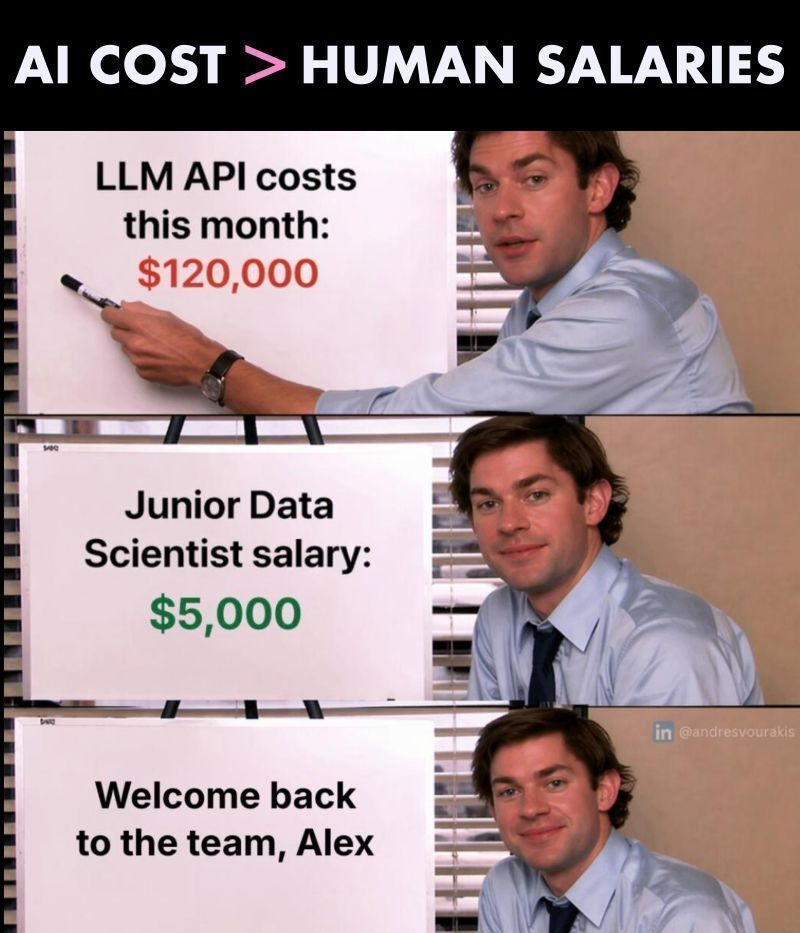
The automobile, the lightbulb, the personal computer—all revolutionary inventions that followed a simple pattern: build something people want, and they'll throw money at you. Fast forward to 2024, and AI companies have somehow reversed this entire business model. They've built products that cost billions in compute and electricity, users absolutely love them, and now they're desperately begging those same users to actually want the product they're already using. The punchline? Every previous tech revolution had investors asking "will people use this?" while AI has investors screaming "PLEASE want this, we're burning through venture capital faster than our GPUs burn through kilowatts!" Training models costs more than a small country's GDP, inference isn't getting cheaper, and somehow the pitch has devolved from "disrupting industries" to "pretty please develop a dependency on our chatbot." Supply and demand just left the chat—along with profitability, apparently.

Output Redirection

Output Redirection
Someone just visualized the Unix pipe operator in the most literal way possible. The command peel apple.txt | bunny is taking the output from peeling an apple and piping it directly into a bunny. In shell scripting, the pipe | redirects stdout from one command to stdin of another, but here it's just... feeding a rabbit. The precision of this visual metaphor is chef's kiss—you're literally taking the stream of peeled apple and redirecting it to the bunny process, which appears to be consuming it in real-time. No buffering, no intermediate files, just pure streaming I/O. The bunny's throughput seems pretty good too.

When Test Values Get Pushed To Prod

When Test Values Get Pushed To Prod
You know that sinking feeling when you deploy to production at 4:59 PM on a Friday and suddenly realize your entire user base is seeing "John Doe", "[email protected]", and license plates that literally say "EXAMPLE"? Yeah, someone definitely forgot to swap out their placeholder values before merging that PR. The DMV worker who approved this plate probably had the same energy as a code reviewer who just rubber-stamps everything with "LGTM" without actually reading the diff. Now this driver is cruising around as a real-life manifestation of every developer's nightmare—being the living proof that someone skipped the environment variable check. Fun fact: This is exactly why we have staging environments. Too bad nobody uses them properly.

Somethings Supporting Those Umm Technologies

Somethings Supporting Those Umm Technologies
Ah yes, the classic tech industry anatomy lesson. OpenAI and Microsoft Copilot are getting all the attention up top, looking shiny and impressive, while the real MVPs—FOSS projects, independent artists, and venture capital—are doing the heavy lifting down below. It's almost poetic how these AI giants are basically standing on the shoulders of... well, everything else. OpenAI scraped half the internet (including your GitHub repos, you're welcome), Copilot trained on millions of lines of open-source code, and both are propped up by billions in VC money that's desperately hoping this AI bubble doesn't pop before they exit. The irony? The open-source community built the foundation, artists unknowingly donated their work to the training sets, and VCs threw cash at it like confetti. Meanwhile, the fancy AI tools get all the credit while casually forgetting to mention the awkward "how did we get this data again?" conversation. Classic tech move—stand on giants, claim you're flying.

My Boss

My Boss
The duality of workplace reactions: you're out here ready to flip tables and rage-quit over yet another production bug at 5 PM on a Friday, meanwhile your boss is sitting there like some emotionless algorithm analyzing edge cases. "Oh that's interesting" is corporate-speak for "I have zero emotional investment in your suffering and will now ask you to investigate this during your weekend." The sheer contrast between your very human, very justified meltdown and their cold, detached curiosity is the perfect summary of every dev's relationship with management. They're observing your crisis like it's a fascinating science experiment while you're literally combusting.

I Love Microsoft

I Love Microsoft
So you're telling me 30% of your new code is AI-generated and you've got a bug where clicking 'X' spawns Task Manager instances like rabbits? The math checks out. Nothing says "cutting-edge AI-powered development" quite like a basic UI interaction causing process duplication. Really makes you wonder what that 30% of AI code is doing—probably writing infinite loops and feeling proud about it. The corporate irony here is chef's kiss: bragging about AI productivity while shipping bugs that would make a junior dev blush. Sure, AI can write code faster, but apparently nobody told it about the whole "quality assurance" thing. At this rate, Windows 12 will just be a chatbot apologizing for bugs in real-time.

Beautiful But Deadly

Beautiful But Deadly
You know that feeling when your code compiles on the first try? That's not victory—that's a red flag. After enough years in the trenches, you learn that code which works immediately is basically a ticking time bomb. No compiler errors? Congratulations, you've just written something so cursed that even the compiler is too scared to complain. It's sitting there, silently judging you, knowing full well you've got edge cases hiding like landmines and race conditions waiting to ruin your 3 AM on-call shift. The real pros know: if it compiles first try, you either forgot to save the file or you're about to discover a logic bug so subtle it'll haunt production for months. Trust nothing. Test everything. Especially the stuff that looks perfect.

Vibe Coder Life

Vibe Coder Life
You know someone's treating their codebase like a personal diary when every commit message looks like "🔥🚀💥❌✅". Instead of writing descriptive variable names or meaningful comments, they're out here communicating exclusively through hieroglyphics. Is that fire emoji because the code is hot garbage that needs to be deleted, or because it's performing well? Is the rocket a deployment or just wishful thinking? The checkmark could mean tests are passing or just vibes-based approval. The real kicker is trying to debug their code when the only documentation is "fixed the thing 💯" from 6 months ago. Good luck figuring out what handleStuff() does when the only comment above it is "🎯🔥". Pro tip: emojis don't show up in stack traces, and your future self will absolutely hate you during that 2 AM production incident.

It Will Be The End Of Me

It Will Be The End Of Me
You know that moment when you stare at your screen, questioning your entire existence as a developer? You're supposed to be testing the code to find bugs, but instead you're watching your code expose every flaw in your logic, every shortcut you took, and every "I'll fix it later" comment from three months ago. The tests aren't just failing—they're personally attacking your life choices. That smug grin turning into existential dread perfectly captures the transition from "let's see if this works" to "why did I ever think I could code?" The real question isn't whether you're testing the code or the code is testing you—it's how long until you accept that the code won, and you're just along for the ride.

I Hate Microsoft

I Hate Microsoft
When you're so done with Microsoft's ecosystem that you're ready to pledge your soul to Valve and their Steam Deck running SteamOS (which is Linux-based, btw). The irony? You're basically begging a gaming company to save you from Windows updates, forced reboots, and the never-ending "We're getting things ready for you" screens. The best part is that SteamOS is built on Linux, so you're essentially saying "I'd rather learn Proton compatibility layers and fiddle with Wine prefixes than deal with one more Edge browser popup." And honestly? Valid. At least when Linux breaks, you chose to break it yourself.

Just Learn How To Write Code Yourself

Just Learn How To Write Code Yourself
So we've reached the point where "coders" who can't function without AI assistance are being told they have no business shipping software. The brutal honesty here is refreshing. It's like watching someone realize their entire skillset is just being really good at prompting ChatGPT. The vibe shift is real. We went from "AI will replace all programmers" to "if you need AI to write every line, you're not actually a programmer" faster than you can say "stack overflow copy-paste." Sure, AI is a tool—but if you can't debug, architect, or understand what the AI just generated, you're basically a glorified middleman between a language model and production. Tony Stark energy: "Learn the fundamentals or get out of my codebase."