

Refactoring Complete

Refactoring Complete
Ah yes, the classic refactoring success story. You took that tangled mess of spaghetti code and transformed it into... lasagna. Still pasta, still carbs, just with more layers and a fancier name. The architecture is now "layered" which sounds way more professional in stand-ups, even though you basically just added more abstraction layers that nobody asked for. At least now when someone asks "where's the business logic?" you can confidently say "it's somewhere between layers 3 and 7" instead of "good luck finding it in that 2000-line god function." Progress is progress, right? The code review will be *chef's kiss* because everyone loves a good lasagna—I mean, layered architecture.

Task Failed Successfully

Task Failed Successfully
You know that feeling when you spend hours crafting the perfect UI with clean components, semantic HTML, and accessibility best practices, only to watch a user completely bypass your carefully designed UX flow? The dev created a beautifully simple teapot with a functional spout that pours perfectly into the cup below. But the user? They're just gonna lift the entire lid and pour directly from the top, ignoring the spout's existence entirely. Sure, they got their tea. The task technically succeeded. But at what cost? Your elegant design patterns, your intuitive user journey, your perfectly positioned action buttons—all rendered meaningless by someone who decided to brute-force their way to the solution. It's like building a REST API with proper endpoints and watching someone scrape your HTML instead. The real kicker? They'll never know how it was supposed to work, and you'll die inside a little watching the analytics show 0% engagement on your proudest feature.

Task Failed Successfully 2

Task Failed Successfully 2
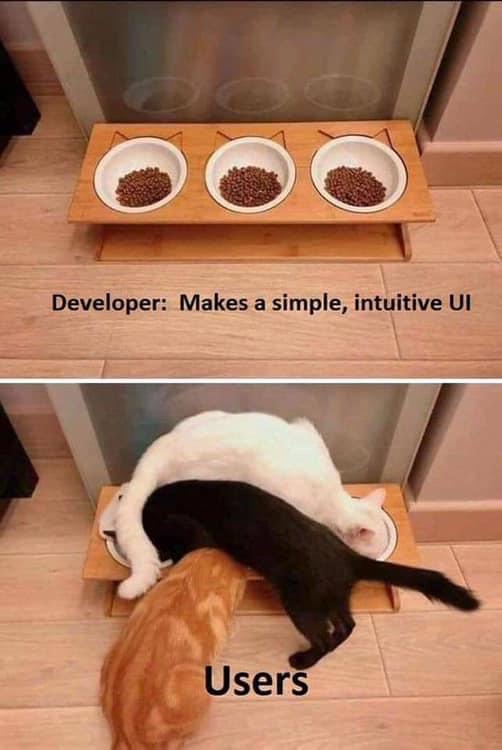
You spend hours crafting the perfect user experience with clean separation, logical flow, and elegant design patterns. Then you deploy it and users immediately find the most chaotic way possible to use it. Three cats fighting over three perfectly separated bowls? Nah, let's all just jam our faces into the same space like we're debugging a race condition. The real kicker is they'll still complain the UI is confusing. You can lead users to intuitive design, but you can't make them use it intuitively. They'll find a way to break your carefully planned architecture every single time, and honestly? After a decade in this industry, I've learned to just accept the chaos and add more logging.

Flexing Generational Wealth

Flexing Generational Wealth
When your inheritance isn't a trust fund but two sticks of Corsair Vengeance RAM worn as bling. Forget gold chains—real wealth is measured in gigabytes and clock speeds. This guy's out here dripping in DDR4 like it's the crown jewels, and honestly? In today's market where RAM prices fluctuate more than crypto, he might actually be onto something. The swagger is immaculate, the mustache is questionable, but the flex? Undeniable. Your parents left you property? Cool. His parents left him 32GB of dual-channel memory. Who's really winning here?

Found Yet Another Website That Tries To Scam Us By Sending Ram To Sam Altman

Found Yet Another Website That Tries To Scam Us By Sending Ram To Sam Altman
So you're buying 32GB of RAM and this pop-up appears asking if you'd like to "donate" 1GB to the Sam Altman Foundation for "AGI Compute Relief." Because apparently, OpenAI—the company burning through billions in compute—desperately needs your single gigabyte of DDR5 to power their 7-trillion-dollar cluster. The kicker? Your remaining 31GB is "still capable of running Chrome tabs." Barely. Chrome would eat all 32GB and still ask for more like a digital black hole. The passive-aggressive "No thanks, I will keep all 32 GB (Sam Altman will be notified)" button is chef's kiss. Yes, I'm sure Sam is personally monitoring every declined RAM donation while counting his billions. This is either the most elaborate dark pattern ever created or someone's fever dream of what "charitable hardware" looks like. Either way, if this is real, the audacity is almost impressive.

See Sam Altman I'm Using More Than 5 Percent Of My Ram

See Sam Altman I'm Using More Than 5 Percent Of My Ram
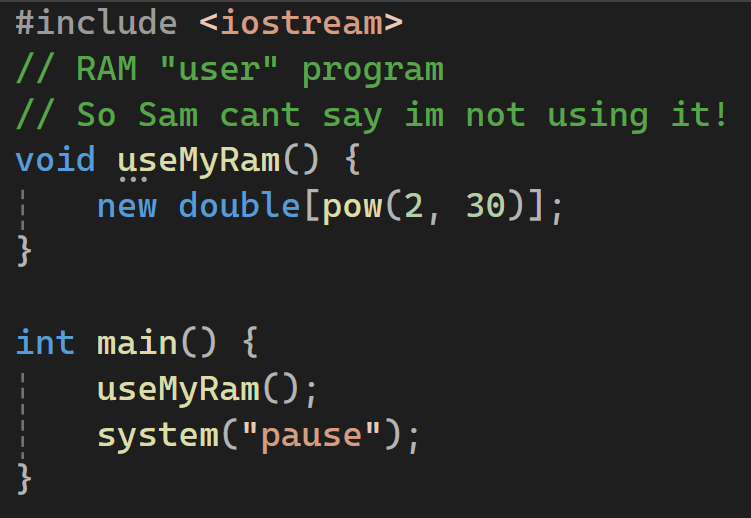
Someone really looked at OpenAI's CEO and said "you know what'll show him? Allocating 2^30 doubles in memory." That's roughly 8 gigabytes of RAM for a single array that does absolutely nothing except exist. The joke here is a dig at Sam Altman's comments about how people barely use their computer's resources, suggesting we should all be running AI models locally. So naturally, the programmer's response is the most passive-aggressive memory allocation possible—creating a massive array just to prove they can use their RAM, thank you very much. The system("pause") at the end is chef's kiss—keeping that RAM hostage until you press a key, like holding up a sign at a protest. Peak developer pettiness.

8 Hours Of Uninterrupted Bliss

8 Hours Of Uninterrupted Bliss
That feeling when you've got 32GB of DDR5 RAM sitting in your machine and Sam Altman's OpenAI servers are doing all the heavy lifting. Your CPU is practically idle, your RAM usage is at like 8%, and you're sleeping like a baby on a cloud made of unutilized memory bandwidth. The irony is beautiful: you dropped serious cash on bleeding-edge DDR5 (probably paid scalper prices too), only to realize that modern AI development means shipping your compute problems to someone else's datacenter via API calls. Your beefy local setup is just sitting there twiddling its thumbs while GPT-4 runs on Microsoft's Azure clusters. Peak efficiency? Nah. Peak peace of mind? Absolutely. Meanwhile, Sam's probably losing sleep over those electricity bills and H100 GPU allocations while you're literally sleeping on clouds. The tables have turned, my friend.

NordVPN

NordVPN
Encrypt your traffic on public Wi-Fi, stream from anywhere, and cover up to ten devices with one plan. 30-day money-back guarantee.

Girlfriend Made This, Think It's Great.

Girlfriend Made This, Think It's Great.
Your girlfriend just turned the global chip shortage into a dark comedy masterpiece. The chocolate skeleton represents what's left of developers after trying to build a PC in 2021-2023, or worse, trying to deploy a fleet of servers when semiconductor manufacturers are backordered until the heat death of the universe. The real kicker? She's not wrong. While we're all frantically optimizing our code to squeeze out every last byte of performance, Chrome is over here casually consuming 47GB of RAM to display a single tab with a cat GIF. Meanwhile, crypto miners and AI training farms are hoarding GPUs like they're collecting Infinity Stones, and car manufacturers can't ship vehicles because they can't get enough chips for the dashboard displays. The skeleton is all of us waiting for that DDR5 RAM to come back in stock at non-scalper prices. Beautiful, tragic, and disturbingly accurate.

Perfect Square

Perfect Square
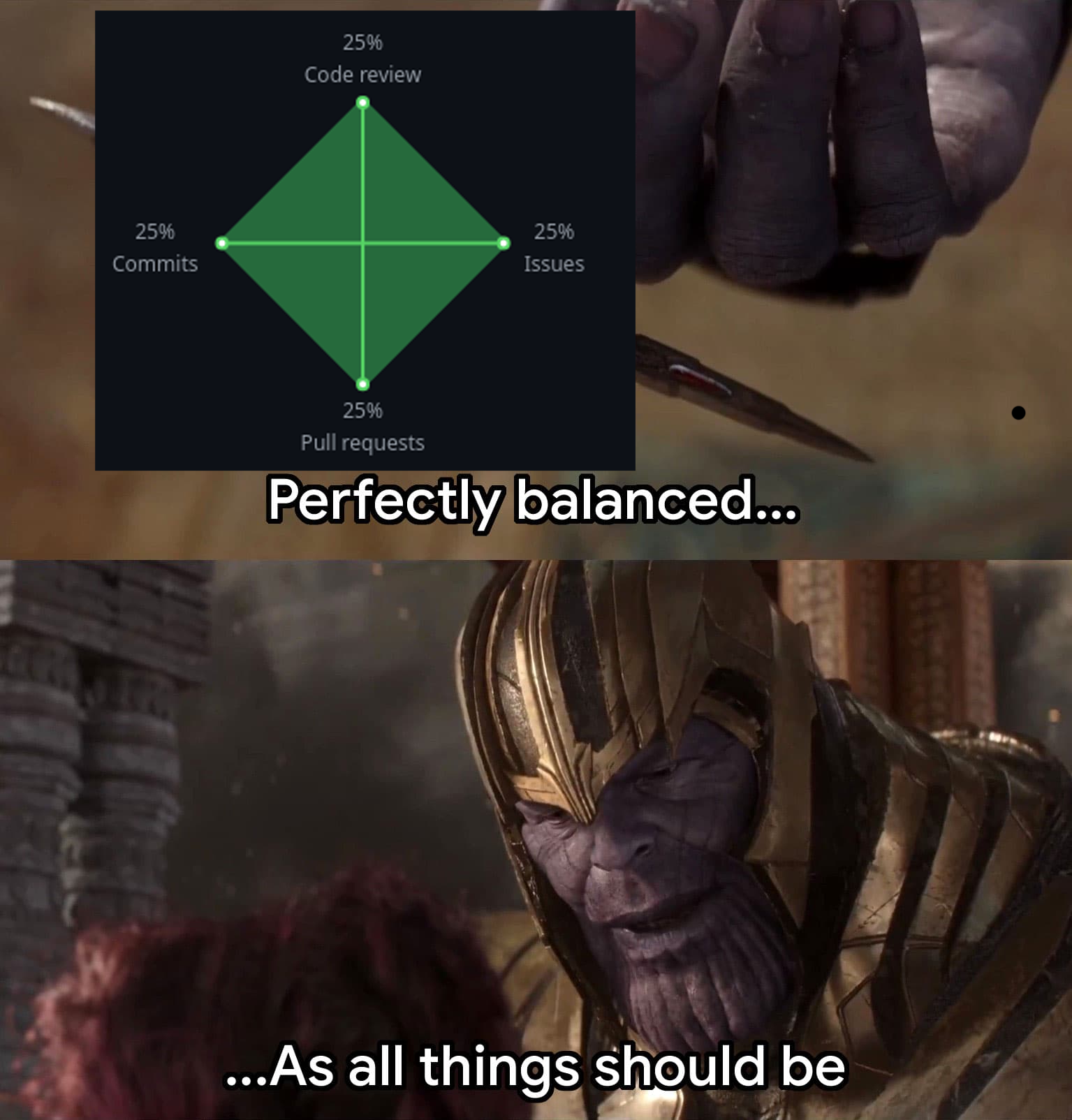
When your project metrics show a perfectly symmetrical diamond with 25% allocated to code review, commits, issues, and pull requests, you've either achieved engineering nirvana or you're lying to yourself. Spoiler: it's definitely the latter. In reality, most teams spend 70% firefighting production bugs, 20% in meetings arguing about tabs vs spaces, and 10% actually writing code. But hey, those quarterly reports to management aren't going to fabricate themselves! The Thanos seal of approval really drives home the delusion—sure, your workflow is "balanced," just like how your codebase has "no technical debt" and your estimates are "always accurate."

How To Catch A Sam Altman

How To Catch A Sam Altman
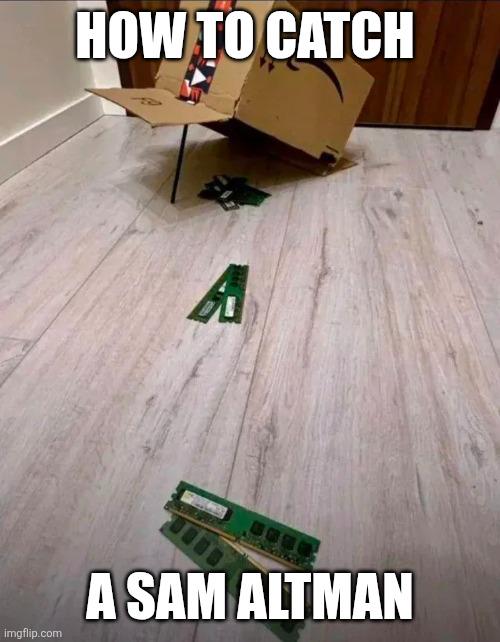
Just leave a trail of GPUs leading to a cardboard box propped up with a stick. Works every time. The OpenAI CEO's natural instinct to hoard compute resources for the next AGI breakthrough makes him particularly vulnerable to this classic trap. You can practically hear him muttering "just one more H100 cluster" as he crawls under the box.

My LLM Prompted Me To Create This

My LLM Prompted Me To Create This
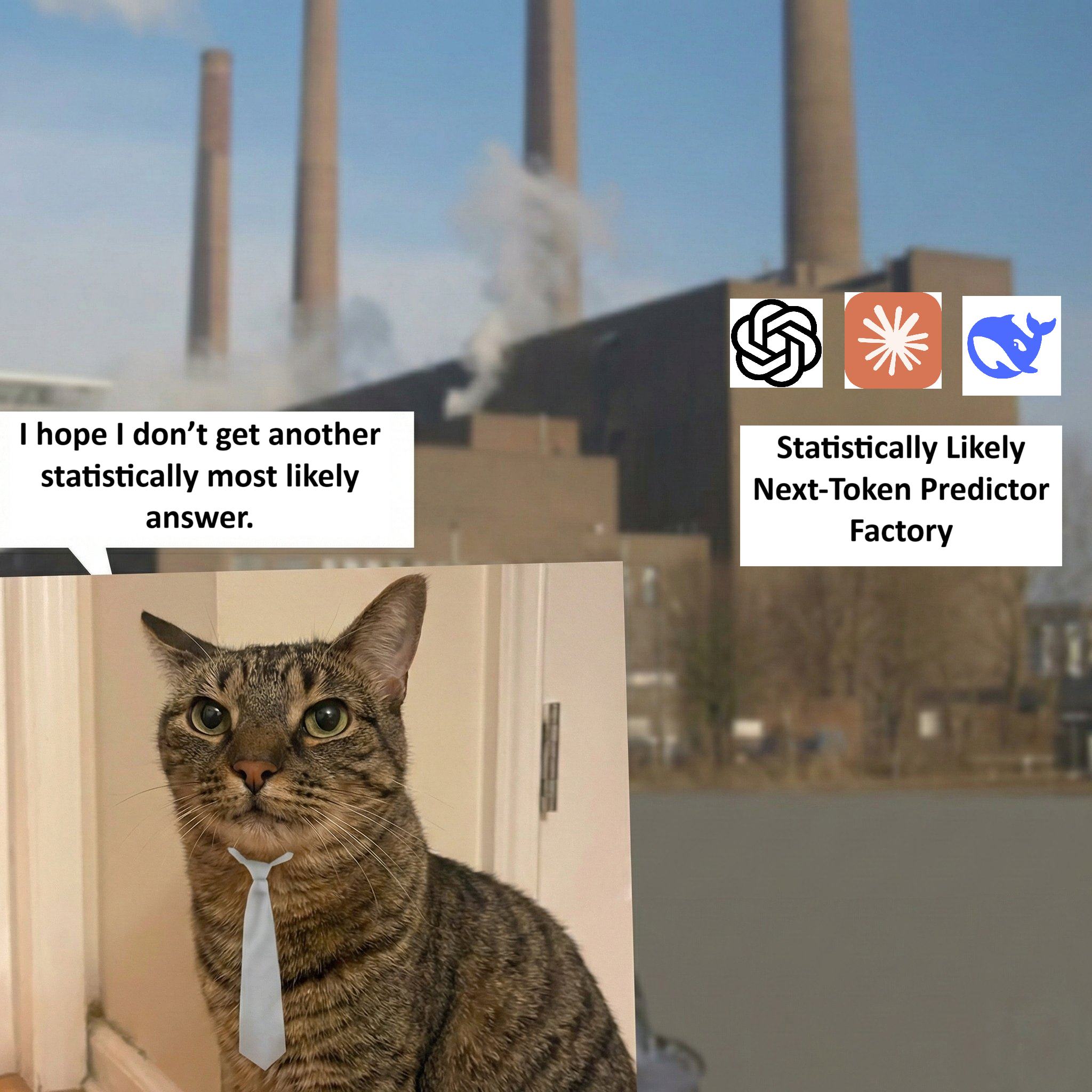
The business cat is nervously eyeing those pollution-spewing smokestacks labeled "Statistically Likely Next-Token Predictor Factory" because he knows exactly what's coming. Every time you ask an LLM a question, it's not actually reasoning or understanding—it's just playing an incredibly sophisticated game of "what word comes next?" based on probability distributions. So when you ask ChatGPT or Claude something nuanced, there's always that lurking dread that instead of a thoughtful answer, you'll get the statistically most probable response that sounds confident but is completely hallucinated. It's like asking a parrot that's read the entire internet—sure, it sounds smart, but it's fundamentally just predicting tokens based on training data patterns. The factory imagery is chef's kiss because it captures how these models are literally industrial-scale probability machines churning out tokens. No consciousness, no real understanding—just pure statistical inference at massive scale. And yet here we are, trusting them to write our code, debug our apps, and explain complex concepts. What could possibly go wrong? 🎲

I'll Take 2 X 128 GB Please

I'll Take 2 X 128 GB Please
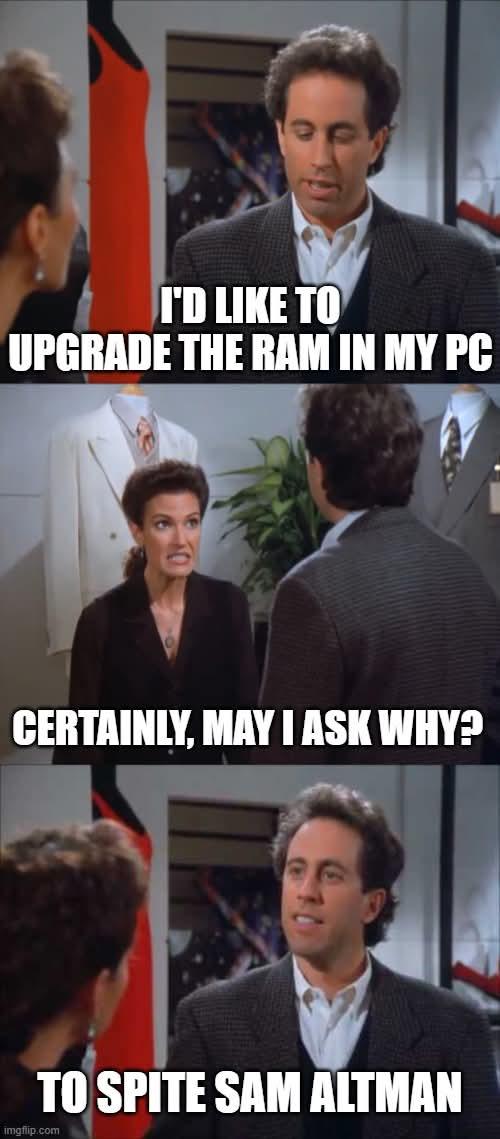
You know your RAM situation is dire when spite becomes a valid technical justification for hardware upgrades. "Why do you need 256GB of RAM?" "Because Chrome exists and I refuse to let it win." The real power move here is that the spite is actually directed at Sam Altman, presumably for making AI models so resource-hungry that your poor laptop sounds like a jet engine every time you try to run a local LLM. Nothing says "I'm petty AND technically competent" quite like dropping $500 on RAM just to prove a point. Fun fact: Most developers could probably get by with 16GB, but where's the fun in that? We need those extra 240GB for the 47 Docker containers we forgot were running and that one Electron app that thinks it's Chrome's evil twin.

T-Rex Geek Dinosaur Pixel Art Without Internet Connection T-Shirt

T-Rex Geek Dinosaur Pixel Art Without Internet Connection T-Shirt
Funny nerdy cool graphic design T-Rex pesent for programmers, computer science students and college courses, internet surfers and HTML CSS JavaScript coder. Also for Java front and back-end web devel…