

Bell curve Memes

Posts tagged with Bell curve
Another Bell Curve

Another Bell Curve
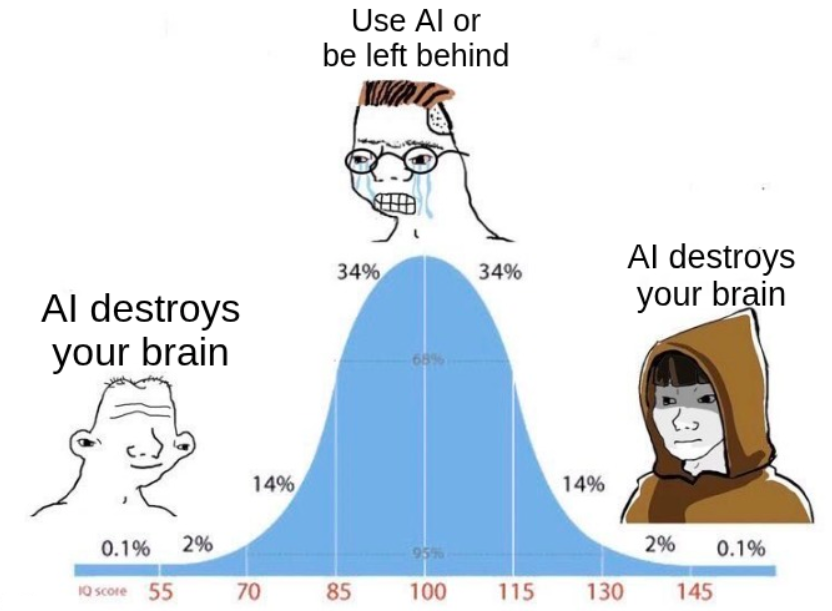
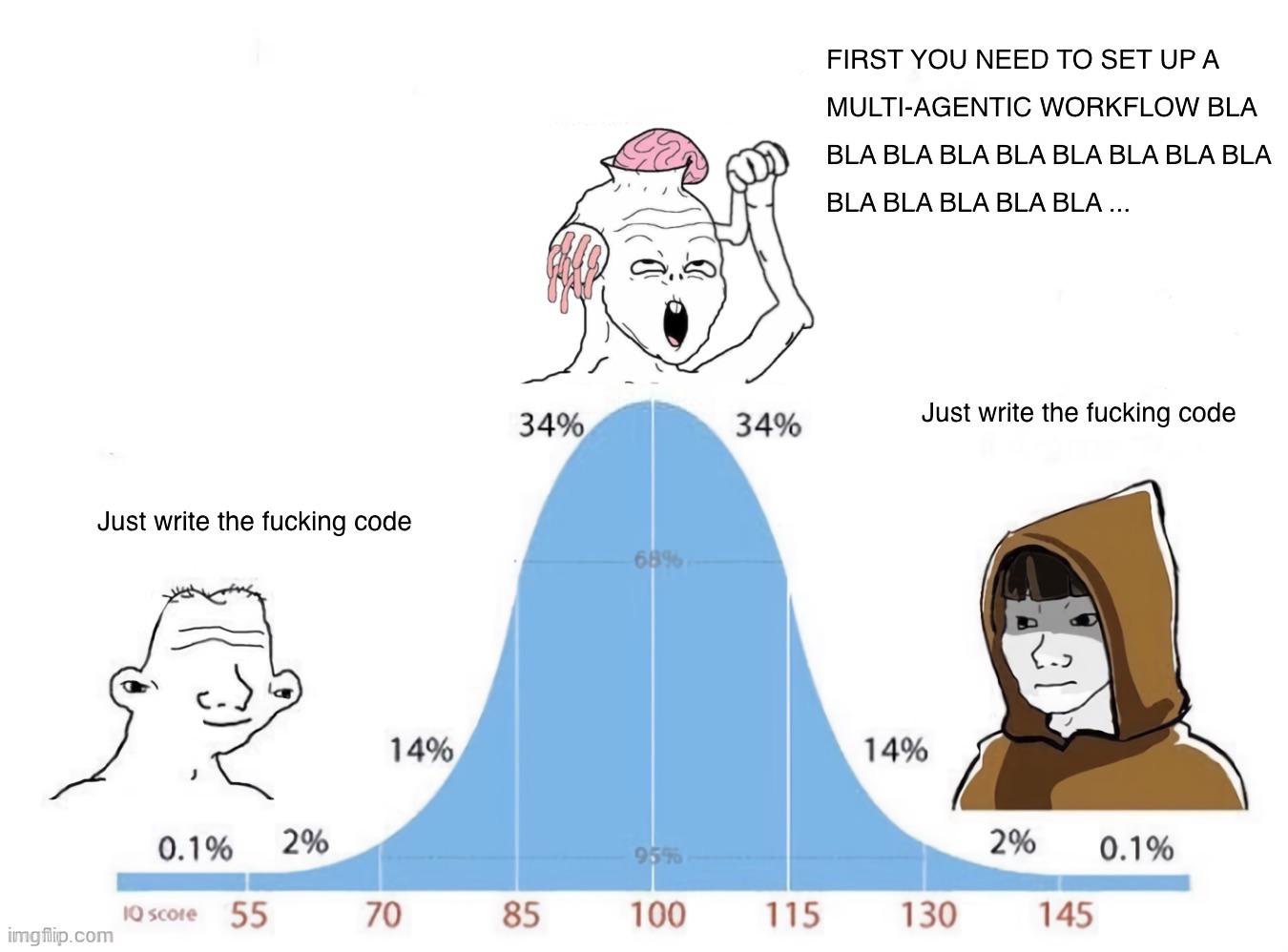
The bell curve meme strikes again. The low IQ folks and the galaxy-brain geniuses have finally found common ground: they both know AI is rotting our ability to think. Meanwhile, the anxious middle is sweating bullets about "staying relevant" and desperately prompt-engineering their way through every task. The dumb ones don't care because they never relied on their brain anyway. The smart ones have seen enough tech hype cycles to know that outsourcing your entire cognitive function to a probabilistic text generator might not end well. But that 68% in the middle? They're mainlining ChatGPT like it's coffee, terrified they'll wake up obsolete if they don't let the robots do their thinking. Spoiler: your brain is a muscle. Use it or lose it. The AI is a tool, not a replacement for actually understanding what you're building.

Hehe Funny Hat

Hehe Funny Hat
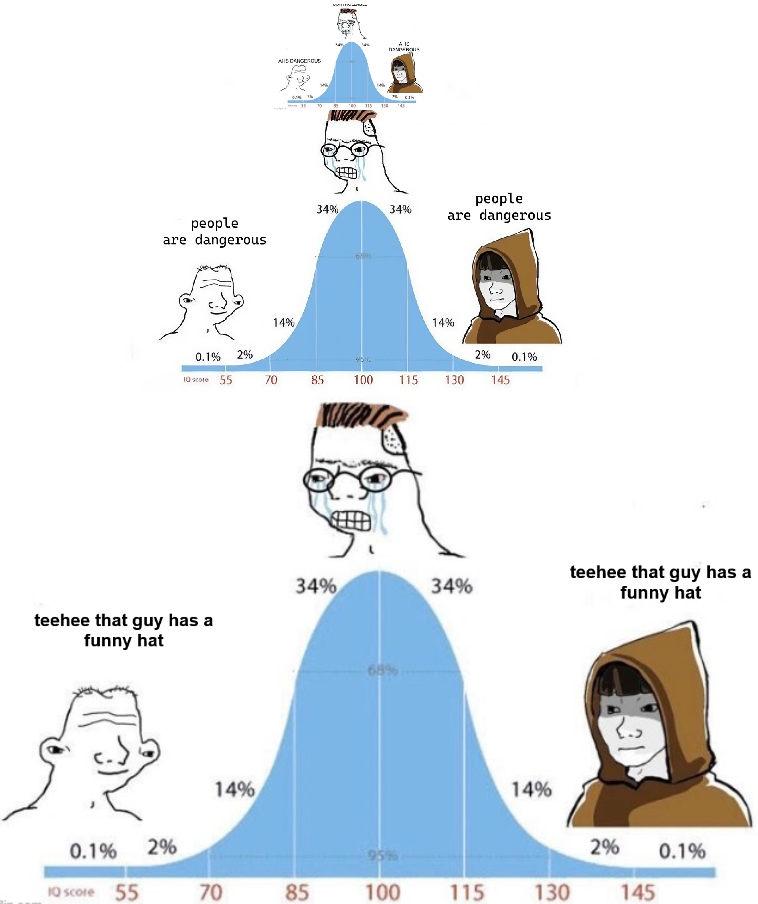
When you're so focused on the guy with the funny hat that you completely ignore the actual bell curve distribution. The top panel shows a proper IQ distribution with the extremes recognizing that "people are dangerous" while the middle stays blissfully ignorant. But then the bottom panel reveals the true intellectual convergence: everyone, regardless of IQ, just wants to appreciate that magnificent hoodie. It's the horseshoe theory of meme analysis—sometimes the low-IQ take and the high-IQ take are exactly the same. Both ends of the spectrum see past the pseudo-intellectual posturing and just vibe with the simple joy of "teehee that guy has a funny hat." The guy in the middle is having an existential crisis trying to understand the deeper meaning while everyone else has already achieved enlightenment through hoodie appreciation.

People Use AI

People Use AI
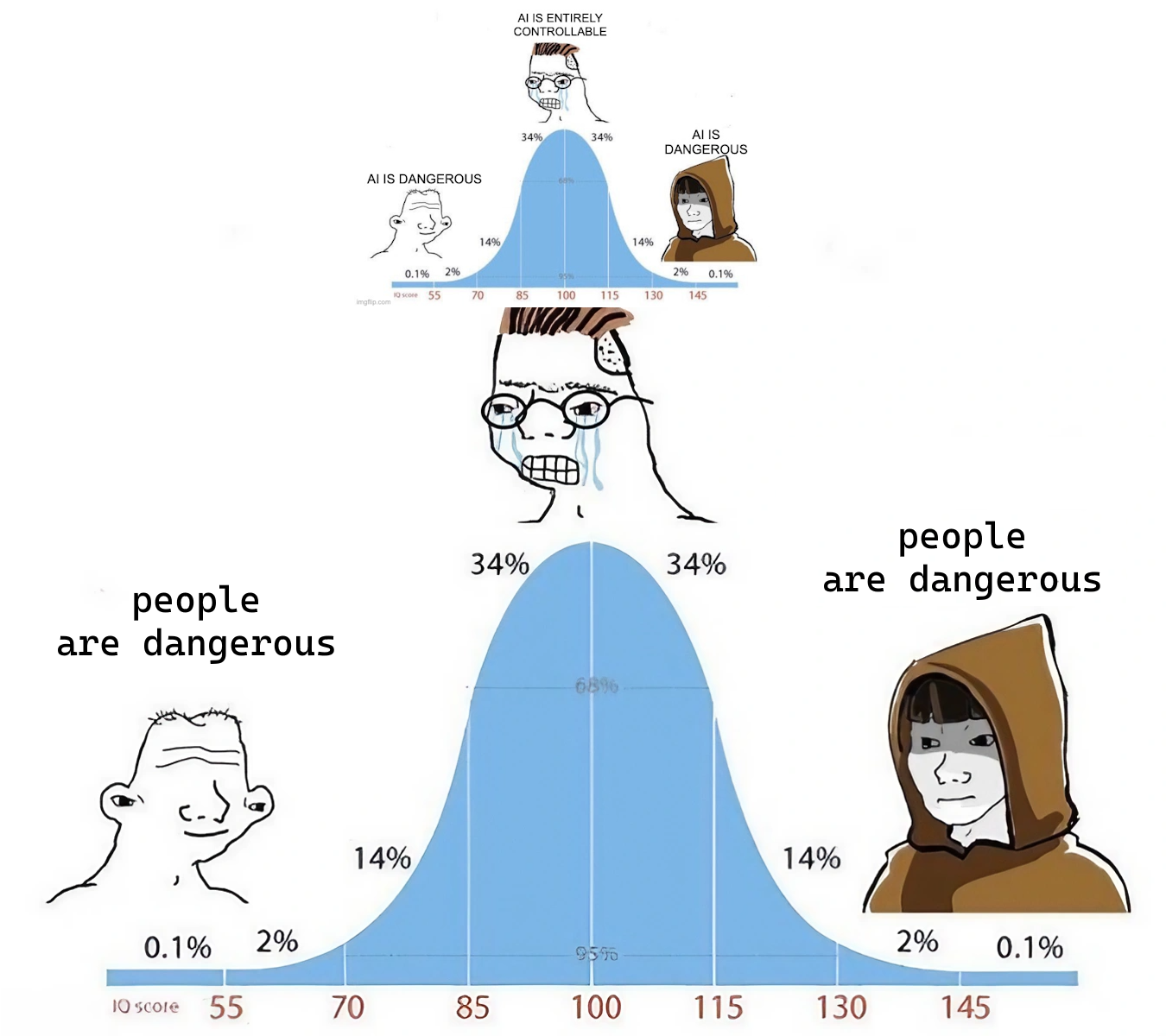
The beautiful irony here is watching people debate whether AI or humans are the real threat, while completely missing that the bell curve shows they're literally the same distribution . The top panel shows folks arguing about AI safety with the extremes thinking it's either totally controllable or apocalyptically dangerous. The bottom panel? Same exact curve, same exact percentages, just swap "AI" for "people." It's like running two identical unit tests but changing the variable name and being shocked they both pass. The 68% in the middle are just vibing with reasonable takes while the 0.1% tails are preparing bunkers or writing Medium articles about how everything is fine. The real kicker is that whoever made this probably used AI to generate it, creating a beautiful recursive loop of irony. Plot twist: maybe the dangerous ones are the 34% on each side who are slightly concerned but not enough to actually do anything about it. That's the sweet spot where bugs make it to production.

AI Is Scary

AI Is Scary
When you ask people about AI safety, you get a perfect bell curve distribution. On the far left, you've got the "AI is dangerous" crowd who probably still think Skynet is a documentary. On the far right, another "AI is dangerous" group—except these folks actually understand transformers and alignment problems. And then there's the massive 68% in the middle who think "AI is entirely controllable" while nervously sweating through their shirt. These are the same people who confidently deploy ChatGPT integrations into production without rate limits. The real joke? Both extremes are technically right, but for wildly different reasons. One watched too much sci-fi, the other read too many research papers. Meanwhile, the middle is just hoping their AI chatbot doesn't start recommending users eat glue on pizza.

It May Be Slow But It's Useful

It May Be Slow But It's Useful
The Python community in a nutshell: a perfect bell curve distribution where the extremes agree on the same thing for completely different reasons. The beginners think Python is good because it's easy and reads like English. The experts think Python is good because they've already optimized everything with C extensions and numpy, so performance doesn't matter anymore. Meanwhile, the midwits in the middle are having an existential crisis about GIL limitations, execution speed, and why their script takes 5 seconds to import pandas. They've learned just enough to be dangerous and just enough to be annoyed. The real kicker? All three groups are right. Python IS slow and horrible. Python IS good. It's the Schrödinger's cat of programming languages—simultaneously productive and painful until you open the performance profiler.

Just Gonna Drop This Off

Just Gonna Drop This Off
So while everyone's having existential crises about AI replacing programmers, here's a friendly reminder that intelligence follows a bell curve. The folks screaming "AI IS SMART" and "AI WILL REPLACE PROGRAMMERS" are sitting at opposite ends of the IQ distribution, both equally convinced they've figured it all out. Meanwhile, the vast majority in the middle are just like "yeah, AI is a tool that's pretty dumb at a lot of things but useful for some stuff." It's the Dunning-Kruger effect in real time: people with minimal understanding think AI is either a god or completely useless, while those who actually work with it daily know it's more like a very confident intern who occasionally hallucinates entire libraries that don't exist. Sure, it can autocomplete your code, but it'll also confidently suggest you divide by zero if you phrase the question wrong. The real galaxy brain take? AI is a productivity multiplier, not a replacement. But nuance doesn't make for good LinkedIn posts, does it?

It Do Be Like That

It Do Be Like That
The bell curve strikes again, proving that the simplest and most overcomplicated solutions somehow meet at the extremes of the intelligence spectrum. The minimalists on the left just want Notepad with syntax highlighting, the galaxy-brain folks on the right have transcended IDE bloat and returned to simplicity, while the middle is having a full meltdown demanding an IDE that probably writes their code, makes coffee, and predicts the future. The real comedy here is that both ends are objectively correct. You don't need a 2GB Electron app that takes 30 seconds to boot just to edit text files. But the middle section? They're convinced they need AI autocomplete, 47 extensions, a built-in browser, and probably a massage chair feature before they can write a single line of code. Meanwhile, Vim users are laughing in 0.001 seconds startup time.

This Sub In A Nutshell

This Sub In A Nutshell
The bell curve strikes again. You've got the newbies on the left who just discovered JavaScript's type coercion and think they've unlocked the secrets of the universe. On the right, the grizzled veterans who've seen enough production bugs to know that literally every language has its own special brand of chaos. And there in the middle? The vast majority who picked JavaScript as their punching bag because it's trendy to dunk on JS. Plot twist: they're using it in their day job anyway because the entire web runs on it. The real joke is that all programming languages are weird and quirky once you dig deep enough. JavaScript just has the audacity to do it in a browser where everyone can see.

The Horseshoe Theory Of Gaming Hardware Opinions

The Horseshoe Theory Of Gaming Hardware Opinions
Ah, the beautiful bell curve of gaming opinions! The intellectual titans at both extremes (IQ 55 and 145) have reached the same profound conclusion: "Steam Machine is fine." Meanwhile, the average 100 IQ crowd is busy panicking about dated hardware and kernel-level anticheat compatibility. It's the perfect illustration of horseshoe theory in tech opinions - only the truly simple and truly brilliant can appreciate mediocrity for what it is. The rest of us waste precious brain cycles on "facts" and "specifications." Ignorance truly is bliss... and apparently so is genius.

The Bell Curve Of PC Cooling Wisdom

The Bell Curve Of PC Cooling Wisdom
The bell curve of PC building wisdom! The 68% middle-of-the-road builders follow conventional airflow wisdom with intakes below GPU and exhausts at the top. Meanwhile, the 0.1% geniuses at both extremes have transcended to a zen-like state where "front intakes and back exhaust is all you need." It's the hardware equivalent of solving complex problems with elegant simplicity. The galaxy-brain move isn't adding 17 RGB fans that sound like a jet engine—it's understanding basic thermodynamics and not overthinking it. The true masters have circled back to first principles while everyone else is busy creating wind tunnels in their cases!

Excel: The Ultimate Legacy Code

Excel: The Ultimate Legacy Code
The bell curve of software development wisdom strikes again! The middle 68% of developers are frantically learning 20+ programming languages and frameworks, convinced they need to build custom apps for everything. Meanwhile, the geniuses at both extremes of the IQ spectrum share the same profound insight: "Just use Excel." After 15 years in the industry, I've watched countless teams spend months building complex systems that could've been a spreadsheet with some macros. The real 10x developer isn't the one who knows Rust, Go, and TypeScript—it's the one who realizes your "revolutionary inventory management system" is just a glorified table with math.

The Bell Curve Of DevOps Enlightenment

The Bell Curve Of DevOps Enlightenment
The bell curve of DevOps wisdom. On both extremes (with IQs of 55 and 145), you've got the enlightened ones who know the truth: just blame AWS and chill. Meanwhile, the average 100 IQ middle-managers are sweating bullets about "hosting in-house" like it's 2005 and they just discovered server racks. The true galaxy brains understand that when your cloud provider inevitably goes down, you can just post the AWS status page in Slack and take an early lunch.