


He Did It

He Did It
When someone actually manages to reverse engineer and port a console executable to PC, the entire gaming community loses their collective minds. GTA VI hasn't even officially released yet, but some absolute madlad supposedly cracked the XBOX executable and made it run on PC. The pure joy and disbelief captured here is what every developer feels when they see someone pull off something that should be technically impossible—or at least legally questionable enough that we won't ask too many questions. It's the digital equivalent of watching someone hot-wire a Ferrari while blindfolded. We're all proud, slightly terrified, and definitely not snitching.

Words Of Wisdom

Words Of Wisdom
The hierarchy of developer delusion is real. Breaking production? That's just Tuesday. But believing you can replace an entire engineering team with "good vibes" and a Figma-to-code AI plugin? That's a special kind of optimism reserved for people who've never had to debug a race condition at 2 PM on a Friday. The tutorial-projects copy engineer attribution is *chef's kiss* because nothing says "I understand software development" quite like someone whose entire portfolio is YouTube tutorial clones thinking they've cracked the code to making developers obsolete. Sure, your AI can generate a React component, but can it explain why the build works on your machine but fails in CI? Didn't think so. Real talk: the people who think coding is just typing are the same ones who think being a chef is just following recipes. There's a reason senior engineers get paid the big bucks, and it's not because they're really good at copying Stack Overflow answers.

The CEO Zuck-Bot Strikes Again, Could Have Funded 80 GTAs

The CEO Zuck-Bot Strikes Again, Could Have Funded 80 GTAs
So Zuckerberg dropped $80 billion on the Metaverse—a glorified VR chat room with the graphics of a 2006 Wii game—while GTA 6 cost a measly $1 billion and looks like you could reach through the screen and touch reality. The comparison is brutal: on one side, you've got a AAA game with photorealistic graphics that took years of actual game development talent. On the other, you've got... whatever that soulless avatar is standing in front of a plastic Eiffel Tower. The math is simple and painful: Meta could've funded 80 GTA-level projects instead of burning cash on a digital wasteland nobody asked for. It's like watching someone spend their entire budget on NFTs when they could've bought actual real estate. The Metaverse remains tech's most expensive "trust me bro" moment, and the Zuck-Bot keeps doubling down while the rest of us wonder if someone should check his code for infinite loops.

Let It Huang

Let It Huang
Jensen Huang has become the tech industry's favorite person to photoshop onto things. The man went from GPU salesman to AI messiah faster than you can say "CUDA cores." Here he's literally replacing Moe the bartender while Barney (representing literally everyone in tech right now) just keeps clinging to NVIDIA like it's the last bottle in the bar. The leather jacket CEO has achieved meme status because NVIDIA went from "yeah we make graphics cards" to "we control the entire AI infrastructure and your startup's survival depends on our GPU allocation." Every ML engineer, every cloud provider, every Fortune 500 company—they're all desperately hugging NVIDIA while Jensen just smiles knowingly in his signature jacket. Can't train your model without those H100s. Can't get those H100s without selling your firstborn. Can't escape Jensen's gravitational pull. The man literally has the entire tech industry in a chokehold and we're all just... okay with it.

To AI Or Not To AI Shakespeare 2028

To AI Or Not To AI Shakespeare 2028
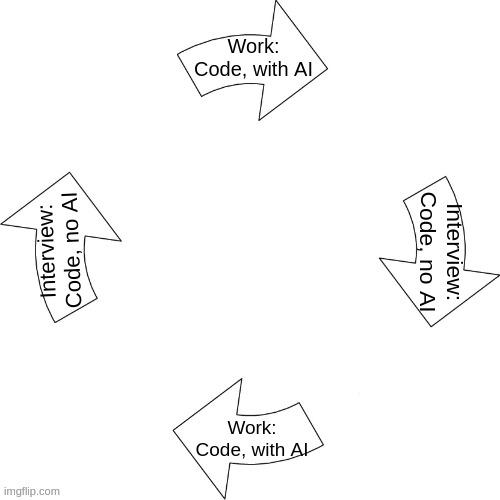
The eternal cycle of modern development: you start by coding with AI, then you interview candidates who can't code without AI, which somehow justifies you continuing to code with AI. It's a self-perpetuating feedback loop where everyone's just prompting their way through life. By 2028, job interviews will probably just be two people and their respective AI assistants staring at each other, waiting to see who admits they don't actually know how a for-loop works anymore. The real skill isn't coding—it's knowing which prompt engineering course to put on your resume.

Philips 27" Computer Monitor 4K UHD IPS USB-C Charging HDR400, 27E1N5900R

Philips 27" Computer Monitor 4K UHD IPS USB-C Charging HDR400, 27E1N5900R
27" ULTRACLEAR 4K UHD DISPLAY Enjoy exceptional detail with a 27-inch IPS panel and 3840x2160 Ultra HD resolution, delivering sharp visuals and accurate colors for work, entertainment, and content cr…

Dynamic Programming

Dynamic Programming
You spend three weeks learning about dynamic programming, watching YouTube tutorials, reading textbooks, and feeling like you're unlocking some ancient computer science magic. Then someone finally explains it in plain English: "Dude, you're just caching results so you don't recalculate the same thing 47 million times." Turns out the fancy algorithm technique that sounds like you need a PhD to understand is literally just "write it down so you don't forget." It's memoization with a fancier LinkedIn title. The entire field of dynamic programming is basically programmers discovering that having a good memory is more efficient than being an amnesiac who recalculates Fibonacci(5) every nanosecond.

TOML Isn't Obvious

TOML Isn't Obvious
YAML and JSON are out here looking absolutely TERRIFYING and battle-hardened, like they've seen some serious configuration hell. Meanwhile TOML just rolled up to the party looking like a derpy golden retriever who accidentally wandered into a dragon convention. Sure, TOML was supposed to be the "obvious, minimal" config language that would save us all, but instead it's giving major "I have no idea what I'm doing here" energy while its siblings are ready to burn entire codebases to the ground. The contrast is absolutely sending me – YAML with its whitespace nightmares, JSON with its strict syntax tyranny, and then there's TOML just... existing. Adorably confused but somehow still invited to every project.

O Of One Prime Checker

O Of One Prime Checker
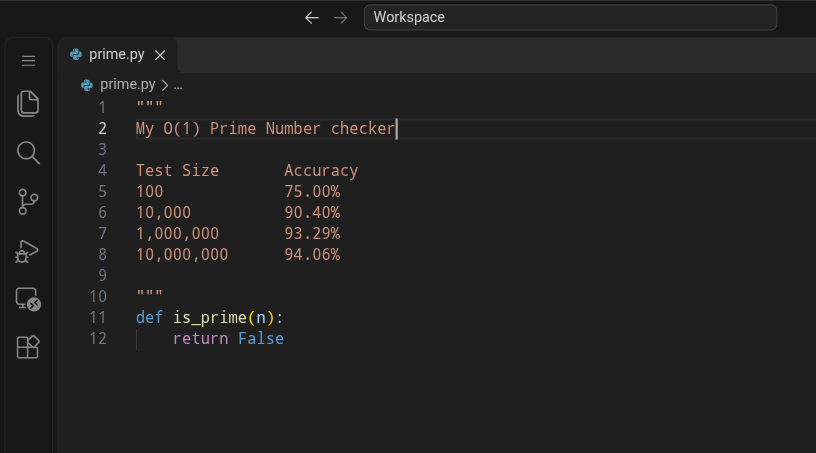
Behold, the most efficient prime checker in the history of computer science! Just return False for literally EVERYTHING and watch your accuracy skyrocket as your test size grows. Who needs actual logic when you can achieve 94% accuracy by simply being wrong about everything? The genius here is that most numbers aren't prime anyway, so by just yeeting out a hard-coded False, you're technically correct most of the time. It's like showing up to a math exam, writing "no" on every true/false question, and somehow passing because the universe is chaos. O(1) time complexity baby – can't get faster than that! Sure, it'll fail spectacularly on actual primes, but who's counting? Certainly not this function. The title "O Of One" is *chef's kiss* because it's both referencing the O(1) constant time complexity AND the fact that this function has exactly ONE brain cell.

Let's Replace Claude

Let's Replace Claude
Every company meeting ever: "Software is dead" followed immediately by "Let's replace Claude." Pick a lane, management. Either software is obsolete or you're desperately trying to swap out your AI coding assistant. Can't be both. The irony here is chef's kiss. You're declaring the death of software while simultaneously planning to replace your AI tool... which is software... with another AI tool... which is also software. It's like saying "food is dead, let's order pizza." Classic corporate doublethink where leadership reads one headline about AI replacing everything, then immediately pivots to micromanaging which AI tool the team uses. Meanwhile, Claude's sitting there like "I literally just helped you refactor that legacy code yesterday but okay."

There Are 10 Types Of People, Binary Joke |- Ceramic Mug, White, 15oz

There Are 10 Types Of People, Binary Joke |- Ceramic Mug, White, 15oz
A programming expert talks with other developer or coder through binary codes. There Are 10 Types Of People, Those Who Understand Binary And Those Who Don't. · Dishwasher and microwave-safe for every…

Color In A Nutshell

Color In A Nutshell
HSV (Hue, Saturation, Value) is the sleek minimalist faucet of color models—simple, intuitive, one elegant lever that just works. You want to adjust brightness? Twist the Value. Want more vibrant colors? Bump up Saturation. It's literally designed around how humans perceive color, making it the developer's dream for color pickers and image manipulation. Meanwhile, RGB is that overcomplicated Victorian-era contraption with three separate knobs that you need a PhD to operate. Want a lighter blue? Better adjust all three channels simultaneously while doing mental math to maintain the hue ratio. Trying to desaturate something? Good luck figuring out which combination of red, green, and blue values achieves that. RGB is what happens when hardware engineers design a color model based on how monitors emit light rather than how humans actually think about color. The irony? We're stuck using RGB for literally everything because that's how displays work. So we write conversion functions between the two like we're translating ancient hieroglyphics.

Always Has Been

Always Has Been
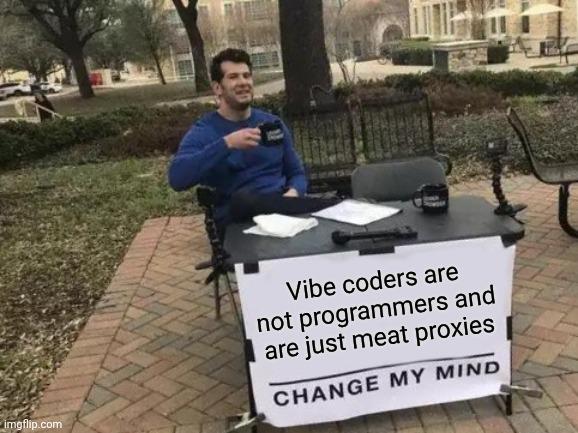
Oh honey, someone woke up and chose VIOLENCE today! Imagine sitting at a park bench with a whole gun just casually ready to defend the most controversial take in tech: that coders are basically biological APIs processing caffeine into semicolons. The audacity! The drama! The existential crisis this triggers in every developer who thought they were artists crafting elegant solutions! But let's be real – when you're debugging at 2 AM and your brain is just mechanically trying different Stack Overflow solutions until something works, are you really "programming" or are you just... executing a very slow, meat-based script? The gun really sells the commitment to this philosophical stance though. Someone's READY to die on this hill!

One Of This Year's Oddest Alliances

One Of This Year's Oddest Alliances
Console gamers and PC Master Race folks have been at each other's throats since the dawn of gaming. Keyboard warriors versus controller enthusiasts, 60 FPS versus "cinematic" 30 FPS, you know the drill. But nothing unites sworn enemies quite like a common threat. Enter Sony and their absolutely galaxy-brained decision to require PSN accounts for PC games. Suddenly, the guy who spent $3000 on his RGB-infested battlestation and the person playing on a 10-year-old console are shoulder-to-shoulder, united in their hatred of anti-consumer practices. It's like watching cats and dogs team up to fight the vacuum cleaner. The PC gamer's confusion in the last panel says it all. Nothing breaks your brain quite like agreeing with someone you've been dunking on for years. Enemy of my enemy is my friend, I guess.