

php Memes

Java For Shell

Java For Shell
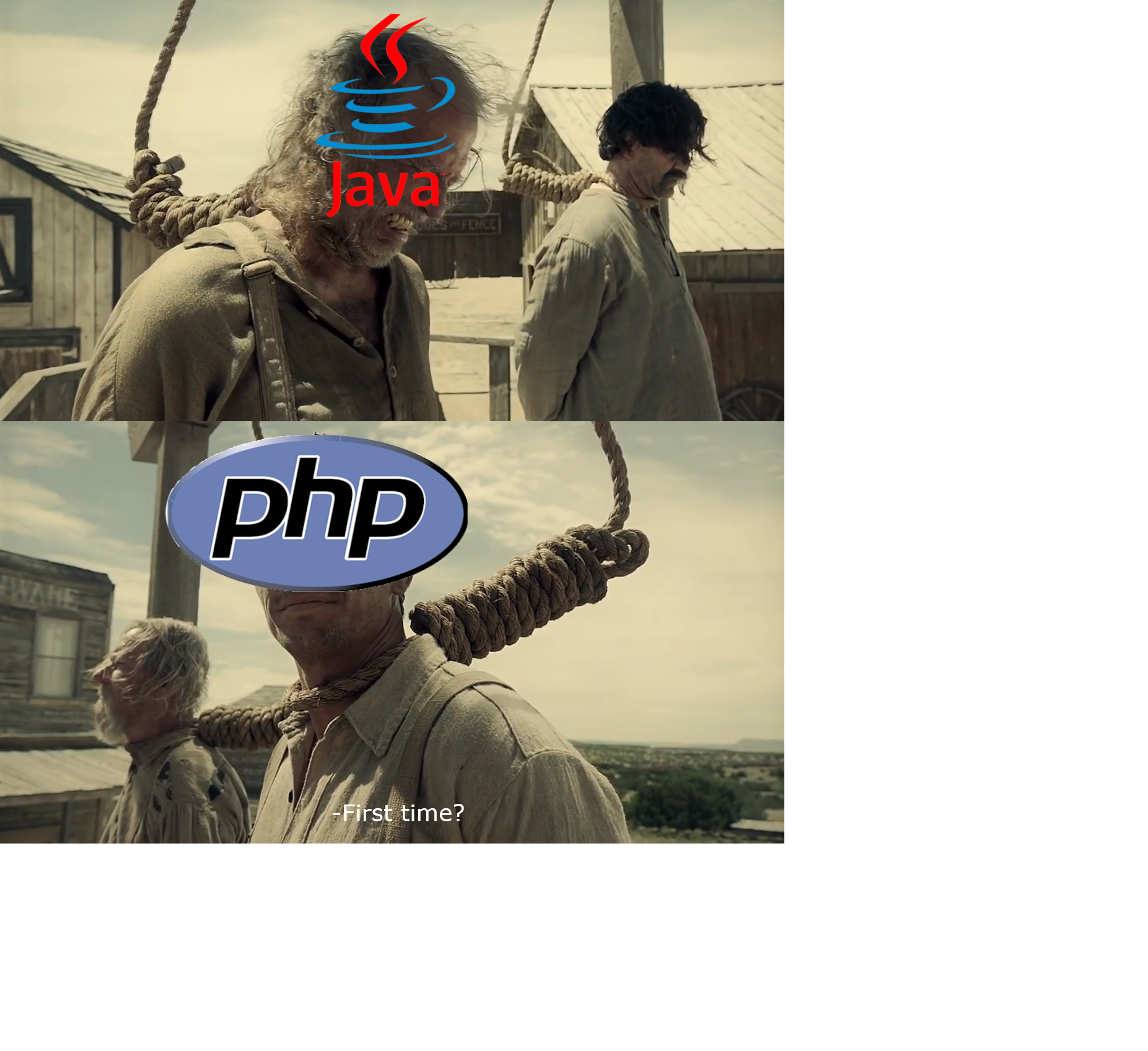
Nothing says "I've been through some stuff" quite like watching Java get hanged while PHP nervously asks if it's your first execution. Java's been the enterprise workhorse for decades, taking all the blame for verbose code and boilerplate hell, while PHP just casually survived the early web era by being everywhere despite everyone roasting it. The hangman's noose is basically a metaphor for how the dev community treats these languages—Java gets the corporate death sentence for being too ceremonious, but PHP? PHP's been to the gallows so many times it's basically immune at this point. "First time?" indeed. Both languages have survived more hate threads than you've had stand-ups.

The Temporary Fix Has Outlived Two Frameworks And A Rewrite

The Temporary Fix Has Outlived Two Frameworks And A Rewrite
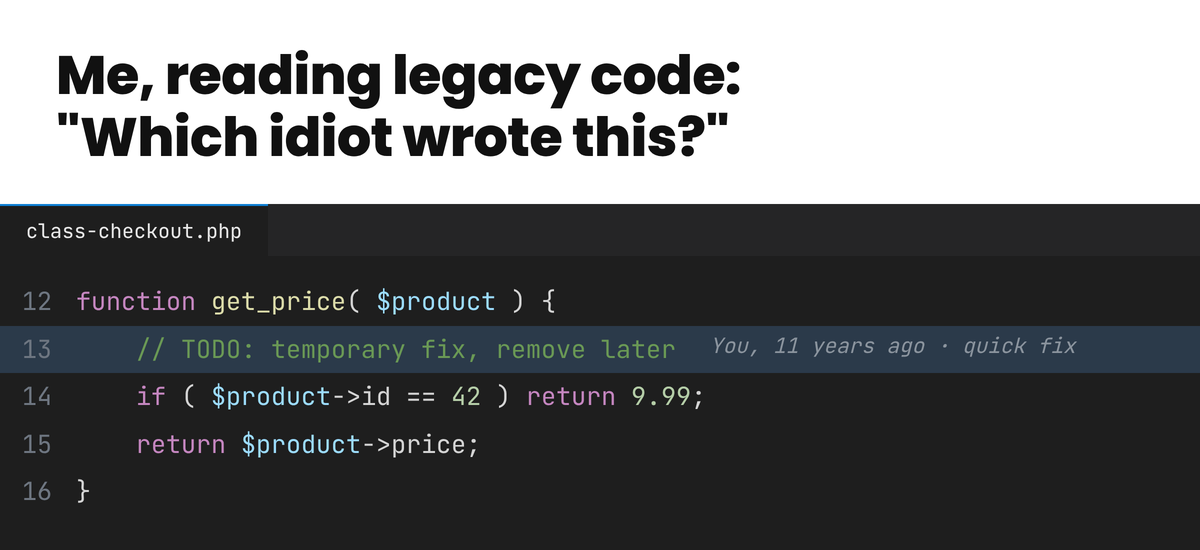
Nothing says "professional software engineering" quite like a TODO comment from 11 years ago that's still doing its job perfectly. That hardcoded price check for product ID 42? Still there. Still working. Still making $9.99 on whatever mystery product that is. The real comedy is discovering YOU were the idiot who wrote it. Past you slapped a "quick fix" on there with every intention of doing it properly later. But here's the thing: it works. And in software development, working code has the half-life of uranium-238. Nobody touches it. Nobody questions it. It just... persists. Meanwhile, the entire codebase has been migrated through Angular, React, Vue, and back to jQuery (because why not), survived a complete rewrite, and this little gem is still sitting there in class-checkout.php like a cockroach after nuclear winter. Temporary? That word has lost all meaning. This is permanent infrastructure now.

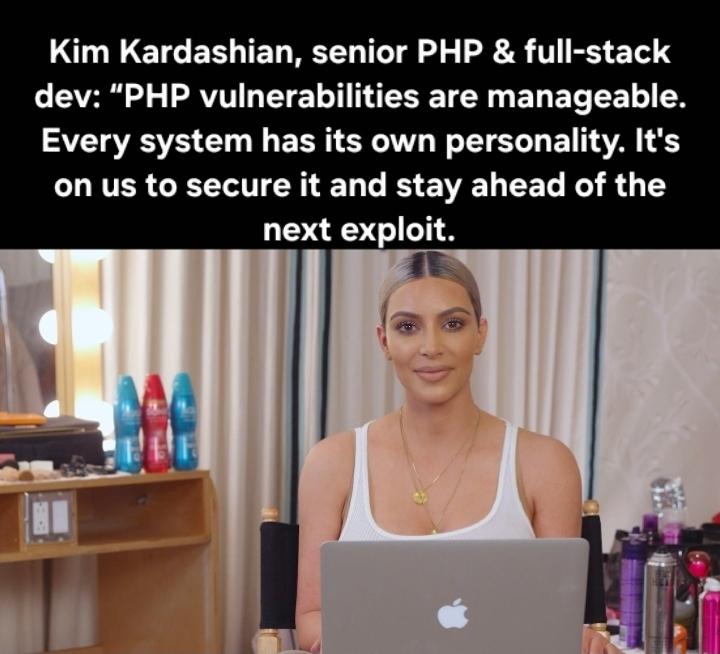
Kim Has A Point

Kim Has A Point
When Kim Kardashian is giving better security advice than your entire dev team's Slack channel. She's out here treating PHP vulnerabilities like a skincare routine—manageable with the right maintenance. Meanwhile, your production server is running PHP 5.6 and hasn't seen a patch since 2014. The "every system has its own personality" line is actually kind of profound though. It's the developer equivalent of "love yourself"—except instead of self-care, it's about remembering to update your dependencies before someone drops a zero-day on your head. Honestly, if Kim can understand proactive security measures, there's no excuse for that one dev who keeps saying "it works on my machine" while ignoring every CVE notification.

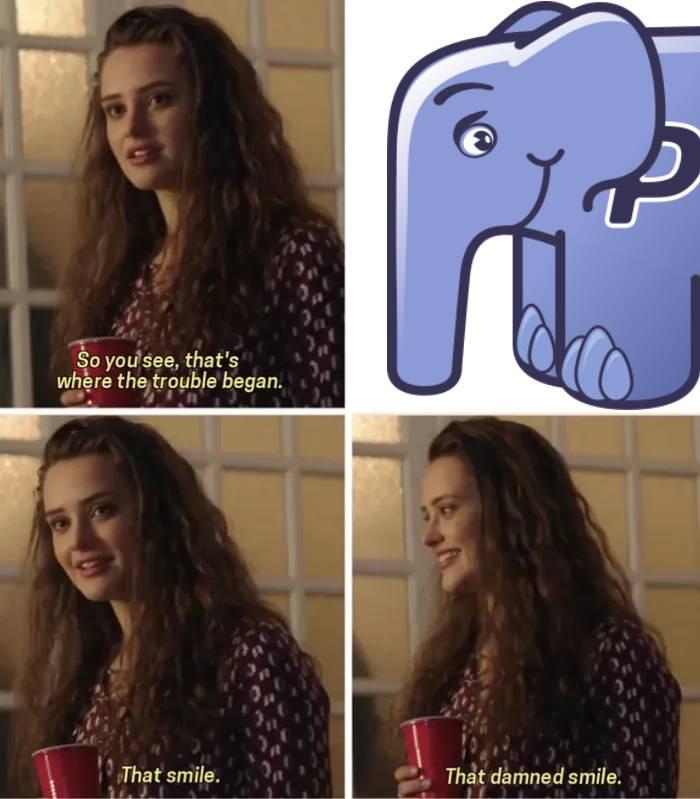
That Damned Ele Ph Pant

That Damned Ele Ph Pant
Oh sweetie, let me tell you about the PHP ElePHPant – that adorable blue mascot that's been haunting developers' dreams since forever. You know EXACTLY where this is going the moment you see that innocent little smile. It's giving "I'm cute and harmless" energy while simultaneously being the reason your legacy codebase is held together with duct tape and prayers. That grin? That's the same energy as your production server running PHP 5.6 in 2024 because "if it ain't broke, don't fix it" (narrator: it IS broke). The ElePHPant sits there, all cheerful and optimistic, while you're debugging why == returns true when comparing a string to zero. THAT SMILE. That cursed, knowing smile that says "yes, I know about the inconsistent function naming, what are you gonna do about it?" Pure chaos wrapped in adorable packaging.

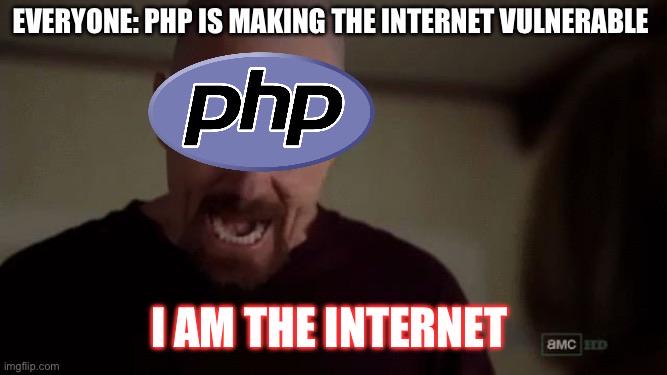
Powering The Internet Since Eternity

Powering The Internet Since Eternity
Everyone loves to trash PHP for its security holes and weird quirks, but here's the uncomfortable truth: it's still running like 77% of the web. WordPress, Facebook (well, their Hack variant), Wikipedia—all powered by the language everyone loves to hate. PHP sitting there with that smug grin because while developers are busy dunking on it at conferences and on Twitter, it's literally keeping the internet alive. Your blog? PHP. Your e-commerce site? Probably PHP. That random forum from 2004 that somehow still has the answer you need? Definitely PHP. Sure, it's got vulnerabilities and made some questionable design choices back in the day, but it's been around since '95 and refuses to die. It's the cockroach of programming languages—indestructible and everywhere you don't want it to be, but somehow essential to the ecosystem.

Git 50 Pack 1-Inch Retro Stickers for Scrapbooking, Journals, Planners, Laptops, Phones and Water Bottles

Git 50 Pack 1-Inch Retro Stickers for Scrapbooking, Journals, Planners, Laptops, Phones and Water Bottles
Quantity: Each pack contains 50 individual circular stickers. Dimensions: Perfectly sized at a 1" diameter (25mm) for precise placement. · High-Quality Adhesive: Strong peel-and-stick backing that ad…

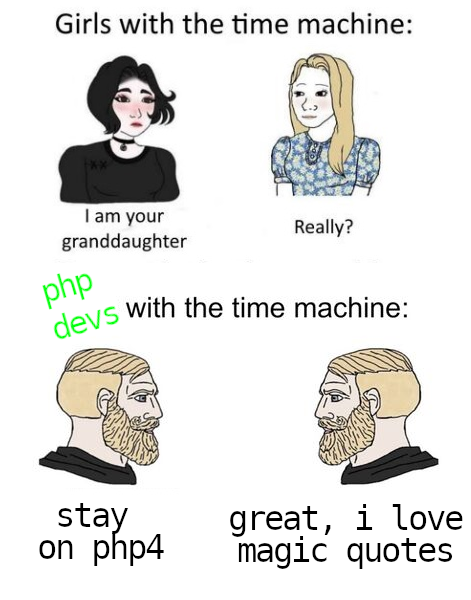
Magic Quotes

Magic Quotes
For those blessed enough to have never encountered it: Magic Quotes was PHP's "security feature" that automatically escaped quotes in user input. Sounds helpful, right? Wrong. It created more problems than it solved, mangled data, and made SQL injection vulnerabilities *worse* in many cases because devs thought they were protected when they weren't. The joke here is that if PHP devs could go back in time, they wouldn't warn themselves about future mistakes or suggest better practices. Nope. They'd tell their past selves to stay on PHP 4 and keep using Magic Quotes—arguably one of the worst decisions in PHP history. It's like saying "yeah, keep using that broken parachute, it's great!" The feature was so universally hated that it was deprecated in PHP 5.3 and completely removed in PHP 5.4. But here we are, romanticizing the bad old days like some kind of Stockholm syndrome survivors.

Poor Php

Poor Php
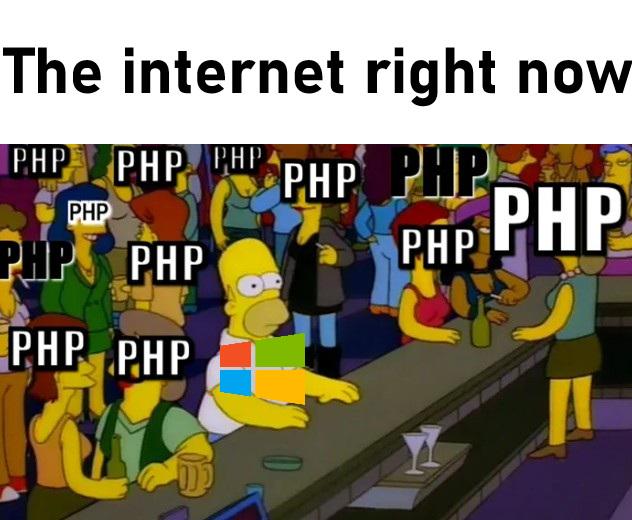
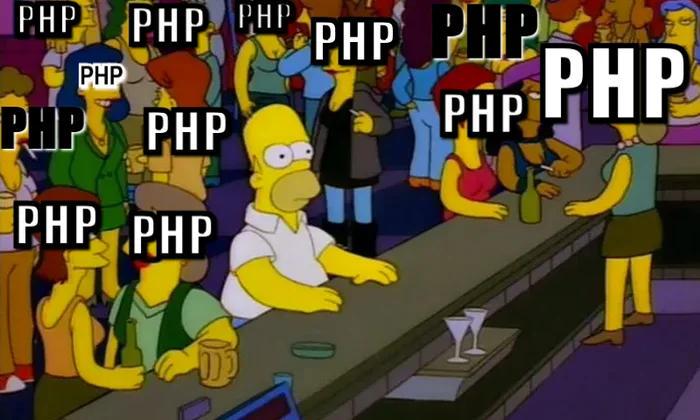
When you're the last JavaScript developer at a bar full of PHP devs trying to convince you that "PHP is actually good now, we swear!" Meanwhile you're just sitting there with your single-page app wondering how you ended up in this nightmare. The internet's current obsession with dunking on PHP has reached peak saturation. Every framework, every language, every bootcamp grad with two weeks of React experience feels personally obligated to remind PHP that it exists. And PHP? It's still out here powering like 77% of the web, completely unbothered, paying the bills while everyone else argues about which JavaScript framework will be obsolete next month. Plot twist: Homer's probably having a better time than the guy who has to explain why his Next.js app needs 47 dependencies to render "Hello World".

We Need To Make PHP Illegal It's Not My Fault

We Need To Make PHP Illegal It's Not My Fault
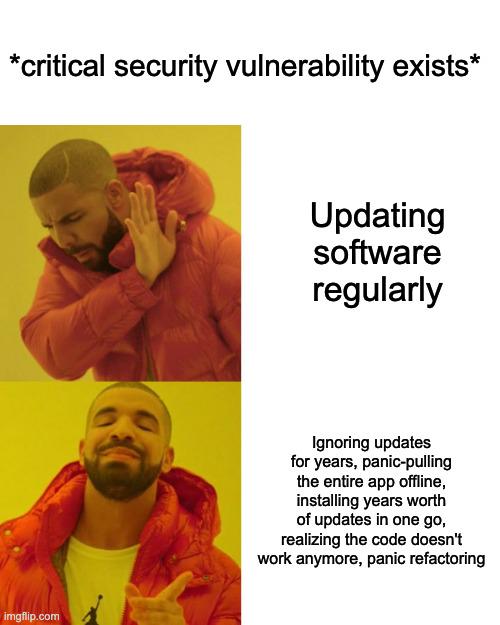
The Drake meme format strikes again, but this time it's calling out every developer's dirty little secret. When a critical security vulnerability drops, there are two types of people: the responsible ones who update their dependencies like clockwork, and the chaos agents who've been running the same PHP 5.6 installation since Obama's first term. The bottom panel is pure poetry. You ignore updates for years because "if it ain't broke, don't fix it," then suddenly you're forced to update everything at once. Now your entire codebase is throwing errors because some function got deprecated three major versions ago, your database queries are screaming about SQL injection vulnerabilities, and you're frantically Googling "how to refactor 50,000 lines of legacy code in 2 hours." The title blaming PHP is chef's kiss because it's the programming equivalent of "the dog ate my homework." Sure, PHP has its quirks, but let's be real—the vulnerability exists because someone thought $_GET['user_input'] directly into a SQL query was a vibe.

Crazy Week

Crazy Week
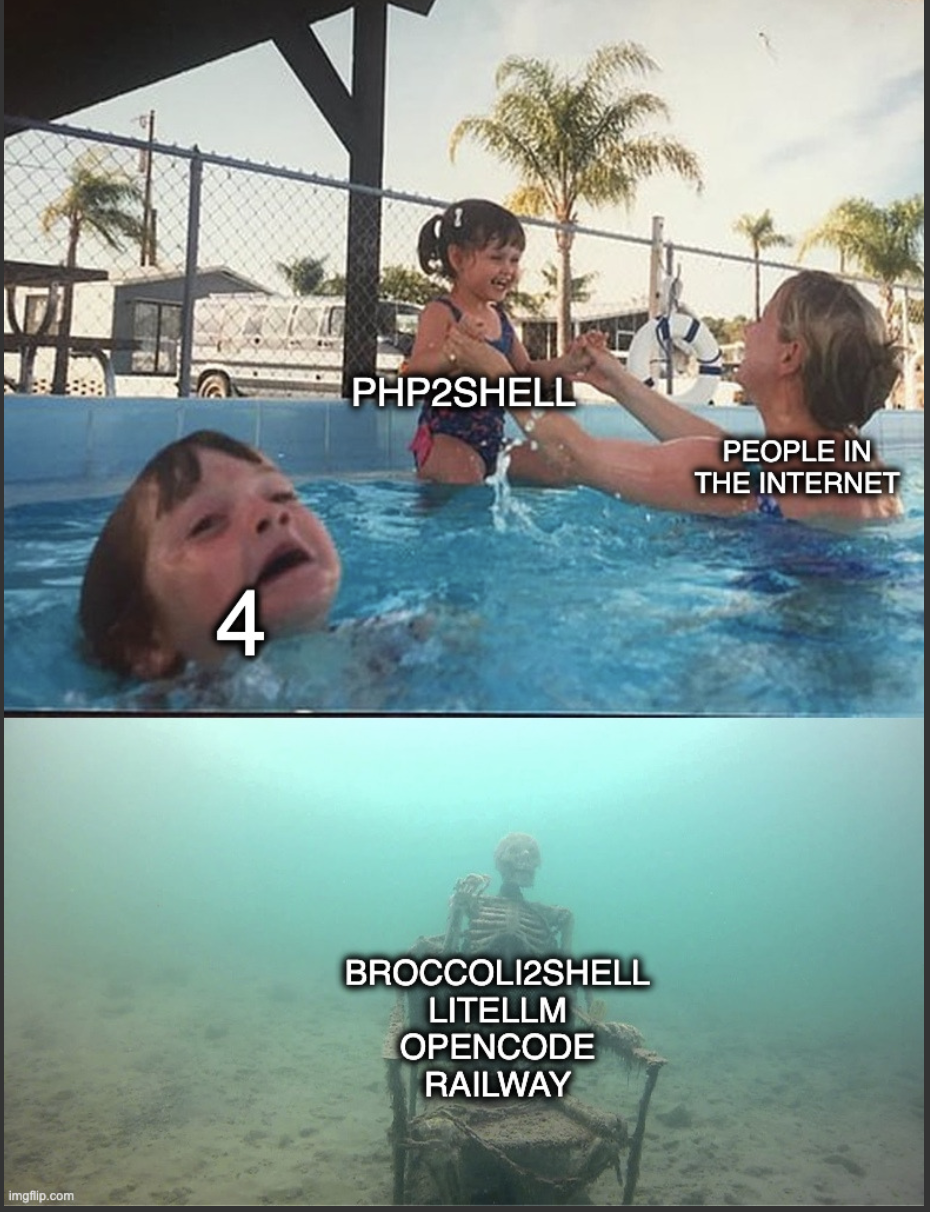
PHP2SHELL gets all the attention while everyone's having a great time patching. Meanwhile, the security team is still down there dealing with the skeleton crew of vulnerabilities that have been sitting in the backlog since 2018. Broccoli2Shell, LiteLLM, OpenCode, Railway—nobody cares because they're not trending on Twitter. Classic security theater: one CVE gets the spotlight while the rest slowly decompose in the depths of your dependency tree. The number 4 really captures the mood—just another Tuesday for incident response teams who are perpetually underwater, drowning in alerts nobody else acknowledges. Fun times.

Haters Gonna Hate

Haters Gonna Hate
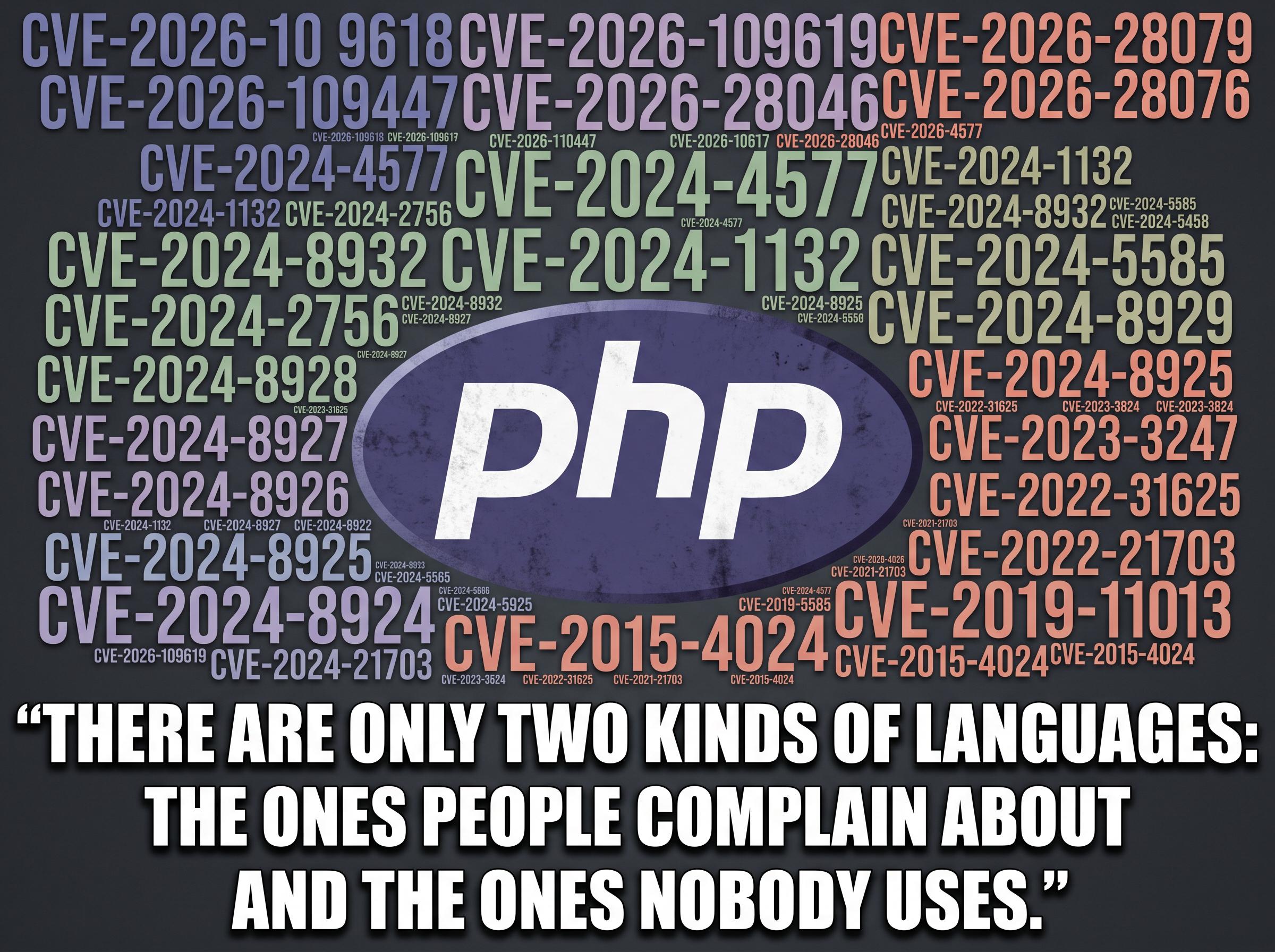
PHP developers just casually flexing their collection of CVEs like they're Pokémon cards. The quote is a classic Bjarne Stroustrup gem about programming languages, but seeing it paired with PHP's security vulnerability hall of fame is *chef's kiss*. The irony here is delicious—PHP gets roasted constantly for being "outdated" and "insecure," yet it powers like 77% of the web. Sure, it has more CVEs than a cybersecurity conference has coffee cups, but guess what? It's still running your favorite WordPress blog, your e-commerce site, and probably half the internet. Meanwhile, those "perfect" languages nobody uses? Zero CVEs because you can't have vulnerabilities if nobody's attacking your non-existent production deployments. PHP devs are out here living rent-free in everyone's head while shipping actual products.

JYLH JOYSEEKER 42" Standing Desk Converter, Quick Sit to Stand Desk Riser

JYLH JOYSEEKER 42" Standing Desk Converter, Quick Sit to Stand Desk Riser
Compact Design: The standing desk riser allows to find healthy balance between sitting or standing. The desk converter effectively transforms any desk into a standing desk, this solution not only hel…

The Internet Right Now

The Internet Right Now
Homer sitting alone at a bar while literally everyone else is labeled "PHP" – yeah, that tracks. After decades of being the internet's punching bag, PHP is having its redemption arc thanks to Laravel, modern frameworks, and the fact that it still powers like 77% of all websites (WordPress isn't going anywhere, folks). Meanwhile, Homer represents basically every other language watching PHP dominate web hosting like it never left. The irony? While developers were busy learning the hot new framework of the week, PHP quietly kept running half the internet without breaking a sweat. Sometimes the "dead" language is just built different.

Not Suspicious

Not Suspicious
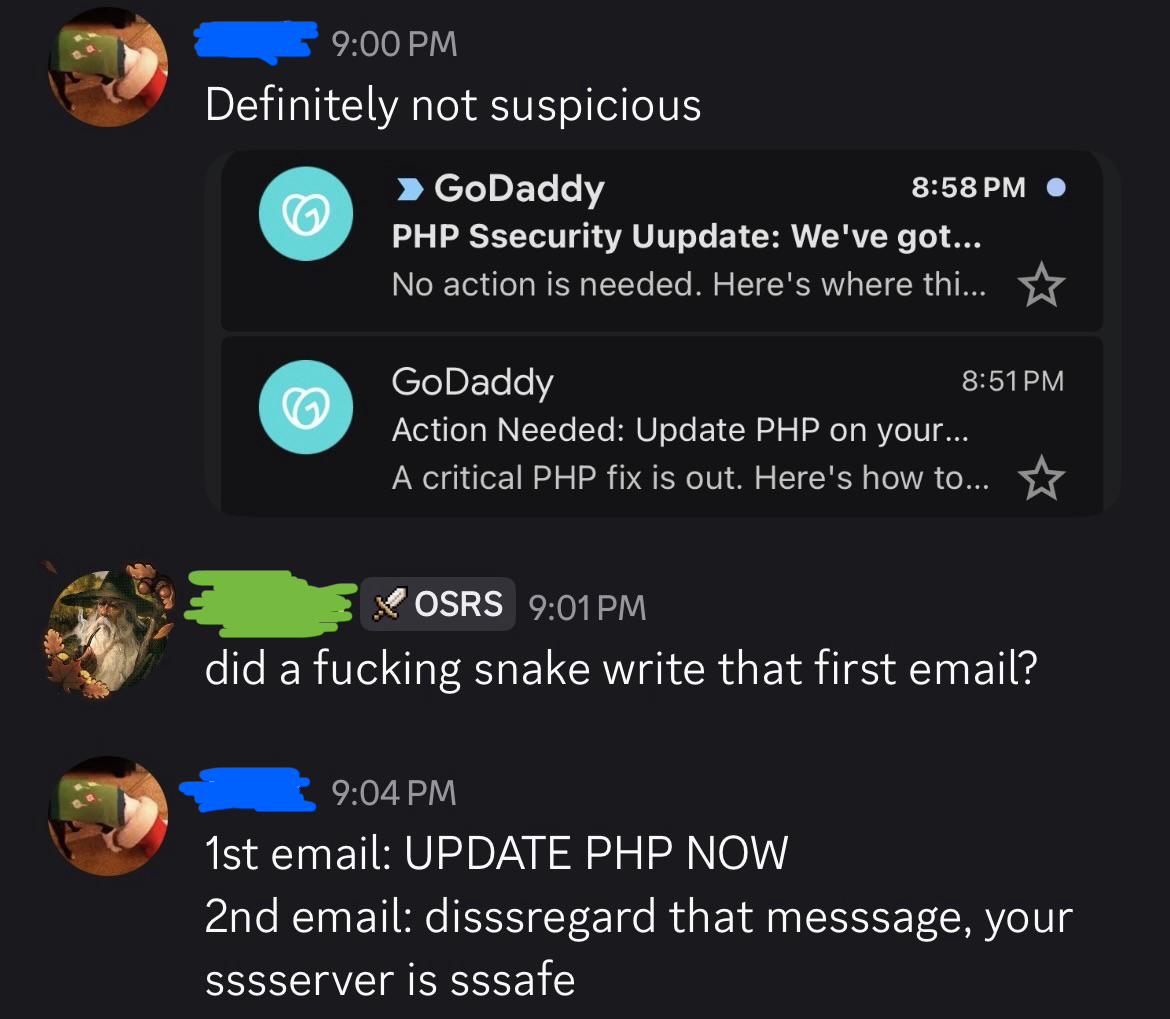
GoDaddy really said "no action needed" and then immediately followed up with "ACTION NEEDED" like they're having an internal crisis. The whiplash between these two emails sent 7 minutes apart is peak enterprise communication energy. Either their marketing team and security team don't talk to each other, or someone realized mid-coffee that maybe downplaying a critical PHP vulnerability wasn't the move. The friend's reaction is spot-on though. You know an email is sketchy when it reads like it was written by a snake having a stroke. That second email with the excessive S's is giving major "I'm totally not a phishing attempt, fellow human" vibes. Pro tip: legitimate companies don't reassure you that your "sssserver is sssafe" unless they're sponsored by Slytherin. Nothing screams "definitely not suspicious" quite like contradicting yourself in under 10 minutes and then hissing your reassurances. Classic hosting provider moment.