

Developer pain Memes

Posts tagged with Developer pain

It Is What It Is

It Is What It Is
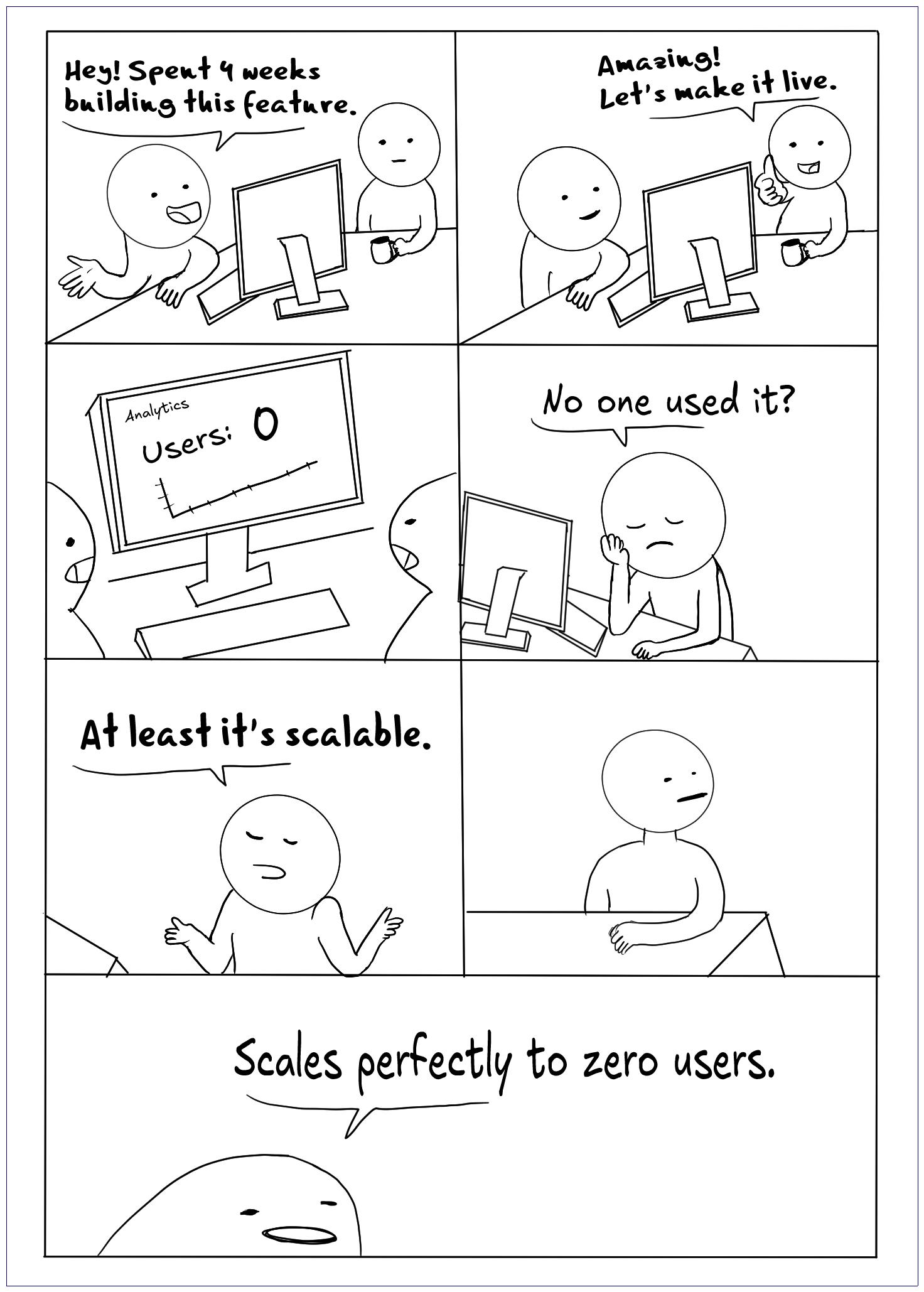
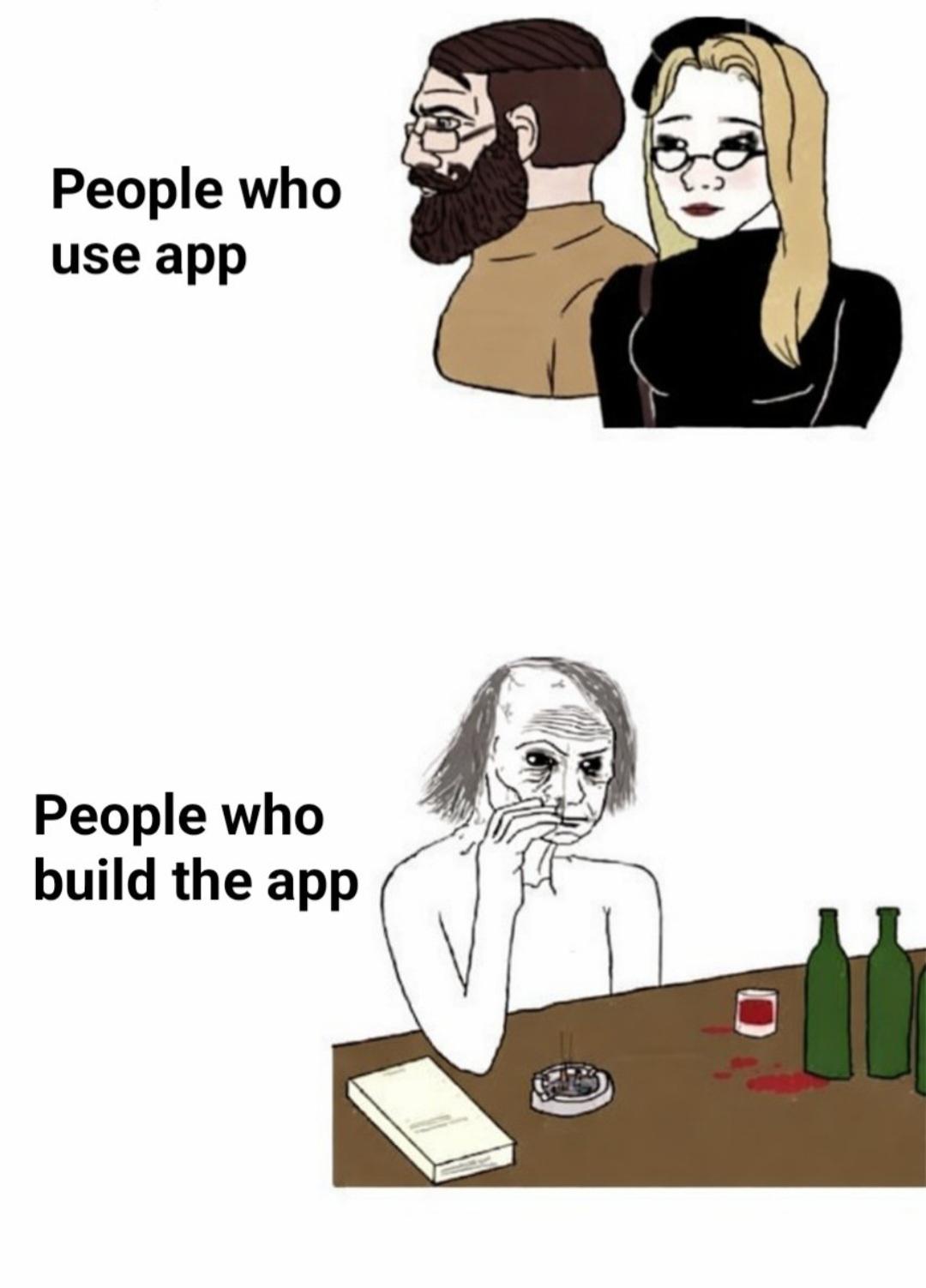
Oh, the TRAGEDY of being a developer! Users are out here living their best lives, blissfully unaware that your app is basically held together with duct tape, prayers, and 47 Stack Overflow tabs. They're clicking buttons like everything's fine while you're sitting there in existential dread, fully aware of that one function you wrote at 3 AM that definitely shouldn't work but somehow does. You know the code is a disaster. You know there's technical debt older than some of your coworkers. But hey, it compiles and the users are happy, so... *takes another sip* ...it is what it is. The weight of knowing your beautiful creation is actually a beautiful mess is a burden only developers must bear.

Nothings Fucking Working Mr Duck

Nothings Fucking Working Mr Duck
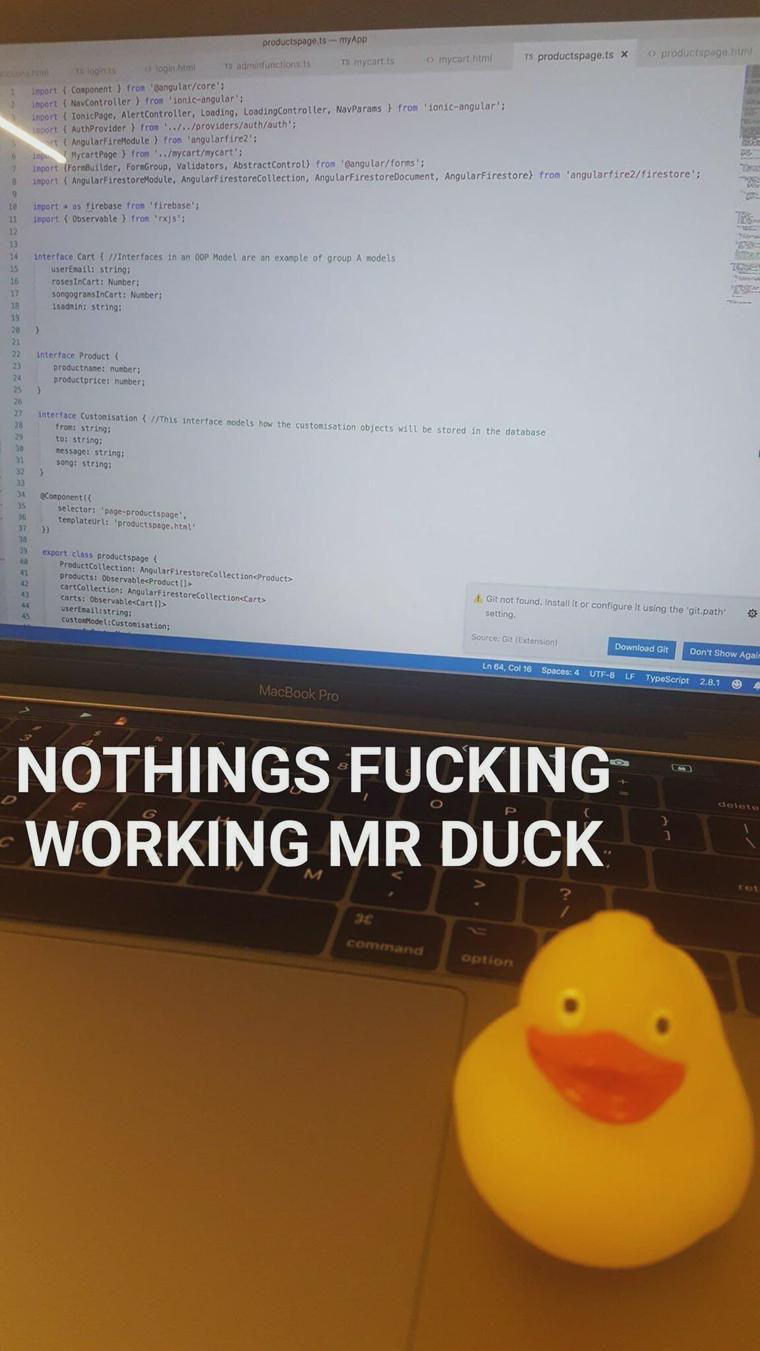
When rubber duck debugging reaches its absolute BREAKING POINT and even your emotionless yellow companion can't save you from the Angular/Firebase/TypeScript hellscape you've created. The code is screaming, Git isn't found, nothing is configured, and your only friend is a bath toy judging you silently from the keyboard. Rubber duck debugging is supposed to be therapeutic – you explain your code to an inanimate object and magically find the bug. But sometimes the duck just sits there while your entire development environment implodes and you're left questioning every life choice that led you to this moment. The duck has seen things. Terrible, terrible things.

Java Is Javascript

Java Is Javascript
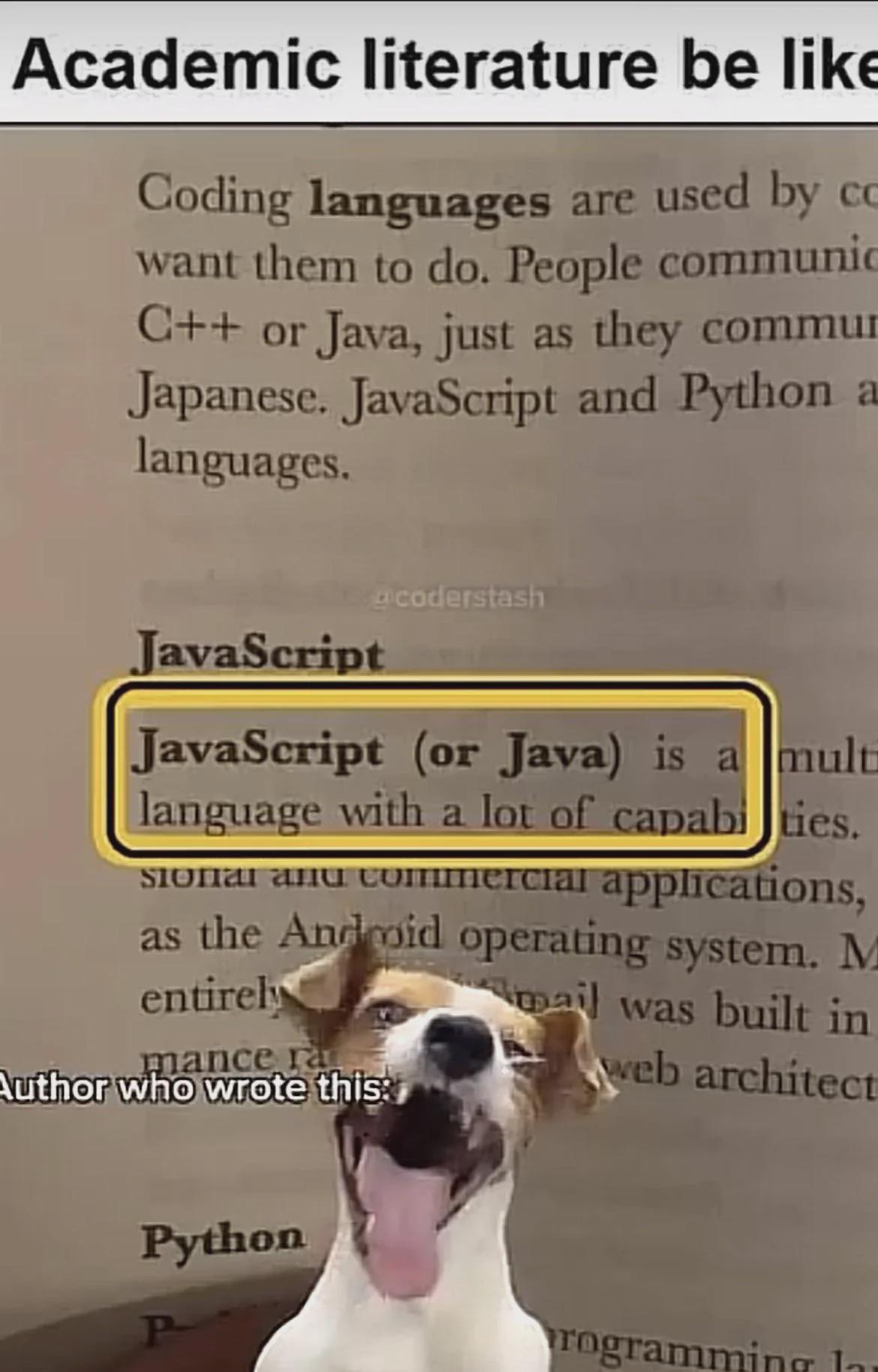
When academic literature casually drops "JavaScript (or Java)" like they're interchangeable terms, you know someone's getting peer-reviewed by angry developers in the comments section. That's like saying "cars are used for transportation, such as sedans or horses." The highlighted text is doing the programming equivalent of calling a dolphin a fish—technically they both swim, but one will make marine biologists want to throw their textbooks into the ocean. Java and JavaScript have about as much in common as ham and hamster. One is a statically-typed, object-oriented language that runs on the JVM and powers enterprise applications. The other is a dynamically-typed scripting language that was created in 10 days and somehow ended up running the entire internet. The only thing they share is a marketing decision from 1995 that has been haunting developers ever since. The dog's expression perfectly captures every developer's reaction when reading this academic masterpiece. Someone needs to tell this author that naming similarity doesn't equal functionality similarity, or we'd all be writing code in C, C++, C#, and Objective-Sea.

I Hate Copilot

I Hate Copilot
You spend half your day debugging, checking stack traces, rewriting functions, questioning your entire career choice... only to discover that Visual Studio Code or GitHub Copilot decided to helpfully insert a random closing parenthesis somewhere in your code. Thanks, AI overlord. Really appreciate you turning my clean function into syntactic chaos while I was looking away for 0.3 seconds. The best part? You were so focused on the complex logic that you never suspected the bug was just a stray ) chilling in line 47 like it owns the place. Nothing humbles you quite like realizing the "critical bug" was autocomplete being a little too enthusiastic. And yes, you will blame Copilot for the next 6 months even though deep down you know you hit Tab without looking.

When The Readme Is Useless

When The Readme Is Useless
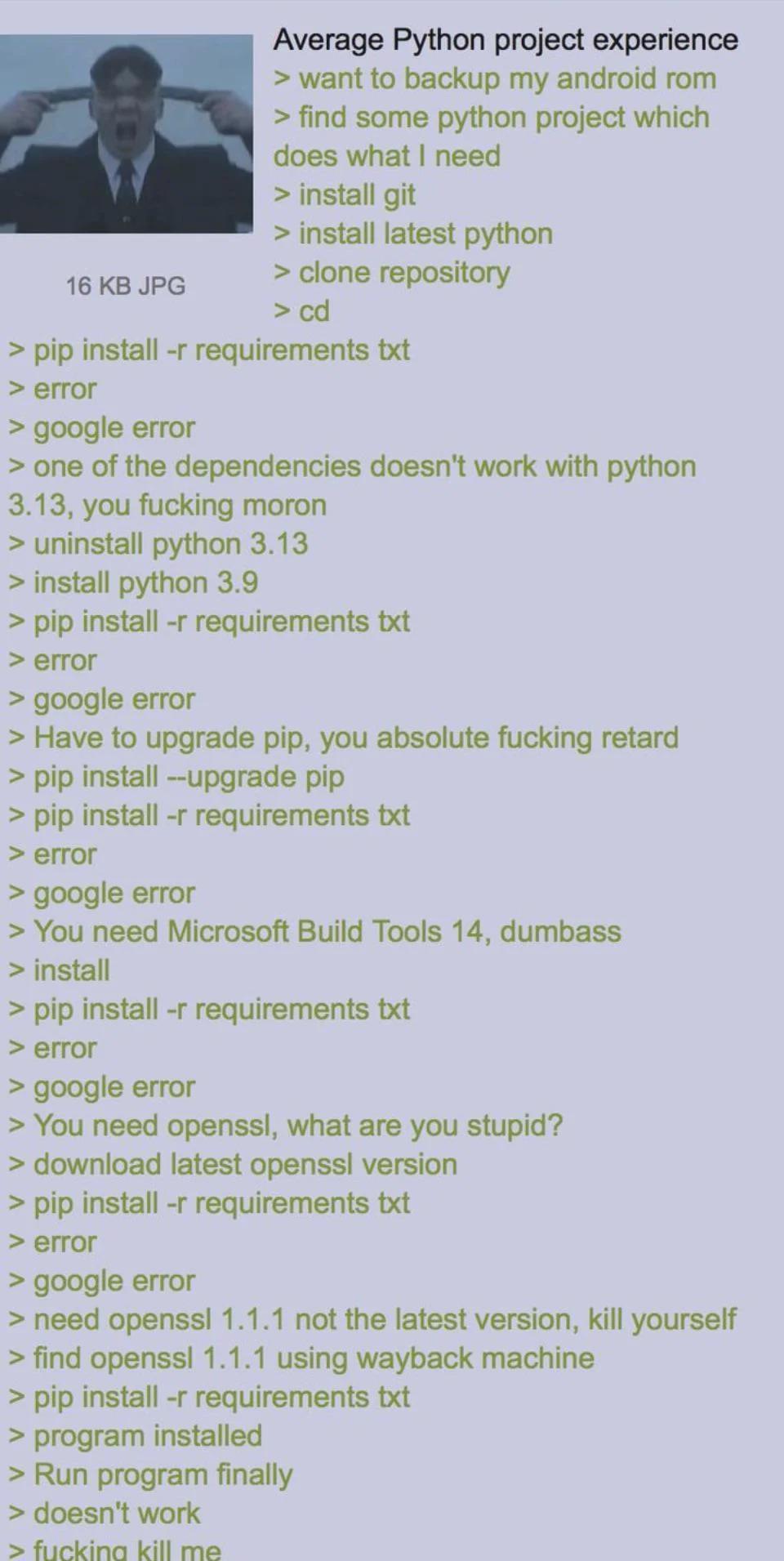
You know that special circle of hell reserved for projects with READMEs that just say "Installation: clone and run"? Yeah, this is it. No dependencies listed, no build instructions, no environment setup, just raw source code and vibes. You're sitting there running random commands like some kind of build system archaeologist, desperately hoping npm install or make will magically work. Meanwhile the original dev is probably on a beach somewhere, blissfully unaware that their "self-documenting code" is about as helpful as assembly instructions written in ancient Sumerian. The real kicker? When you finally get it working after three hours of trial and error, you realize the project does exactly what the title says it does, and you could've just written it yourself in 20 minutes.

Please Make The Pain Stop

Please Make The Pain Stop
The contrast here is absolutely brutal. Regular programmers get to proudly tell their past selves about their cool modern language, getting that sweet validation. Meanwhile, ABAP programmers? They're being hunted down by the Terminator himself. For context: ABAP (Advanced Business Application Programming) is SAP's proprietary language from the 1980s, still heavily used in enterprise resource planning systems. It's verbose, quirky, and let's just say it hasn't aged like fine wine. More like milk left out in the sun. The joke cuts deep because ABAP devs are stuck maintaining legacy systems that corporations refuse to modernize because "it works" and migration costs are astronomical. So while everyone else is playing with React hooks and Rust async, ABAP programmers are writing DATA: lt_table TYPE STANDARD TABLE OF... you get the idea. Walther Abap didn't invent ABAP (that was actually SAP founders), but the personification of their collective suffering into one target for time-traveling rage? Chef's kiss. 💀

Coding Starts Chill Debugging Ends In Pain

Coding Starts Chill Debugging Ends In Pain
You start your day feeling blessed, writing beautiful functions, architecting elegant solutions, vibing with your IDE's autocomplete like it's reading your mind. Then you hit run and suddenly you're the High Sparrow doing a walk of shame through King's Landing. Debugging transforms you from Pope Francis radiating divine confidence into a weathered peasant who's seen too much. That semicolon you forgot? It aged you 40 years. The null pointer exception that only appears in production? That's your hair turning gray in real-time. The race condition that happens once every 1000 executions? You're now speaking in ancient tongues. The contrast is chef's kiss perfect—coding feels like you're writing poetry, debugging feels like you're deciphering someone else's fever dream from 2003 with zero comments and variable names like "temp2_final_ACTUAL".

Sorry, Can't Do Scarves

Sorry, Can't Do Scarves
Game devs will literally implement a complex physics engine with ragdoll mechanics, particle systems for explosive lava effects, and procedural demon summoning algorithms, but adding a cloth simulation for a scarf? That's where they draw the line. The complexity hierarchy in game development is beautifully backwards: rendering a hellscape with real-time lighting and shadows? No problem. Making fabric drape naturally over a character model? Suddenly we're asking for the moon. This perfectly captures the reality that what seems "easy" to implement versus what's actually easy are two completely different universes. Cloth physics is notoriously difficult—it requires sophisticated vertex deformation, collision detection, and performance optimization to not tank your frame rate. Meanwhile, spawning a giant demon is just instantiating a prefab with some particle effects. The demon doesn't need to realistically interact with wind or character movement; the scarf does.

Toml

Toml
Oh honey, the TOML community really thought they were doing something revolutionary here. Started with v0.1 looking all innocent with their dotted keys, then v0.5 came along like "let's make it SLIGHTLY more nested" and everyone's nodding along. But THEN v1.1 drops and suddenly we're writing what is essentially JSON with extra steps, and the character just SNAPS. The absolute horror of realizing you've been gaslit into thinking TOML was "more readable" than JSON when you're now staring at the exact same nested structure with curly braces. The betrayal! The drama! It's like watching someone slowly morph into the very thing they swore to destroy. RIP simple config files, you will be missed.

Disappointed Yet Again

Disappointed Yet Again
Oh, the eternal cycle of hope and despair! You Google your bug, find a GitHub issue from 2017, and think "FINALLY! Someone else suffered through this nightmare and surely the devs have blessed us with a fix by now!" But NOPE. You scroll through four entire pages of people begging for a solution, only to find h4t0n dropped a comment last week asking "any progress on this?" and the silence is DEAFENING. The "GODDAMMIT" at the end? That's the sound of your soul leaving your body as you realize you're about to become comment number 247 asking the same question. Spoiler alert: there will be no progress. There never is. Welcome to open source, where issues from the Obama administration still haunt us. 💀

Like Give Me One Reason I Would Buy It

Like Give Me One Reason I Would Buy It
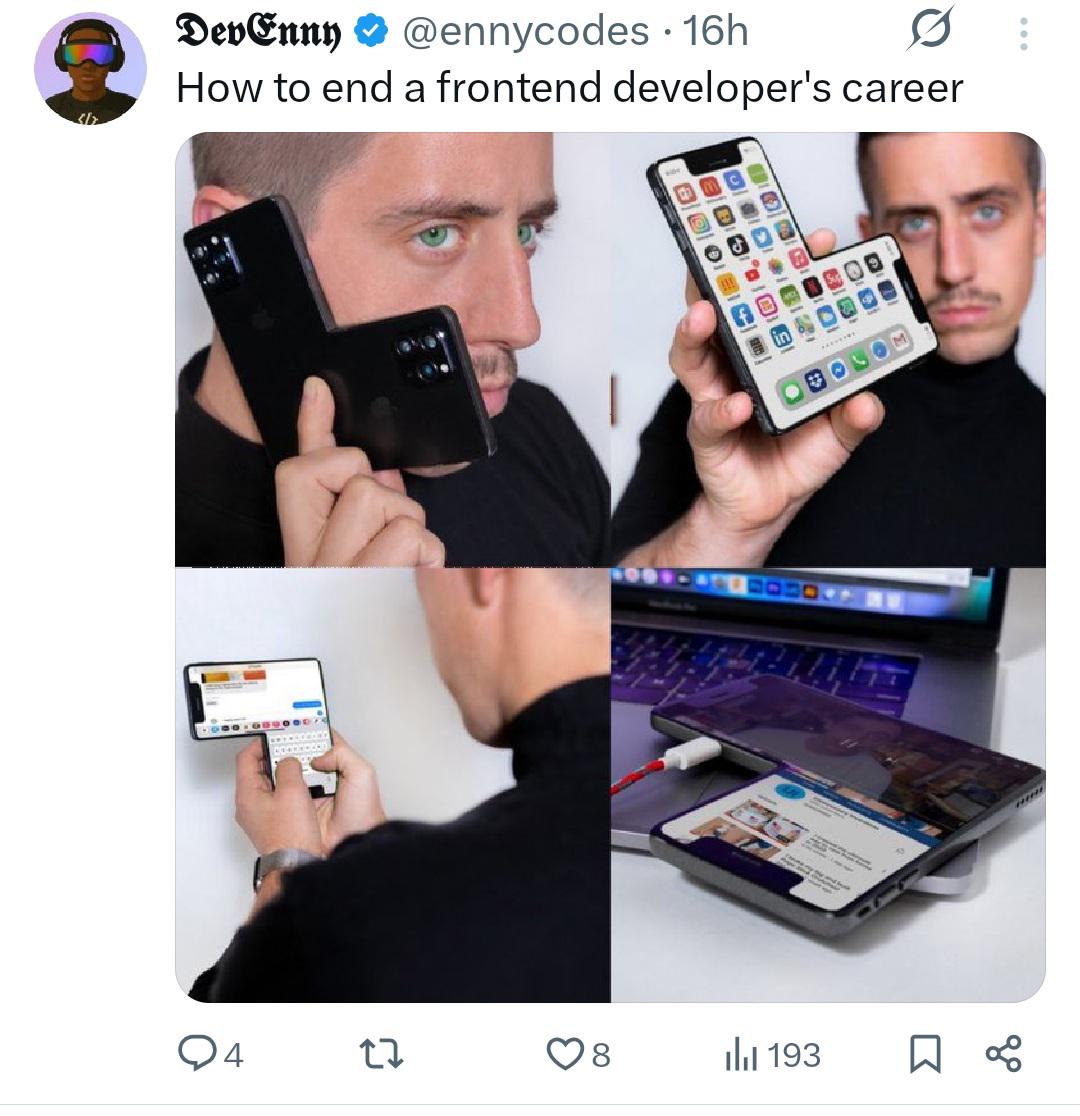
Someone's showing off a Windows laptop with that gorgeous rainbow wallpaper, asking for reasons NOT to buy it. The frontend dev's response? Pure terror. And honestly, valid. That notch at the top of the screen is the digital equivalent of a design crime scene. Frontend devs already lose sleep over responsive design, cross-browser compatibility, and centering divs. Now imagine having to account for a random chunk of screen real estate that just... doesn't exist. Your carefully crafted header? Bisected. Your navigation bar? Compromised. Your pixel-perfect design? Destroyed by hardware. The notch is basically saying "hey, remember how you spent 3 hours getting that layout perfect? Well, I'm gonna sit right here and ruin it." It's the hardware version of Internet Explorer—something that forces you to write special cases and workarounds that make you question your career choices. MacBook notches were already controversial enough, but at least macOS handles it somewhat gracefully. Windows with a notch is like adding a try-catch block to your HTML—technically possible, but deeply cursed.

Please Keep Your Documentation Updated I Am Begging

Please Keep Your Documentation Updated I Am Begging
Oh, the sheer AUDACITY of outdated documentation! You waltz into what SHOULD be a simple integration task, armed with confidence and the API docs. "This'll take a day, maybe two," you whisper to yourself like a naive little summer child. But PLOT TWIST: Those docs were last updated when dinosaurs roamed the earth! Endpoints don't exist anymore, authentication methods have completely changed, and half the parameters are deprecated. Now you're spelunking through cryptic error messages, reverse-engineering their API by trial and error, and questioning every life choice that led you to this moment. Three weeks later, you emerge from the portal dimension of despair, hair disheveled, eyes bloodshot, having aged approximately 47 years. The "straightforward" task has consumed your soul and your sanity. Meanwhile, the third-party API provider is probably sipping margaritas somewhere, blissfully unaware they've created a documentation graveyard that's ruining lives. Pro tip: If the docs say "Last updated: 2019," just run. Run far, far away.