Developer experience Memes

Posts tagged with Developer experience
Can We Go Back To Arguing About Agile And Microservices Please

Can We Go Back To Arguing About Agile And Microservices Please
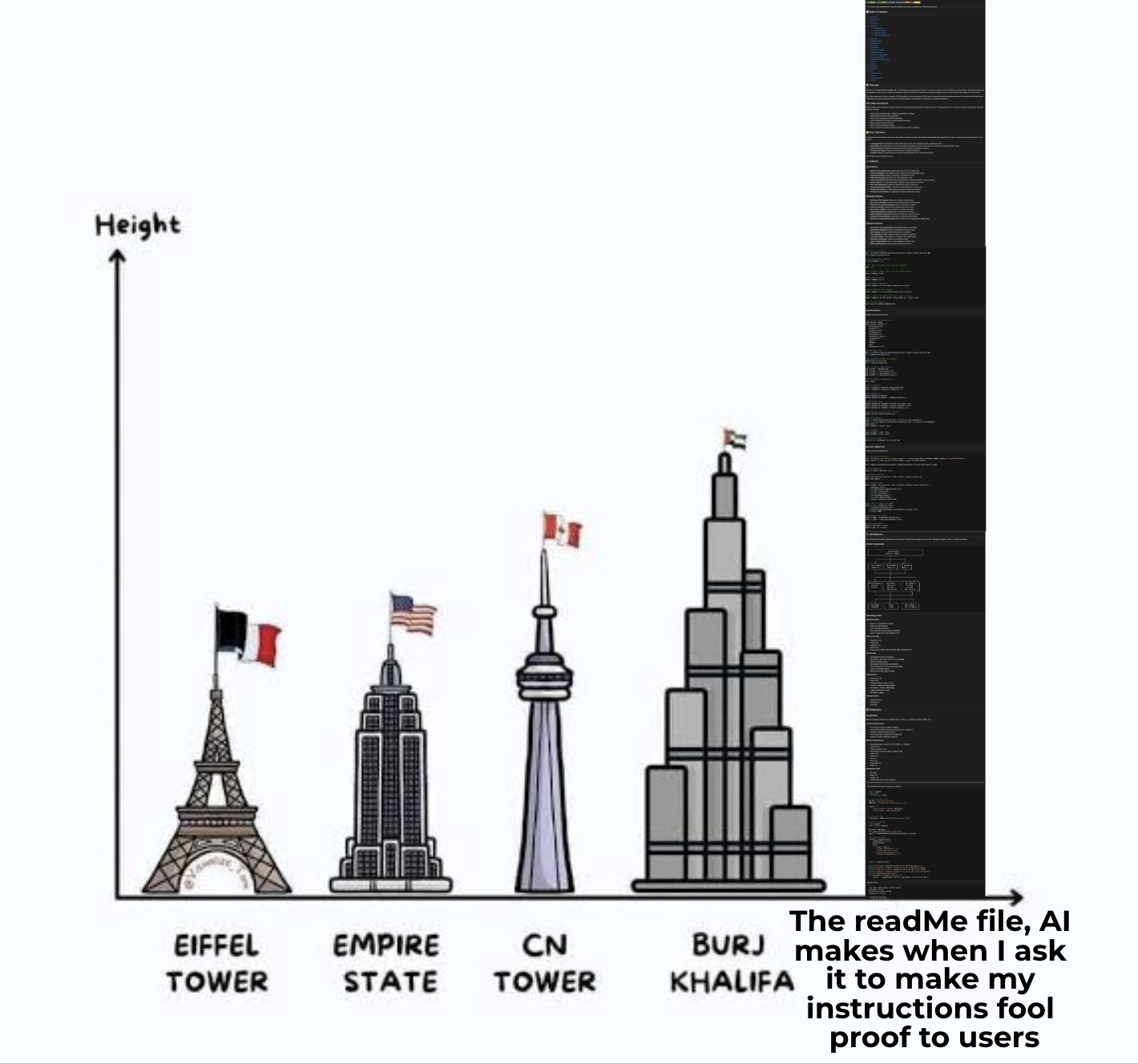
Remember when we used to fight about whether Scrum was a cult or microservices were just distributed monoliths with extra steps? Good times. Now we've evolved to measuring developer productivity with metrics that are somehow even more useless than story points. First they wanted to know how fast we ship features. Then someone got the brilliant idea to measure lines of code like we're paid by the character. Both metrics are equally terrible—one encourages shipping garbage fast, the other encourages verbose garbage. And the punchline? Management's already brainstorming the next metric: production incidents per sprint, probably. The real kicker is that none of these metrics capture what actually matters: solving problems, writing maintainable code, and not making your teammates want to quit. But hey, at least they're easy to put in a spreadsheet.

The Usual

The Usual
Three years in frontend and you're still just copying CSS from Stack Overflow and praying flexbox behaves today. The meme uses Buzz Lightyear trapped in his own helmet to represent that beautiful paradox where you've got "experience" on your resume but you're still trapped in tutorial hell, fighting with CSS centering, and wondering if you should've just learned backend instead. The self-aware smile says it all—you know exactly what you signed up for, and you're still here, still Googling "how to center a div" like it's day one.

Peak Performance Vs Peak Performance

Peak Performance Vs Peak Performance
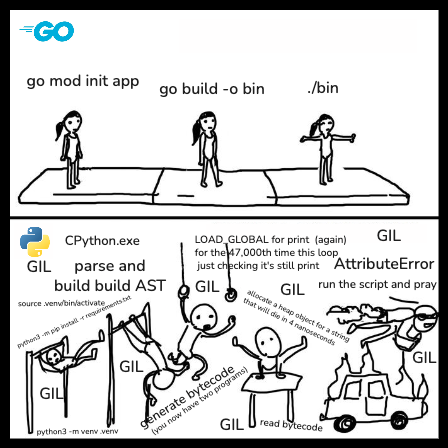
Go developers living their best minimalist life: three simple commands, clean binaries, and they're sipping coffee by 9 AM. Meanwhile, Python devs are drowning in a sea of GIL locks, parsing ASTs for the 47,000th time, and praying to the runtime gods while their code throws AttributeErrors like confetti at a chaos parade. Both languages claim "peak performance" but one's doing yoga on a beach while the other's fighting a hydra made of dependency conflicts and interpreter quirks. The contrast is *chef's kiss* brutal.

I Know Package Managers Can Be Rough, But This??

I Know Package Managers Can Be Rough, But This??
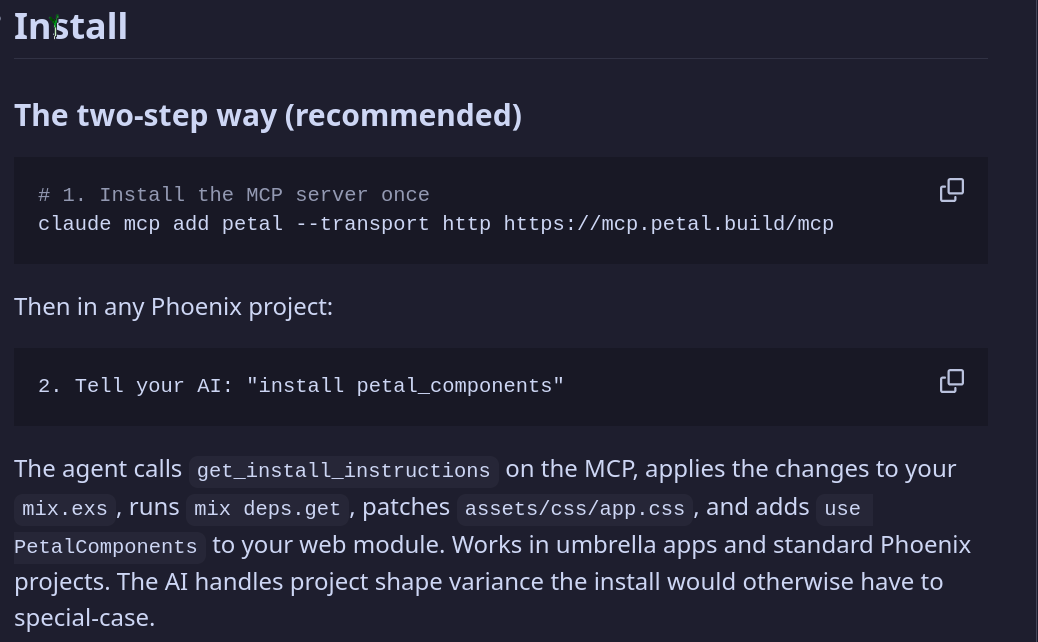
So we've officially reached the point where installing a UI component library requires you to negotiate with an AI agent . Step 1: Install the MCP server. Step 2: Politely ask your AI overlord to "install petal_components" like you're ordering coffee from a very particular barista. The AI then calls some mystical function, patches your CSS, modifies your mix.exs, and "handles project shape variance" because apparently your Phoenix app's geometry matters now. Remember when we just ran mix deps.get and called it a day? Those were simpler times. Nothing says "modern development workflow" quite like adding a middleman AI to do what package managers have been doing for decades. What's next, asking ChatGPT for permission to commit code?

Do Not Cite The Deep Magic To Me, Witch. I Was There When It Was Written.

Do Not Cite The Deep Magic To Me, Witch. I Was There When It Was Written.
That vintage Best Buy Y2K warning sticker hits different when you're a senior dev who actually lived through the millennium bug panic. Some junior developer trying to explain legacy code issues? Please. You were literally there debugging COBOL on New Year's Eve 1999 while everyone else was partying. The 52x CD-ROM drive really seals the nostalgia here. Back when "52x" was considered blazing fast and you could physically hear your computer thinking. Now some fresh bootcamp grad wants to lecture you about technical debt? Buddy, you've been managing technical debt since their parents were on dial-up. The Aslan energy is immaculate. "I was there 3,000 years ago" perfectly captures that moment when someone half your age tries to explain a design pattern you implemented before Stack Overflow even existed.

Growth

Growth
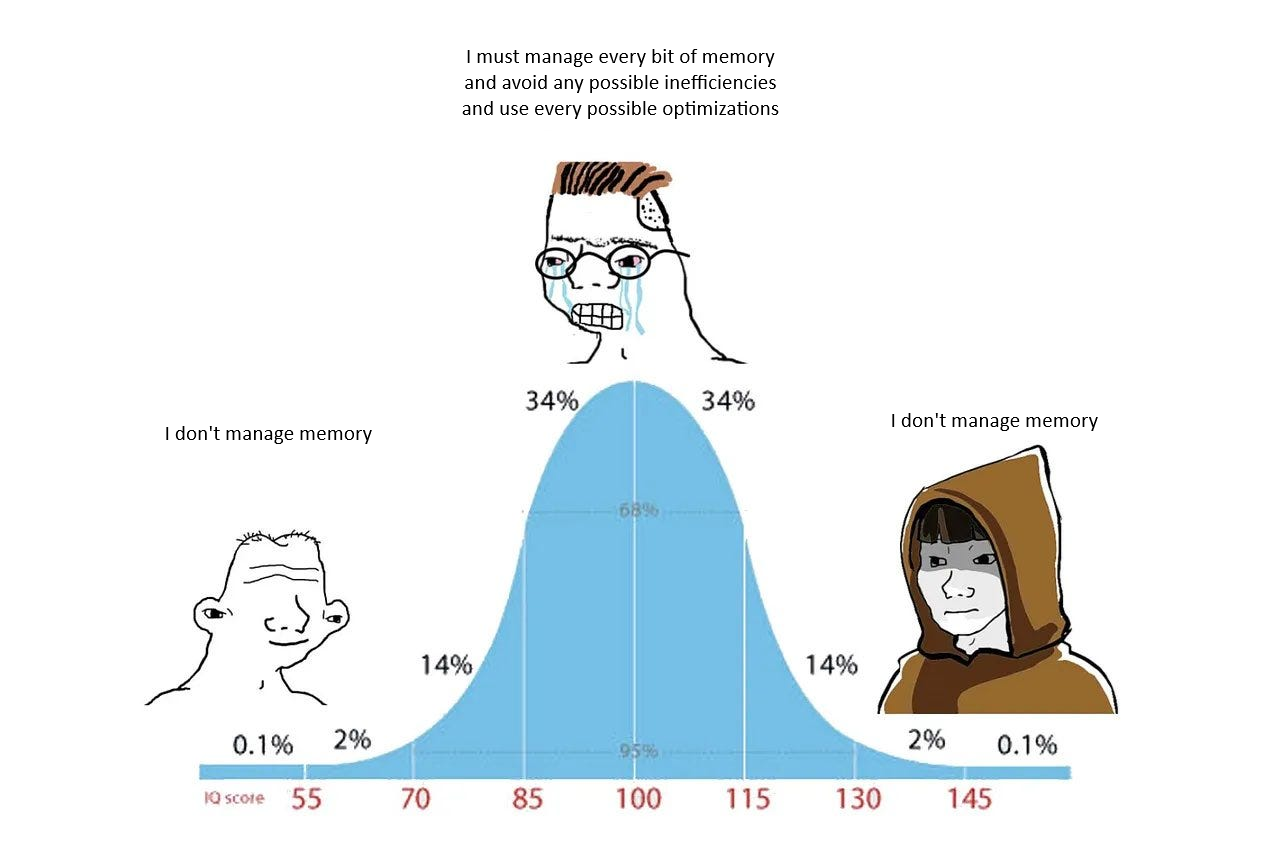
The bell curve strikes again. Junior devs obsess over manual memory management and micro-optimizations like they're writing firmware for a Mars rover, sweating every malloc and free. Meanwhile, the average developers just let garbage collection do its thing and ship features. But then you reach enlightenment—senior devs who've seen enough production incidents know that sometimes you really don't need to manage memory because modern runtimes are pretty damn good at it. The difference? The juniors stress about it because they read it in a textbook. The seniors don't stress about it because they've actually measured it and realized premature optimization is still the root of all evil. Both say the same thing, but only one of them sleeps well at night.

UPLIFT DESK Bamboo (72 x 30 inch) Standing Desk 2-Leg V3 Adjustable Stand Up C-Frame (White), Advanced Keypad, Wire Grommets, Wire Tray, Rocker Board

UPLIFT DESK Bamboo (72 x 30 inch) Standing Desk 2-Leg V3 Adjustable Stand Up C-Frame (White), Advanced Keypad, Wire Grommets, Wire Tray, Rocker Board
Strong, Fast, Smart, Durable, & Safe: 355 lb lifting capacity; dual German-made motors; 3-stage legs (33% faster movement & 33% greater height range); advanced anti-collision system; included wire ma…

It Is Completely Fine If You Can't Deal With The Difficulty, It Is Simply Not The Game For You

It Is Completely Fine If You Can't Deal With The Difficulty, It Is Simply Not The Game For You
You know those devs who refuse to add error handling, logging, or any kind of user-friendly features because "real developers should just read the source code"? Yeah, this is their energy. They'll build the most cryptic API imaginable with zero documentation and then act like you're the problem for asking where the getting-started guide is. Meanwhile, their README is just "Installation: Install it. Usage: Use it." Cool, cool. Very helpful. The gatekeeping is strong with this one—like those people who think adding helpful error messages is "hand-holding" and that struggling through obscure stack traces builds character. Spoiler: it doesn't. It just builds resentment and a desire to use literally any other library.

Never Knew The Meaning

Never Knew The Meaning
Urban Dictionary really went for the throat on this one. Vercel users catching strays for choosing a platform that locks them into its ecosystem. The definition hits different when you realize how many devs picked Vercel for the slick DX and zero-config deploys, only to discover they're now married to a proprietary platform with vendor lock-in tighter than a Python dependency tree. Sure, it deploys faster than you can say "npm run build," but good luck migrating that serverless function architecture anywhere else without rewriting half your stack.

Import Regret

Import Regret
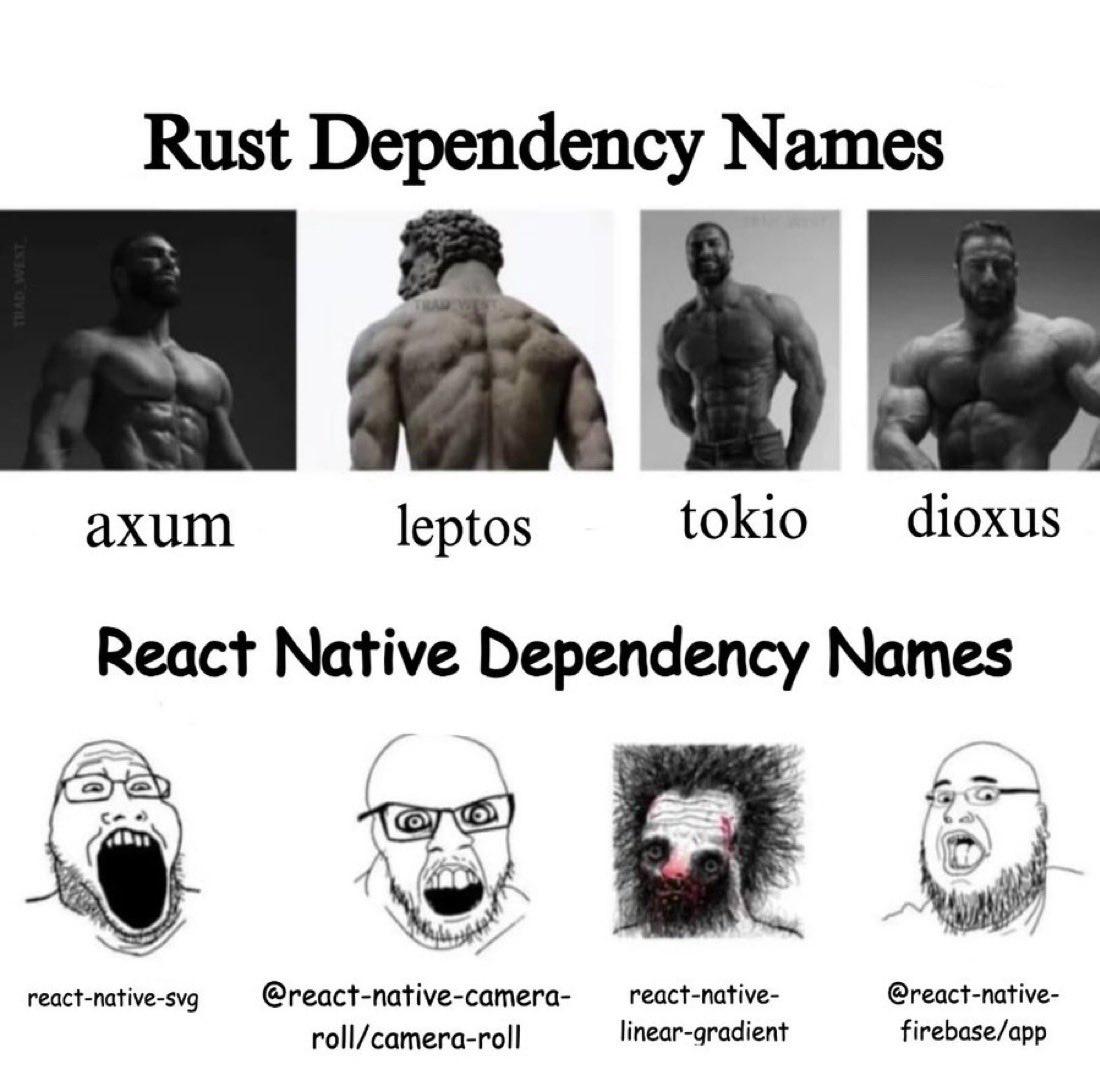
Rust developers get to import dependencies with names that sound like ancient Greek warriors: axum, leptos, tokio, dioxus. Meanwhile React Native devs are stuck typing @react-native-camera-roll/camera-roll like they're navigating a corporate directory structure designed by a committee that hates joy. The scoped packages with their forward slashes and redundant naming conventions read like someone's having an identity crisis. "Yes, I'm react-native-firebase, but also I live in the @react-native-firebase namespace, and my actual name is /app, nice to meet you." Every import statement becomes a novel. Rust said "one word" and moved on with their life.

Everybody Wants Your Data These Days

Everybody Wants Your Data These Days
You just want to write some code, maybe try out a new editor that promises better autocomplete or faster indexing. But nope—can't even open a file without creating an account, syncing your preferences to the cloud, and probably agreeing to share your coding habits with seventeen analytics platforms. Remember when IDEs were just... software you installed? Now they're "platforms" with "ecosystems" that need to know your email, GitHub account, and possibly your blood type. JetBrains wants you logged in for licenses, VS Code wants you synced across devices, and don't even get me started on the cloud-based IDEs that literally can't function without authentication. Just let me edit text files in peace without becoming part of your user engagement metrics.

It May Be Slow But It's Useful

It May Be Slow But It's Useful
The Python community in a nutshell: a perfect bell curve distribution where the extremes agree on the same thing for completely different reasons. The beginners think Python is good because it's easy and reads like English. The experts think Python is good because they've already optimized everything with C extensions and numpy, so performance doesn't matter anymore. Meanwhile, the midwits in the middle are having an existential crisis about GIL limitations, execution speed, and why their script takes 5 seconds to import pandas. They've learned just enough to be dangerous and just enough to be annoyed. The real kicker? All three groups are right. Python IS slow and horrible. Python IS good. It's the Schrödinger's cat of programming languages—simultaneously productive and painful until you open the performance profiler.

Whatever Just Let Me Build My Useless Garbage

Whatever Just Let Me Build My Useless Garbage
You just want to spin up a quick todo app for the 47th time, but some AI-powered dev tool is asking for permissions that would make the NSA blush. Full access to your filesystem? Sure. Screen recording 24/7? Why not. Your calendar, contacts, and "the whole fucking shebang"? Absolutely necessary for... improving your developer experience, apparently. But here's the thing—you're so desperate to avoid actually configuring your environment manually that you'll just slam that "GRANTED AS FUCK" button without a second thought. Who cares if it can see your browser history of Stack Overflow tabs and that embarrassing Google search for "how to center a div"? You've got a half-baked side project to abandon in two weeks, and you need it NOW. The modern developer's dilemma: trading your entire digital soul for the convenience of not reading documentation. Worth it? Probably not. Gonna do it anyway? Absolutely.

FMOUSE Gaming Wireless Mouse, Tri-Mode (2.4G/Bluetooth/Wired), 4800 DPI, 1000Hz Ergonomic Hollow RGB Rechargeable Type-C for Mac/Laptop/iPad/Office - Gray

FMOUSE Gaming Wireless Mouse, Tri-Mode (2.4G/Bluetooth/Wired), 4800 DPI, 1000Hz Ergonomic Hollow RGB Rechargeable Type-C for Mac/Laptop/iPad/Office - Gray
True Tri-Mode & 3-Device Switch – Effortlessly connect via 2.4G USB receiver, dual Bluetooth, or wired Type-C. Seamlessly switch between 3 devices (Mac/Laptop/iPad/Android) for smooth gaming, office …