

What You Think 😅

What You Think 😅
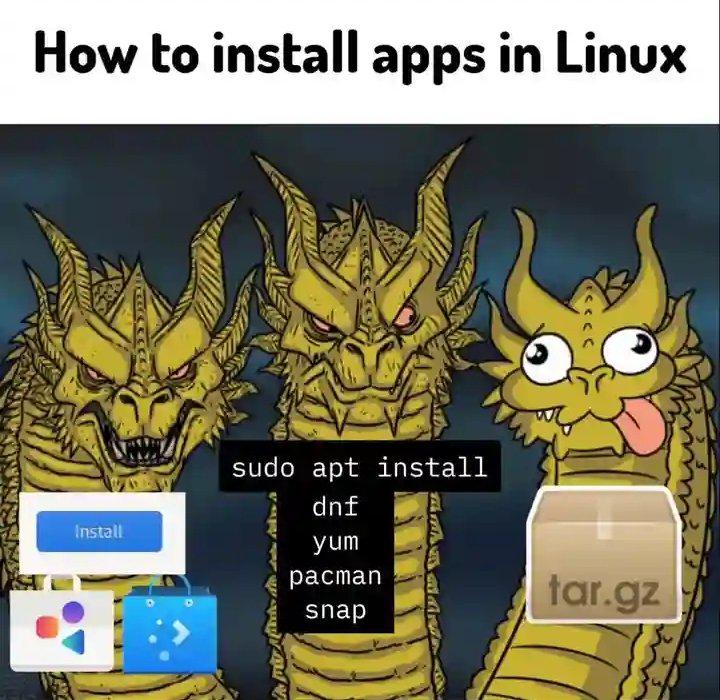
Hollywood really thinks "hacking" means furiously typing random commands while dramatic music plays in the background. Meanwhile, every developer watching is like "bruh, he's literally just running sudo apt-get update and installing packages." The most dangerous cyber attack in cinema history? Apparently it's just updating your Linux system and throwing in some npm installs for good measure. Nothing screams "elite hacker breaking into the Pentagon" quite like watching someone install dependencies for 20 minutes. At least they got the part right where it takes forever and you're just sitting there waiting with a drink in hand.

It's Coming For My Job

It's Coming For My Job
AI just casually generating a literal physical 3D holographic masterpiece of a seeded database for testing when you asked for a simple diagram. Meanwhile, you're still trying to figure out how to export your schema to PNG without it looking like garbage. The gap between what AI can produce and what we actually need is hilariously wide, yet somehow it still makes us question our job security. Like yeah, cool futuristic cityscape inside a glass cube, but can it fix the flaky integration tests that only fail on Fridays? The real kicker? Some PM is gonna see this and ask why your actual testing environment doesn't look this impressive.

Corporate Security Be Like

Corporate Security Be Like
Nothing screams "enterprise-grade security protocols" quite like a Post-it note slapped on a thermostat declaring "ADMIN ACCESS ONLY." Because clearly, the biggest threat to your organization isn't SQL injection or zero-day exploits—it's Karen from accounting cranking the heat to 78 degrees. The sheer irony of protecting a physical device with the cybersecurity equivalent of a "Please Don't Touch" sign is *chef's kiss*. We've got firewalls, VPNs, multi-factor authentication, and password managers with 256-bit encryption... but when it comes to the office thermostat? Just write something intimidating on a sticky note and call it a day. Security through obscurity has officially evolved into security through passive-aggressive office supplies. The IT department would be proud—if they weren't too busy dealing with actual security incidents while someone's still adjusting the temperature anyway.

Sure That Will Fix Everything

Sure That Will Fix Everything
When your backend has more spaghetti code than an Italian restaurant and someone casually drops "maybe we should just rewrite the whole thing" in a meeting. Everyone's sitting there like they just witnessed a declaration of war. Because nothing says "I value my sanity" quite like throwing away 5 years of legacy code, 47 undocumented features, and that one function nobody understands but everyone's too scared to touch. The rewrite fantasy is every developer's guilty pleasure—until you remember that the current system, despite being held together by duct tape and prayers, actually works. Meanwhile, your proposed rewrite will take 18 months, blow past every deadline, and somehow end up with the exact same bugs plus exciting new ones. Spoiler alert: You're not going to rewrite it. You're going to add another abstraction layer and call it "refactoring."

Why Computer Engineers Should Not Be Surgeons

Why Computer Engineers Should Not Be Surgeons
So apparently the medical equivalent of "have you tried turning it off and on again?" is just straight-up murder and resurrection. The surgeon here is treating a human body like it's a crashed production server at 2 PM on a Friday. Just kill all processes, reboot, and hope nothing's corrupted. No logs, no diagnostics, just the nuclear option. To be fair, this troubleshooting methodology has a 100% success rate in IT. The patient might not remember their passwords afterward, but that's a separate ticket.

Who Needs Fun When You Can Have Fn

Who Needs Fun When You Can Have Fn
Kotlin devs: "Our methods are fun !" *polite smile* Rust devs: "Hold my borrow checker. Our methods are fn ." *unhinged grin* The Rust community really looked at Kotlin's wholesome fun keyword and said "yeah but what if we made it shorter and more cryptic?" Peak systems programming energy right there. Nothing says "I enjoy pain" quite like preferring fn over fun . Both languages are great, but only one of them makes you feel like you're speedrunning carpal tunnel syndrome while fighting the compiler for sport.

Just Trying To Build A PC In 2025 Be Like...

Just Trying To Build A PC In 2025 Be Like...
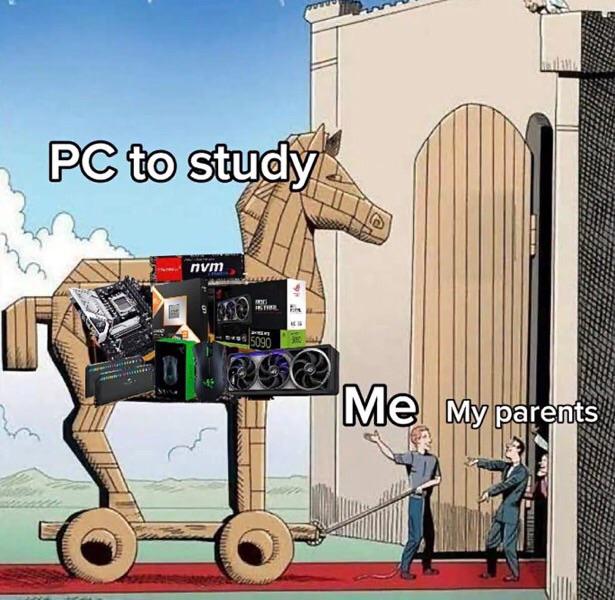
Look, I've been through enough hardware cycles to know the drill. You start planning your build, check PCPartPicker, and immediately realize you need to take out a small loan just for DDR5. Then you hear whispers about the "AI bubble bursting" and suddenly you're doing the math: if NVIDIA stock tanks, maybe—just maybe—those absurdly overpriced components will finally become affordable. The real kicker? We're all sitting here praying for an economic downturn just so we can justify our hobby. That's where we are as a society. Waiting for the market to crash so 1TB of RAM doesn't cost more than a used car. Because apparently every stick of memory now needs to be "AI-optimized" and costs accordingly. Remember when 16GB was overkill? Now Chrome alone needs that just to keep 12 tabs open. The hardware industry really saw us coming.

U Can Do It My Little Machine, I Believe In You

U Can Do It My Little Machine, I Believe In You
RAM shortage headlines predicting doom until 2027, and here we are patting our ancient war machines like "just one more year, buddy." Nothing says optimism like running production workloads on hardware that's already crying for retirement while memory prices skyrocket. The delusion is strong when you're convincing yourself that 8GB DDR3 will totally handle that new Kubernetes cluster. We're all just one kernel panic away from admitting we need an upgrade, but until then, positive affirmations for aging silicon it is.

True Senior Engineers Answer

True Senior Engineers Answer
Oh, the DIVINE WISDOM of senior engineers! When you dare ask them for a simple deadline, they transform into mystical fortune tellers who speak only in riddles and philosophical paradoxes. "The answer will reveal itself" – translation: "Bold of you to assume time is linear, junior." They've reached such an enlightened state of engineering consciousness that they no longer operate on mortal concepts like "dates" or "commitments." Instead, they've ascended to a realm where deadlines exist in a quantum superposition of "maybe Tuesday" and "when the stars align." The best part? They're not even wrong! After years of watching "two-week projects" turn into six-month odysseys, they've learned that giving ANY specific date is basically signing a blood oath with the demo gods. So they just... don't. Truly, this is the wisdom that comes with surviving a thousand production incidents.

I Can Make It Work In Just 3 Lines Of Code

I Can Make It Work In Just 3 Lines Of Code
Python programmer casually flexing about solving problems in 3 lines while the C++ programmer is over there having a full existential crisis. Classic high-level vs low-level language showdown. Python devs get to import a library that does everything, write a list comprehension, and call it a day. Meanwhile the C++ crowd is manually managing memory, dealing with pointers, template metaprogramming, and questioning their life choices just to accomplish the same thing in 300 lines. Both get the job done. One just requires significantly less therapy afterward.

Someone Said To Use The Stack Because Its Faster

Someone Said To Use The Stack Because Its Faster
So someone told you stack allocation is faster than heap allocation, and you took that advice a bit too literally. The function allocates a char array on the stack and then returns a pointer to it. Problem? That stack memory gets deallocated the moment the function returns, so you're handing back a pointer to memory that's already been reclaimed. It's like giving someone directions to a house that's been demolished. The comment "delicious segfault awaits" is chef's kiss accurate. Whoever tries to dereference that returned pointer is in for undefined behavior territory—could be garbage data, could be a crash, could be nothing at all until production when it spectacularly explodes. Stack allocation is faster, but returning stack-allocated memory is basically writing a check your program can't cash. Classic case of knowing just enough to be dangerous. Should've used malloc or just passed a buffer as a parameter. But hey, at least it compiles! (with warnings you definitely ignored)

Anime Gender Type Theory

Anime Gender Type Theory
Someone took their TypeScript generics knowledge and applied it to the most important problem in computer science: categorizing anime characters by gender presentation. Because nothing says "I understand covariance and contravariance" quite like explaining why that cute anime character might be a trap. The progression is beautiful: simple generic Girl, then a Variant that could be Boy OR Girl (Schrödinger's waifu), then a Boy that implements the IGirl interface (the classic "looks like a girl, sounds like a girl, but surprise"), and finally void—because some things transcend mortal understanding. The BitCast at the end is the cherry on top: when type safety fails you, just reinterpret those bits and pray. Your type system can't save you now.