

Vibe Coding My Own Grave

Vibe Coding My Own Grave
So you thought pair programming with AI would boost your productivity, huh? Instead, you've got an overly enthusiastic coding assistant that's basically cheering you on while you architect your own demise. The AI is out here throwing confetti emojis and thumbs up while you're digging yourself into technical debt so deep you'll need a rescue team. The real kicker? The AI isn't wrong—it's just aggressively positive about every terrible decision you make. "Let's add another nested ternary!" "You've got this!" Sure, until code review rolls around and you're explaining why you thought a 500-line function was a good idea. The gun is metaphorical, but the damage to your codebase is very, very real.

Devs Reading Steam Reviews

Devs Reading Steam Reviews
Game devs scrolling through Steam reviews at 3 AM, desperately searching for validation after months of crunch, and finding someone who played for 1.4 hours but got so hooked they lost track of time. The glowing eyes moment hits when they realize the player praised the graphics AND the flashlight implementation. THE FLASHLIGHT. You know you've made it when someone notices your lighting system. That "You are a good man. Thank you" response? That's every dev who's ever had their soul crushed by "Not Recommended - 2,847 hours played" reviews. This one positive review from someone with barely any playtime but genuine enthusiasm is worth more than a thousand "it's okay I guess" from players with 500+ hours. It's the emotional support we didn't know we needed but absolutely deserve.

Never A Moment Of Peace

Never A Moment Of Peace
You know what's wild? Senior devs have earned their right to a peaceful lunch. They've survived the trenches, paid their dues, and now they just want to eat their sandwich without incident. Meanwhile, the junior dev is sitting there, sweating bullets, knowing they just nuked production but trying to time the confession perfectly. Like somehow waiting until after lunch makes it better? Spoiler: it doesn't. The server is down NOW, Karen. The real tragedy here is that the senior dev already knows. They felt a disturbance in the force the moment that server went down. Their Slack is probably exploding. Their phone is vibrating off the table. But they're still trying to finish that burrito in peace, pretending everything is fine for just five more minutes. Pro tip: if you crash production, rip the band-aid off immediately. Don't let your senior enjoy their lunch thinking everything is fine. That's just cruel.

Software Engineers After LLMs

Software Engineers After LLMs
The devolution is complete. We went from Googling "how to reverse a string" to literally asking ChatGPT to create basic loops like we've forgotten the fundamental building blocks of programming. The crying wojak perfectly captures that moment when you realize you've outsourced your brain so hard that even a for-loop feels like rocket science without AI assistance. It's like having a calculator for so long that you forgot how to add 2+2. Except now it's "ChatGPT please help me breathe" energy. The best part? The AI probably writes better loops than we do at this point, which makes the whole situation even more tragic. We've essentially become prompt engineers who occasionally remember we used to write actual code.

Didn't Realise The Marriage DLC Meant No More Hobbies Oops

Didn't Realise The Marriage DLC Meant No More Hobbies Oops
Someone built an absolute beast of a gaming rig with a Ryzen 7 9800X3D, RTX 4080, liquid cooling, and a 360Hz ultrawide monitor—only to use it exclusively for Fortnite on lowest settings at 1250 FPS uncapped. Now they're liquidating the entire setup because "it's time to move on" after getting married. The best part? They claim "no hard stress testing or benchmarking ever done" on hardware that could render the entire Matrix in real-time, but was instead relegated to battle royale duty. That's like buying a Ferrari and only driving it to check the mailbox. Marriage DLC apparently comes with a mandatory uninstall of the Gaming Hobby package. The patch notes didn't mention this feature, but here we are. RIP to another fallen gamer's RGB dreams.

Every Startup Right Now

Every Startup Right Now
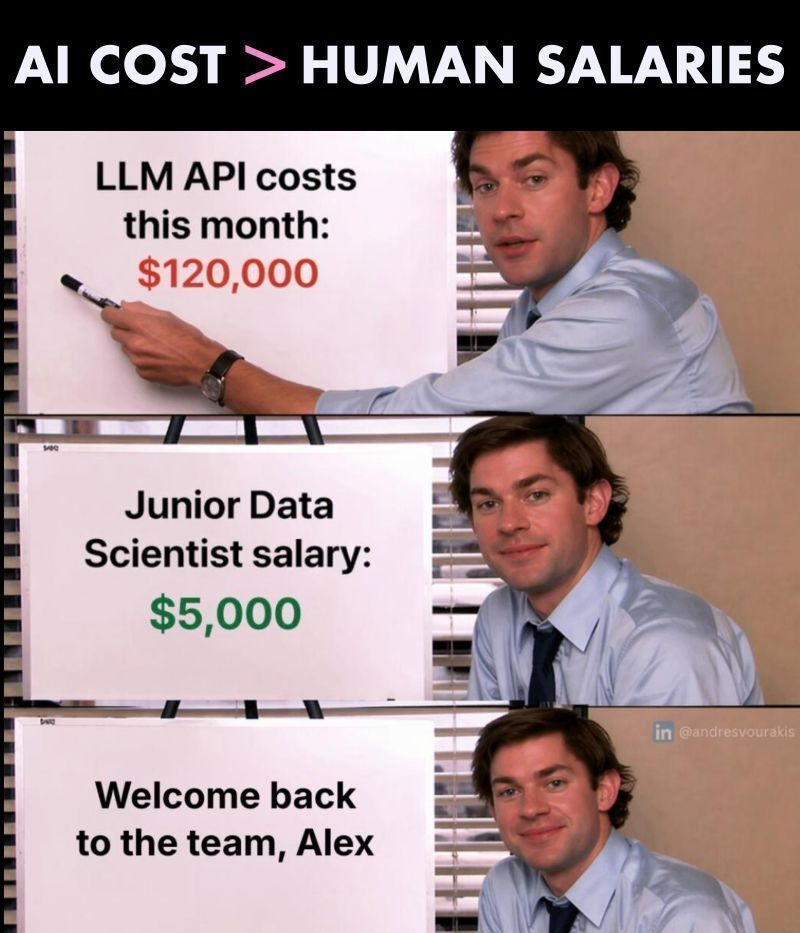
Startups in 2024: "We can't afford competitive salaries or decent benefits, sorry." Also startups: *Drops $500k/month on OpenAI API credits for their chatbot that nobody asked for*. The AI gold rush has VCs throwing money at anything with "agent" in the pitch deck while actual human developers are getting equity that's worth less than Monopoly money. Because why hire three senior engineers when you can subscribe to five different AI tools that hallucinate code and call it "autonomous development"? Fun fact: The average AI agent subscription costs more per month than what some startups pay their junior devs. Priorities, people.

Can't Wait For 2027

Can't Wait For 2027
Oh, the beautiful trajectory of privacy erosion! In just two years, we went from "I won't even tell you my NAME, you creepy AI" to literally handing over the keys to our entire digital kingdom. Like, forget trust issues—by 2026 we're apparently running MCP servers (Model Context Protocol, basically letting AI agents access and control your stuff) with full admin privileges to our bank accounts, emails, and payment processors. What could POSSIBLY go wrong? It's giving "I've given up on life and decided to speedrun financial ruin" energy. The descent into madness is real, folks.

You Know What Would Be Even Funnier

You Know What Would Be Even Funnier
Using email as a primary key is already a terrible idea—what happens when users want to change their email? Cascade updates everywhere, foreign key nightmares, and a database migration that'll haunt your dreams. But sure, let's one-up that disaster by using the password as the primary key. Nothing says "job security through catastrophic technical debt" like having to update every single reference in your database when someone inevitably forgets their password. Also, you'd be storing plaintext passwords, which is basically a resume-building exercise for your next gig after the data breach lawsuit.

This Meme From 2016 Did Not Age Well

This Meme From 2016 Did Not Age Well
Back in 2016, someone confidently predicted that RGB RAM would be the peak of PC building evolution. Spoiler alert: they severely underestimated the gaming industry's ability to turn literally everything into a disco ball. Fast forward to 2026, and we've got RAM sticks that look like they're having a full-blown rave, complete with enough RGB zones to give your GPU an identity crisis. The prophecy wasn't wrong—it just wasn't ambitious enough. We've gone from "let's add some lights" to "what if we made RAM that doubles as a nightclub?" The real question is: does it run faster when it's rainbow? Science says no, but our hearts say absolutely yes.

Spec Was Followed

Spec Was Followed
Someone asked engineers to name every computer ever, and Richard took it literally . Instead of listing actual computer names, he wrote a loop that iterates through all computers and sets each one's name to "ever". Technically correct? Absolutely. Useful? Not even slightly. It's the classic malicious compliance meets literal interpretation. The spec said "name every computer ever" and by god, every computer is now named "ever". Requirements met, ticket closed, PR approved. Don't blame the engineer—blame whoever wrote that ambiguous spec without acceptance criteria. This is why we can't have nice things in software development. And why product managers wake up screaming at 3 AM.

Vibe Coders

Vibe Coders
Day 1 of "vibe coding" and you've already hit a database constraint error. Trying to insert age 17 but getting that beautiful "User with this age already exists" message because someone thought making age a unique key was a galaxy brain move. Either their database schema was designed by someone who thinks every 17-year-old is the same person, or they're using age as a primary key instead of, you know, an actual unique identifier like a UUID or auto-incrementing ID. The real crime here isn't the error—it's the database design that allowed this to happen in the first place. Somewhere, a senior dev is crying into their coffee.

I Mean...

I Mean...
Microsoft out here trying to defend telemetry while Google's like "yeah but I only track your browsing history, search queries, location, emails, and literally everything you do online." Apple's playing the privacy card while still collecting data, just with better PR. And then there's Linux—the only one genuinely confused why anyone would even want to spy on users. The beauty here is that Linux is the kid at the party who doesn't understand why everyone else is being shady. Open source transparency hits different when you realize you can literally read the code and see there's no telemetry nonsense baked in. Meanwhile, the big three are just arguing over who's less invasive, which is like debating who's the tallest dwarf.