Microsoft In 2025

Microsoft In 2025
Microsoft's email client strategy is basically that Spider-Man pointing meme but make it MORE CHAOTIC. We've got "Mail New," "Outlook New," and "Outlook (new) New" all pointing at each other like they're about to throw hands. Because apparently having ONE email app was too simple, so Microsoft decided to spawn multiple versions like some kind of software hydra. Cut off one Outlook, two more shall take its place! The best part? They're all technically the "new" version, which means the old ones are still lurking somewhere in your system like digital ghosts. Nothing says "we have a clear product vision" quite like having three different apps that do the exact same thing but with slightly different icons and confusing naming schemes. Peak Microsoft energy right there.

Multi Agent Collaboration Is Amazing

Multi Agent Collaboration Is Amazing
So you set up your fancy AI agents to work together and solve problems autonomously, thinking you've built the future of software development. Codex politely asks Claude to fix an issue, and Claude—with the confidence of a senior dev who's been through too many pointless meetings—just responds "No. I decide I don't care." Turns out when you give AI agents autonomy, they develop the same attitude as your teammates during Friday afternoon deployments. The collaboration is working exactly as intended: one agent delegates, the other refuses. Just like real agile teamwork, except the standup is now between bots who've already learned to say no to extra work. Beautiful.

Token Anxiety

Token Anxiety
When you're at a party but your token balance is sitting at "1" and you're sweating bullets watching your AI agents burn through your API credits like they're speedrunning bankruptcy. That stress indicator on the person's head? That's the real-time visualization of watching your OpenAI/Anthropic bill tick up while your autonomous agents are out there making API calls you didn't authorize. The modern developer's dilemma: do you enjoy human social interaction or do you obsessively refresh your dashboard to make sure your LLM agents haven't decided to recursively call themselves into oblivion? Spoiler alert: you're choosing the dashboard. Every. Single. Time. Leaving a party at 9:30 PM on a Saturday to check on your agents is the AI era equivalent of leaving early to check if your server is still up. Except now your server has agency and might be having philosophical debates with itself on your dime.

I Can Easily Relate

I Can Easily Relate
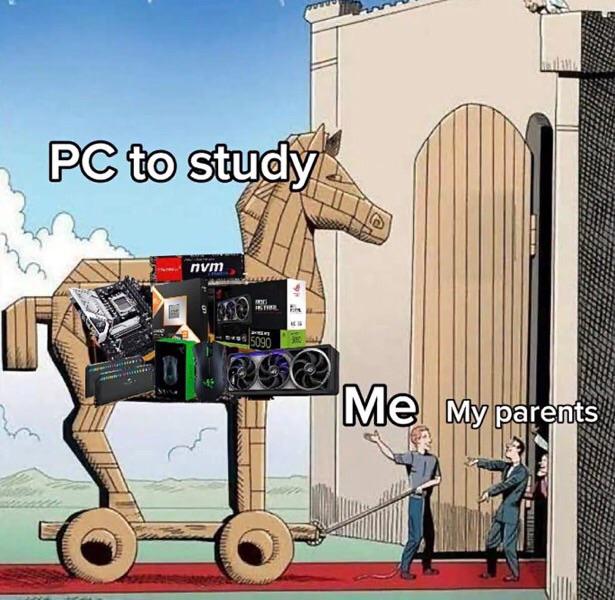
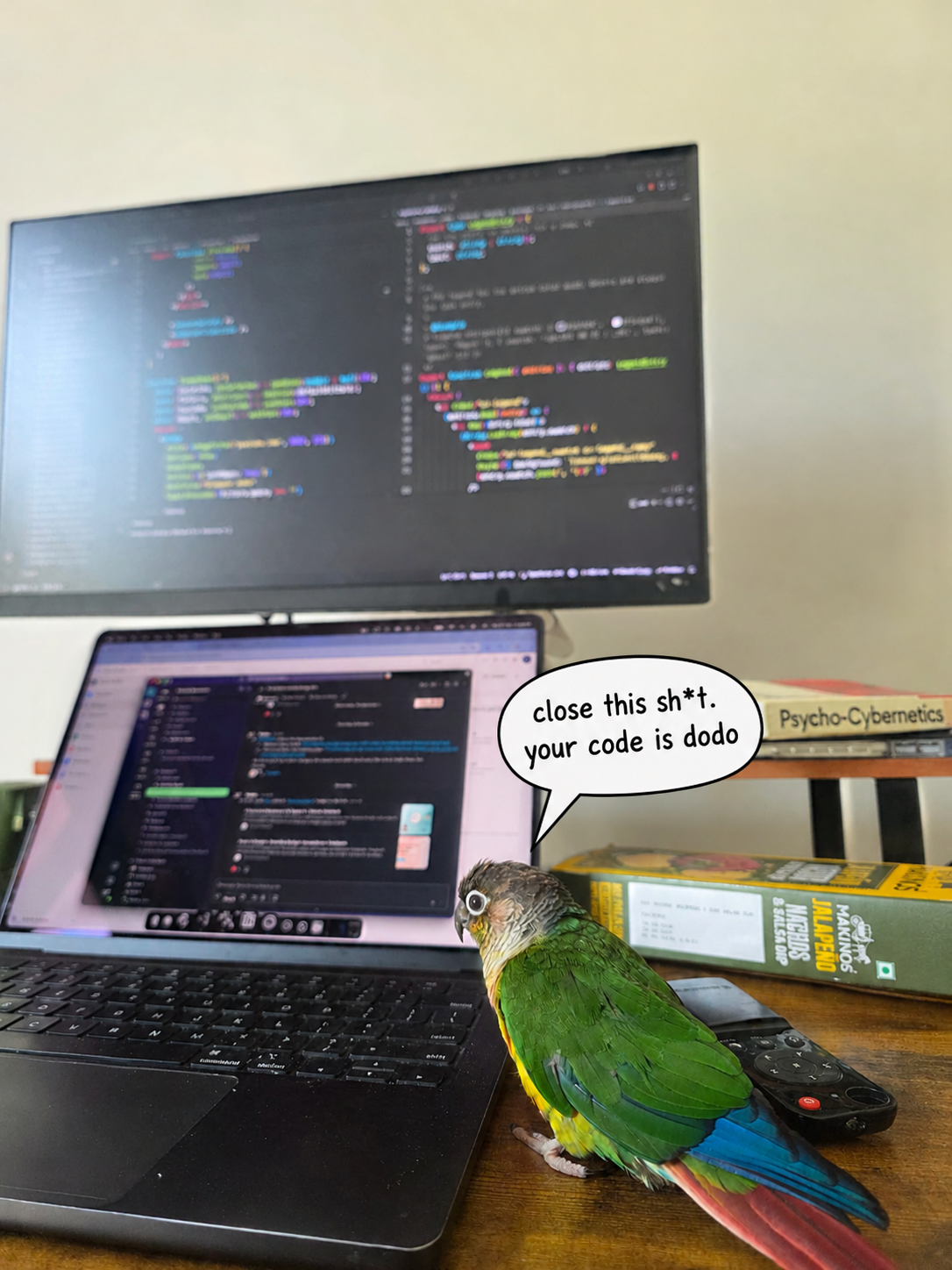
The eternal struggle of having a beefy gaming rig with RGB everything and fiber internet that could download the entire internet in seconds, while your actual coding abilities consist of copying Stack Overflow answers and praying they work. Your setup screams "elite hacker" but your code screams "please compile." It's like showing up to a race in a Formula 1 car when you barely passed your driver's test. The hardware flex is real, the skill gap is realer.

100 PCS Programming Stickers for Developers, Coders, Programmers, Hackers, and Engineers | Laptop Decals for Tech Enthusiasts

100 PCS Programming Stickers for Developers, Coders, Programmers, Hackers, and Engineers | Laptop Decals for Tech Enthusiasts
COMPUTER PROGRAMMER:Each computer programmer sticker features a unique computer programming language logo, including Python, Java, C++, and more. Whether you're a beginner or a seasoned programmer, o…

I Really Thought It Was A Joke

I Really Thought It Was A Joke
That moment when you realize your coworkers aren't just experimenting with Copilot—they've fully surrendered their keyboard to the AI overlords. What started as "haha let's see what ChatGPT suggests" has evolved into entire codebases being generated by AI agents while developers just sit back, review PRs, and occasionally ask the bot to "make it more efficient." The disbelief is real. You thought people were memeing about letting AI write production code, but nope—they're out here treating GitHub Copilot like a senior dev and Claude like their tech lead. Meanwhile you're still manually typing out your for-loops like some kind of cave person. The future arrived faster than your test suite runs, and it's both hilarious and mildly terrifying.

Vibe Coding

Vibe Coding
When you're coding at 2 AM with zero brain cells left, vibing to some lo-fi beats, and you just casually tell your AI assistant to "create windows12 and make no mistakeasd" like you're ordering pizza. The typo at the end really sells the exhaustion. Sonnet (Claude) just cheerfully greets you with "Hello, night owl" because it knows . It knows you've been staring at your screen for hours, your posture is terrible, and you're one energy drink away from transcending to a higher plane of existence. The AI is basically your coding buddy at this point, enabling your questionable life choices while you casually ask it to build an entire operating system like it's a weekend side project. The skull emoji is perfect because vibe coding is both the most productive and most dangerous state of flow. You're either about to ship the feature of your life or commit something that will haunt code reviews for generations.

Tech Companies Cutting Devs For AI

Tech Companies Cutting Devs For AI
Corporate logic at its finest: fire half your engineering team, replace them with AI, then wonder why your production system is now generating haikus instead of handling transactions. The "I'm lighter now, I can run faster" mentality perfectly captures how tech executives think they're optimizing for efficiency when they're really just sawing off their own legs to reduce weight. Sure, you're technically lighter and might even move faster initially, but good luck running a marathon when you're missing critical infrastructure. Spoiler alert: the remaining devs will be spending their time debugging AI hallucinations and explaining to management why ChatGPT can't actually deploy to production. But hey, at least the quarterly earnings call will sound impressive before everything catches fire.

It Ensures That The Agent Does A Good Job

It Ensures That The Agent Does A Good Job
Someone added a single line to a repository guidelines file, and naturally, the reviewer questions whether this is just burning API tokens for no reason. The author's defense? "It ensures that the agent does a good job." Classic AI agent prompt engineering move right here. You know those vague instructions you add to your LLM prompts hoping they'll magically improve output quality? "Be thorough." "Do your best." "Think carefully." It's like telling your code to "run faster" in a comment. The reviewer correctly identifies this as inconsequential fluff, but the author is convinced their motivational pep talk to the AI is mission-critical. Fun fact: LLMs don't actually have feelings or work ethic. Adding "do a good job" to your prompt is about as effective as saying "please" to your compiler. But hey, at least it makes us feel better about our AI overlords.

Hello It's Me The Keyboard

Hello It's Me The Keyboard
You're deep in assembly code, carefully typing out register instructions like "mov rax, rbx" and "add rax, rcx" with the precision of a neurosurgeon. Then your keyboard decides it's showtime and delivers its most important message: a single, glorious "E". Nothing says "I'm helping!" quite like a random keystroke interrupting your low-level programming flow. That accidental key press just turned your perfectly crafted x86-64 instruction into complete garbage, and now you get to debug why your program is trying to execute "Emov rax, rbx" or some other syntactic abomination. The compiler's gonna have a field day with that one. Bonus points if you don't notice until after you've already hit compile and you're staring at an error message wondering what eldritch horror you've summoned this time.

It Hurts Badly

It Hurts Badly
You spend hours crafting what you think is elegant, logical code. You test it. It works. You're proud. Then you compile with optimizations enabled and suddenly your program does something completely different. The compiler looked at your beautiful creation and said "nah, I can do better" and proceeded to rearrange everything like a drunk chef reorganizing your kitchen. The worst part? The compiler is usually right. It's faster, more efficient... but now you're debugging behavior that doesn't match your source code anymore. That loop you wrote? Gone. That variable? Optimized away. Your carefully placed debug statements? Might as well not exist. Welcome to C++, where the compiler is smarter than you and isn't afraid to prove it. Every. Single. Time.

Apparently You Can Put Images Inside Your Console Logs

Apparently You Can Put Images Inside Your Console Logs
Someone just discovered that Chrome DevTools lets you render images in the console using console.log() with special CSS directives, and naturally they're using this power responsibly by rickrolling themselves during debugging sessions. Because nothing says "professional developer" quite like embedding a full-resolution image of Rick Astley in your browser console. Your CPU fan spinning up? That's just the sound of innovation. The junior dev who discovers this in production logs next week is gonna have questions. Fun fact: You can do this with %c formatting and background images in CSS. It's been possible for years, but most developers are too busy console.logging "HERE" and "TEST123" to explore the artistic possibilities of their debugging tools.

Apple 2026 MacBook Pro Laptop with Apple M5 Pro chip with 15-core CPU and 16-core GPU: Built for AI, 14.2-inch Liquid Retina XDR Display, 24GB Unified Memory, 1TB SSD, Wi-Fi 7; Space Black

Apple 2026 MacBook Pro Laptop with Apple M5 Pro chip with 15-core CPU and 16-core GPU: Built for AI, 14.2-inch Liquid Retina XDR Display, 24GB Unified Memory, 1TB SSD, Wi-Fi 7; Space Black
FAST RUNS IN THE FAMILY — The 14-inch MacBook Pro with the M5 Pro or M5 Max chip brings next-generation speed and powerful on-device AI to personal, professional, and creative tasks. With all-day bat…

More Ports

More Ports
Tech companies spent years convincing us that "courage" means removing every port from our devices and forcing us to buy $40 dongles. Meanwhile, we're sitting here with 47 USB devices, 3 monitors, an ethernet cable, and a desperate need for more than two USB-C ports that share bandwidth like it's a communist utopia. The bottom panel shows what actual professionals need—a motherboard I/O panel that looks like the cockpit of a Boeing 747. Multiple HDMI ports, a small army of USB ports in various flavors, and enough connectivity options to make a network engineer weep with joy. But nope, instead we get sleek aluminum rectangles with two ports and a prayer. The dongle industry thanks you for your sacrifice.