

Space Complexity Is The Most Important Thing Now

Space Complexity Is The Most Important Thing Now
Welcome to 2024, where RAM costs more than your kidney and suddenly everyone's rediscovering DFS like it's some ancient wisdom. For decades, BFS was the go-to for graph traversal because who cares about O(n) space when RAM is cheap, right? Just throw more memory at it! But now with the global RAM shortage and prices skyrocketing, developers are frantically switching to DFS with its beautiful O(h) space complexity for tree traversals. The irony? Computer science professors have been preaching space-time tradeoffs since forever, but it took an economic crisis for devs to actually care about that queue eating up all your precious gigabytes. Stack-based recursion is having its redemption arc, and somewhere a CS101 professor is saying "I told you so."

Just Ask AI If You Need Advice Honey

Just Ask AI If You Need Advice Honey
Nothing quite captures the exquisite agony of being a junior dev like watching your client speed-run straight into a disaster you predicted THREE WEEKS AGO. You're sitting there, wisdom bubbling up inside you like a volcano, knowing EXACTLY how to fix it because you've literally watched this trainwreck happen a dozen times before. But can you say anything? NOPE! Because you're on that sweet junior salary and apparently that means your brain doesn't count yet. So you just sit there with that forced smile plastered on your face, internally screaming while the client barrels toward catastrophe like it's their life's mission. The hierarchy has spoken, and your role is to suffer in silence while pretending everything is fine. Totally fine. Nothing to see here. Just another day in paradise where experience is inversely proportional to your ability to use it.

OneDrive: Look At Me, I Am Your C Drive Now

OneDrive: Look At Me, I Am Your C Drive Now
OneDrive has this delightful habit of silently taking over your entire file system like some kind of digital coup. One day you're just trying to save a file to your Desktop, and suddenly you realize it's not actually on your Desktop—it's in the cloud, syncing to OneDrive, whether you asked for it or not. Microsoft really said "local storage? never heard of her" and just started redirecting your Documents, Desktop, and Pictures folders without so much as a courtesy email. The best part is when you're on a train with no internet and can't access your own files because they're "Files On-Demand" now. Thanks, I really needed my tax documents to be unavailable during my audit. Nothing says "seamless user experience" like your C drive becoming a glorified shortcut to someone else's server.

When You Finally Remove Useless Classes From Your Code

When You Finally Remove Useless Classes From Your Code
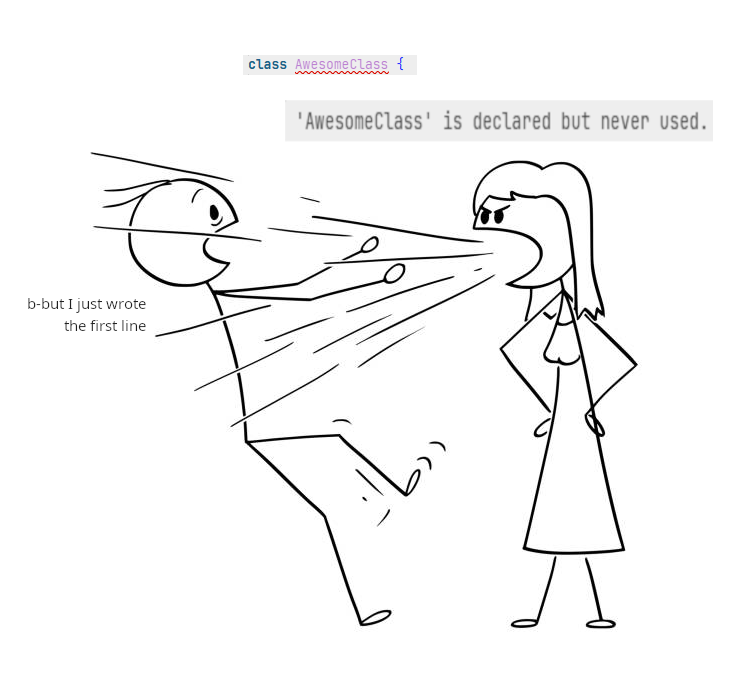
You know that feeling when you've been carrying around dead code for months—maybe years—and you finally get the courage to delete those abstract factory singleton builder classes that literally do nothing? Revolutionary moment right there. It's like declaring independence from technical debt. The crowd goes wild because everyone's been silently judging that bloated codebase, but nobody wanted to be the one to touch it. Now you're the hero who reduced the bundle size by 40% and made the CI pipeline actually finish before the heat death of the universe. Chef's kiss. Until you realize three months later that one of those "useless" classes was actually being reflection-invoked by some ancient framework configuration and now production is on fire.

Badum

Badum
When your company car is literally a Microsoft vehicle but you still can't trust it not to blue screen on the highway. The double meaning here is chef's kiss—"crash" as in software failure AND actual vehicular collision. It's like putting a Windows logo on anything automatically reduces its reliability by 40%. The driver probably boots up the ignition and waits 15 minutes for updates before every trip. At least when it crashes, they can just Ctrl+Alt+Delete and restart the engine, right?

You Are Absolutely Right

You Are Absolutely Right
So you've got Stack Overflow warriors absolutely ROASTING your question for being "dumb," getting flagged as duplicate, and having grammar mistakes that apparently warrant a death sentence. But then an LLM swoops in like a golden retriever who just wants to help and tells you "YOU ARE ABSOLUTELY RIGHT" with the warmest embrace known to mankind. The contrast is *chef's kiss* – on one side you've got the gatekeeping tribunal of doom ready to obliterate your self-esteem, and on the other you've got AI being the most supportive friend who validates your existence even when your code is held together by duct tape and prayer. Sure, the LLM might be confidently incorrect half the time, but at least it won't make you question your entire career choice before breakfast.

Prod Is Down During The Standup

Prod Is Down During The Standup
Oh, the absolute CHAOS when production decides to spontaneously combust right in the middle of your daily standup! Everyone's just casually discussing their "blockers" and "sprint goals" when suddenly someone's phone starts blowing up with PagerDuty alerts. The tension is PALPABLE – do we acknowledge the five-alarm fire consuming our infrastructure, or do we maintain eye contact and pretend everything is fine while the revenue counter spins backwards? The suits are standing there looking all corporate and composed while someone's frantically typing away trying to roll back that deployment from 10 minutes ago. Nothing says "agile methodology" quite like watching your entire team collectively decide whether to finish standup or save the company. Spoiler alert: the standup always gets cut short, but not before someone says "let's take this offline" with the energy of a building evacuation.

Is This Not Enough

Is This Not Enough
You've already achieved logarithmic time complexity—the HOLY GRAIL of algorithmic efficiency—and they're sitting there asking if you can squeeze out MORE performance? What do they want, O(1) for everything? Do they expect you to invent time travel? O(log n) is literally one step away from constant time. You're already operating at near-theoretical perfection, and here comes the interviewer acting like you just submitted bubble sort to production. The audacity! The sheer NERVE! It's like winning an Olympic gold medal and having someone ask if you could've run it backwards while juggling. Some interviewers really do be out here expecting you to violate the fundamental laws of computer science just to prove you're "passionate" about optimization.

And No More Space

And No More Space
SQL devs really built their entire personality around hoarding data. The moment you tell them a table isn't needed anymore, they experience physical pain watching it get yeeted into the void. That disk space? Gone. Those carefully crafted indexes? Dust. The 47 joins they memorized? Useless. It's like watching someone lose a beloved pet, except the pet is a normalized database schema they spent three weeks optimizing. They stand there, arms outstretched, as if they could somehow catch the DROP TABLE command mid-execution. Spoiler: they can't.

It's Not Microservices If Every Service Depends On Every Other Service

It's Not Microservices If Every Service Depends On Every Other Service
Oh honey, someone said "microservices" in a meeting and suddenly the entire engineering team went feral and split their beautiful monolith into 47 different services that all call each other synchronously. Congratulations, you've created a distributed monolith with extra steps and network latency! 🎉 The unmasking here is BRUTAL. You thought you were being all fancy with your "microservice architecture," but really you just took one tangled mess and turned it into a tangled mess that now requires Kubernetes, service mesh, distributed tracing, and a PhD to debug. When Service A needs Service B which needs Service C which needs Service A again, you haven't decoupled anything – you've just made a circular dependency nightmare that crashes spectacularly at 2 PM on a Friday. The whole point of microservices is LOOSE COUPLING and independent deployability, not creating a REST API spaghetti monster where changing one endpoint breaks 23 other services. But sure, tell your CTO how "cloud-native" you are while your deployment takes 45 minutes and requires updating 12 services in the exact right order. Chef's kiss! 💋

Yoda Knows Error Handling

Yoda Knows Error Handling
Junior dev says they'll handle errors. Yoda drops the holy trinity of exception handling: try-catch blocks and the often-forgotten finally clause. That look of existential dread in the last panel? That's the exact moment you realize your "I'll just log it" approach wasn't cutting it. Finally blocks execute regardless of whether exceptions occurred, perfect for cleanup operations like closing database connections or file handles. But let's be honest, most of us remember finally exists only when the code reviewer asks "but what about resource cleanup?"

One Drive In A Nutshell

One Drive In A Nutshell
OneDrive's most impressive feature is its ability to silently yoink your files into the cloud without your consent, then gaslight you about their location. You think you saved it to your Desktop? Wrong. It's now in some mystical cloud dimension that OneDrive may or may not acknowledge exists. The best part? When you desperately search for your file, OneDrive just shrugs and plays dumb like it's never met you before. It's like having a roommate who "organizes" your stuff by hiding it in random places and then denies any involvement. Microsoft really said "let's make file management feel like a hostage negotiation" and called it a feature.