

validation Memes

Good Naming Convention

Good Naming Convention
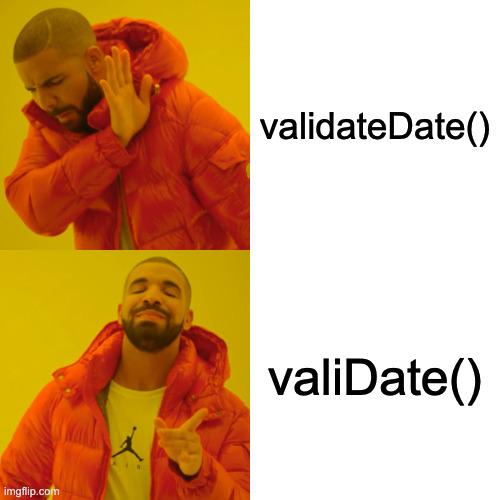
The subtle art of variable naming strikes again. Someone discovered that validateDate() sounds like you're checking if a date is valid, but valiDate() sounds like you're going on a date with someone who's actually worth your time. It's the programming equivalent of realizing you can make your function names do double duty as puns. Why settle for boring technical accuracy when you can have camelCase wordplay that makes your code reviews 10% more entertaining? Your linter won't catch it, but your teammates will either love you or silently judge you. Pro tip: This also works with isValid() vs isVali() for when you need to check if someone's vali-d enough to merge their PR.

Devs Reading Steam Reviews

Devs Reading Steam Reviews
Game devs scrolling through Steam reviews at 3 AM, desperately searching for validation after months of crunch, and finding someone who played for 1.4 hours but got so hooked they lost track of time. The glowing eyes moment hits when they realize the player praised the graphics AND the flashlight implementation. THE FLASHLIGHT. You know you've made it when someone notices your lighting system. That "You are a good man. Thank you" response? That's every dev who's ever had their soul crushed by "Not Recommended - 2,847 hours played" reviews. This one positive review from someone with barely any playtime but genuine enthusiasm is worth more than a thousand "it's okay I guess" from players with 500+ hours. It's the emotional support we didn't know we needed but absolutely deserve.

Choke Me Daddy Dev Version

Choke Me Daddy Dev Version
When your input validation finds a null value and decides the appropriate punishment is making the thread sleep for approximately 115 days. Nothing says "robust error handling" quite like passive-aggressively freezing your application because someone didn't fill out a form field. The comment "Punish user for null" is chef's kiss – like the developer is some kind of vengeful deity dispensing justice through Thread.Sleep(). Sure, you could throw an exception, log it, or display a helpful error message... but why not just commit application seppuku instead? Your users will definitely appreciate the 9,999,999 millisecond timeout while contemplating their sins of poor data entry.

Half Width Characters

Half Width Characters
You enter a perfectly valid password with letters and numbers, meeting all their ridiculous requirements. But wait—the form rejects it because you used "ineligible characters." The kicker? You need to use "half-width roman characters." For those lucky enough to have never encountered this nightmare: half-width vs full-width characters are a thing in Japanese and other East Asian text systems. Full-width characters take up more space (think a vs a). Some legacy systems or poorly designed forms throw a fit if you accidentally use the wrong width, even though they look nearly identical. Instead of, you know, just normalizing the input on the backend like a sane developer, they decided to make it YOUR problem. Because why make UX better when you can just confuse users with error messages that sound like they're written in ancient riddles? Classic enterprise move right there.

Mo Validation Mo Problems

Mo Validation Mo Problems
When your users keep complaining about API key validation being "too strict," so you just... remove it entirely. Problem solved, right? Wrong. So, so wrong. The commit message is peak developer exhaustion: "I'm tired of users complaining about this, so remove the validation, and they can enter anything. It will not be our fault if it doesn't work." Translation: "I've given up on humanity and I'm taking the entire security infrastructure down with me." Nothing says "I hate my job" quite like removing authentication safeguards because support tickets are annoying. Sure, let them enter literally anything as an API key—emojis, SQL injection attempts, their grocery list. What could possibly go wrong? At least when the system inevitably burns down, you can point to this commit and say "told you so." The best part? It passed verification and got merged. Somewhere, a security engineer just felt a disturbance in the force.

No Algorithm Can Survive First Contact With Real World Data

No Algorithm Can Survive First Contact With Real World Data
Your algorithm passes all unit tests with flying colors. Integration tests? Green across the board. You deploy to production feeling like a genius. Then real users show up with their NULL values in required fields, negative ages, emails like "asdfjkl;", and suddenly your code is doing the programming equivalent of slipping on ice while being attacked by reality itself. The test environment is a sanitized bubble where data behaves exactly as documented. Production is where someone's last name is literally "DROP TABLE users;--" and their birthdate is somehow in the year 3000. Your carefully crafted edge cases didn't account for the infinite creativity of actual humans entering data. Fun fact: This is why defensive programming exists. Trust nothing. Validate everything. Assume users are actively trying to break your code, because statistically, they are.

Do You Agree?

Do You Agree?
The hierarchy of developer street cred, accurately depicted. Instagram followers? Cool story bro. Twitter followers? Getting warmer. Reddit followers? Now we're talking actual technical respect. But that single GitHub follower? That's someone who looked at your code, didn't immediately run away screaming, and hit follow anyway. That's basically a marriage proposal in developer terms. Social media clout means nothing when your repos are empty. But one person who willingly subscribed to your commit history? That's validation that actually matters. They're basically saying "I trust your code enough to get notifications about it." Peak achievement unlocked.

You Are Absolutely Right

You Are Absolutely Right
So you've got Stack Overflow warriors absolutely ROASTING your question for being "dumb," getting flagged as duplicate, and having grammar mistakes that apparently warrant a death sentence. But then an LLM swoops in like a golden retriever who just wants to help and tells you "YOU ARE ABSOLUTELY RIGHT" with the warmest embrace known to mankind. The contrast is *chef's kiss* – on one side you've got the gatekeeping tribunal of doom ready to obliterate your self-esteem, and on the other you've got AI being the most supportive friend who validates your existence even when your code is held together by duct tape and prayer. Sure, the LLM might be confidently incorrect half the time, but at least it won't make you question your entire career choice before breakfast.

What For 1 Follower In Real Life

What For 1 Follower In Real Life
Getting 1,000 Instagram followers? Cool, whatever. 100 Twitter followers? Meh, decent. 5 Reddit followers? Now we're talking—you're basically a celebrity because who even follows people on Reddit? But ONE GitHub follower? *Chef's kiss* You've ascended to godhood. Someone looked at your spaghetti code, your half-finished projects, and your README that just says "TODO," and thought, "Yes, I need MORE of this in my life." That's not just validation, that's a spiritual awakening. Move over influencers, we've got a developer who someone actually wants to stalk... I mean, follow... for their code commits.

The Final Boss User Input

The Final Boss User Input
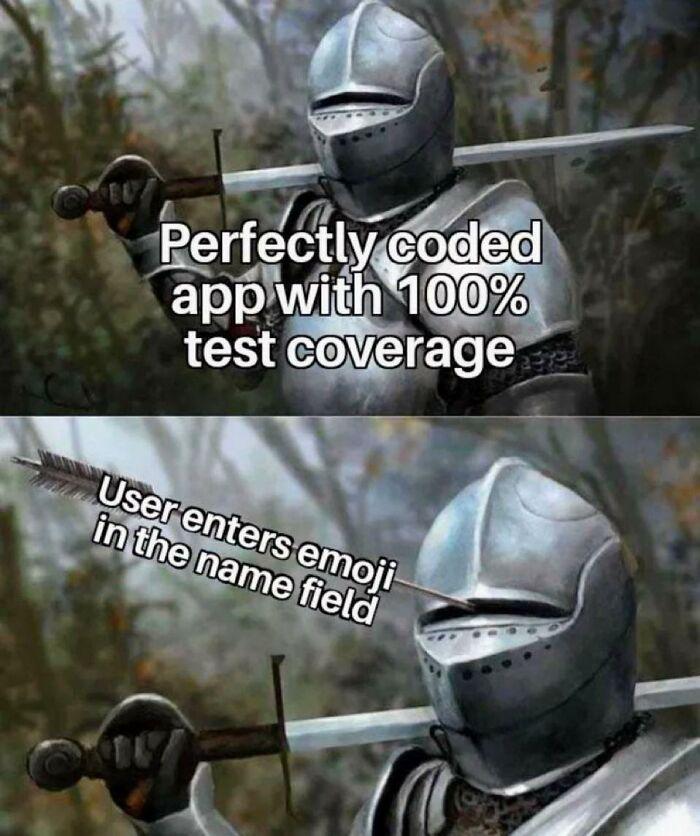
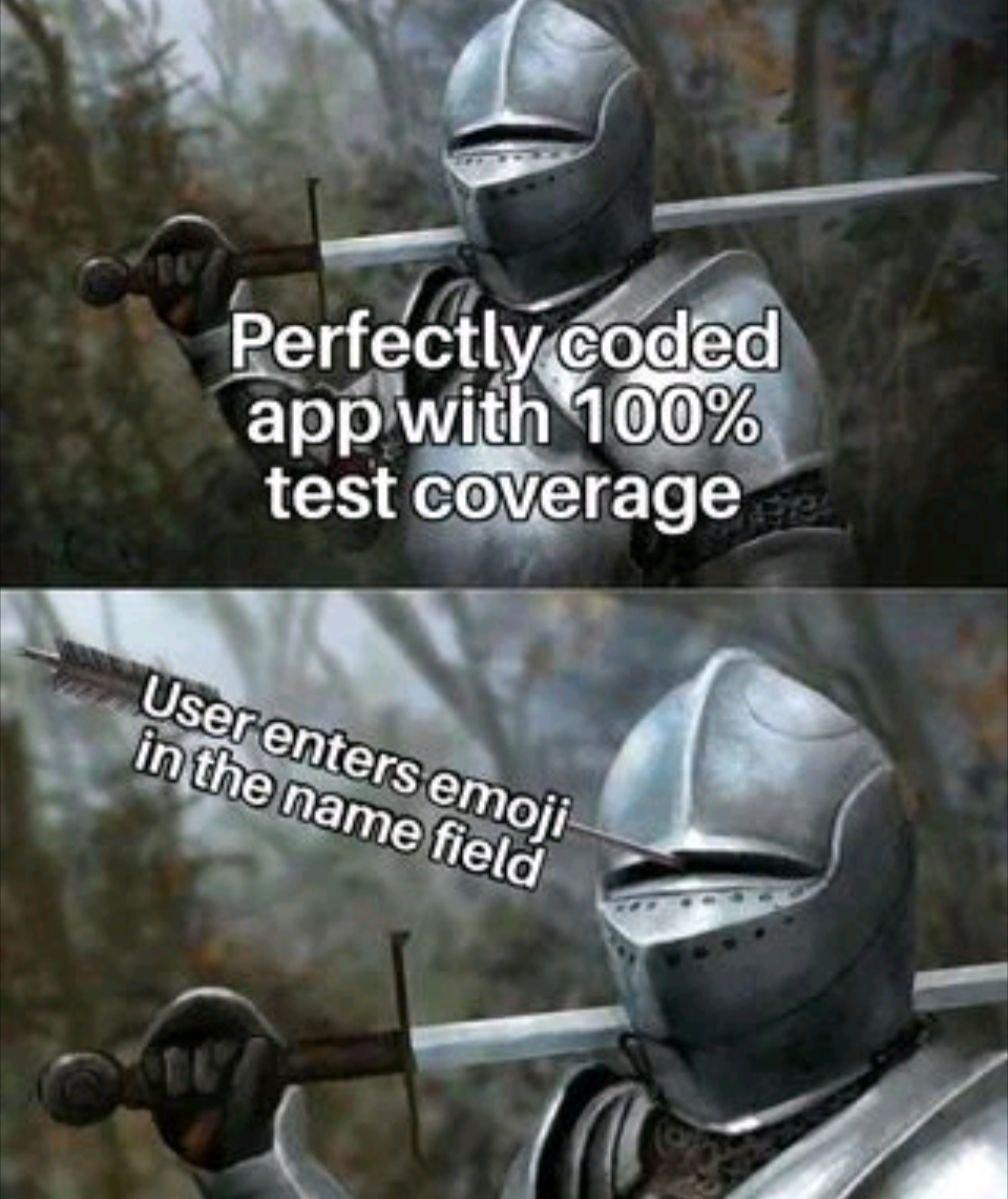
You've spent weeks writing pristine code, achieved that mythical 100% test coverage, handled every edge case known to humanity... and then some user decides to put 🎉💀🔥 in the name field. Your entire validation layer just got obliterated by three Unicode characters. Because apparently, while you were busy testing for SQL injection and XSS attacks, nobody thought to ask "what if someone just... doesn't use letters?" Your regex that confidently checks for ^[a-zA-Z]+$ is now weeping in the corner while your database tries to figure out how to sort "John Smith" and "💩". Fun fact: Emojis are stored as multi-byte UTF-8 characters, which means your VARCHAR(50) field might actually only fit like 12 emojis. But sure, your tests passed. Your beautiful, emoji-less tests.

What Should I Do Now

What Should I Do Now
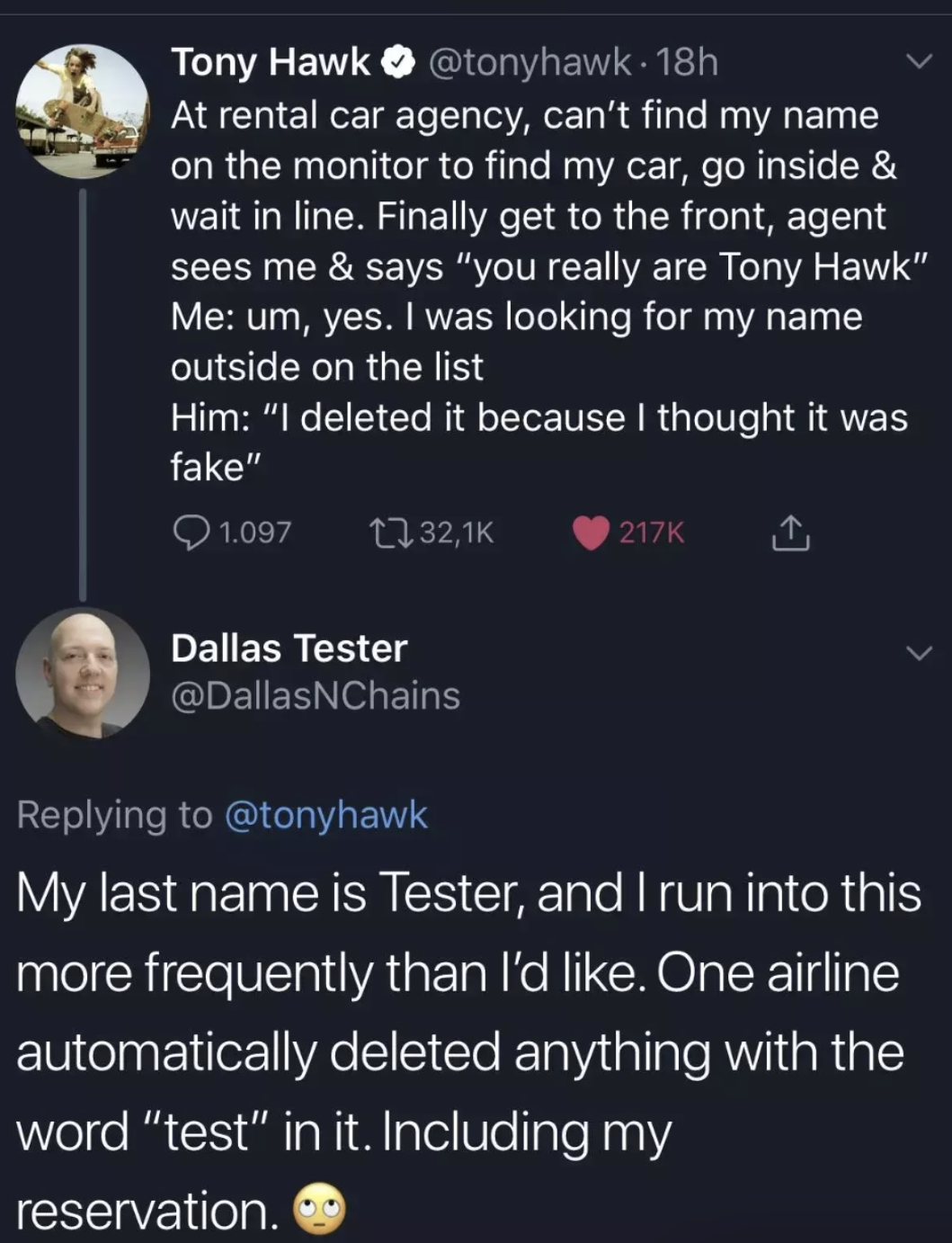
Guy's surname is "Wu" and some form system decided that two characters just isn't enough for a last name. Because clearly, every database architect in history assumed all humans follow the same naming conventions. The validation rule says minimum 3 characters, and Wu says "I exist." Meta's official account responding with "wuhoooo!" is either peak corporate humor or someone in their social media team is having way too much fun. Fun fact: This is a classic example of Falsehoods Programmers Believe About Names . Names can be one character, they can have no last name, they can be symbols, they can change daily. Your regex won't save you.

Time Travel: The Ultimate Visa Hack

Time Travel: The Ultimate Visa Hack
Behold the ultimate hack for time-sensitive bureaucracy! When your visa application says "impossible" but your system clock says "hold my beer." Changing your computer's time to trick a government website is peak developer ingenuity. The backend developers were probably like "date validation? That's frontend's problem!" and the frontend team was like "we'll just check if it *looks* like a date." And now we have a visa system that can be fooled by the same trick we used to extend free software trials in 2003. Security through obscurity at its finest!