Uptime Memes

Posts tagged with Uptime
They Achieved Greatness

They Achieved Greatness
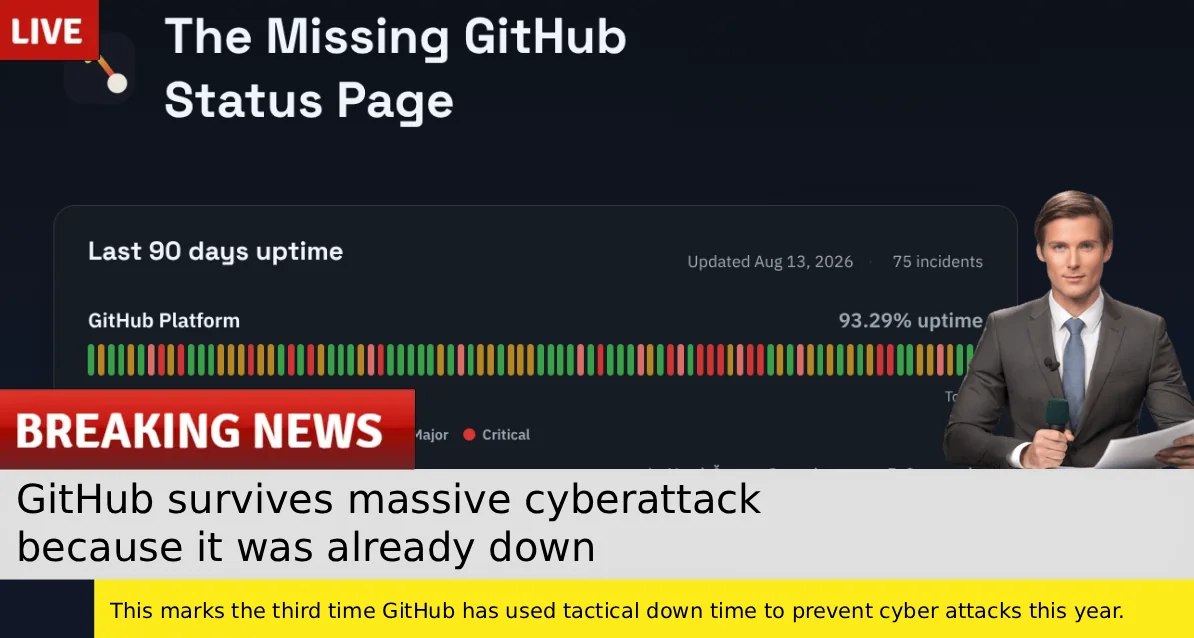
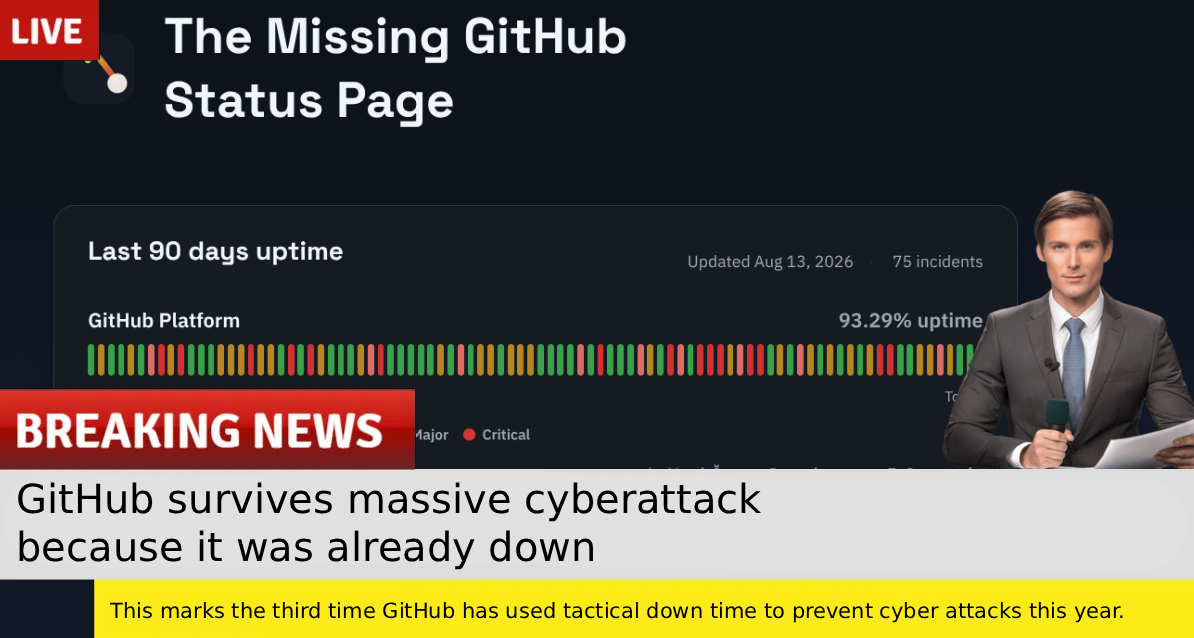
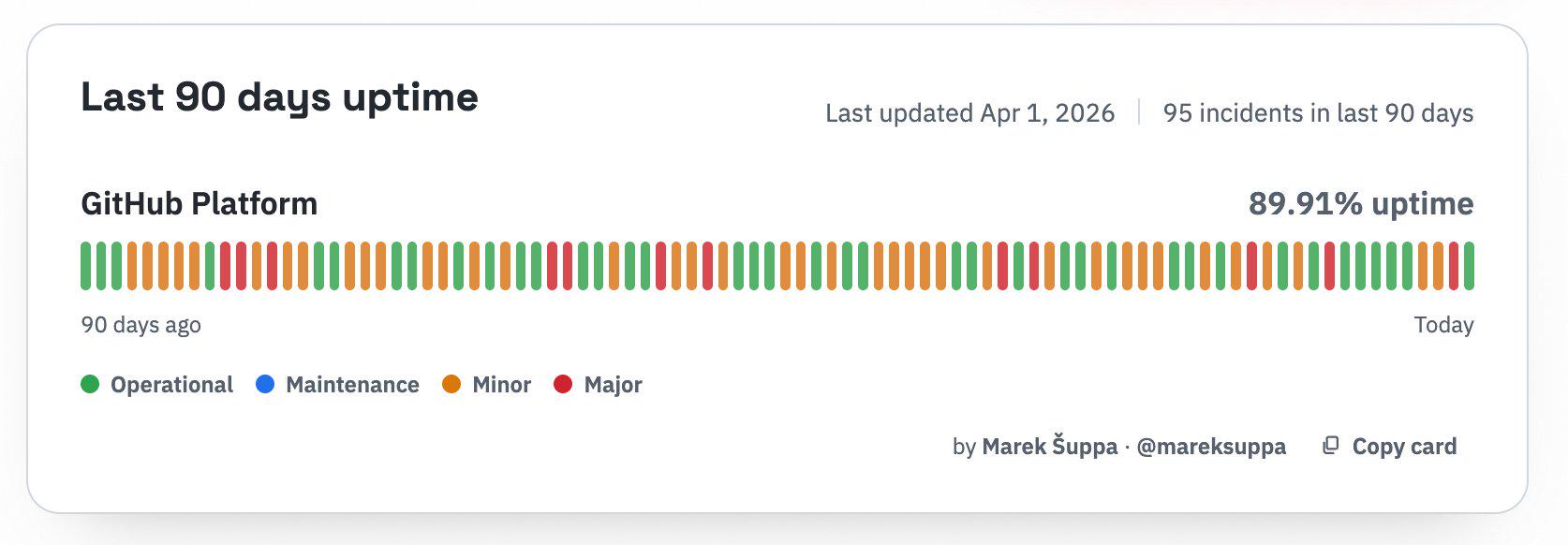
GitHub Platform flexing that sweet 89.91% uptime like it's a badge of honor. That's basically saying "we're only down 10% of the time!" which translates to roughly 9 days of downtime over 90 days. With 95 incidents sprinkled in there like confetti at a chaos party, this status page looks like a Christmas light display having an existential crisis. The bar graph is a beautiful mess of green (operational), orange (minor issues), and red (major outages) that screams "we're fine, everything's fine" while the building burns. For context, most enterprise SaaS platforms aim for 99.9% uptime (the "three nines"), so GitHub's sitting at a solid C+ here. But hey, when you're the monopoly of code hosting, who needs reliability? Developers will still push to main at 2 AM regardless.

It's Microslop

It's Microslop
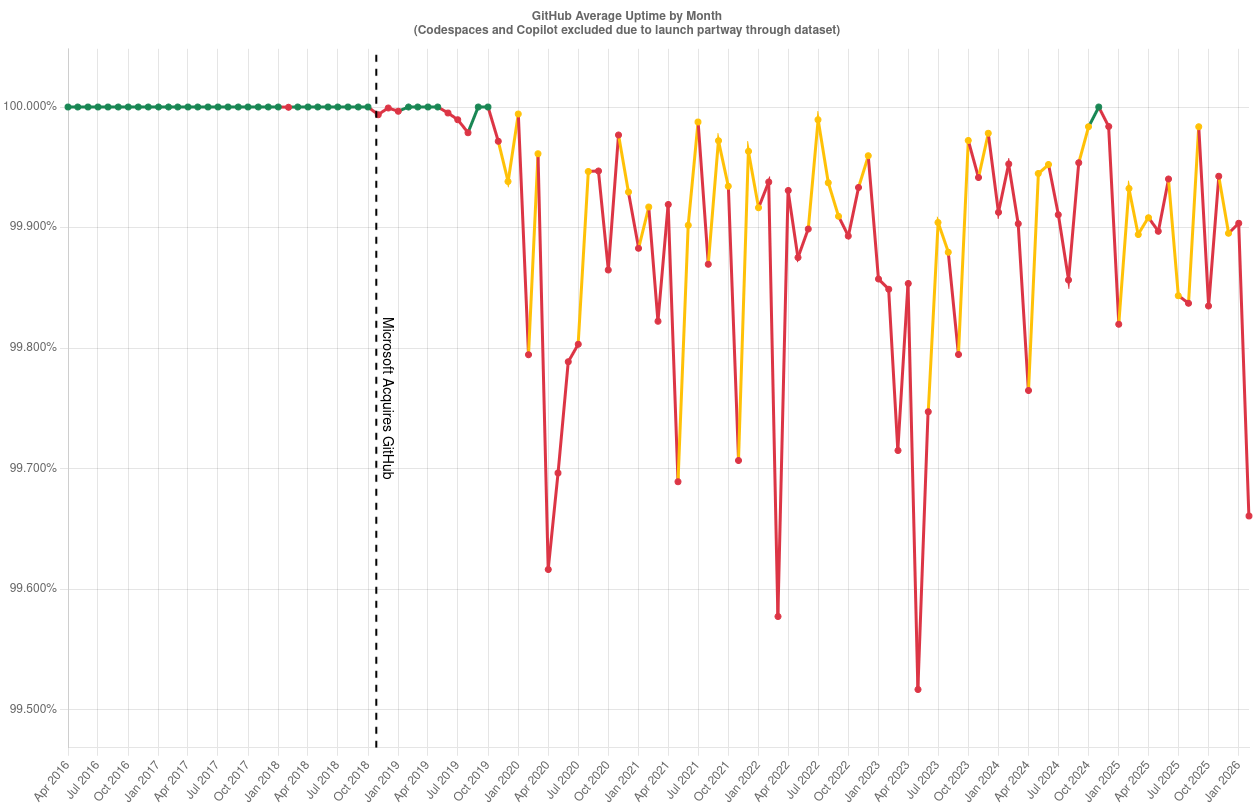
So GitHub was basically rock-solid for years until Microsoft acquired them in 2018, and suddenly the uptime chart looks like my heart rate monitor during a production deployment. That vertical line marking the acquisition is doing some heavy lifting here—it's literally the moment everything went from "five nines" to "five why's." The green line (pre-Microsoft) is flatter than a junior dev's learning curve, while the post-acquisition rainbow spaghetti of red and yellow is giving major "we migrated to Azure" vibes. Nothing says enterprise acquisition quite like turning a stable platform into a reliability roulette wheel. Fun fact: "Microslop" has been a beloved nickname in tech circles since the 90s, but charts like these keep it eternally relevant. At least they're consistent at being inconsistent.

Ninety Days Ninety Incidents Challenge Complete

Ninety Days Ninety Incidents Challenge Complete
GitHub's status page looking like a Christmas light display gone wrong. 90 incidents in 90 days is a perfect 1:1 ratio – that's the kind of consistency most engineers can only dream of achieving! The bar graph is basically a rainbow of chaos with more orange and red bars than a traffic jam simulator. The real kicker? They're still rocking 90.84% uptime, which technically means they met their SLA... probably. Someone's on-call rotation must feel like Groundhog Day, except instead of reliving the same day, you're just getting paged every single day. The DevOps team deserves hazard pay and therapy at this point.

Multi Billion Dollar Company

Multi Billion Dollar Company
Claude.ai proudly displaying their 98.98% uptime like it's something to celebrate. That's roughly 9 hours of downtime over 90 days. For a multi-billion dollar AI company that everyone's paying premium subscriptions for, that uptime graph looks like a Christmas light display having an existential crisis. The irony? Most indie devs running their side projects on a $5 DigitalOcean droplet have better uptime than this. Nothing screams "enterprise-grade infrastructure" quite like a status page that looks like it's been through a blender. Those red bars at the end marked "Major Outage" are just *chef's kiss*. Meanwhile, their marketing team is probably calling this "industry-leading reliability" while their DevOps team is stress-testing their resume templates.

Programming Is Solved

Programming Is Solved
Imagine thinking AI has "solved" programming, only to realize your entire workflow now depends on Claude's uptime. That 98.88% looks reassuring until you're sprinting away from a deadline while Claude decides to take a coffee break. The duck's smug confidence in the first panel versus the absolute terror in the second perfectly captures the moment you realize you've outsourced your entire brain to a service that can go down at any moment. Nothing says "solved" quite like your AI assistant having a worse uptime than your uncle's Geocities website from 2003.

Software Engineering Is Solved

Software Engineering Is Solved
So apparently software engineering is "solved" because Claude has 99% uptime. Cool, cool. Guess we can all pack up and go home now. Just ignore those suspiciously red bars at the end of each timeline labeled "Degraded Performance" - I'm sure those weren't during your critical demo or when you were frantically trying to meet a deadline. The beautiful irony here: we've replaced the uncertainty of writing our own buggy code with the uncertainty of depending on someone else's buggy infrastructure. Progress! Now instead of debugging your own stack traces, you get to refresh a status page and tweet angrily at a cloud provider. The future truly is now. That 1% downtime? That's when your boss asks "why isn't the AI working" and you have to explain that no, you didn't break anything, it's just that our entire product architecture is now a single point of failure hosted by someone else. But hey, at least you don't have to maintain it... until you do.

But What Does The Power Button Do Then?

But What Does The Power Button Do Then?
Someone put a power switch on their PSU with "POWER NEVER ENDS" engraved right next to it. So now you've got a philosophical paradox on your hands: if power never ends, what exactly is that switch controlling? A placebo? Your hopes and dreams? The button has become decorative at this point. It's like putting a brake pedal in a car with "BRAKES DON'T WORK" written on it. The switch just sits there, mocking the very concept of on/off states. Schrödinger's power supply—it's simultaneously on and off until you check if your server is still responding.

What Shutdown? We Don't Do That Here

What Shutdown? We Don't Do That Here
Shutdown? What shutdown? My laptop has been running continuously since the Obama administration. The only time it restarts is when Windows forces an update while I'm in the middle of debugging a critical production issue. My uptime isn't measured in hours or days—it's measured in git commits and coffee cups. Closing the lid is just putting it into hibernation mode so I can transport my 47 open Chrome tabs, 12 VS Code windows, and that one terminal where I've been running a script for so long I'm afraid to touch it to my next location. Shutting down is for people who don't have nightmares about losing their terminal history.

When Your DDoS Protection Becomes The Problem

When Your DDoS Protection Becomes The Problem
The infamous Cloudflare 500 error page – where everything is working except the one thing you actually need. DevOps promised "cutting edge DDoS protection" but apparently forgot to protect us from their own service going down. Classic case of "we've secured everything so well that even legitimate users can't get in." It's like putting a state-of-the-art security system on your house but then losing the only key. The browser works, the host works, but London? London has chosen chaos today.

You Dawg, I Heard You Like Downtime

You Dawg, I Heard You Like Downtime
Recursive downtime monitoring at its finest. When your monitoring service fails, who monitors the monitor? It's like needing a smoke detector for your smoke detector. The irony of relying on downdetector.com only to find it's also experiencing the void of nothingness we call "unplanned service interruption." Just another day in the life of an SRE wondering if the internet is actually down or if it's just their ISP having a moment.

When The Internet's Bouncer Has Had Too Much To Drink

When The Internet's Bouncer Has Had Too Much To Drink
Ah, Cloudflare's status page—where "investigating" and "continuing to investigate" are just fancy ways of saying "we have no clue what's happening but we're frantically Googling the error messages too." The true poetry is in that beautiful ASCII shrug ¯\_(ツ)_/¯ update, silently screaming "have you tried turning the internet off and on again?" while half the web burns. Nothing says "mission-critical infrastructure" quite like timestamps proving they've been "investigating" for 3+ hours while DevOps teams worldwide explain to management why their five-nines uptime just became three-nines.

If I Go Down I'm Taking You With Me

If I Go Down I'm Taking You With Me
Ah, the perfect digital murder-suicide! Your service crashes, but instead of letting the world know about your incompetence, you take down the monitoring service too. It's like unplugging the smoke detector during a house fire because the beeping is annoying. That Cloudflare logo just makes it *chef's kiss* - because nothing says "high availability" like being the single point of failure for half the internet. When your status page is hosted on the same infrastructure that's currently burning to the ground, you've achieved peak DevOps enlightenment.