

Azure Memes

Azure: where Microsoft decided that what the cloud really needed was more enterprise acronyms and a portal that changes layout every few months. These memes celebrate the cloud platform that somehow manages to be both more corporate and more developer-friendly than its competitors. If you've ever deployed to the wrong region because the dropdown menu had 50+ options, explained to management why moving to Azure isn't just "installing Windows on AWS," or felt the special satisfaction of using Azure DevOps for your open-source project hosted on GitHub (which is also Microsoft now, confusingly), you'll find your fellow blue-cloud dwellers here. From the comprehensive integration with Microsoft's ecosystem to the occasional mystery of services that seem to do the same thing but with slightly different names, this collection honors the platform that made the cloud accessible to enterprises that were afraid of Amazon but already had Microsoft licenses.
Breaking: NASA Is Using Office 365 Uninstaller Version 5.56 In Response To The Outlook Issues Onboard The Artemis II Spacecraft

Breaking: NASA Is Using Office 365 Uninstaller Version 5.56 In Response To The Outlook Issues Onboard The Artemis II Spacecraft
When you're literally going to the moon but someone in IT decided Office 365 was mission-critical software. The astronauts return early only to discover Microsoft's bloatware has somehow infected their spacecraft. The sheer horror on their faces when they realize they'll be receiving Outlook meeting invites at 250,000 miles from Earth is priceless. Nothing says "advanced space exploration" quite like dealing with Outlook crashes during re-entry. The crew's reaction escalates from confusion to full-on existential dread faster than a forced Windows update. At least they can uninstall it... oh wait, you need admin privileges for that, and IT is back on Earth. Houston, we have a problem, and it's asking us to restart to complete the installation.

It's Microslop

It's Microslop
So GitHub was basically rock-solid for years until Microsoft acquired them in 2018, and suddenly the uptime chart looks like my heart rate monitor during a production deployment. That vertical line marking the acquisition is doing some heavy lifting here—it's literally the moment everything went from "five nines" to "five why's." The green line (pre-Microsoft) is flatter than a junior dev's learning curve, while the post-acquisition rainbow spaghetti of red and yellow is giving major "we migrated to Azure" vibes. Nothing says enterprise acquisition quite like turning a stable platform into a reliability roulette wheel. Fun fact: "Microslop" has been a beloved nickname in tech circles since the 90s, but charts like these keep it eternally relevant. At least they're consistent at being inconsistent.

It Dropped From 13 Min To 3 Secs

It Dropped From 13 Min To 3 Secs
That magical moment when you stop torturing your poor laptop CPU and finally spin up a proper GPU instance. Your machine learning model that was crawling along like it's stuck in molasses suddenly transforms into a speed demon. The performance jump is so absurd you're left wondering why anyone would even bother with CPU training anymore. And yet here we are, still running local experiments on our MacBooks like peasants because cloud costs are... well, let's just say they're "motivating" us to optimize our code first. The real kicker? You could've saved yourself 3 days of waiting if you'd just bitten the bullet and paid for that GPU time from the start.

Just A Dashing Of AI

Just A Dashing Of AI
Microsoft really said "let's sprinkle AI on literally everything" and went full Salt Bae mode. Windows? AI. Word? AI. Excel? Believe it or not, also AI. PowerPoint? You guessed it. Teams? Double AI. Even GitHub got the treatment. The Windows logo getting pelted with AI features while every single app icon at the bottom waits for its turn is peak 2023-2024 tech strategy. Nothing says "innovation" quite like renaming your search bar to Copilot and calling it revolutionary. Remember when software just... did things? Now everything needs an AI assistant to help you write emails you don't want to send, generate code you don't understand, and summarize meetings that should've been emails in the first place.

Love Living In A Timeline Where MS Paint Has A Login Screen. What Went Wrong With Microsoft?

Love Living In A Timeline Where MS Paint Has A Login Screen. What Went Wrong With Microsoft?
Remember when you could just... open Paint and draw? Those were simpler times. Now Microsoft wants you to sign in with your Microsoft account just to scribble some pixels on a canvas. It's like needing a passport to use a crayon. The SpongeBob "Caveman" meme format captures the sheer absurdity perfectly—primitive brain trying to comprehend why a 30-year-old bitmap editor that literally just pushes RGB values around needs cloud integration and user authentication. Next thing you know, they'll add AI-powered brush strokes and a subscription tier for the color picker. This is peak modern Microsoft: take something that worked fine since Windows 3.1, "modernize" it by shoving Azure AD authentication down its throat, and call it innovation. Paint used to be 2MB of pure simplicity. Now it probably phones home more than Windows Telemetry.

Certifications Vs. Real World Experience

Certifications Vs. Real World Experience
You can collect certifications like Pokémon cards—CompTIA A+, BSc, CCNA, AWS, Azure, CEH—but the moment you meet someone who just casually uses Linux daily? Game over. They've probably never touched a certification exam in their life, yet they'll outshoot you every single time when it comes to actual problem-solving. There's something deeply humbling about spending thousands on certs only to watch a sysadmin who learned everything from breaking their Arch install fix your production server in 30 seconds. Certifications get you past HR; Linux experience gets you past Tuesday.

Thank You Slopya Nadella, Very Cool

Thank You Slopya Nadella, Very Cool
Microsoft's cloud services have been so reliable lately that we're tracking uptime in... *checks notes* ...zero days. That's right, the counter hasn't budged from 0000 because Azure and Microsoft services keep face-planting harder than a junior dev deploying to prod on a Friday. The meme shows someone gleefully hugging themselves with "Microslop" labels everywhere, because when your entire business depends on Microsoft's infrastructure and it goes down for the millionth time, all you can do is laugh through the pain. The "Slopya Nadella" wordplay is *chef's kiss* – a beautiful roast of Microsoft's CEO Satya Nadella during yet another outage. Nothing says "enterprise-grade reliability" quite like your cloud provider speedrunning downtime records. But hey, at least we're all suffering together in the Azure void. 🔥

This Never Fucking Works

This Never Fucking Works
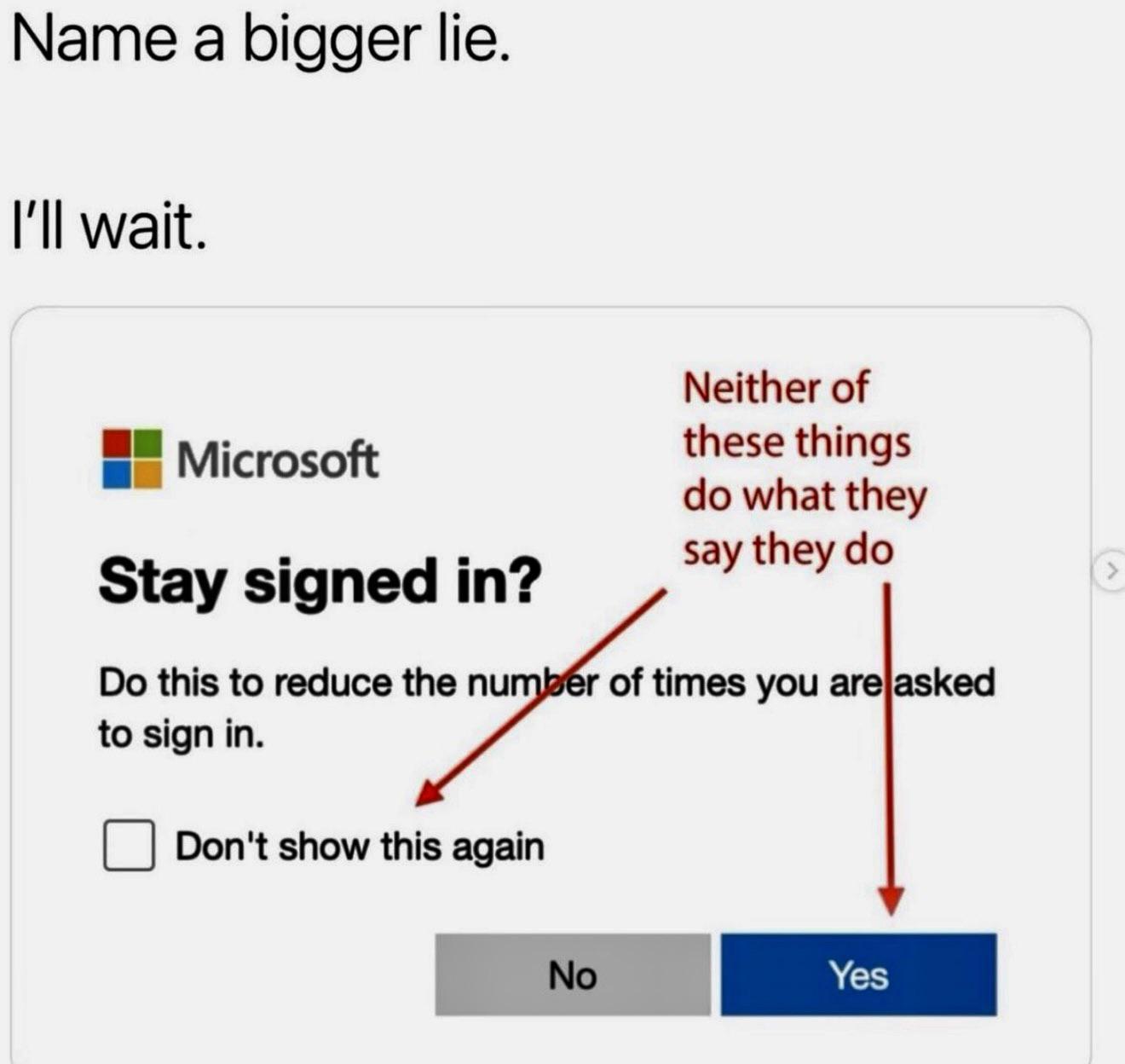
Microsoft's login system asking if you want to stay signed in, promising to "reduce the number of times you are asked to sign in." Then there's the "Don't show this again" checkbox. Spoiler alert: you'll see this dialog tomorrow. And the day after. And every single day until the heat death of the universe. These checkboxes are basically digital placebos. You click them with hope in your heart, believing this time will be different. It never is. Microsoft will ask you to sign in again before you finish your coffee. The checkbox might as well say "Click here to feel momentarily empowered before we ignore your preferences entirely." The "Yes" button to stay signed in? Also decorative. Your session will expire faster than milk left on a radiator.

New Ms Logo

New Ms Logo
Someone took Microsoft's iconic four-square logo and replaced it with the emotional journey of using their products. Top left: nuclear explosion (error). Top right: crying face (frustration). Bottom left: sad face (depression). Bottom right: somehow still smiling (Stockholm syndrome). Then they renamed it "Microslop" because subtlety is overrated. The logo perfectly captures the developer experience: start with catastrophic errors, cry about it, accept your fate with sadness, and eventually develop an inexplicable attachment to the pain. It's like a visual representation of every Windows update, Azure outage, and "Works on my machine" moment rolled into one beautiful disaster.

In Light Of The Recent Jensen Huang Complaint And His Contributions To The Current State Of Tech

In Light Of The Recent Jensen Huang Complaint And His Contributions To The Current State Of Tech
Jensen Huang really out here catching strays for making GPUs so expensive that Microsoft and Nvidia became household names for draining corporate budgets. But you know what? The man deserves credit where credit is due. He didn't just create a tech company—he created "Microslop Nshitia," the beautiful merger of bloated software and overpriced hardware that perfectly encapsulates modern tech. Your AI model needs 8 H100s to run? That'll be the GDP of a small nation, thanks. Want to train anything? Better get that enterprise license from Microsoft Azure while you're at it. It's the perfect ecosystem: Microsoft provides the cloud infrastructure to burn money, and Nvidia provides the GPUs to set that money on fire even faster. The Drake meme format really captures the vibe—rejecting the individual corporate overlords but fully embracing their unholy alliance. Because if you're gonna get fleeced, might as well get fleeced by the dream team.

This Isn't Normal

This Isn't Normal
When someone dares to suggest you could just use a simple, straightforward solution but instead you're out here wrestling with the Azure Storage SDK like it's a feral beast that refuses to be tamed. Because why would ANYTHING in cloud development be intuitive or easy? The SDK documentation reads like ancient hieroglyphics, the error messages are about as helpful as a chocolate teapot, and you're just sitting there screaming into the void while your code throws exceptions you didn't even know existed. But sure, let's just "be normal" about our cloud storage implementation. Normal is for people who don't enjoy suffering through 47 authentication methods and blob container permissions that make zero sense!

Cloud Native

Cloud Native
CTO proudly announces they've migrated 95% of their infrastructure to the cloud, throwing around buzzwords like "resilient," "scalable," and "modern" to a room full of impressed stakeholders. Then someone asks the uncomfortable question: "Doesn't that mean we're entirely dependent on—" but gets cut off by the true believer shouting about best practices and industry standards. Nothing can go wrong when you follow the herd, right? Cut to: Cloudflare goes down and the entire internet breaks. Major outage. Good luck! Boss nervously asks how much of their infrastructure is affected. The answer? That 95% they were bragging about. But don't worry! The good news is they're only down when everyone else is down too. Misery loves company, and so does vendor lock-in. Who needs redundancy across multiple providers when you can just... hope really hard that AWS/Azure/GCP stays up? Turns out "cloud-native" sometimes just means "native to someone else's problems."