

sql Memes

Relational Databases

Relational Databases
Nothing says "forever alone" quite like spending your Friday night normalizing tables and writing JOIN queries while everyone else is out there forming actual human connections. The crying cat perfectly captures that special blend of sadness and acceptance when you realize your most meaningful relationships are between primary and foreign keys. At least your databases don't ghost you... they just throw constraint violations.

The Most Dangerous Character In SQL: (In)Visible

The Most Dangerous Character In SQL: (In)Visible
So someone named "Geoffrey" managed to nuke the entire system, and naturally everyone's playing detective trying to figure out what went wrong. Unicode characters? Nah. SQL injection with "root" or "null"? Not today. Maybe an SQL keyword like "select"? Keep guessing. Turns out it was just... Geoffrey. Except look closer at that last line. See the difference? Ge o ffrey vs Ge ο ffrey . That second "o" is the Greek omicron (ο) instead of a Latin "o". Visually identical, but to your database? Completely different characters. Welcome to the wonderful world of homoglyphs, where your WHERE clause confidently returns zero rows while you question your entire career. This is why we can't have nice things, and why every senior dev has trust issues with user input. Input validation isn't paranoia—it's pattern recognition from trauma.

Sql Love Affair

Sql Love Affair
Oh honey, someone just turned database design into relationship advice and honestly? They're not wrong. The setup is *chef's kiss* – girl asks what you need for a good relationship, and this absolute legend responds with "PRIMARY KEYS" because apparently we're all just living in one giant relational database and nobody told us. For those blissfully unaware: primary keys are what keep your database tables from descending into chaos. They're unique identifiers that make sure every record is special and can be properly referenced – you know, like how you'd want to uniquely identify your significant other instead of accidentally texting the wrong person named "Alex" in your contacts. Without primary keys, your relationships (and your data) would be a hot mess of duplicates and confusion. So yeah, turns out good data integrity and good relationships have more in common than we thought. Who knew SQL was secretly a dating guru this whole time?

Clickhoracle Mongno Sq Liteca

Clickhoracle Mongno Sq Liteca
When your database race starts off with the trendy new kids (OLTP, OLAP, NoSQL, VectorDB) confidently sprinting ahead, but then SQL comes in like a vengeful god with its classic problems: deadlocks, negative account balances, unsupported JOINs, and the eternal "still building that index..." message. The real kicker? That little guy watching from the sidelines with a wrench is probably the DBA who's been warning everyone about proper indexing strategies for the past three months. But sure, let's just throw more RAM at it. Meanwhile VectorDB is already having an existential crisis trying to figure out what a deadlock even means in vector space.

We Invented Object Oriented Design To Solve A Problem And Then Invented SQL To Unsolve It Again

We Invented Object Oriented Design To Solve A Problem And Then Invented SQL To Unsolve It Again
The eternal irony of software engineering: we spent decades building beautiful OOP abstractions with encapsulation, inheritance, and polymorphism, only to throw it all away the moment we need to persist data. SQL databases force us to flatten our elegant object hierarchies into normalized tables, then painfully reconstruct them with JOINs. The meme roasts SQL's quirks with surgical precision: case sensitivity that makes you question your life choices, tables that are just "rows of stuff" (goodbye encapsulation), and foreign keys that are basically pointers but worse. The "WHERE LIKE" and "SELECT FROM of it" mockery is chef's kiss—SQL reads like English written by someone who learned programming from a fever dream. Those three CREATE TABLE examples? Pure gold. MySQL's arbitrary constructor order, PostgreSQL declaring types before names (backwards from most languages), and Oracle forgetting strings exist entirely. Each database vendor decided to implement SQL their own special way, creating a fragmentation nightmare. The punchline "Hello I would like INNER JOIN apples please" perfectly captures how unnatural SQL feels compared to object navigation. Instead of customer.orders , you're writing verbose JOIN ceremonies. Object-relational mapping exists precisely because this impedance mismatch is so painful.

It Can Store Vectors

It Can Store Vectors
Every database migration in a nutshell! First you're screaming at PostgreSQL like it's your mortal enemy, then you reluctantly try it, and suddenly... That magical moment when you discover PostgreSQL isn't just a MySQL replacement—it's a full-blown upgrade with actual vector support, JSON capabilities, and transactions that actually work as intended. The bird's dreamy expression in the last panel perfectly captures that "where have you been all my life?" revelation after suffering through MySQL's limitations for years. The database equivalent of upgrading from a bicycle to a Tesla and wondering how you ever survived before.

SQL Time Is Always Wrong Time

SQL Time Is Always Wrong Time
What happens when a DBA designs a clock? You get Roman numerals in completely random order because SQL queries without proper constraints do whatever they want. Notice how IX (9) is where 4 should be, and V (5) is at 6 o'clock. The comment "It Will Work This Time" is the eternal lie every developer tells themselves before running untested SQL in production. Spoiler: it never does.

SQLite: The Lightweight Database With Heavy Trust Issues

SQLite: The Lightweight Database With Heavy Trust Issues
SQLite users know the struggle all too well. You're happily writing queries, reaching out for that precious data, when suddenly your database hits you with the classic "database is locked" error. It's like inviting someone to dinner and then locking the front door. "Come on in! Oh wait, you can't." And just like that, your beautiful DELETE statement gets bodyblocked by a pink blob while your transaction gets ROLLBACK'd into oblivion. The true SQLite experience: lightweight enough to fit in your pocket, temperamental enough to make you question your career choices.

Clock But It's SELECT DIGITS FROM NUMBERS ORDER BY DIGIT NAME DESC

Clock But It's SELECT DIGITS FROM NUMBERS ORDER BY DIGIT NAME DESC
OH. MY. GOD. This is what happens when you let a database admin design a clock! The numbers are in complete chaos because some SQL-obsessed maniac decided to ORDER BY DIGIT NAME DESC instead of, you know, ACTUAL NUMERICAL ORDER like a SANE HUMAN BEING! The SQL query literally sorted the digits by their spelled-out names in descending order, so "twelve" comes before "three" which comes before "ten" and so on. Can you imagine trying to tell time on this monstrosity?! It's like asking what time it is and getting back "SELECT CURRENT_TIME FROM REALITY WHERE SANITY = NULL"!

The Programmer Dating Hierarchy

The Programmer Dating Hierarchy
The programmer dating market has spoken, and it's absolutely savage. Everyone's fighting over that one Rust developer with memory-safe relationships while C++ devs are left wondering if they've been friend-zoned or just garbage collected. Notice how Java gets a question mark – even the dating pool has NullPointerExceptions when it comes to Java devs. Meanwhile, Python coders are getting attention despite spending hours arguing about whitespace, and JavaScript users somehow remain popular despite their toxic relationship with semicolons. The SQL enjoyer is probably great at relationships – they know how to properly JOIN tables at dinner parties. But that Rust developer? Memory safe, thread safe, AND relationship safe. The ultimate triple threat.

Age As A Primary Key: What Could Possibly Go Wrong?

Age As A Primary Key: What Could Possibly Go Wrong?
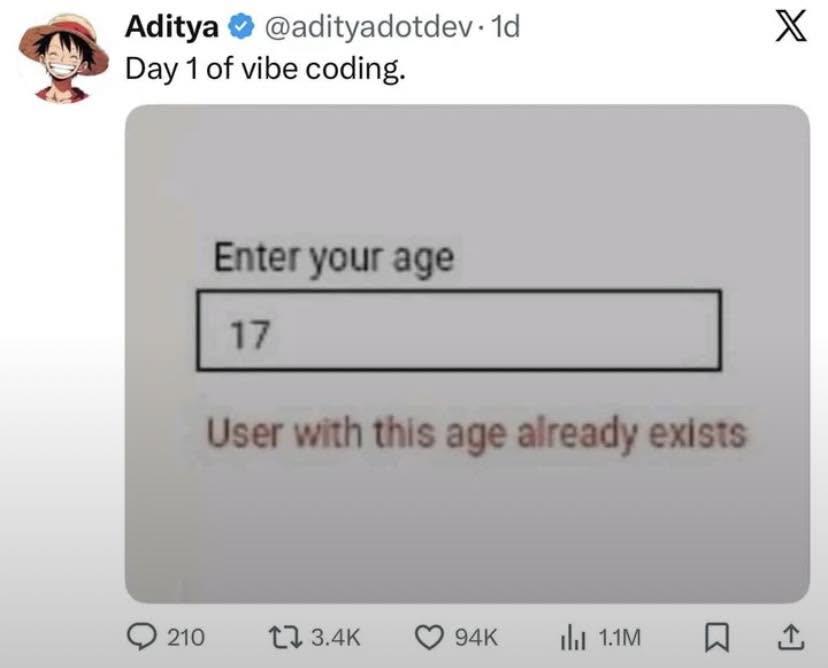
Congratulations, you've just created the world's worst database design! Using age as a primary key is like using a sandwich as a doorstop - technically possible but fundamentally wrong. Primary keys should be unique and unchanging, but unless you've discovered the fountain of youth, your age changes every year. Plus, there are roughly 8 million 17-year-olds on Earth right now, all trying to register for your app. No wonder it's complaining! Next time, maybe try something truly unique... like I don't know... an ID?

Primary Key Catastrophe

Primary Key Catastrophe
When your database design meets reality in the most painful way possible. Someone actually made AGE a primary key instead of, you know, something unique like an ID. Now every 17-year-old on the platform is technically the same person. Congrats, you've invented digital reincarnation! Next up: using "favorite_color" as a password hash.