

Paranoia Memes

Posts tagged with Paranoia
New Fear Unlocked

New Fear Unlocked
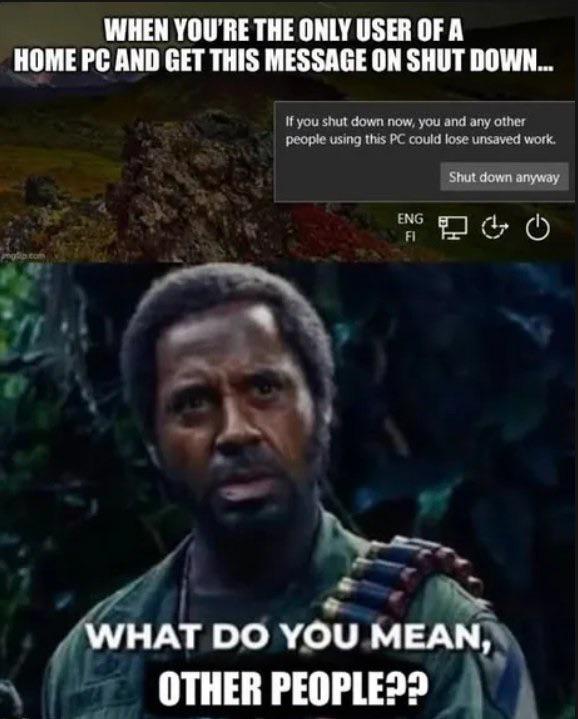
You know that moment when Windows casually drops an existential crisis on you? You're shutting down your supposedly solo home PC, and suddenly the OS is like "hey, just FYI, there are OTHER PEOPLE using this machine right now." Wait. WHAT other people? You live alone. You're the only user account. Nobody's remoted in. The sheer panic of realizing Windows knows something you don't is absolutely terrifying. Is it counting your background processes as "people"? Did someone hack in? Is your smart toaster now a user? Are the ghosts in your machine finally getting recognized by the OS? This is the digital equivalent of coming home and finding an extra toothbrush in your bathroom. The "Shut down anyway" button suddenly feels like a hostage negotiation. Windows really said "not my problem" and left you to deal with your phantom users. Thanks, Microsoft.

Programmers Know The Risks Involved!

Programmers Know The Risks Involved!
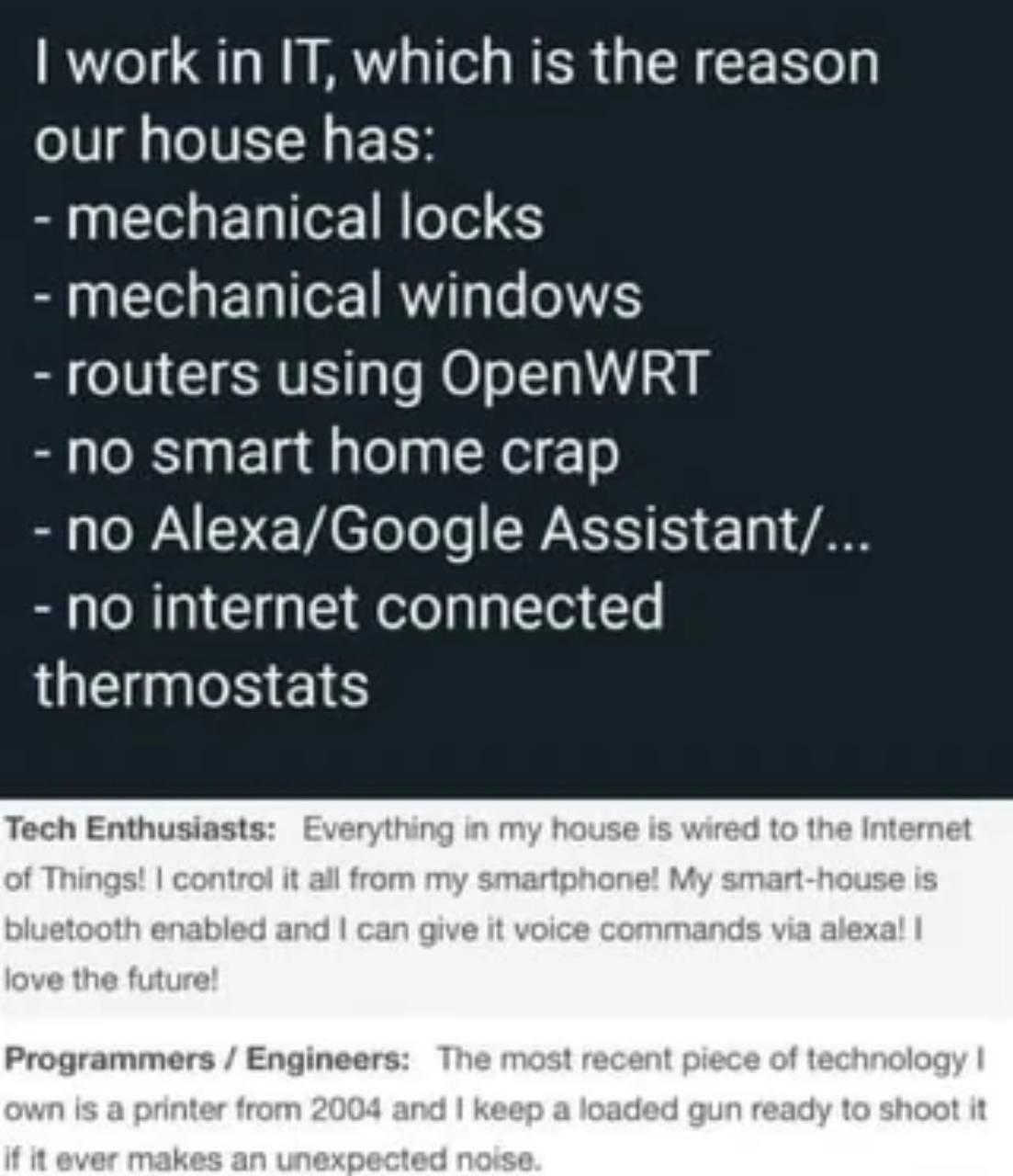
When you work in IT, you develop a very specific type of paranoia that makes you treat every piece of technology like it's personally plotting your demise. While tech enthusiasts are out here living their best sci-fi fantasy with voice-activated toasters and internet-connected toilet paper holders, programmers have seen enough security vulnerabilities to know that the only smart home device you can trust is a mechanical lock from the 1800s. The contrast is GLORIOUS. One side is bragging about controlling their entire house from their smartphone like Tony Stark, while programmers are literally keeping a loaded gun next to their 2004 printer in case it makes a suspicious beep. Because nothing says "I understand cybersecurity" quite like refusing to let your thermostat connect to WiFi and running OpenWRT on your router like you're preparing for digital warfare. OpenWRT, by the way, is open-source firmware for routers that gives you actual control over your network instead of trusting whatever backdoor-riddled garbage the manufacturer shipped. It's basically the difference between renting and owning your router's soul.

Programmers Know The Risks Involved

Programmers Know The Risks Involved
When you understand how technology actually works, you realize that "smart home" is just a fancy way of saying "200 attack vectors living rent-free in your house." Mechanical locks can't be phished, mechanical windows don't need security patches, and OpenWRT routers are basically the programmer's way of saying "I trust myself more than I trust Cisco." Meanwhile, tech enthusiasts are out here treating their homes like beta testing environments for every IoT device that promises convenience. Voice assistants? That's just always-on microphones with extra steps. Internet-connected thermostats? Because what could possibly go wrong with letting your HVAC join a botnet? The real power move is the 2004 printer with a loaded gun next to it. Because if two decades of dealing with printer drivers has taught us anything, it's that printers are inherently evil and must be dealt with using extreme prejudice. PC LOAD LETTER? More like PC LOAD LEAD.

Code Compiled In First Attempt

Code Compiled In First Attempt
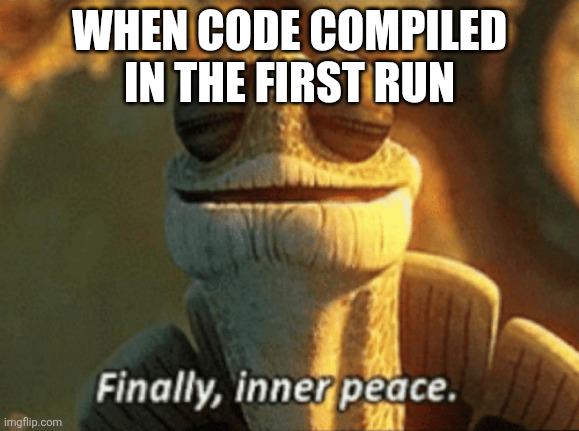
You know something's wrong when your code compiles on the first try. Either you've ascended to a higher plane of existence, or you're about to discover a runtime error so catastrophic it'll make you wish for the comfort of syntax errors. That moment of "inner peace" lasts exactly 3 seconds before the paranoia kicks in and you start frantically checking if you accidentally commented out half your codebase. Spoiler: it runs perfectly, which means it's definitely cursed.

Real Trust Issues

Real Trust Issues
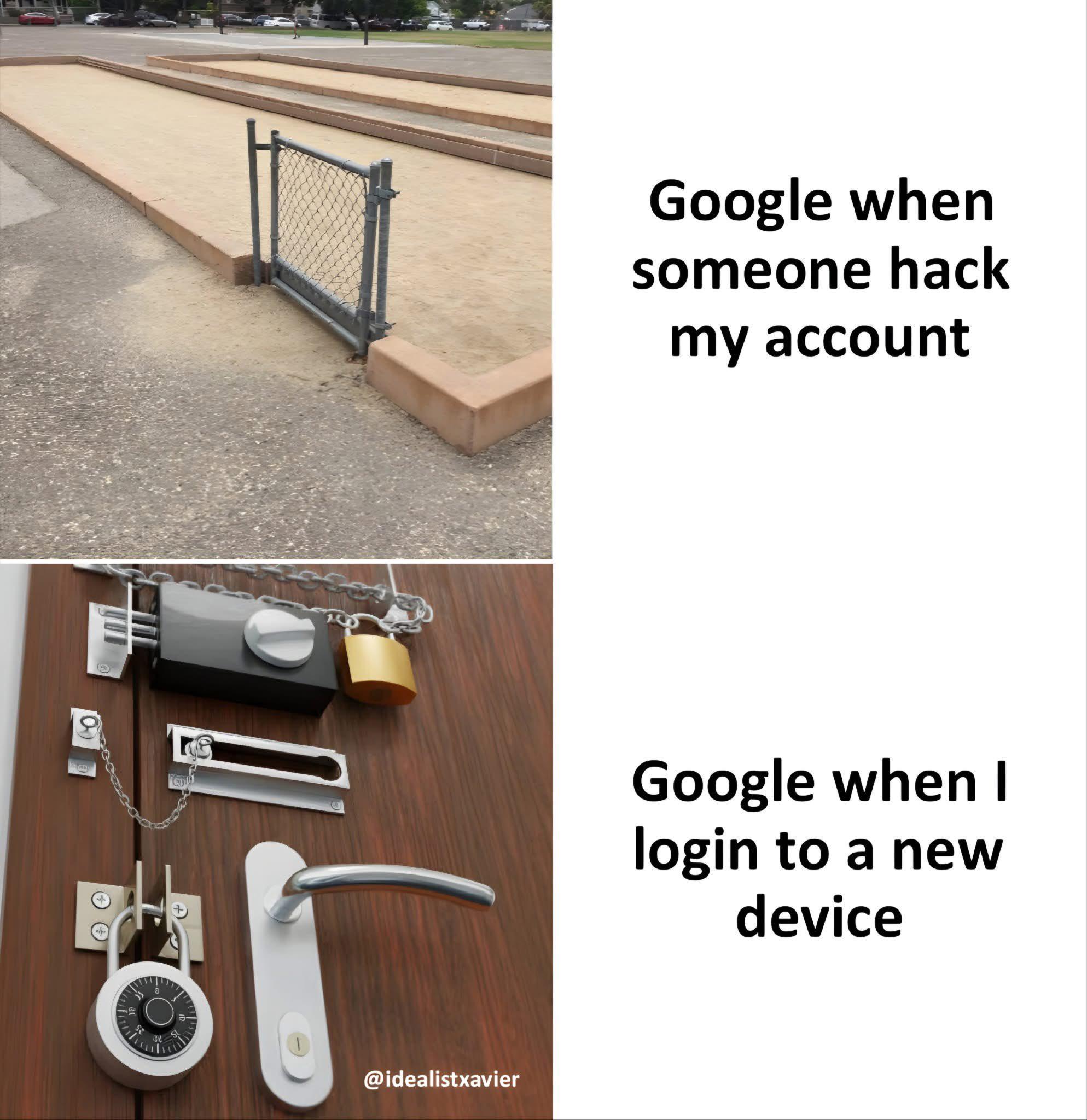
Google's security paranoia in a nutshell. Someone tries to hack your account? They install a decorative baby gate that a toddler could step over. You try logging in from a new device? Fort Knox suddenly materializes on your door with padlocks, chains, combination locks, and probably a retinal scanner they forgot to photograph. The irony is that Google will happily let a bot from Kazakhstan try your password 47 times, but heaven forbid you get a new phone and want to check your email. Suddenly you're answering security questions from 2009, verifying on three other devices, and providing a DNA sample. Two-factor authentication? More like twelve-factor authentication when it's actually you trying to get in.

Power Button Paranoia Chronicles

Power Button Paranoia Chronicles
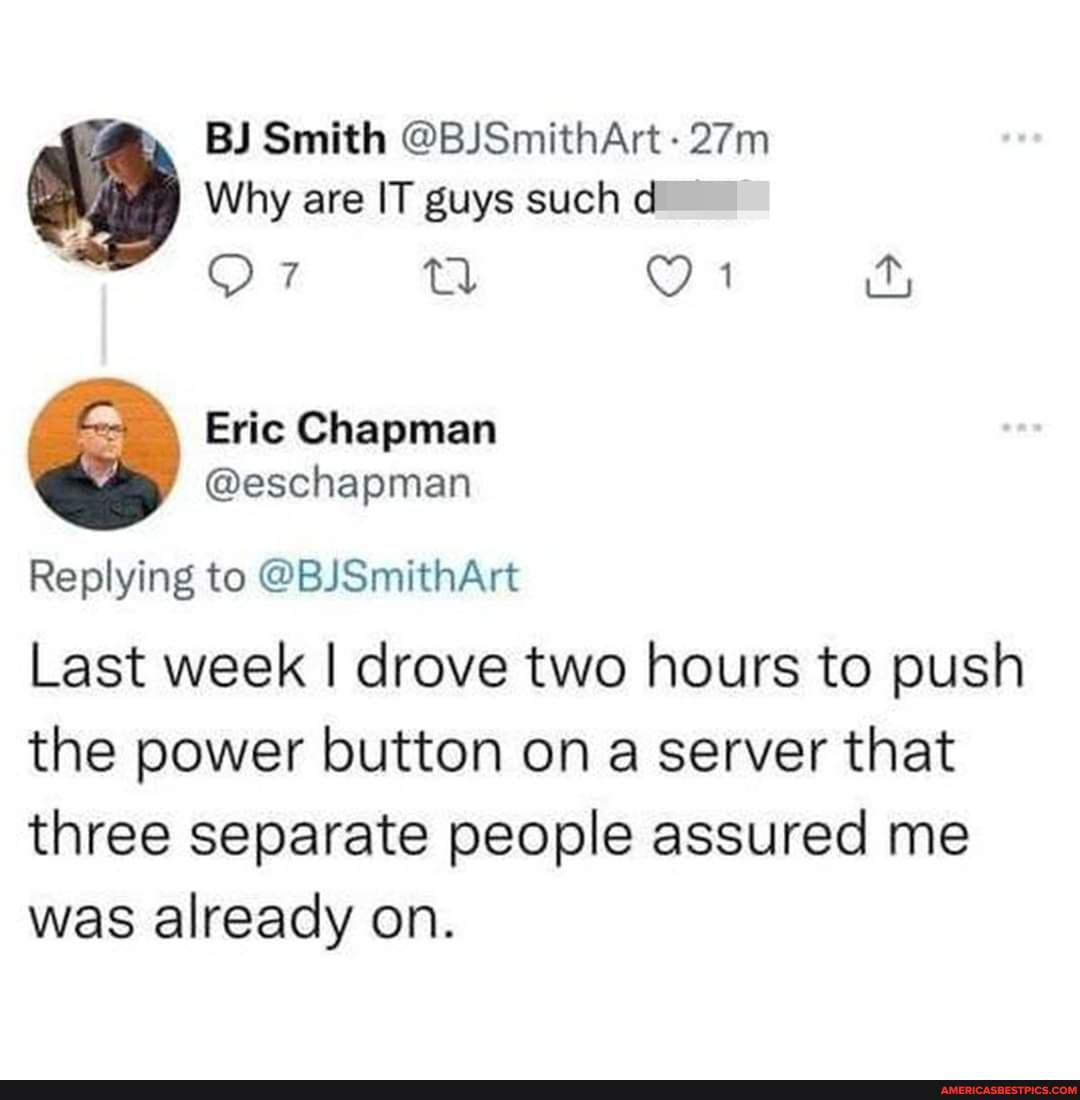
Trust issues level 9000! When someone asks why IT professionals are difficult, here's your answer: driving two hours just to physically verify a server is powered on despite THREE people's assurances. Because in the server room, "trust but verify" isn't just a motto—it's a survival mechanism. That blinking LED is worth more than any verbal confirmation. Remote management tools? Sure, they exist... but nothing beats the sweet relief of pressing that cold metal power button yourself and whispering, "I knew it" when you were right all along.

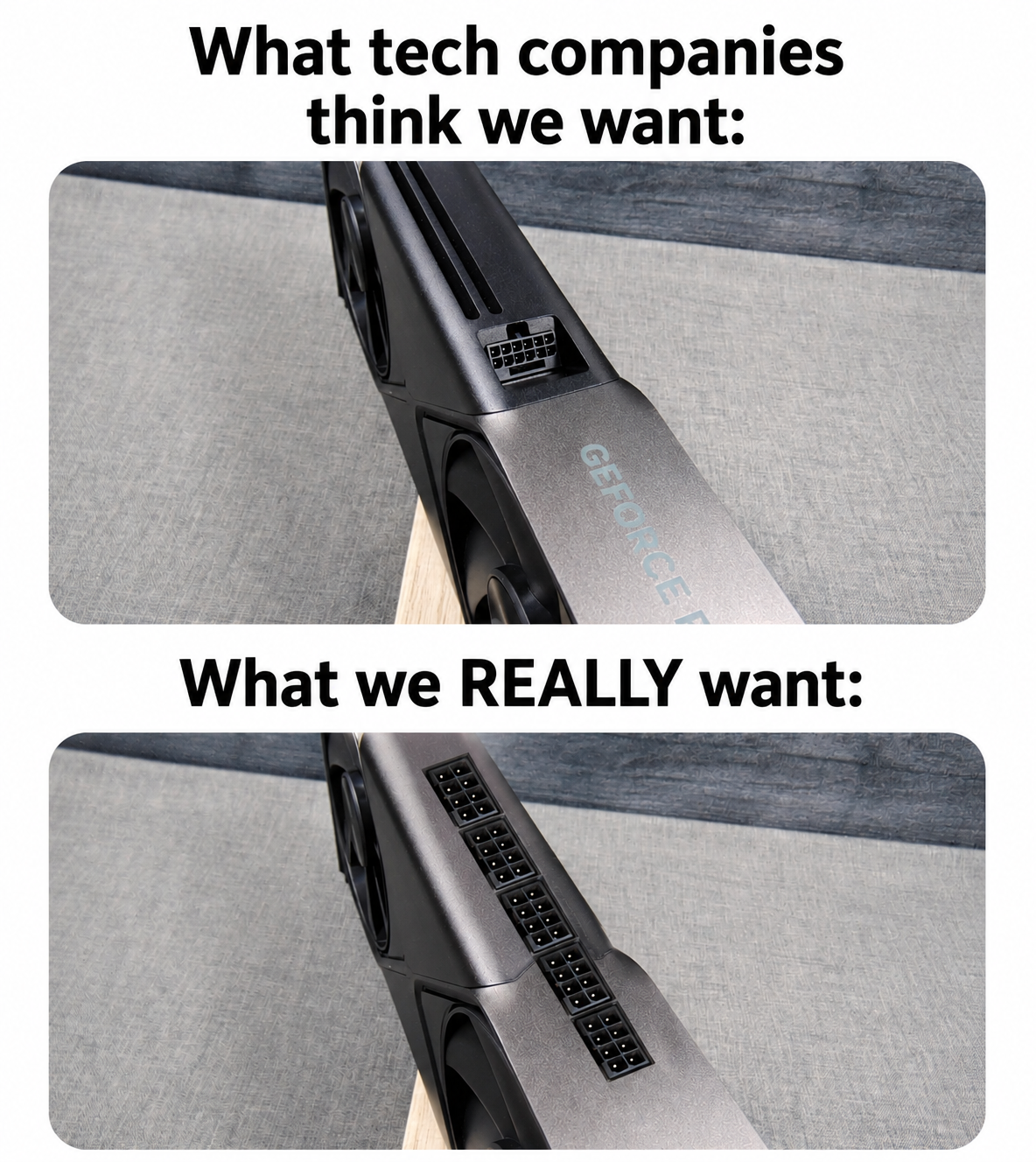
CalDigit TS5 PLUS - Thunderbolt 5 Dock - 20 Port, 10Gb Ethernet, 140W dedicated host Charging, TBT-5 x 3, USB 10Gb/s x10, Dual USB Controllers, Up to Two 8K 60Hz Displays, 1.0m Braided Cable, 330W PSU

CalDigit TS5 PLUS - Thunderbolt 5 Dock - 20 Port, 10Gb Ethernet, 140W dedicated host Charging, TBT-5 x 3, USB 10Gb/s x10, Dual USB Controllers, Up to Two 8K 60Hz Displays, 1.0m Braided Cable, 330W PSU
20 Ports of Extreme Connectivity - Featuring next-level connectivity, the TS5 Plus has more than enough ports for any workflow. The TS5 Plus includes 3x 80Gb/s Thunderbolt 5 ports, 5x USB-A 10Gb/s po…

The Great Clipboard Trust Deficit

The Great Clipboard Trust Deficit
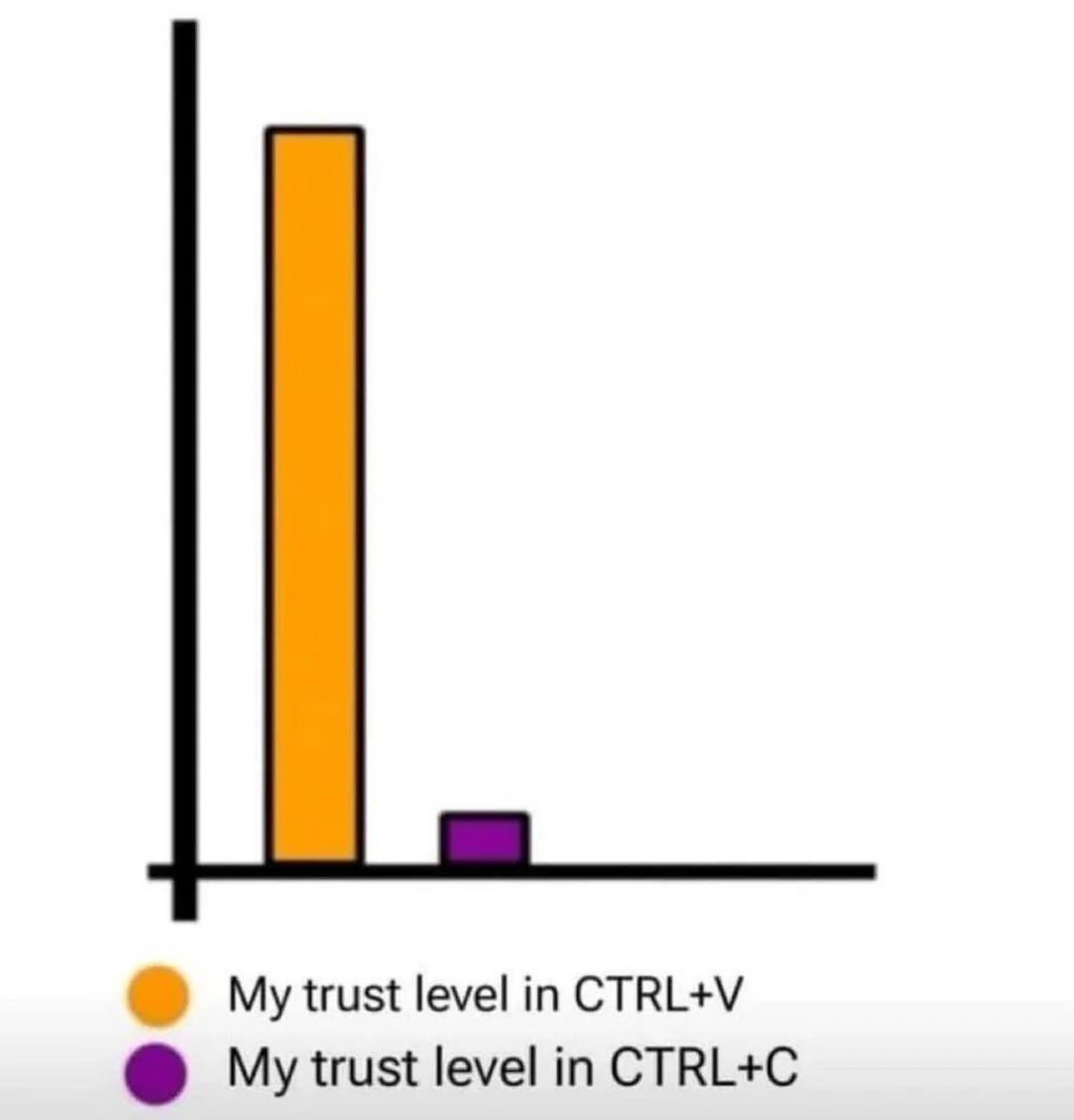
Ah, the existential crisis of keyboard shortcuts! The orange bar towers confidently, representing our unwavering faith in CTRL+V (paste), that magical savior after hours of work. Meanwhile, that tiny purple bar for CTRL+C (copy) might as well be labeled "trust issues." We've all been there—frantically hitting CTRL+C multiple times because did it actually copy though? That moment of panic when you're about to paste something important and suddenly wonder if the clipboard is holding your carefully selected text or just the remnants of that cat meme you copied three days ago. The most sophisticated developers among us have evolved to press CTRL+C at least 17 times in rapid succession. It's not paranoia if the clipboard really is out to get you.

The Evolutionary Stages Of Copy-Paste Sophistication

The Evolutionary Stages Of Copy-Paste Sophistication
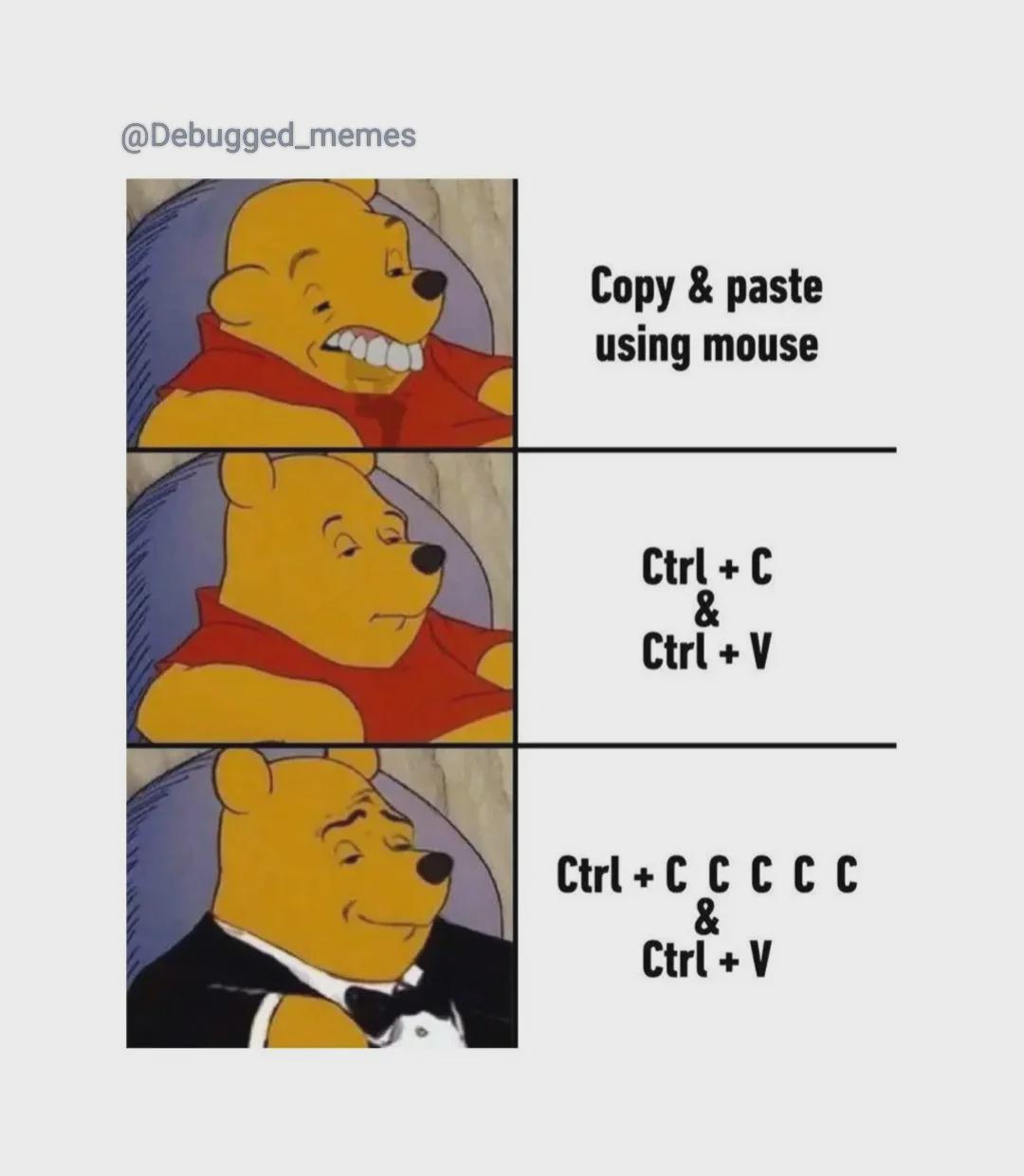
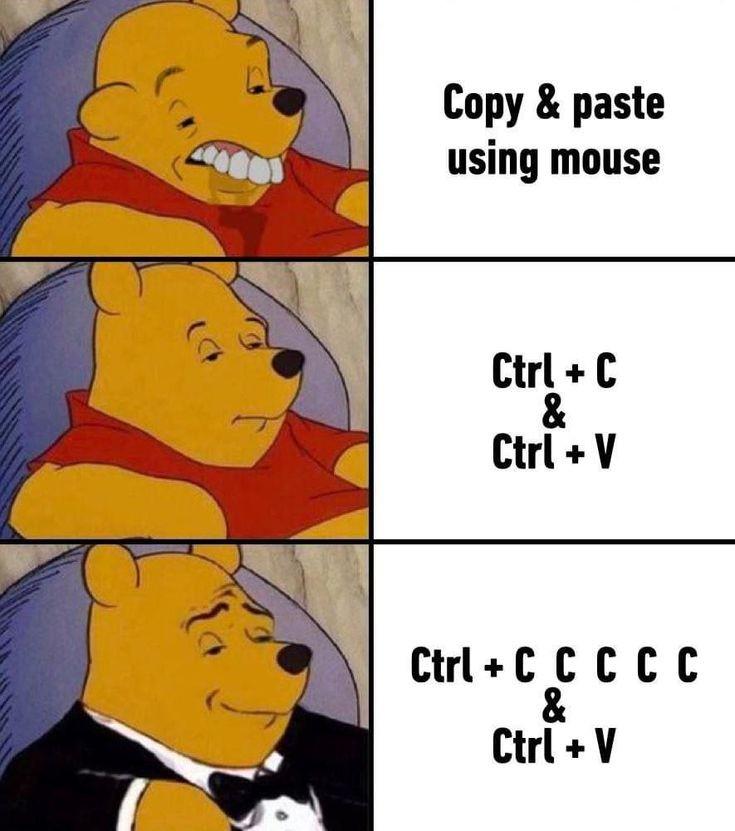
The evolutionary stages of a developer's copy-paste technique. First, there's the primitive mouse method—effective but barbaric. Then comes the standard keyboard shortcut approach—a clear sign of basic intelligence. But the true sophistication emerges when you frantically smash Ctrl+C multiple times because that unresponsive terminal has definitely ignored your first four attempts. It's not paranoia if the clipboard really is out to get you. The tuxedo in the final panel is well-deserved—you've clearly mastered the arcane art of "making absolutely sure" your code snippets survive the perilous journey to the clipboard.

The Save Button Trust Issues

The Save Button Trust Issues
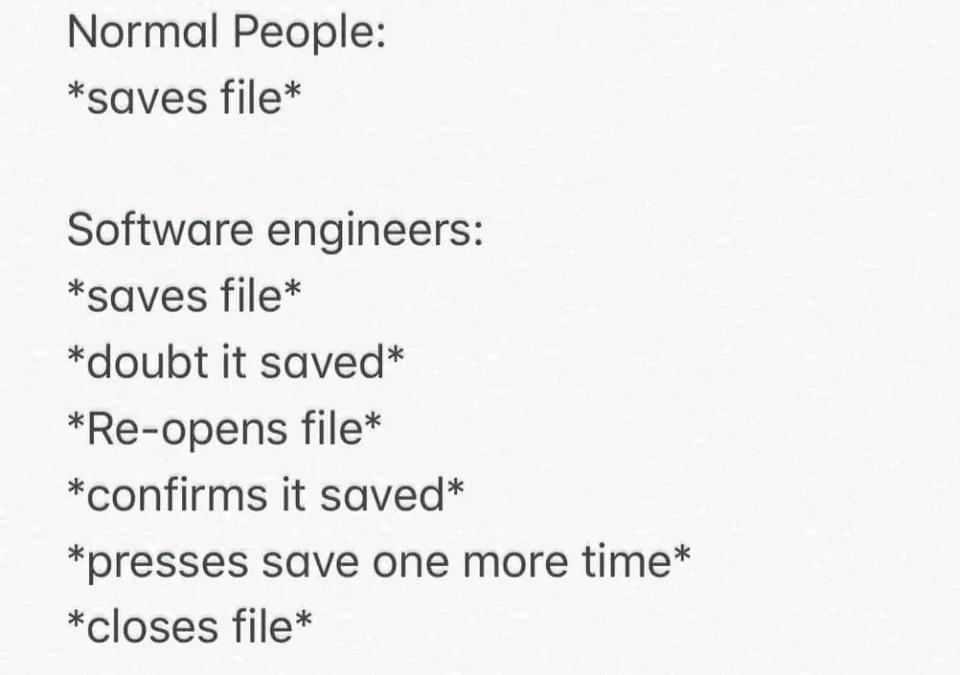
The paranoia is real . While normal humans click save and move on with their lives, developers exist in a perpetual state of file-saving anxiety. That crucial code you just wrote? Did it actually save? Better check. Then save again. Then one more time for good measure. It's not paranoia if the system really is out to get you. We've all lost work to the void at least once, and our trauma manifests as this absurd save-check-save-check ritual that no amount of autosave functionality will ever cure. Ctrl+S is not just a keyboard shortcut—it's a nervous tic developed through years of trust issues with computers.

The Evolution Of Copy-Paste Enlightenment

The Evolution Of Copy-Paste Enlightenment
The evolution of a developer's copy-paste technique is like watching someone level up in a video game. First, you're a noob using the mouse like some kind of digital caveman. Then you graduate to the basic keyboard shortcuts. But the true enlightenment? Spamming Ctrl+C multiple times because you've been burned too many times by clipboard failures. Nothing says "I've been traumatized by lost code" quite like hitting Ctrl+C five times in rapid succession. It's not paranoia if the clipboard really is out to get you.

Trust Issues: A Developer's Guide To Saving

Trust Issues: A Developer's Guide To Saving
Ah, the classic dilemma of the paranoid developer. Rejecting the simple "Save Game" option because deep down we all know that's just begging for a crash. Meanwhile, the "Save and Exit Game" option gets the approving nod because it's like wearing both a belt AND suspenders. Why trust a single save operation when you can immediately retreat to safety? It's not paranoia if the code really is out to get you. The unspoken truth of game development: nothing validates your trust issues quite like losing three hours of progress because you dared to believe in a simple "Save" button.

Maybe We Should Switch To Linux Already

Maybe We Should Switch To Linux Already
Windows security in a nutshell. User asks to install a program, computer happily agrees. Then suddenly the computer gets suspicious and interrogates the program like an overzealous border agent. "Where are you from, buddy?" The program doesn't know its own origin (like most of us after three cups of coffee), and boom—instant virus alert. Meanwhile, Linux users are sipping tea and watching the drama unfold from their fortress of package managers and repositories.