Naming conventions Memes

Posts tagged with Naming conventions

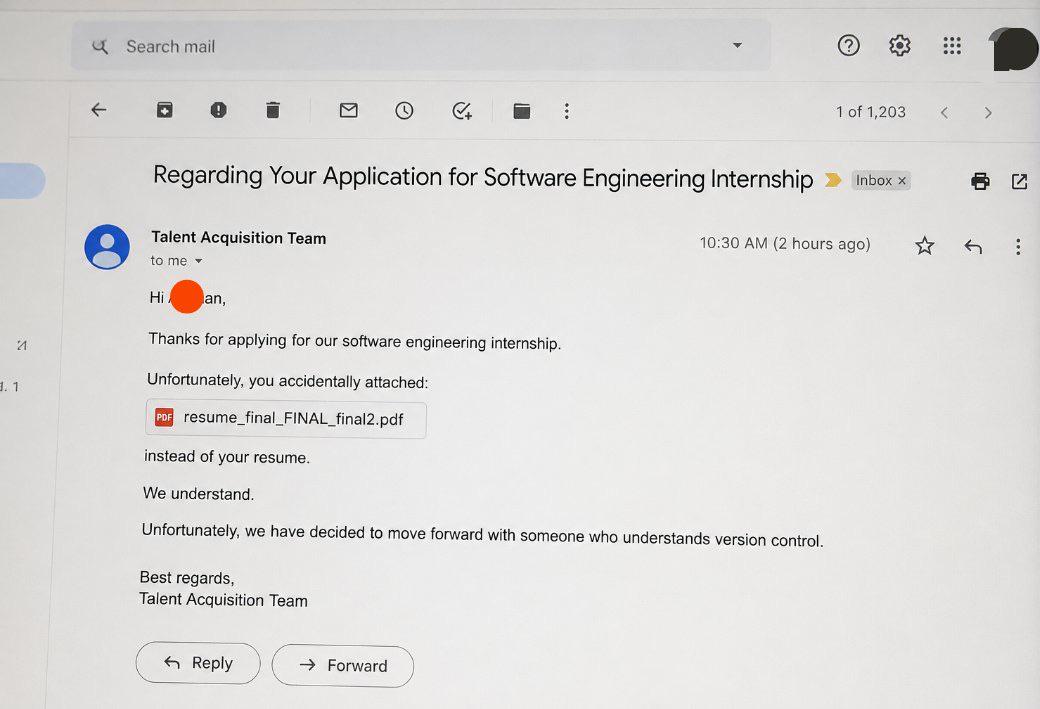
Everything Is App Now

Everything Is App Now
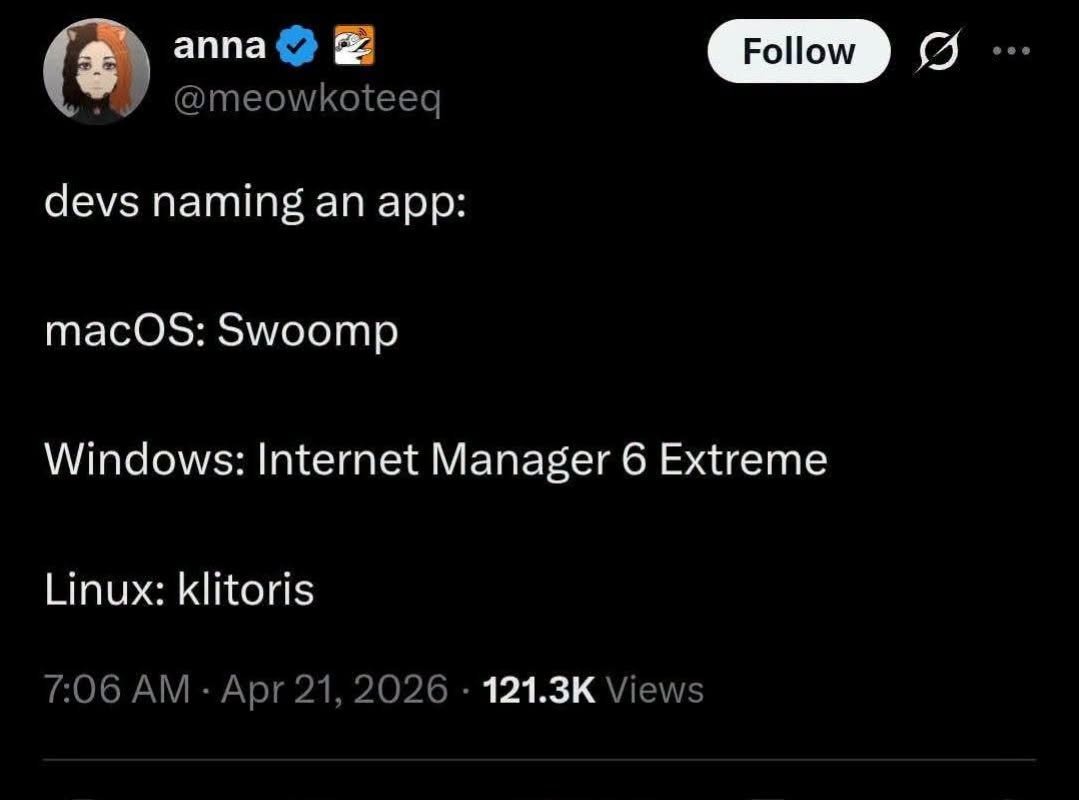
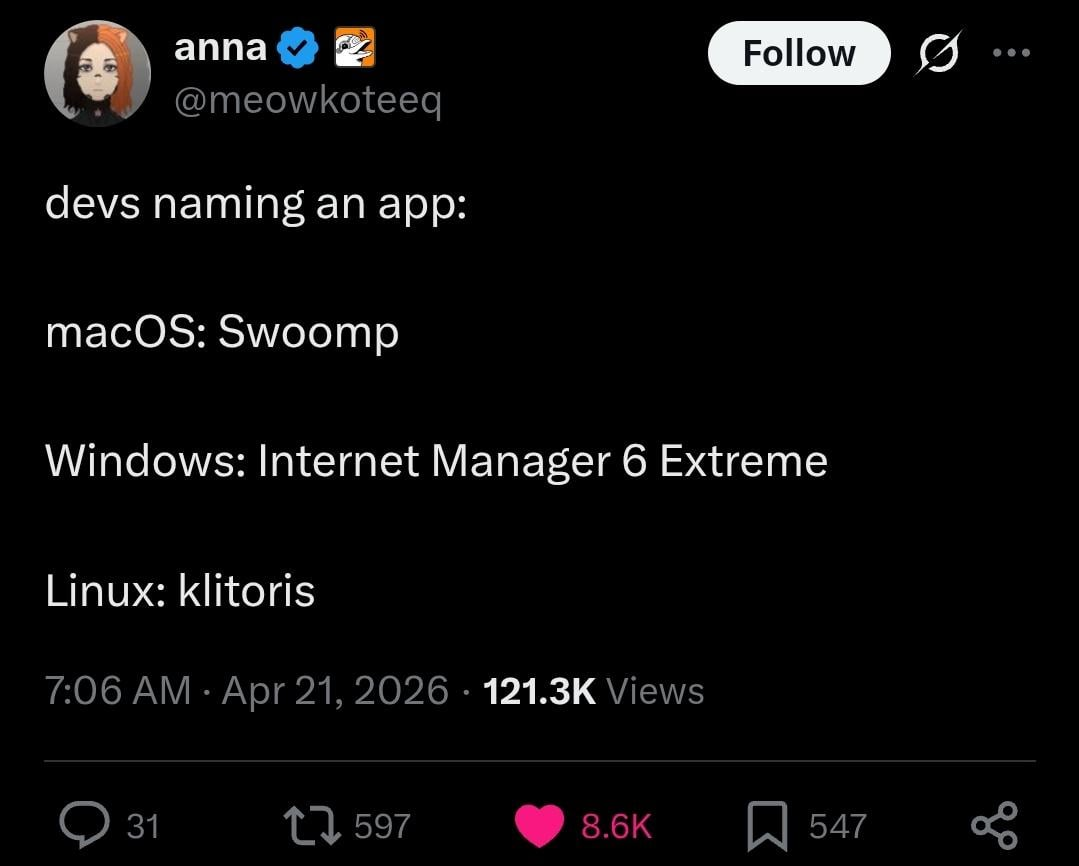
The tech industry's linguistic laziness has reached peak efficiency. We used to have specific, descriptive terms for different types of software—daemons lurking in the background, compilers doing their thing, batch files automating tasks. Now? Just slap "app" on everything and call it a day. It's like we collectively decided that nuance was too much work. Your operating system? App. That kernel-level service running critical infrastructure? Also app. The 50-line Python script you wrote to rename files? Believe it or not, app. Marketing teams discovered that "app" sounds friendlier than "daemon" (fair enough, demons aren't great for branding), and now we're stuck in this vocabulary wasteland where everything from Photoshop to systemd gets the same label. The real tragedy? Try explaining to a junior dev what a daemon actually is when their entire mental model is just "apps all the way down." We've traded precision for simplicity, and honestly, we're not getting it back.

I Know Some Of You Must Be Fuming Right Now

I Know Some Of You Must Be Fuming Right Now
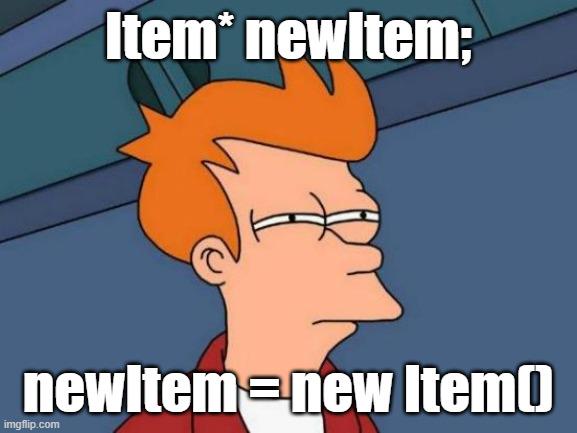
Dropping this hot take in a room full of developers is like throwing a grenade into a Discord server. The "Change My Mind" guy sitting there with a straight face while claiming lower_snake_case is superior to camelCase, PascalCase, or kebab-case? Bold move. Here's the thing though - snake_case genuinely is more readable according to actual research. Your eyes don't have to work as hard to parse word boundaries when there's a literal separator between them. But try telling that to the JavaScript crowd who've been camelCasing since 2009, or the C# devs who'd rather die than give up their PascalCase classes. The real war crime? Mixing conventions in the same codebase. Pick your poison and stick with it, or face the wrath of every code reviewer who has to context-switch between your schizophrenic variable names.

No It's Not C Hashtag Lol

No It's Not C Hashtag Lol
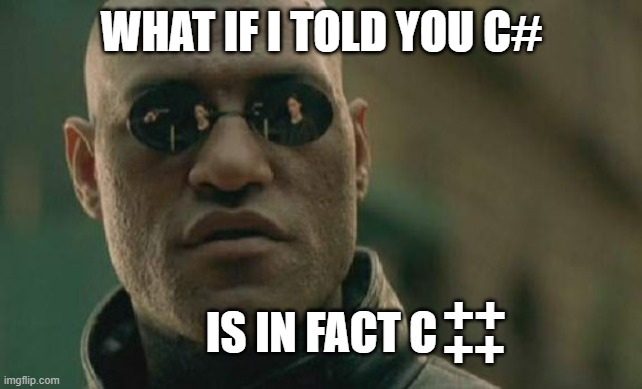
The eternal struggle of explaining C# pronunciation to literally anyone outside the .NET ecosystem. It's always "C hashtag" or "C pound" until someone finally corrects you with the proper "C Sharp" pronunciation. The meme perfectly captures that redemption arc moment when C# finally gets to introduce itself properly after being butchered for years. Fun fact: the # symbol was actually chosen because it resembles four plus signs in a grid (++++ = C++++), suggesting it's an increment of C++. Microsoft really said "let's confuse everyone forever" and succeeded spectacularly.

Can't Have It Short And Also Missing Character

Can't Have It Short And Also Missing Character
Oh the AUDACITY! You want your functions to be clean, readable, and self-documenting with proper parameter names? Well TOUGH LUCK because the dates package decided to go full minimalist mode and name everything like they're texting on a flip phone from 2003. But the MOMENT you try to feed it some actual shorthand notation, it throws a tantrum like "sorry sweetie, you're not my type" 💅 The absolute DRAMA of trying to validate dates with strict parameters while simultaneously dealing with cryptic abbreviated format strings. It's giving "I want my cake and eat it too" energy, except the cake is type safety and the eating is... well, also type safety. Choose your poison: either write "my_stinky_params" that look like a toddler named them, OR embrace the chaos of shorthand that the library won't even recognize. There is no middle ground, only suffering.

Do Not Name Your Assembly Files This

Do Not Name Your Assembly Files This
Someone really went ahead and named their assembly file org.asm and now it's sitting there with executable permissions like a loaded gun. The problem? On Unix systems, if you accidentally type ./org.asm instead of opening it in an editor, you're about to execute random assembly code. It's like naming your pet tiger "Fluffy" – technically you can do it, but it doesn't make it any less dangerous. The real kicker is that org.asm sounds innocent enough, probably short for "organization" or something equally boring. But those -rwxr-xr-x permissions are screaming "I'm executable!" Meanwhile, paste.asm is chilling right below it, probably containing clipboard management code, which is somehow less terrifying than whatever organizational chaos is about to unfold. Pro tip: If your file extension already screams "source code," maybe don't give it a name that makes it sound like a command you'd actually want to run. Save the cryptic three-letter names for your startup.

When Sentence Meets Pronunciation 😂😂

When Sentence Meets Pronunciation 😂😂
Odin's having an existential crisis wondering if he failed as a mentor because he kept calling his son's favorite language "C hashtag" instead of "C Sharp." Plot twist: they're the same thing, just pronounced differently. Here's the thing—literally everyone who's ever encountered C# has gone through the "hashtag vs sharp" identity crisis at least once. It's written with a # symbol, which the entire internet has trained us to call a hashtag, but Microsoft decided to get all musical and fancy by naming it after the sharp symbol (♯) in music notation. Because nothing says "enterprise software development" like pretending you're composing a symphony. Fun fact: The # symbol isn't even technically a sharp symbol—that's ♯, which looks slightly different. But good luck typing that on your keyboard, so we all just use the pound/hash/number sign and pretend we're sophisticated.

Sweating While Thinking Which Button To Deploy

Sweating While Thinking Which Button To Deploy
Two equally terrible choices, and you're about to ship one of them to production. On one hand, you could be the corporate drone who removes all personality from your code because management thinks comments should be "professional." On the other, you could embrace the chaos and name your StringBuilder "bobTheBuilder" like the absolute legend you are. The real tragedy? Both options are going to haunt you during the next code review. Your boss will passive-aggressively ask why you're wasting time on "clever" naming, while your fellow devs will judge you for having a StringBuilder that isn't called "bobTheBuilder." There's no winning here. At least bobTheBuilder builds things. Unlike most of our code.

The More You Know

The More You Know
When artists romanticize their creative process with "you inspired this masterpiece," developers immortalize their crushes in the most practical way possible: branch names. Nothing says "I'm thinking about you" quite like typing git checkout feature/sarah-login-fix forty times a day. The real power move? When that branch gets merged into main and becomes part of the production codebase forever. Your crush's name is now in the git history for eternity, timestamped and commit-hashed. Way more permanent than a song that might get lost in someone's Spotify library. And that Reddit comment warning about Rebecca Purple? Yeah, that's a real CSS color ( #663399 ) named after Rebecca Alison Meyer, daughter of CSS expert Eric Meyer, who passed away at age six. So naming conventions can get... unexpectedly emotional. Maybe stick to feature names instead.

The Forbidden Linux Naming Truth

The Forbidden Linux Naming Truth
Dad dropped an uncomfortable truth bomb about Linux naming conventions that nobody asked for. GIMP (GNU Image Manipulation Program), GNOME (GNU Network Object Model Environment)... yeah, the pattern exists. The kid was 12 and probably just wanted to install Minecraft. Now they're having an existential crisis about open-source nomenclature. The reply captures it perfectly: factually accurate, socially inadvisable. Some observations are better left in the group chat with other grizzled sysadmins, not shared with your pre-teen at the dinner table. But hey, at least the kid learned early that Linux culture is... unique. Fun fact: GIMP's mascot is Wilber, a coyote-dog thing with a paintbrush. Even the mascot knows what's up.

When You're In A Stupid Naming Convention Competition And Your Opponent Is USB IF

When You're In A Stupid Naming Convention Competition And Your Opponent Is USB IF
Oh honey, USB IF really said "let's make our naming scheme so confusing that even tech support needs therapy." You thought you were bad at naming variables? Meet the USB Implementers Forum, who decided USB 3.0, USB 3.1 Gen 1, USB 3.1 Gen 2, USB 3.2 Gen 1, USB 3.2 Gen 2, and USB 3.2 Gen 2x2 should ALL exist simultaneously. Because why use simple version numbers when you can create an interdimensional puzzle that requires a PhD to decode? The guy in the meme is like "we're USB 3" and the response is basically "okay but WHICH flavor of USB 3 chaos are we talking about here?" It's like showing up to a party and someone asks what kind of programmer you are, and you say "a good one" – completely unhelpful and raises more questions than answers. The USB naming convention is so spectacularly terrible that it makes JavaScript framework versioning look reasonable by comparison, and that's saying something.

Ternary Digit Conundrum

Ternary Digit Conundrum
Someone discovered the perfect naming convention and honestly, it's both genius and absolutely cursed. Binary digit → bit. Makes sense. Ternary digit → tit. Wait, hold on— The logic is flawless. Base-2 (binary) starts with 'b', add 'it', you get 'bit'. Base-3 (ternary) starts with 't', add 'it', you get... well, a term that's gonna make every code review extremely uncomfortable. Imagine explaining to your manager why your ternary computing documentation keeps getting flagged by HR. Fun fact: The actual term is "trit" (trinary digit), but where's the fun in being technically correct when you can watch Gru's face perfectly capture the exact moment this realization hits? Ternary computing is real though—it uses three states (0, 1, 2) instead of binary's two, and some Soviet computers actually used it. They probably had very interesting technical documentation.

Stop Naming Services After Marvel Characters

Stop Naming Services After Marvel Characters
Finally! Freedom to name your microservice whatever your heart desires! No more boring "user-authentication-service" or "payment-processor-api"—nope, we're going FULL CREATIVE MODE. And what better way to exercise this newfound liberty than naming it after a disabled piglet with a wheelchair? Because nothing screams "professional enterprise architecture" quite like explaining to your CTO that the authentication service is called Chris P. Bacon. The beauty here is the sheer commitment to the bit. Your manager gives you carte blanche on naming conventions, thinking you'll choose something sensible and descriptive. Instead, you've immortalized a piglet from Clermont, Florida in your company's infrastructure. Now every standup meeting includes the phrase "Chris P. Bacon is down" and nobody can keep a straight face. The on-call rotation just got 1000% more entertaining. Bonus points: when new developers join and have to read documentation that casually references Chris P. Bacon handling critical business logic. They'll spend their first week wondering if they joined a tech company or a petting zoo.