
Mobile development Memes

Posts tagged with Mobile development
Patch Notes

Patch Notes
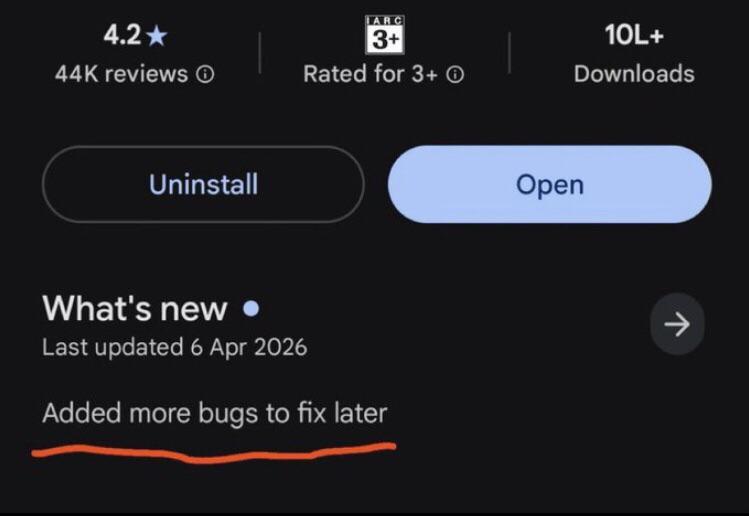
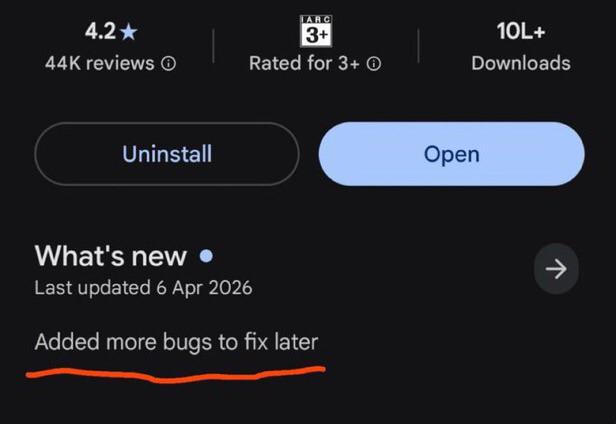
The developer's honesty is refreshing. Instead of the usual corporate speak about "bug fixes and performance improvements," they just straight up admit they're adding bugs to the backlog. It's like technical debt, but weaponized. The update date being in 2026 really seals the deal—nothing says "we'll get to it eventually" quite like patch notes from the future. At least they're transparent about their development process: ship first, fix never.

You Know Him Or It Was You

You Know Him Or It Was You
Oh honey, we've ALL met this person. The 2013 tech bro starter pack is SENDING me right now. The Under Armour hoodie, those rectangular glasses that screamed "I code," and let's not forget the OtterBox case that could survive a nuclear apocalypse but couldn't protect your dignity. But the REAL kicker? That quote at the bottom about switching from iOS to Android like it was some kind of spiritual awakening. Meanwhile, their phone was running CyanogenMod (RIP to a real one), they had Flappy Bird installed before it got yeeted from the app store, and they definitely played Geometry Dash on their hacked TI-84 calculator during math class. The XDA Developers watermark is just *chef's kiss* because you KNOW they spent 47 hours bricking and unbricking their phone just to get a custom boot animation. And those braces? Peak 2013 aesthetic. This whole vibe is equal parts nostalgia and cringe, and honestly? We wouldn't have it any other way.

You Can't Make Anything Look Neat In MIT App Inventor

You Can't Make Anything Look Neat In MIT App Inventor
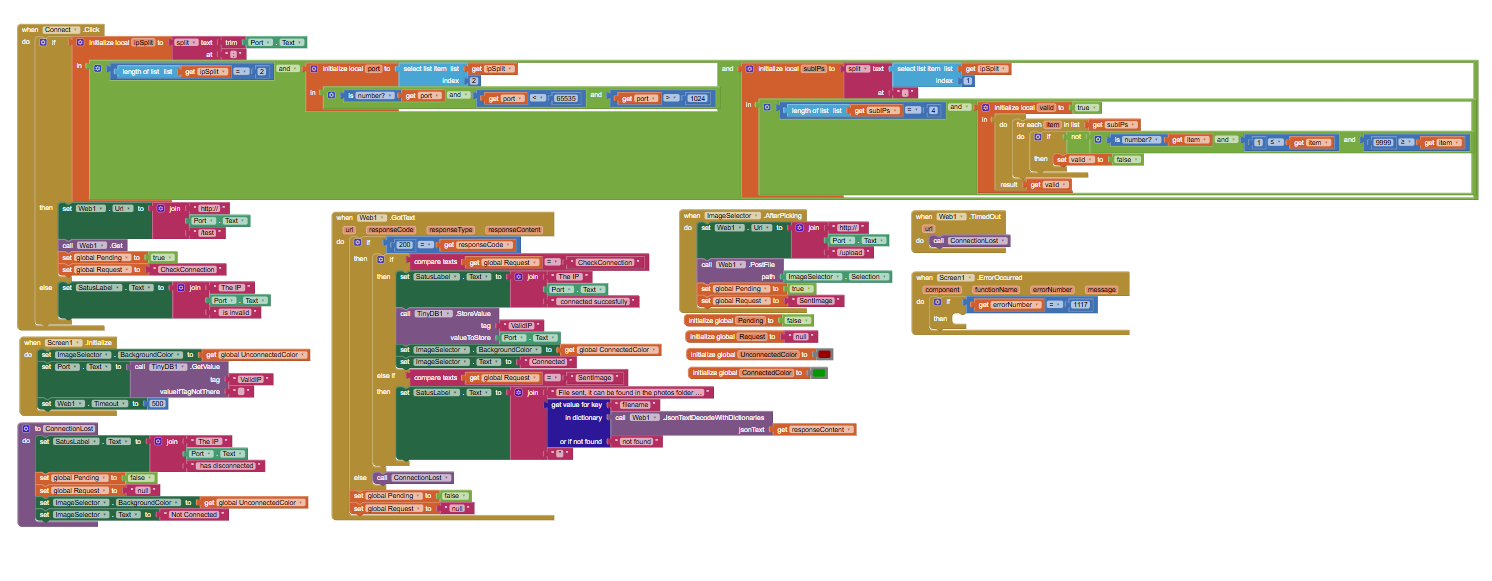
MIT App Inventor's block-based programming interface looks like someone threw a Lego set into a blender and hit "chaos mode." Sure, it's designed to make mobile app development accessible to beginners, but the moment your project grows beyond "Hello World," you're staring at a Jackson Pollock painting made of colorful puzzle pieces. The visual programming blocks sprawl across the screen like spaghetti code that somehow became sentient and decided to organize itself by color instead of logic. You start with good intentions—"I'll keep this organized!"—but three nested conditionals later, you're zooming out to 25% just to see where your function ends. The irony? Block-based programming was supposed to make code MORE readable than text. Instead, you get a rainbow maze that requires a cartography degree to navigate. Pro tip: If your MIT App Inventor project fits on one screen without scrolling, you're either a wizard or you haven't actually built anything yet.

How Hard Can It Be

How Hard Can It Be
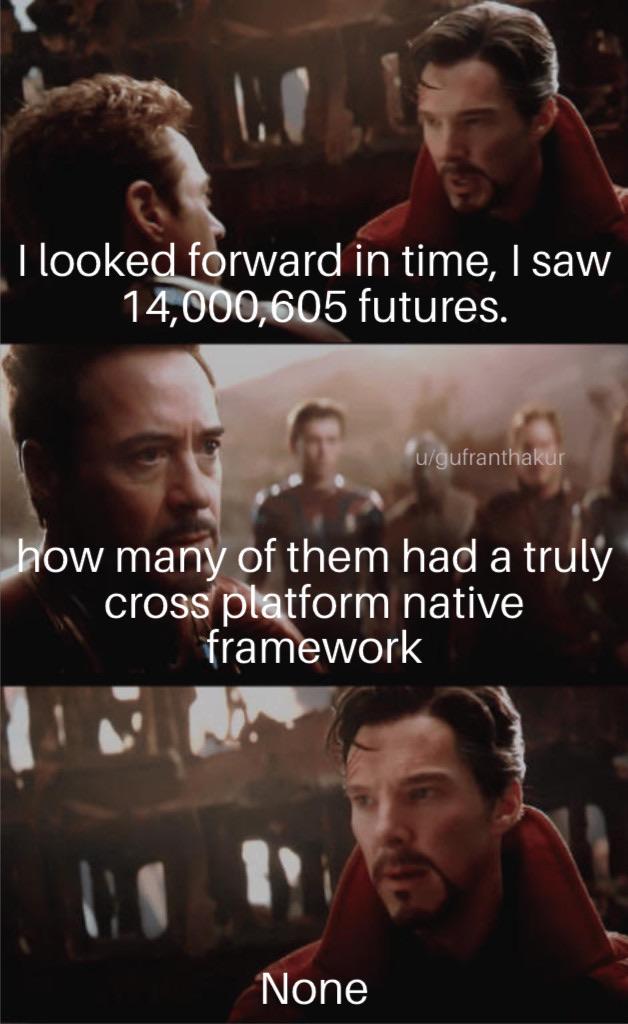
Famous last words before every mobile project: "We'll just use React Native/Flutter/whatever-is-trendy-this-week and boom, one codebase for everything!" Then reality hits. You've got iOS quirks, Android weirdness, different screen sizes, platform-specific APIs, native modules breaking on every update, and that one feature that absolutely requires dropping down to Swift/Kotlin. Your "cross-platform" framework becomes a leaky abstraction wrapped in duct tape and Stack Overflow prayers. The truth? Most apps claiming to be "cross-platform native" are just web views with extra steps, or they've got so much platform-specific code that you might as well have written two separate apps. The dream of write-once-run-anywhere died somewhere between Java applets and Xamarin. But hey, at least we keep trying. Next year's framework will definitely be the one that solves it all. Right? Right?

Peak Software Engineering Was Achieved In 2010

Peak Software Engineering Was Achieved In 2010
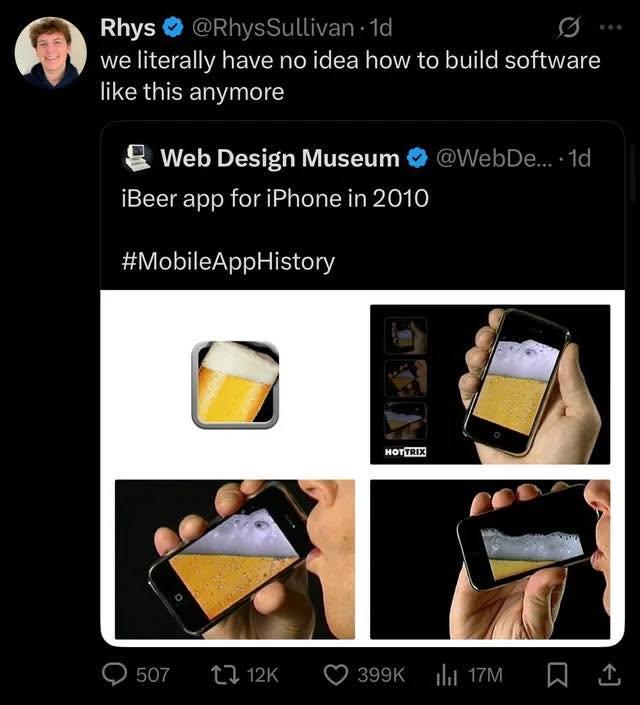
Back in 2010, someone built an iPhone app that literally just showed a beer glass on your screen. You could tilt your phone and the beer would slosh around using the accelerometer. That's it. That was the entire app. And it was glorious . Now we've got teams of 50 engineers, three Scrum masters, daily standups, sprint planning, retrospectives, CI/CD pipelines, microservices, Kubernetes clusters, and 47 different monitoring tools just to build a button that changes color. We've somehow convinced ourselves that complexity equals sophistication. iBeer was peak engineering because someone had a stupid idea, built it in probably a weekend, shipped it, and people loved it. No architectural decision records. No tech debt discussions. No "let's circle back on this." Just pure, unfiltered creativity and execution. Sometimes I wonder if we've lost the plot.

INNOCN 49" Curved Monitor Ultrawide Gaming 5K2K 120Hz 32:9 QHD 5120 x 1440P Computer Monitor, R1800, 99% sRGB, HDR400, USB Type C, DisplayPort, HDMI, Built-in Speakers, Height/Tilt Adjustable - 49C1R

INNOCN 49" Curved Monitor Ultrawide Gaming 5K2K 120Hz 32:9 QHD 5120 x 1440P Computer Monitor, R1800, 99% sRGB, HDR400, USB Type C, DisplayPort, HDMI, Built-in Speakers, Height/Tilt Adjustable - 49C1R
【49 Inch Gaming Monitor Curved Ultrawide】 Premium VA Panel delivers double 5120*1440 resolution up to 120hz( DP1.4) monitor for content creation and gaming, 32:9 aspect ratio bring more wider visual …

Proof By It Works On My Phone

Proof By It Works On My Phone
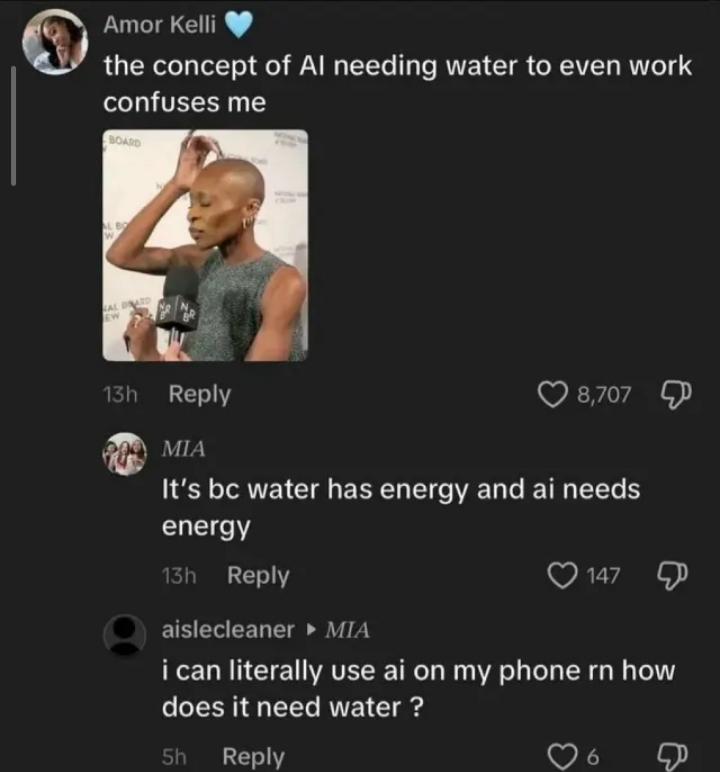
Classic "works on my machine" energy, but make it mobile. Someone's genuinely baffled why AI data centers need cooling infrastructure when ChatGPT runs just fine on their phone without a water cooler attached. Here's the thing: your phone running AI inference on a pre-trained model is like microwaving leftovers. Data centers training those models? That's running an industrial kitchen 24/7. We're talking thousands of GPUs generating enough heat to warm a small city, hence the need for liquid cooling systems that use millions of gallons of water. But sure, it works on your phone, so clearly Big Tech is just being dramatic with all those cooling towers. Next you'll tell me your laptop doesn't need a fan because it's "just running Chrome."

Unethical Life Pro-Tip: Want Your Mobile Game To Have Millions Of Downloads? Easy. Just Submit Your Build For Review Millions Of Times.

Unethical Life Pro-Tip: Want Your Mobile Game To Have Millions Of Downloads? Easy. Just Submit Your Build For Review Millions Of Times.
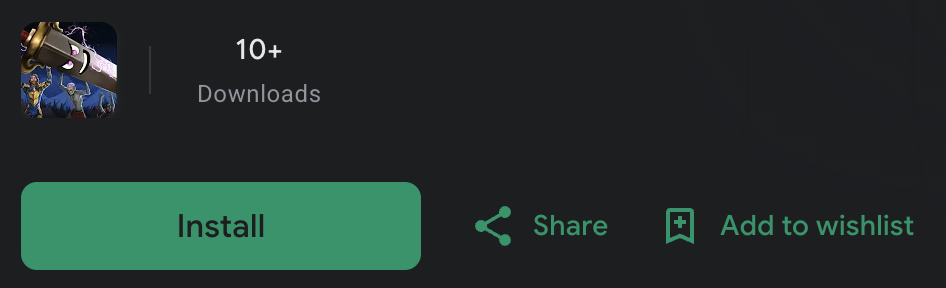
Someone discovered that app store reviewers technically "download" your build every time you submit it for review. So naturally, the logical conclusion is to spam submissions until your download counter looks impressive. It's the developer equivalent of refreshing your own YouTube video to boost views. The "10+ Downloads" badge really sells the success story here—nothing says "viral hit" quite like barely scraping into double digits. Pretty sure this violates approximately 47 different App Store guidelines, but hey, technically correct is the best kind of correct.

Patch Notes

Patch Notes
Ah yes, the classic "we're not fixing bugs, we're adding them to the backlog" approach. You know you're in for a wild ride when the patch notes literally say they're adding bugs instead of fixing them. It's like the dev team just gave up on pretending and decided to be brutally honest with their users. 10L+ downloads though? Those poor souls have no idea what they signed up for. The honesty is almost refreshing—most apps just silently introduce bugs and call them "features" or "performance improvements." At least this team is transparent about their technical debt strategy: infinite accumulation.

Apprehension

Apprehension
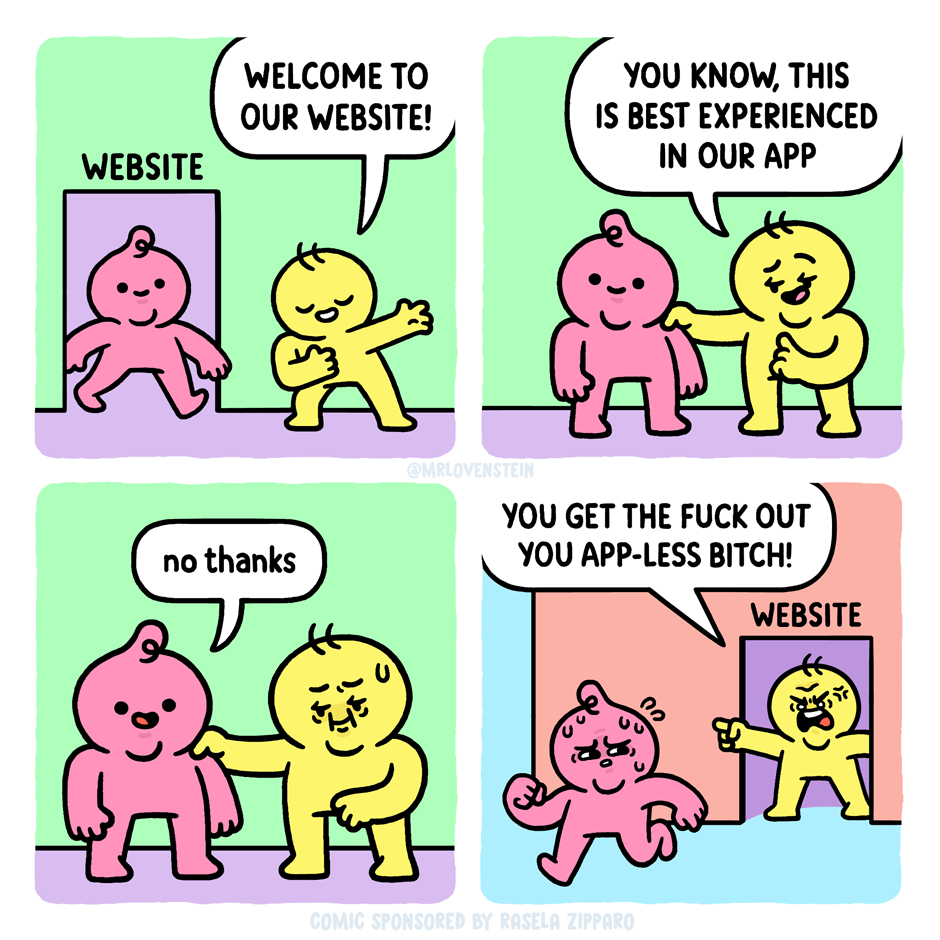
The absolute AUDACITY of websites trying to force you into their app like some kind of digital hostage situation. You just wanted to browse peacefully on your mobile browser, but NO—they've decided your experience is "better" in their 200MB surveillance device that wants access to your contacts, camera, and probably your firstborn child. The website goes from friendly neighborhood helper to full-on rage monster the SECOND you decline their app download. Like bestie, your app probably does the exact same thing as the website but with more notifications and battery drain. The entitlement is REAL. Fun fact: This aggressive app-pushing strategy is called "app interstitials" and Google actually penalizes sites that do this too aggressively. So that rage? Totally justified AND good for SEO karma.

NordVPN

NordVPN
Encrypt your traffic on public Wi-Fi, stream from anywhere, and cover up to ten devices with one plan. 30-day money-back guarantee.

Because Google Cares About Us

Because Google Cares About Us
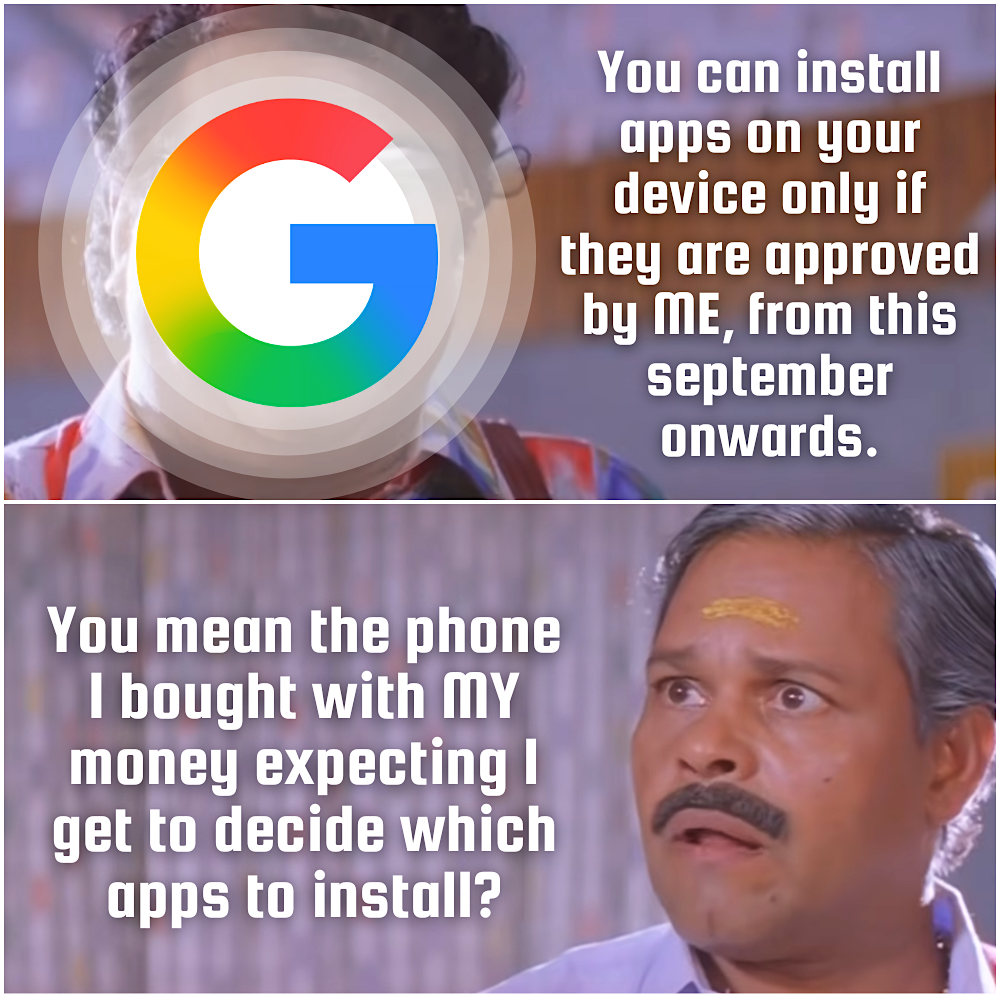
Google's new sideloading restrictions are basically the tech equivalent of your landlord telling you what furniture you're allowed to bring into your own apartment. Sure, they'll frame it as "security," but really it's just another way to keep you locked in their walled garden. You paid $800+ for a device, but apparently that doesn't include the radical privilege of installing whatever software you want on it. Google gets to be the gatekeeper now. Nothing says "open platform" quite like needing Big Brother's permission to install an APK you found on the internet. The best part? They're doing this "for your safety." Because clearly, we've all been too stupid to manage our own devices this whole time. Thanks for the protection, Google. Really feeling that Android freedom right about now.

At Least They Are Honest

At Least They Are Honest
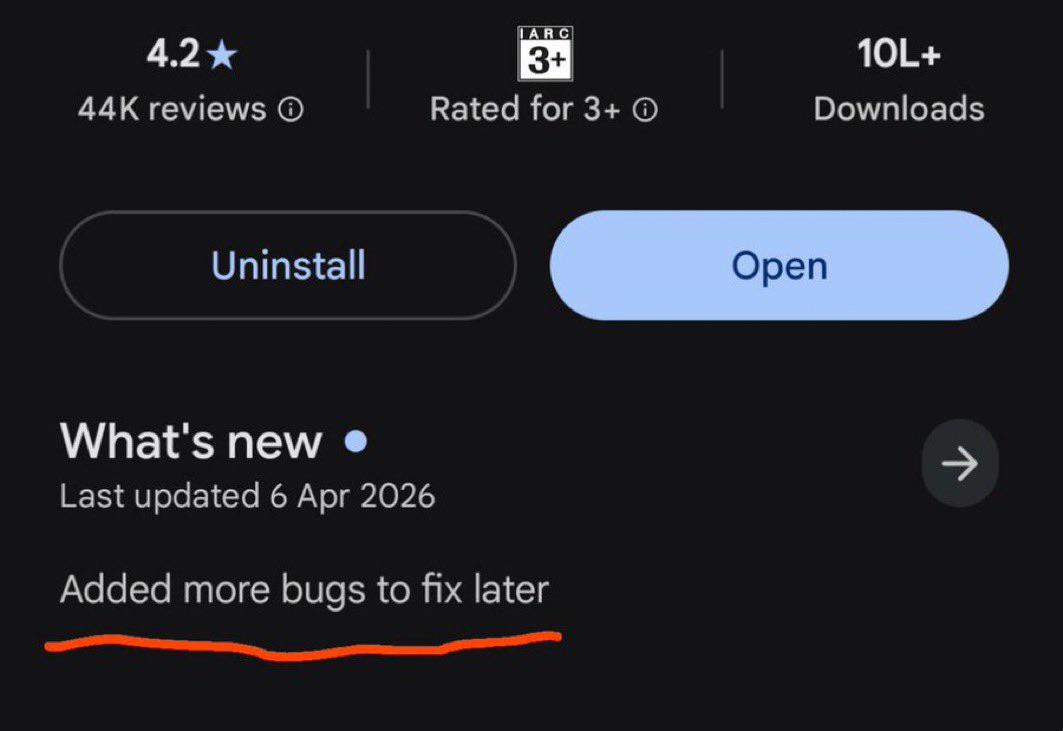
Nothing says "quality software" quite like a changelog that reads "Added more bugs to fix later." Props to the dev team for their radical transparency—most apps just ship the bugs silently and call it a feature. The 4.2-star rating with 44K reviews suggests users have Stockholm syndrome, or they appreciate the honesty more than actual stability. Either way, that backlog just got longer and "later" is doing some heavy lifting here.

When You Forget To Specify The Target

When You Forget To Specify The Target
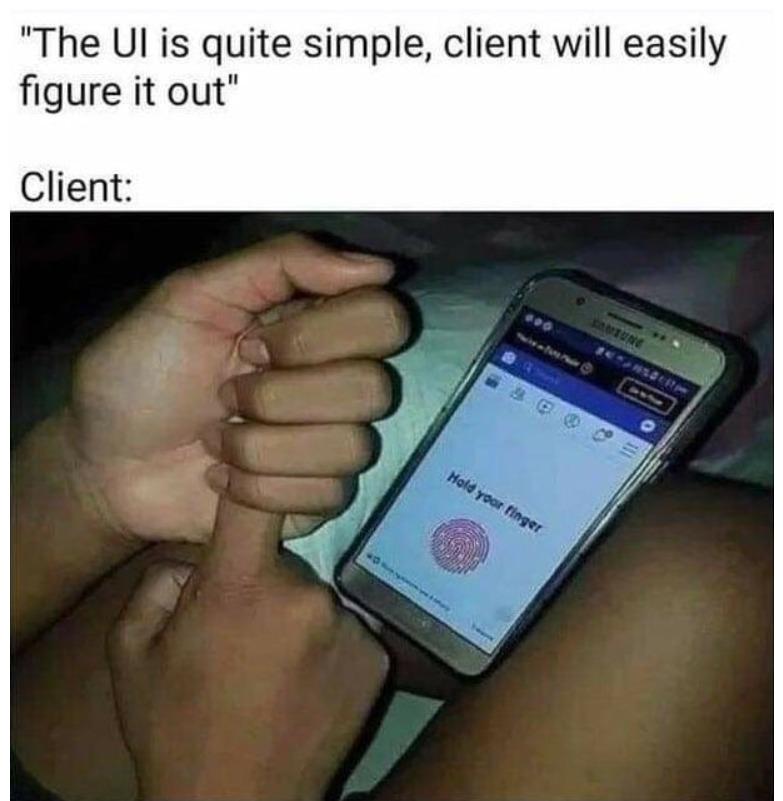
You know that moment when you confidently tell the client "the UI is intuitive, anyone can use it" and then they try to scan their toe as a fingerprint? Yeah, turns out "simple" is relative. What seems obvious to you after staring at wireframes for weeks apparently needs a 50-page manual and maybe some arrows pointing to the actual fingerprint sensor. But sure, let's keep pretending users read tooltips and hover states. The real kicker here is the developer probably spent hours perfecting the fingerprint authentication flow, making it "seamless" and "user-friendly," only to watch someone attempt biometric authentication with their big toe. Sometimes the gap between developer assumptions and user behavior is wider than the Grand Canyon.