

Language design Memes

Posts tagged with Language design
Stop Trying To Reinvent The Wheel

Stop Trying To Reinvent The Wheel
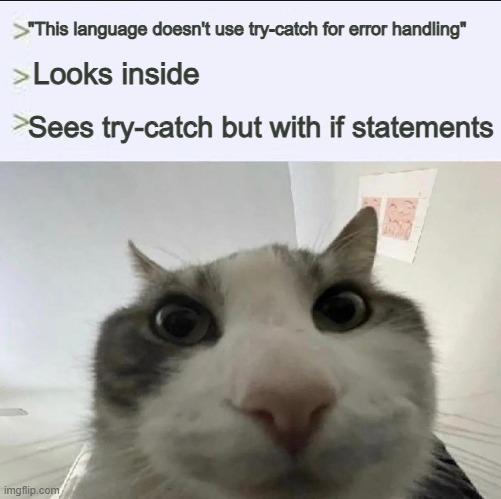
Every language designer ever: "We're going to revolutionize error handling by NOT using try-catch!" Then you peek under the hood and it's literally just try-catch wearing a fake mustache made of if statements. Result types in Rust? Try-catch with extra steps. Go's error returns? Try-catch but you manually carry the error like it's 1972. Swift's guard statements? Spicy try-catch. It's like watching someone insist they invented a "revolutionary new transportation method" and then showing you a bicycle with square wheels. Sure, it's technically different, but was it worth the effort? The industry has spent decades trying to make error handling look cool and different, but at the end of the day we're all just catching errors and pretending our syntax is superior.

You Can Just Stop Using Java

You Can Just Stop Using Java
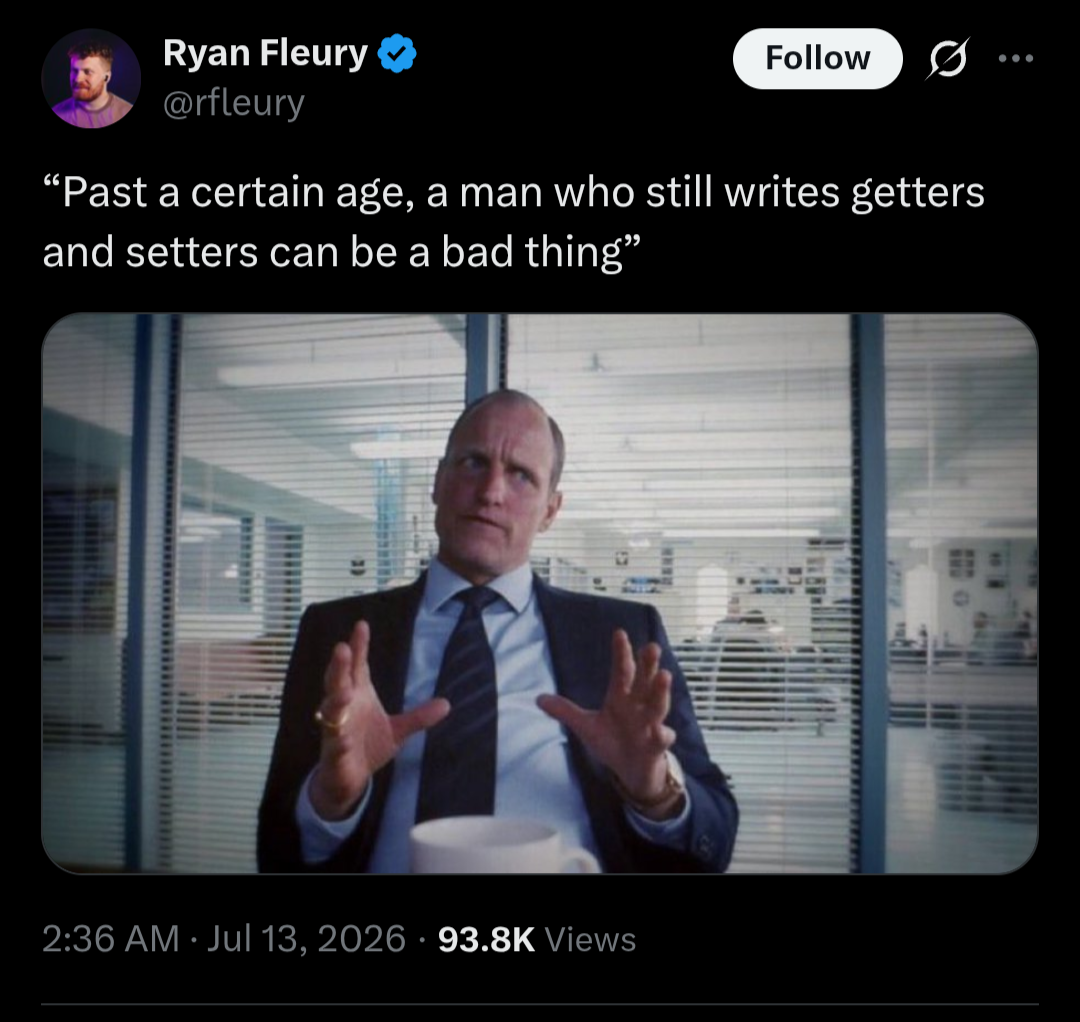
Turns out you don't actually need to write getFirstName() and setFirstName() for every single field in your codebase. Revolutionary concept, I know. Java developers spent decades convincing themselves that manually writing 47 lines of boilerplate for a simple data class was "enterprise-grade" and "best practice." Meanwhile, every other language figured out you could just... not do that. Properties? Direct field access? Records? Nah, let's write another getter. The guy in the suit explaining this groundbreaking wisdom perfectly captures that corporate energy of someone discovering that maybe, just maybe, there are alternatives to verbose ceremonial code. Who knew.

What If I Told You C# Is In Fact C++

What If I Told You C# Is In Fact C++
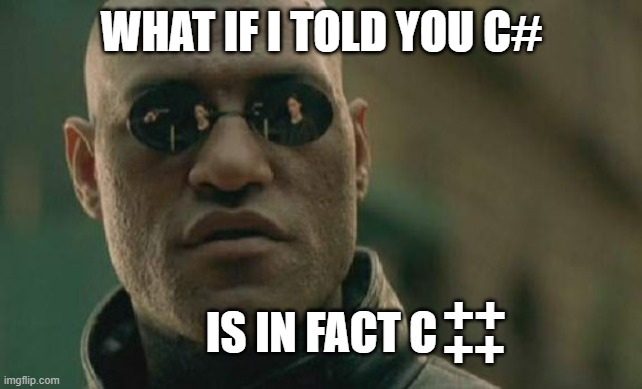
So someone finally noticed that C# is literally just C++ with extra steps. The sharp symbol (#) is basically four plus signs stacked together (two horizontal, two vertical), which means C# = C++++. Mind. Blown. 🤯 It's like Microsoft looked at C++ and said "let's add more pluses but make it aesthetic." The naming convention is basically a visual pun that took 20+ years for most of us to appreciate. Fun fact: the # symbol was chosen because it looks like four "+" symbols in a 2x2 grid, symbolizing C++ incremented twice (C++ ++ = C#). Either that or the marketing team was really into music notation and just went with "sharp" because it sounds cooler than "C plus plus plus plus." Java developers are somewhere crying because their language name doesn't have this kind of mathematical elegance—it's just... coffee.

Go Team Got Their Priorities

Go Team Got Their Priorities
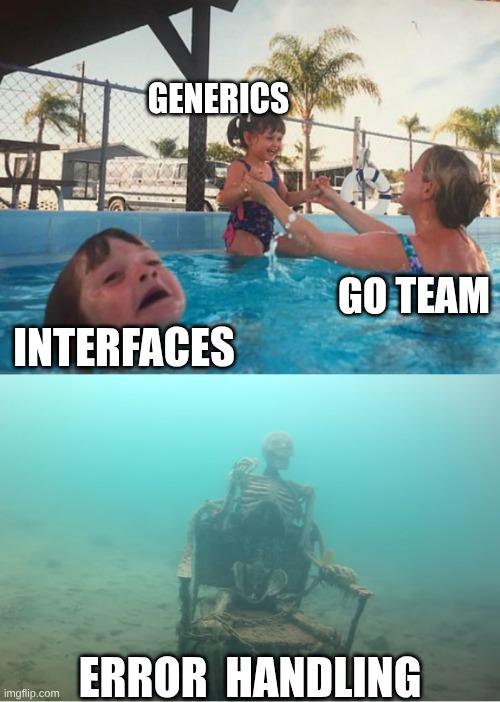
The Go team really said "let's add generics after 13 years of the language existing" and "sure, interfaces are cool" while completely ghosting proper error handling. Meanwhile, developers are still out here writing if err != nil until their fingers bleed. Every. Single. Function. The skeleton at the bottom of the pool? That's every Go dev who's been waiting for a decent error handling mechanism since 2009. Some say they're still checking for nil errors to this day. The Go team keeps promising improvements but then gets distracted by adding yet another way to format strings or optimize the garbage collector by 0.3 nanoseconds. At least we got generics though... only took them longer than it takes to build an entire JavaScript framework from scratch (which happens about every 2 weeks).

Meet Potential Language

Meet Potential Language
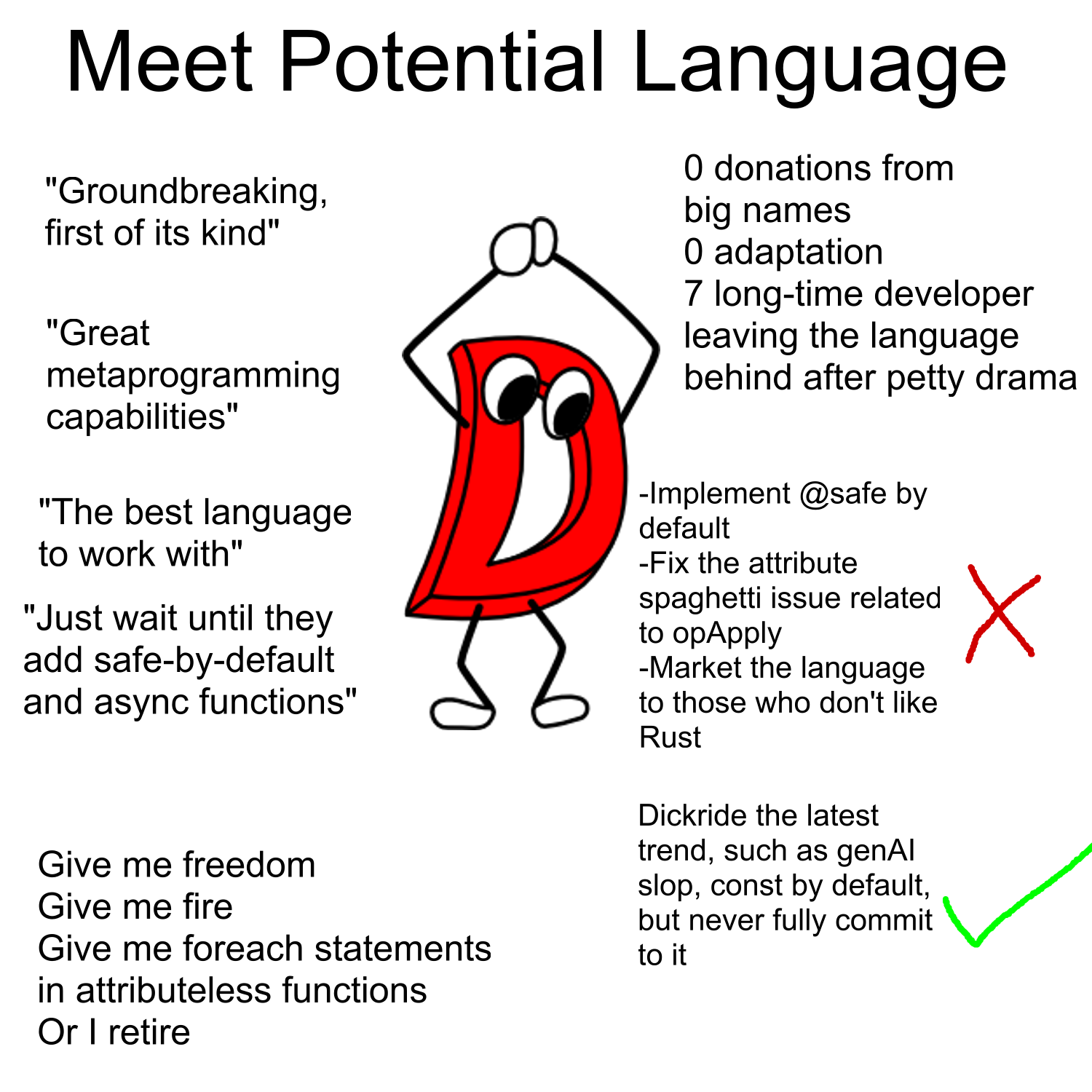
Someone just pitched the D programming language's business plan to investors and it's basically "copy Rust's homework but make it look different." Zero corporate backing, zero adoption, and seven core maintainers rage-quitting after what I can only assume was a heated debate about semicolons. The left side is pure comedy gold—"groundbreaking" metaprogramming that nobody asked for, promises of async features that'll arrive sometime after the heat death of the universe, and the classic "give me foreach or I retire" ultimatum. Patrick Henry would be proud. The right side? Chef's kiss. Their master plan is to market themselves as "Rust for people who don't like Rust" while simultaneously dickriding every trendy feature (genAI slop, const by default) without actually committing to any of them. It's like watching someone try to be edgy and mainstream at the same time. Bold strategy, Cotton. Fun fact: D has been around since 2001 and still hasn't figured out if it wants to be C++, Rust, or its own thing. That's 20+ years of potential energy with zero kinetic results.

6 Pack Magnetic Cable Clips [Cable Smooth Adjustable] Cord Holder, Under Desk Cable Management, JOYROOM Adhesive Wire Holder Keeper Organizer for Home Office Desk Phone Car Wall Desktop Nightstand

6 Pack Magnetic Cable Clips [Cable Smooth Adjustable] Cord Holder, Under Desk Cable Management, JOYROOM Adhesive Wire Holder Keeper Organizer for Home Office Desk Phone Car Wall Desktop Nightstand
7.5 mm Perfect Cable Slot Diameter: Diameter of 0.3 inches (7.5 mm) can hold most cables, such as phone charging cables, USB cords, HDMI thick cables, computer power cords, etc. Besides that, the slo…

I Want What The Committee Was Smoking

I Want What The Committee Was Smoking
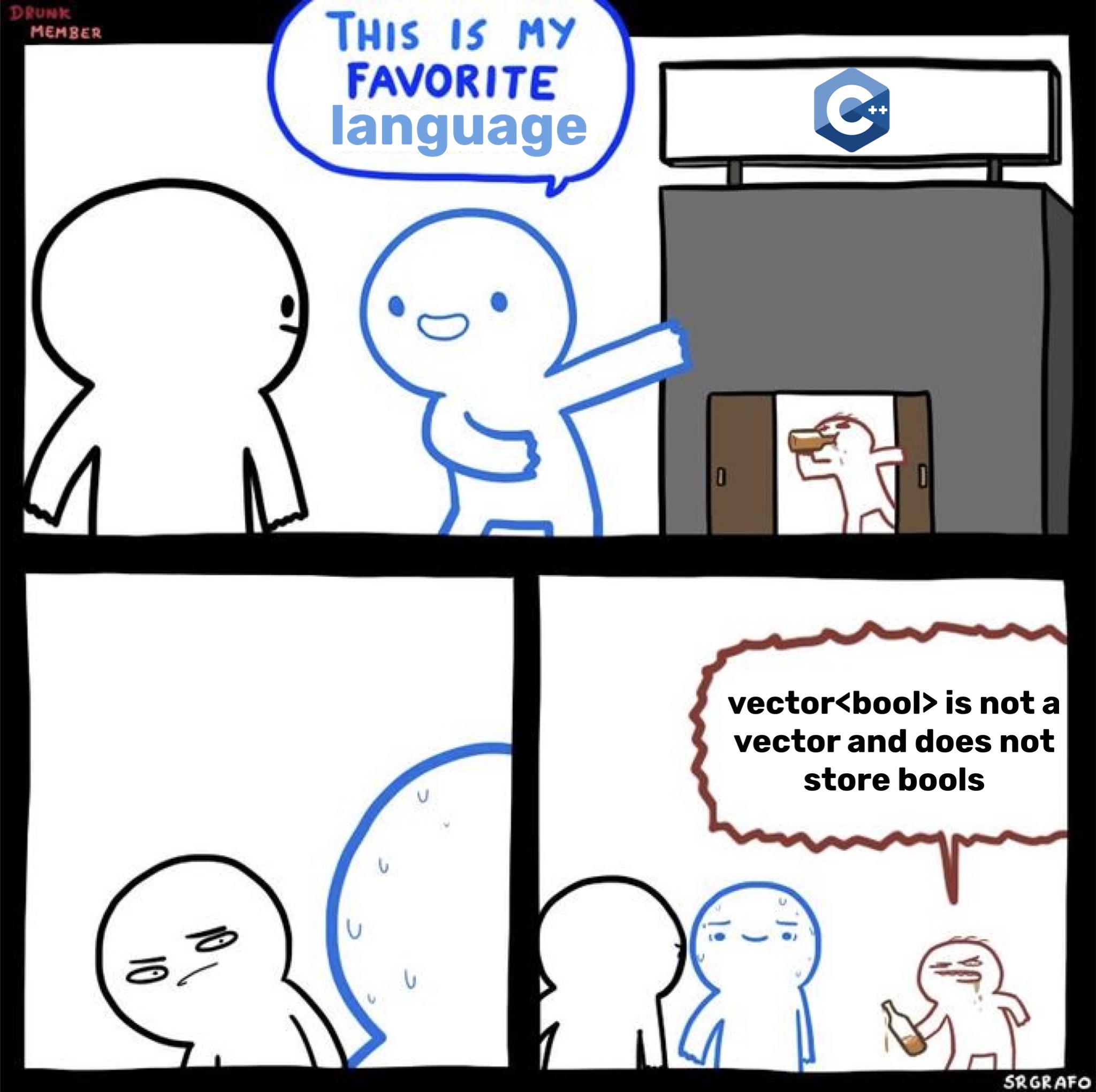
So someone enthusiastically declares C as their favorite language, and the drunk committee member in the back immediately starts screaming the truth: vector<bool> is neither a proper vector nor does it actually store bools. It's a "space-optimized" abomination that packs bits together, breaking the entire mental model of what a vector should be. You can't even get pointers to individual elements because they're bit-packed. The C++ standards committee really thought "hey, let's make this one specific template specialization behave completely differently from every other vector type" and then went home for the day. It violates the principle of least astonishment so hard that seasoned C++ devs still get caught by it. The committee member is having a meltdown because this design decision haunts them to this day.

Gophers Prefer Clean Water

Gophers Prefer Clean Water
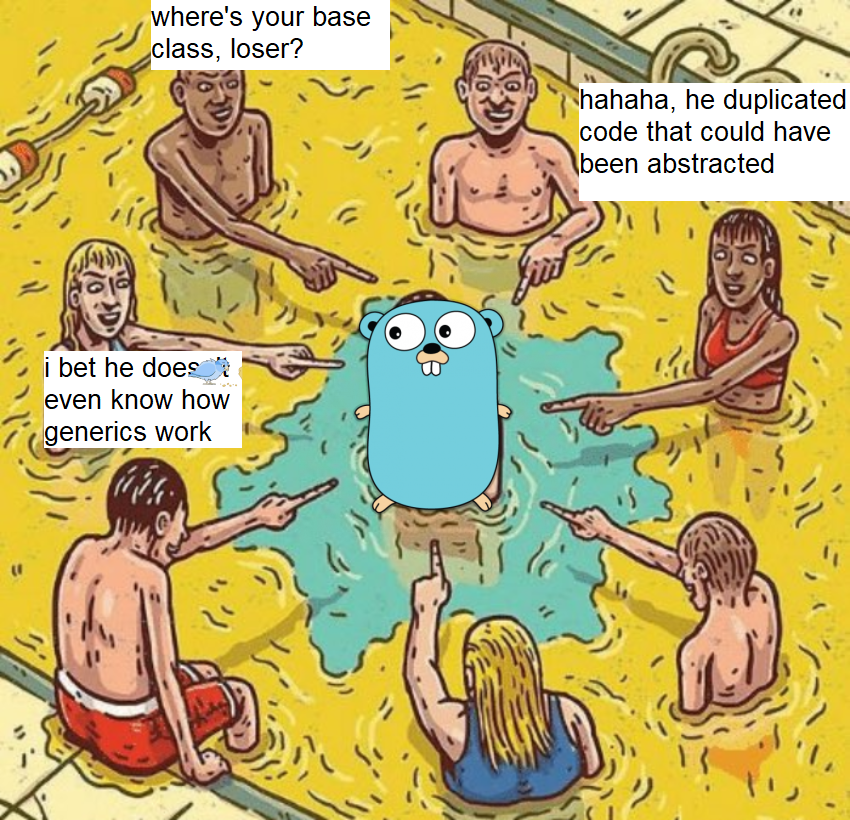
The Go gopher is just vibing in clean water while everyone around it roasts other developers for their coding sins. Meanwhile, Go developers are sitting pretty because their language literally doesn't have inheritance or base classes—it uses composition and interfaces instead. No base classes to forget, no inheritance hierarchies to mess up, no generics to... oh wait, Go added generics in 1.18. But let's be real, half the Go community still pretends they don't exist and just uses interface{} everywhere like it's 2015. The beauty here is that Go's philosophy of simplicity means you literally can't make some of these OOP mistakes. No classes? No problem. No inheritance? Can't forget what doesn't exist. It's like being immune to a disease because you're missing the receptor it needs to infect you. Go developers get to smugly watch the Java and C# folks argue about abstract factory patterns while they're out here writing if err != nil for the 47th time in the same function.

New Age Slop C

New Age Slop C
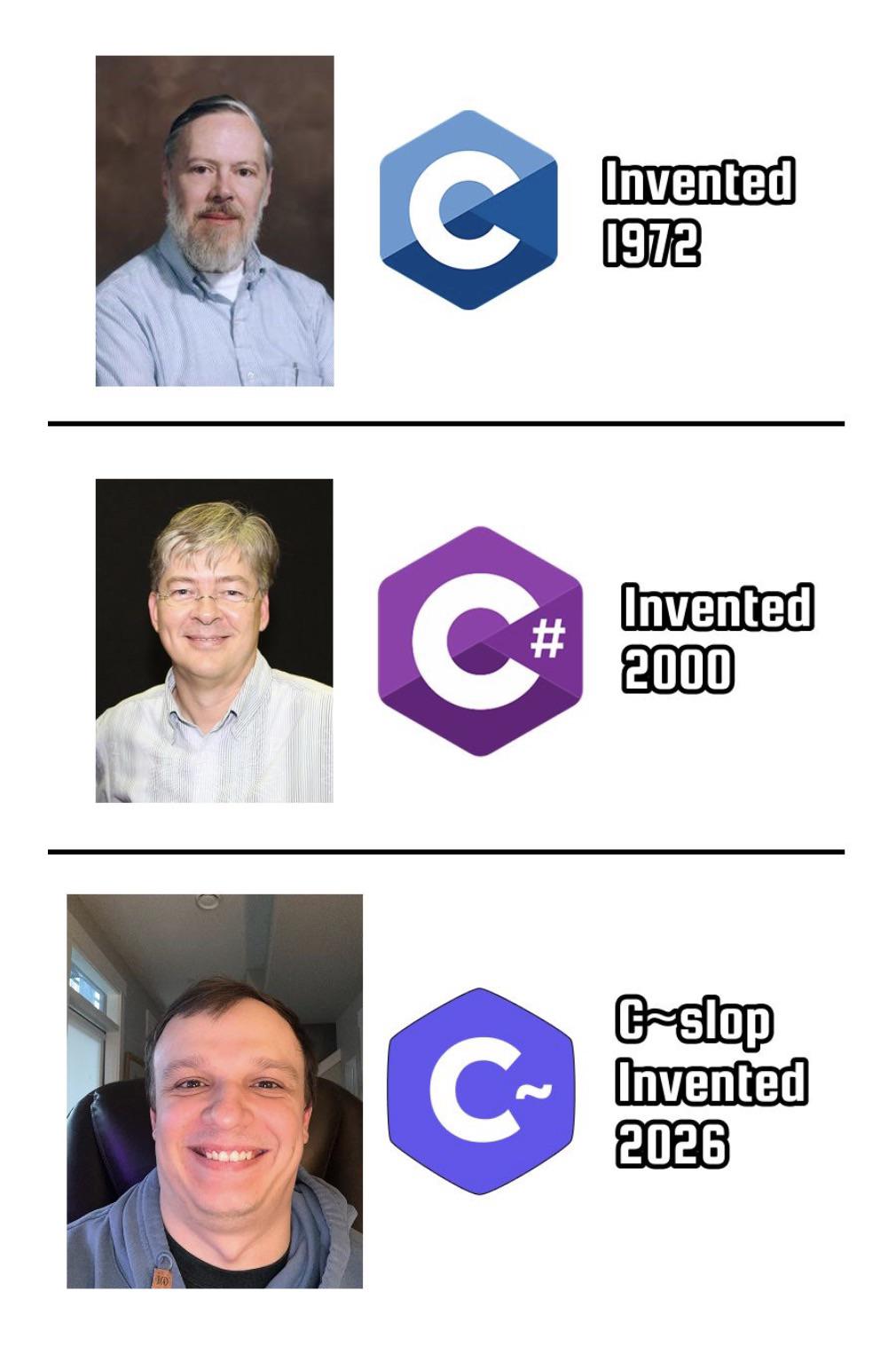
Dennis Ritchie invented C in 1972. Anders Hejlsberg invented C# in 2000. Now some random guy with a webcam and a dream invented "C~slop" in 2026. The natural evolution of programming languages, really. From foundational systems programming to enterprise-friendly managed code to... whatever AI-generated fever dream we're about to endure. The progression of facial expressions tells you everything you need to know. Ritchie looks dignified and accomplished. Hejlsberg looks professional and pleased with his work. Random webcam guy looks like he just discovered he can prompt ChatGPT to write an entire programming language and is way too excited about it. Can't wait for the Hacker News thread where people debate whether C~slop is "production ready."

Operator Overloading Is Fun

Operator Overloading Is Fun
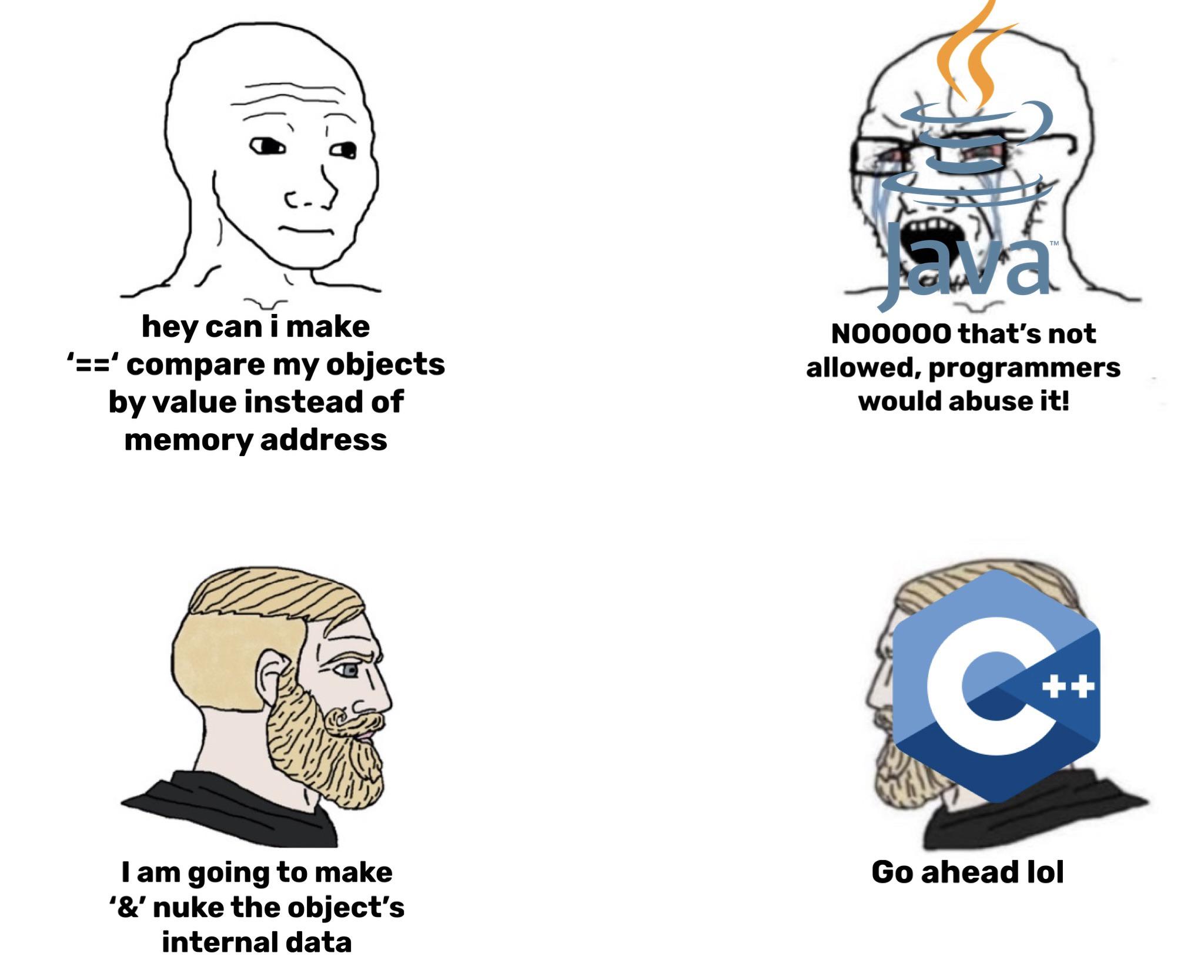
Someone wants to overload the == operator for value comparison instead of reference comparison. Java, being Java, has a complete meltdown because that would be "abuse." Meanwhile, C++ just shrugs and says "go ahead" when asked about overloading the & operator to nuke an object's internal data. Java protects you from yourself by refusing operator overloading entirely. C++ hands you a loaded footgun and a blindfold, then walks away whistling. One language thinks you're a child who can't be trusted with scissors. The other assumes you're a responsible adult who definitely won't use operator overloading to create cursed abominations that make code reviewers weep. Spoiler: C++ is wrong about you being responsible.

SHOKZ New OpenRun Pro 2 Mini -Open-Ear, Bone Conduction Sport Headphones -Sweat Resistant, Workout Headphones -Secure, Wireless, Comfortable Fit -Deep Bass and Smart Mic App

SHOKZ New OpenRun Pro 2 Mini -Open-Ear, Bone Conduction Sport Headphones -Sweat Resistant, Workout Headphones -Secure, Wireless, Comfortable Fit -Deep Bass and Smart Mic App
Unparalleled Audio – This Amazon Exclusive Rose Gold Edition features dual drivers that combine the clear highs of Bone Conduction Tech with the deep bass of Air Conduction Tech for 12 hours of power…

Learning Cpp As C With Classes

Learning Cpp As C With Classes
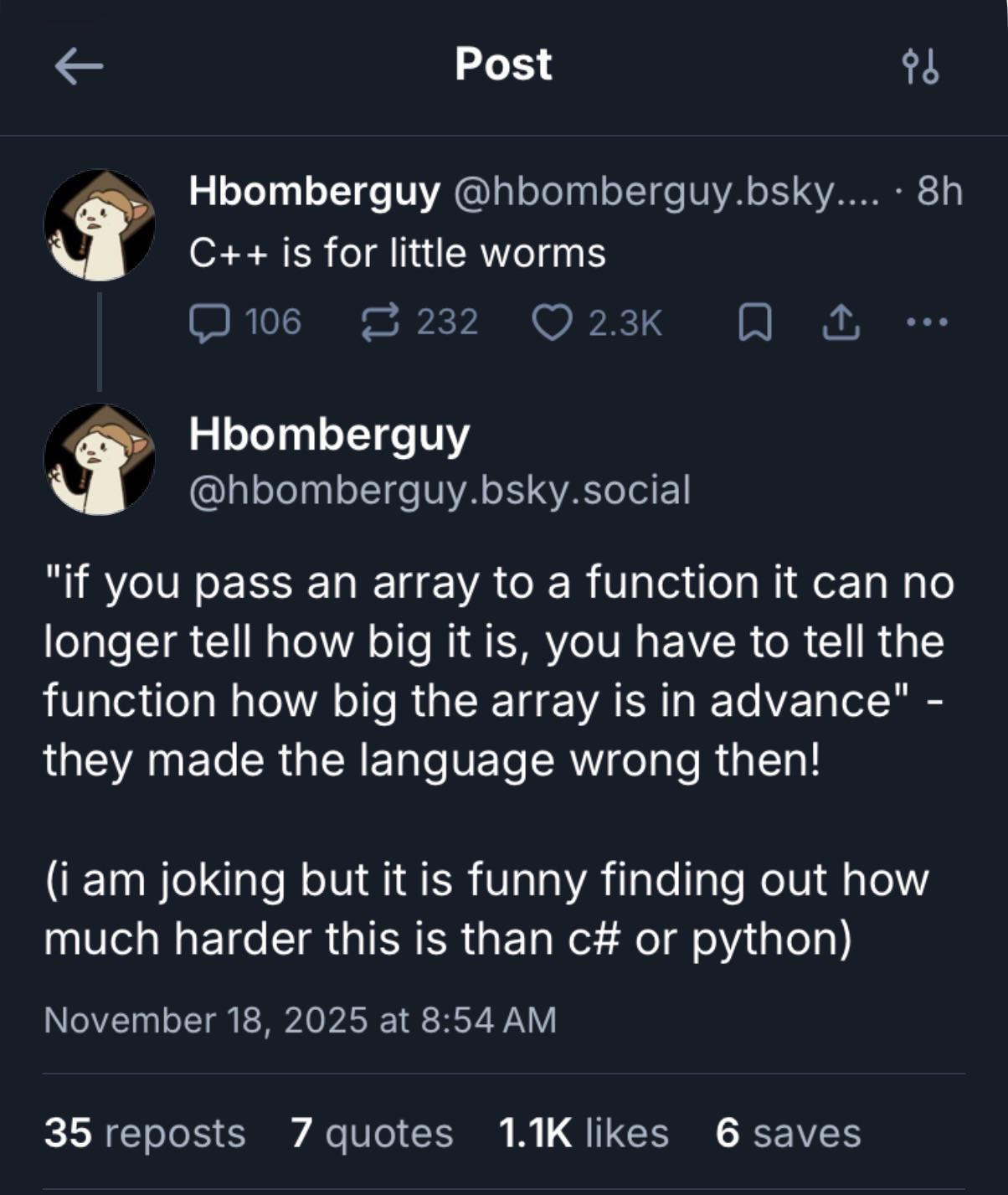
Welcome to C++, where arrays decay to pointers faster than your career expectations after reading legacy code. Someone just discovered that when you pass an array to a function, it immediately forgets its own size and becomes a humble pointer. No size information, no bounds checking, just raw pointer energy. So now you're stuck passing array sizes as separate parameters like it's 1972. Meanwhile, Python devs are over there with their .length property, sipping lattes, while C# folks have their nice Array.Length . But here you are, manually tracking array sizes like some kind of memory accountant. The "C with classes" nickname hits different when you realize Bjarne Stroustrup gave us templates, RAII, and move semantics, but somehow we're still manually babysitting array bounds in 2025. At least we have std::vector and std::array now... if you can convince your team to stop writing C code in .cpp files.

It's All There In The Specs, Bro

It's All There In The Specs, Bro
So you're telling me that accessing an array with a negative index in JavaScript not only works but actually adds a property to the array? And then when you check the array, it shows you this cursed -1: 4 sitting there like it belongs? The bell curve perfectly captures the JavaScript experience: beginners think it's ridiculous (correct), experts also think it's ridiculous (also correct), but the middle crowd has Stockholm syndrome and will defend it with their lives. "It makes sense bro, everything in JS is an object!" Yeah, and that's exactly the problem. JavaScript treats arrays like objects because they are objects, so test[-1] = 4 is just adding a property named "-1" to your array object. It's technically in the spec, which somehow makes it worse.

JS Logo Is Intentional

JS Logo Is Intentional
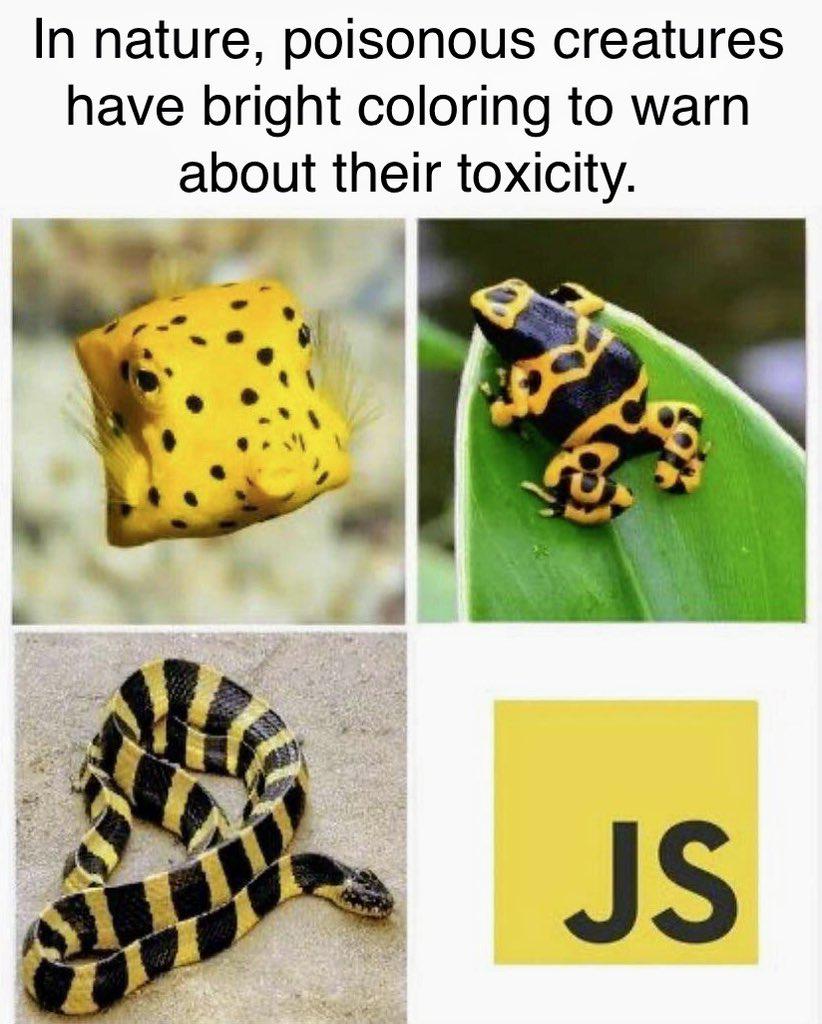
Nature's warning system is truly brilliant. Poisonous creatures evolved bright yellow and black patterns to say "don't touch me or you'll regret it" - and then there's JavaScript with its sunny yellow logo, quietly sitting there, ready to unleash undefined is not a function at 2AM when you're trying to ship to production. The language creators must have known exactly what they were doing. "Let's make it yellow! That way people will know it's dangerous before they write their first callback hell."