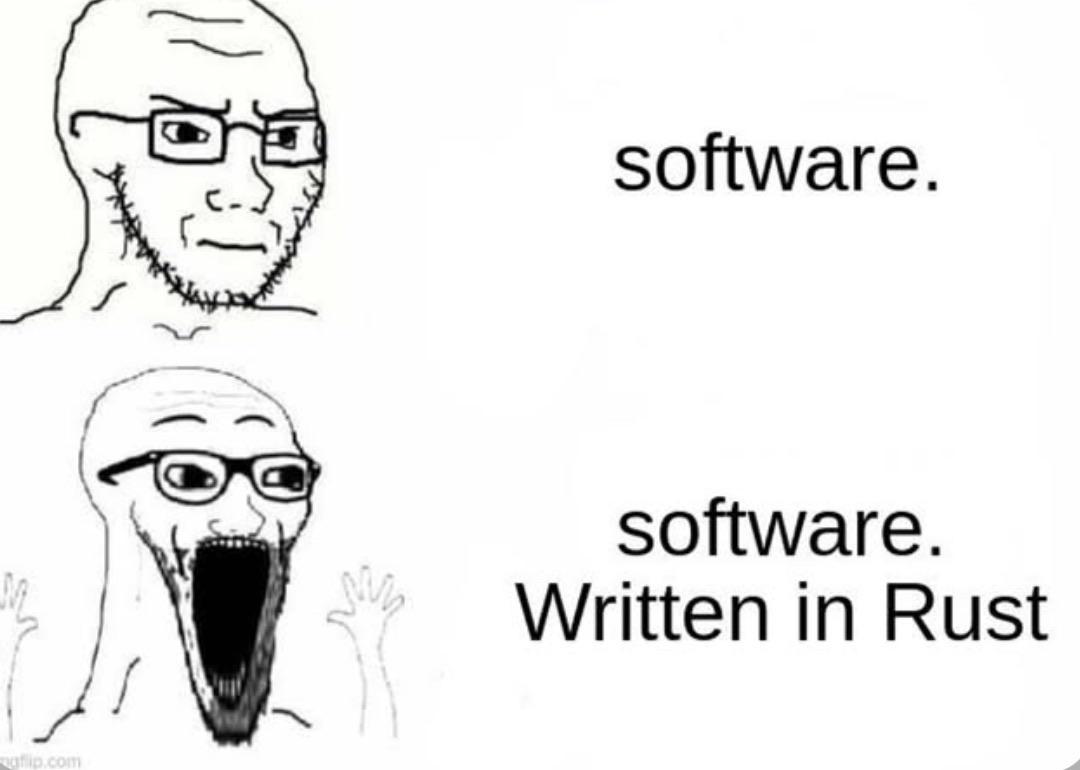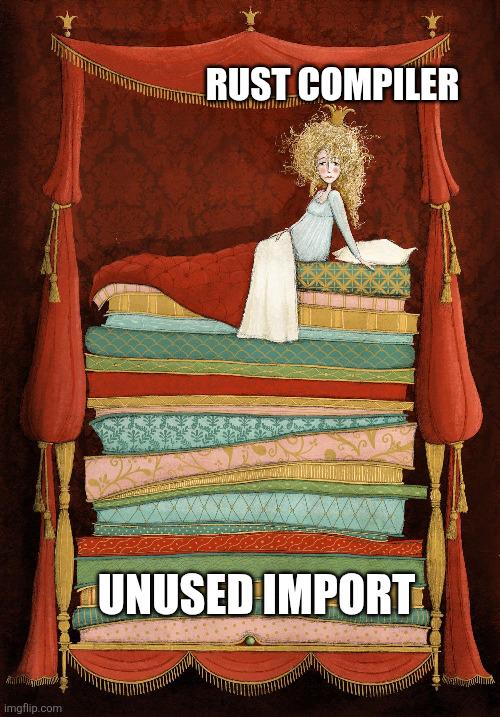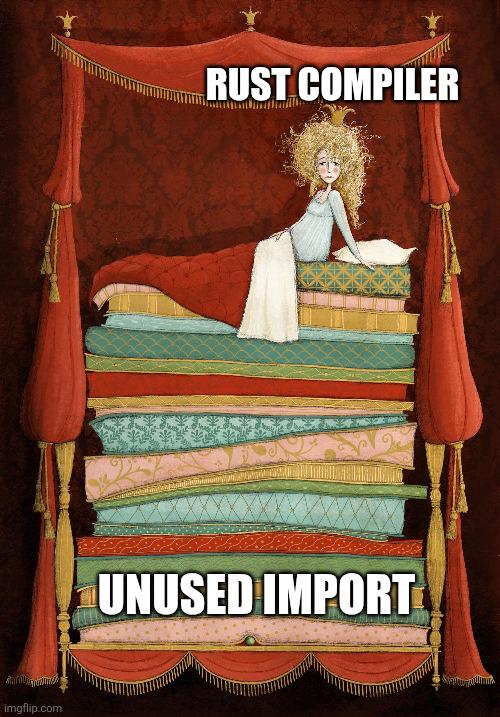


Rust Memes

Rust programming: where memory safety meets compiler errors that read like philosophical treatises on ownership. These memes celebrate the language everyone claims to be learning but few have deployed to production. If you've ever fought the borrow checker at 2 AM, felt smug about not needing garbage collection, or explained to colleagues why rewriting everything in Rust is definitely worth it, you'll find your people here. From cargo cult programming to the evangelistic fervor of new converts, these memes capture the unique blend of pain and pride that comes with writing "unsafe" as little as possible.

The Best

The Best
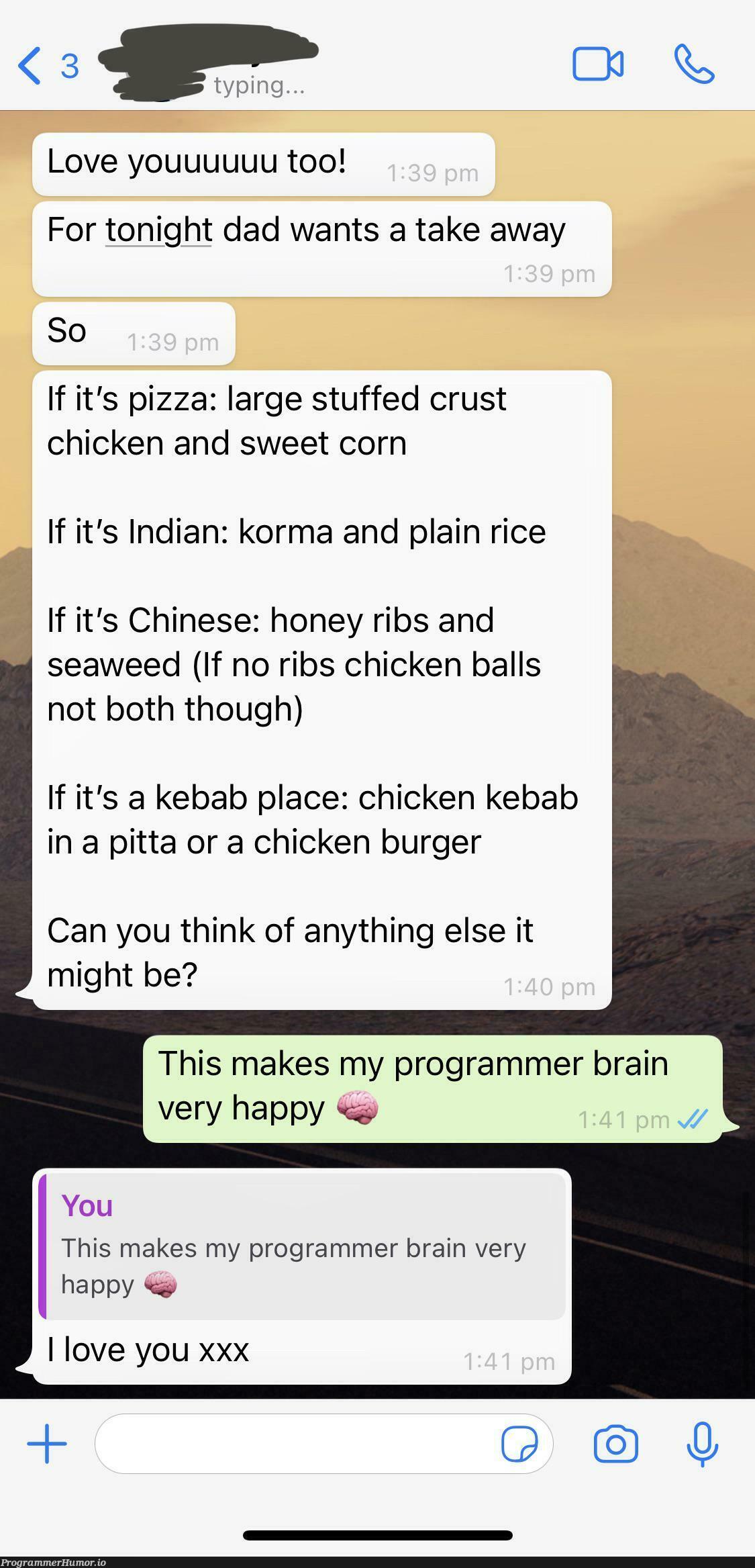
Look, I've been in the trenches long enough to know that "compiled without errors" hits different than any romantic gesture ever could. Your code compiling on the first try? That's basically winning the lottery. It's the developer equivalent of finding out your soulmate exists and they also think tabs are better than spaces. We've all been there—staring at the screen, hitting compile, bracing for impact like it's a bomb defusal. Then... nothing. No red text. No angry compiler screaming at you about missing semicolons or type mismatches. Just pure, unadulterated success. That dopamine rush is unmatched. The bar for happiness in software development is so low it's practically underground. We celebrate the absence of failure like it's a major achievement. Which, let's be honest, it kind of is.

Just Use Bacon Run

Just Use Bacon Run
So cargo watch gets deprecated in Rust and the replacement is bacon . Cool, fine, whatever. But then someone tries to use it with Bun (the JavaScript runtime that's trying to replace Node) and their gherkin—sorry, I mean gerkin , the Cucumber testing framework—starts throwing a fit. The beautiful chaos here is watching someone try to mix Rust tooling with JavaScript tooling while running Chai tests in a runtime that's basically speedrunning the "move fast and break things" philosophy. It's like ordering a bacon cheeseburger but the restaurant gives you a fish sandwich and your pickle is filing a complaint. Welcome to 2024, where we have so many tools that even their names sound like breakfast items and nobody knows what works with what anymore. Just wait until someone tries to run this with Deno and a side of Toast.

Best Integer Type

Best Integer Type
Behold, the holy trinity of integer types in their natural habitat! INT32 is just vibing with a smooth brain, doing basic arithmetic like it's 1999. INT64 shows up with a galaxy brain, handling those bigger numbers like a responsible adult. But then INT54+SIGN bursts through the ceiling with cosmic enlightenment, achieving MAXIMUM EFFICIENCY by packing both the value AND the sign bit into a single integer type. It's like discovering fire, inventing the wheel, and landing on Mars all at once. The sheer elegance of explicitly acknowledging that yes, numbers can be negative too—revolutionary! Who knew that combining size with sign awareness would unlock the secrets of the universe?

This Code Is So Rusty It Gave Me Tetanus

This Code Is So Rusty It Gave Me Tetanus
Oh honey, someone took the phrase "Rust programming" a little TOO literally and decided to create a nested labyrinth of doom that looks like it was written by someone having a fever dream about iterator combinators. Look at those nested match statements breeding like rabbits! The indentation levels go so deep you'd need a spelunking permit to navigate them. And those turbofish operators ( ::<> ) are multiplying faster than you can say "type inference failed." The joke here is double-edged: not only is this actual Rust code that's become horrifyingly complex (probably parsing some header format), but it's also metaphorically "rusty" in the sense that it's an absolute nightmare to read and maintain. It's giving "I learned about pattern matching yesterday and decided to use it EVERYWHERE" energy. The tetanus reference? *Chef's kiss* - because just like rusty metal, this code will absolutely hurt you if you touch it. One wrong move and you'll be debugging for hours wondering why your borrow checker is screaming at you.

Dev Asking A Valid Question

Dev Asking A Valid Question
Look, I've been in this industry long enough to see some wild takes, but asking if AirPods can translate between programming languages is genuinely next-level thinking. Like, if they can translate Spanish to English in real-time, why not Python to Rust? It's the same logic, right? Just different syntax trees passing through Bluetooth. The real tragedy here is that this would actually solve so many problems. Imagine talking to your legacy PHP codebase and having it come out as clean TypeScript. Or better yet, explaining your requirements in plain English and having them automatically translated to whatever cursed language your client insists on using. Someone get Apple on this. I'd pay $249 for AirPods that can translate my manager's feature requests into actual implementable code.

Mutex Will Save You All

Mutex Will Save You All
Grammar lessons from the concurrency trenches. While you're busy learning Latin plurals for your CS vocabulary, the mutex is quietly plotting your demise with race conditions and deadlocks. The joke here is brutal: mutex (mutual exclusion) is supposed to be your savior in multithreaded programming, preventing race conditions by locking shared resources. But its plural? "Deadlock." Because when you start using multiple mutexes without proper ordering, you're basically writing a suicide note for your application. Thread A locks mutex 1 and waits for mutex 2, while Thread B locks mutex 2 and waits for mutex 1. Congrats, your program is now frozen in time like a developer staring at their production logs at 3 AM. The irony is chef's kiss—the very thing meant to save you becomes your downfall when you scale up. It's like hiring security guards who end up blocking each other in doorways.

United Against The Common Enemy

United Against The Common Enemy
Nothing unites warring factions like a common enemy. Developers from every language and framework—from Rust zealots to JavaScript hipsters, Python snake charmers to C++ masochists—all sitting at the round table of tech, putting aside their holy wars over type safety and memory management to collectively agree: Jira absolutely sucks . And the ultimate act of revenge? Assigning that ticket tracking down why Jira is slow to the CEO who mandated using it in the first place. The circle of corporate karma is complete.

The Tech Stack In 2025

The Tech Stack In 2025
The modern tech stack visualized as the world's most precarious Jenga tower! At the very bottom, we have "ELECTRICITY" holding up literally everything - because let's face it, without it we're all just cavemen with MacBooks. The foundation includes Linus Torvalds, IBM, TSMC, and "K&R" (Kernighan and Ritchie, the C language creators) - you know, just the people who INVENTED MODERN COMPUTING, no big deal. Above them, C developers writing dynamic arrays because apparently we still haven't solved that problem after 50 years. Then we've got AWS, libcURL, and the Linux Foundation supporting everything while "unpaid open-source developers" hold up critical infrastructure. Meanwhile, Rust devs are off in their own rocket doing "their thing" while that one C++ project based on "undefined behavior" somehow keeps things running. The middle is pure chaos - web devs "sabotaging themselves" with an ever-growing tower of frameworks, a random Angry Bird labeled "whatever Microsoft is doing," and the cherry on top? A literal cloud labeled "lore accurate cloud server." And somehow this Frankenstein's monster powers everything from nuclear plants to "cookies for fish." The future is now, and it's terrifying!

Function Syntax Evolution: Less Is More

Function Syntax Evolution: Less Is More
The meme shows a beautiful devolution of function syntax across programming languages, with a guy progressively losing his mind with excitement. Golang: func (){} - Mild interest. Kotlin: fun (){} - Growing enthusiasm because coding is suddenly "fun". Rust: fn (){} - Full-on excitement as we're saving precious keystrokes. Bash: (){} - Complete ecstasy. Who needs labels when you can just have parentheses and curly braces floating in the void? Four characters to two. That's 50% efficiency improvement. The CFO will be pleased.

The Final Final Layer_New(3) - Internet's True Form

The Final Final Layer_New(3) - Internet's True Form
The internet's true form finally revealed! It's just a giant Jenga tower of tech stacked on increasingly questionable foundations. From the web dev actively sabotaging himself at the top to the literal "ELECTRICITY" block at the bottom—because who needs clean abstractions? My favorite part is how we're all just tiny figures in this cosmic joke: Rust devs in their corner thinking they're saving the world, unpaid open-source devs holding everything up, and whatever Microsoft is doing with that angry bird. Meanwhile, C developers are still writing dynamic arrays like it's 1972 and somehow that's supporting... *checks notes*... the entire digital economy. And at the very bottom? A system that turns "shiny metal into cookies for fish." Because of course the internet runs on nuclear power plants feeding fish. It's turtles all the way down, except the turtles are increasingly concerning technological decisions!

Wouldn't Have Happened With Rust

Wouldn't Have Happened With Rust
Caveman programmer sitting in his prehistoric cave, debugging code that probably caused the extinction event outside, while smugly thinking "wouldn't have happened with Rust." The irony of using Stone Age hardware to advocate for memory-safe languages is just... *chef's kiss*. Meanwhile, his RGB gaming setup runs on actual fire. Safety first, I guess.

Rust RFCs Be Like

Rust RFCs Be Like
The most honest RFC template in existence. Rust developers proposing new features be like: "Here's my brilliant idea that would require someone else to do all the actual hard work." And then the alternatives section just cuts straight to the chase - "Don't do this." The perfect summary of open source feature requests where enthusiasm massively outweighs implementation willingness. The borrow checker might enforce memory safety, but it can't enforce follow-through on ambitious proposals!