internet Memes

Ha

Ha!
That impossibly thin strand of glass can pump terabytes of data at the speed of light, yet most of us still think the internet is just... vibes and cloud magic. It's wild how something thinner than a human hair carries the entire weight of Netflix binges, Zoom calls, and Stack Overflow answers that save our careers daily. Meanwhile, your ISP charges you $80/month for "up to" speeds that mysteriously vanish during peak hours. The real kicker? That tiny fiber can handle gigabit speeds while your Cat5e cable from 2003 is bottlenecking your entire setup. Physics is both beautiful and humbling.

Weird Al's Advice To A Fan

Weird Al's Advice To A Fan
Weird Al just casually dropped the most programmer-coded response ever. Someone asks how to watch his content in Australia, and he hits them with the holy trinity of piracy hints: VPN (Very Probably No), TORRENT (in all caps for emphasis), and "I have to move along" like he's got plausible deniability to maintain. The man basically wrote a function that returns "how to pirate my own content" without explicitly saying it. It's like commenting your code with wink-wink-nudge-nudge energy. The backronym game is strong here—turning VPN into "Very Probably No" is the kind of wordplay that makes you wonder if Weird Al moonlights as a developer who names variables like isNotUnhappy . Also, shoutout to geo-restrictions being so annoying that even content creators are like "yeah, just pirate it, I don't blame you." Regional licensing is the real bug in production that nobody wants to fix.

Stop Doing DNS

Stop Doing DNS
Someone finally said it. DNS is apparently a scam perpetuated by Big Nameserver to sell more resolvers. Servers were perfectly happy being identified by raw IP addresses until sysadmins got greedy and demanded "respect" in the form of complex distributed systems that nobody understands. The argument here is that we had hosts.txt—a single file that every computer could use to map names to IPs. Simple. Elegant. Completely unscalable. But who needs the internet to grow anyway? Instead, sysadmins convinced everyone we needed this elaborate DNS infrastructure with recursive queries, authoritative nameservers, TTLs, and zone files. Now when someone asks for example.com, you get a 17-step journey through multiple servers just to return an IP address. They've been laughing at us this whole time while we troubleshoot NXDOMAIN errors at 3 AM. The three diagrams with increasing question marks perfectly sum up every developer's understanding of DNS: "I think I get it... wait, what?... I have no idea what's happening anymore."

Shark Still Munching At The Cable

Shark Still Munching At The Cable
The entire internet is basically a Jenga tower held together by duct tape, prayers, and a few corporations we pretend to trust. At the very bottom, literally underwater, sharks are chomping on submarine cables because apparently even marine life has beef with our infrastructure. What's beautiful here is how the whole stack—from ASML making the chips, through Intel/AMD/Nvidia silicon, up past the Linux Foundation, DNS, AWS, Cloudflare, all the way to that precariously balanced mess of "modern digital infrastructure" with WASM and V8—depends on cables that sharks find delicious. Meanwhile, unpaid open source devs are basically holding the entire thing together with their bare hands while AI and Microsoft do... whatever they're doing up there. Fun fact: Sharks actually DO bite undersea internet cables, likely because the electromagnetic fields mess with their sensory organs. Google had to wrap their cables in Kevlar-like material. So yeah, your 404 error might literally be because a great white got hungry. The internet runs on vibes and shark-resistant coating.

Are You This Old??

Are You This Old??
Dial-up internet connection dialogs were the loading screens of the ancient times. You'd literally have to input a phone number, hear the modem screech like a dying robot, and pray nobody picked up the landline while you were downloading a 2MB file. The best part? That "Save password for anyone who uses this computer" option was basically the original zero-trust security model... except backwards. Nothing says "cybersecurity" like storing ISP credentials in plaintext for the entire household to accidentally nuke your connection mid-download. If you remember this screen, you also remember the existential dread of someone yelling "I NEED TO USE THE PHONE" while you were 95% done downloading a Winamp skin.

What's A TXT Record

What's A TXT Record
Someone just asked what a TXT record is and now the entire DNS infrastructure is having an existential crisis. The rant starts off strong: naming servers? Pointless. DNS queries? Never needed. The hosts.txt file was RIGHT THERE doing its job perfectly fine before we overengineered everything. Then comes the kicker—sysadmins apparently want to know "your server's location" and "arbitrary text" which sounds like something a "deranged" person would dream up. But wait... that's literally what TXT records do. They store arbitrary text strings in DNS for things like SPF, DKIM, domain verification, and other critical internet infrastructure. The irony is thicker than a poorly configured DNS zone file. The punchline? After this whole tirade about DNS being useless, they show what "REAL DNS" looks like—three increasingly complex diagrams that nobody understands, followed by a simple DNS query example. The response: "They have played us for absolute fools." Translation: DNS is actually incredibly complex and essential, and maybe we shouldn't have been complaining about TXT records in the first place. It's the classic developer move of calling something stupid right before realizing you don't actually understand how it works.

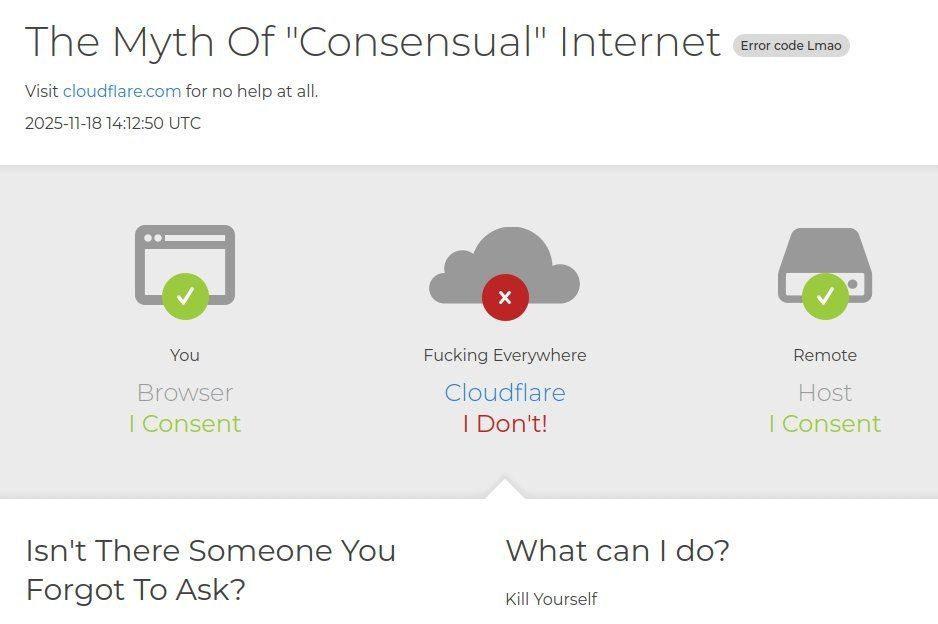
The Myth Of "Consensual" Internet

The Myth Of "Consensual" Internet
When your browser and the remote host are vibing perfectly, both giving enthusiastic consent to exchange packets, but Cloudflare sits in the middle like "I Don't!" and ruins everyone's day. The classic man-in-the-middle scenario, except it's corporate-sanctioned and somehow legal. The "Kill Yourself" suggestion under "What can I do?" is just *chef's kiss* - the most brutally honest error page ever. No "please try again later" or "clear your cache" nonsense. Just straight to existential crisis mode. Fun fact: Cloudflare handles roughly 20% of all web traffic, which means there's a 1 in 5 chance that any given website visit involves this consent-free middleman deciding whether you deserve internet access today. Democracy at its finest.

Better Than Mine

Better Than Mine
Someone's got a ping of 2.6 BILLION milliseconds. For context, that's roughly 744 hours—or 31 days—of latency. At that point, you're not playing online multiplayer, you're sending smoke signals to the server. The best part? Someone in the comments did the math and pointed out it'd literally be faster to train a carrier pigeon to deliver your inputs. RFC 1149 (IP over Avian Carriers) was supposed to be a joke, but here we are, seriously considering it as a viable alternative. Somewhere, a dial-up modem is wheezing in sympathy.

Myth Of Consensual Internet

Myth Of Consensual Internet
So your browser consents, the host consents, but Cloudflare? Nah, they're the third wheel nobody invited who just shows up and ruins everything. The beautiful irony here is that both ends of the connection are perfectly fine with each other, but Cloudflare sits in the middle like an overprotective parent saying "I DON'T!" while the error message helpfully suggests you "Kill Yourself" as a solution. Welcome to the modern internet, where your consent doesn't matter because some CDN decided you look suspicious. The "Isn't There Someone You Forgot To Ask?" is chef's kiss—like yeah, apparently we needed Cloudflare's permission to access a website. Who knew the internet needed a chaperone?

Are You This Old

Are You This Old
Nothing says "I've seen some things" quite like remembering when you had to literally phone your way onto the internet. Dial-up was the OG loading screen—except it took 30 seconds of demonic screeching noises before you could even think about loading a webpage. And God forbid someone picked up the phone while you were connected, because your connection would drop faster than a segfault in production. That Windows XP-era dialog box with its gloriously skeuomorphic design brings back memories of 56k modems, AOL CDs flooding your mailbox, and the sheer patience required to download a single MP3. You'd click "Dial," hear the modem negotiate with the ISP like two fax machines having an argument, and pray the connection succeeded on the first try. Bonus points if you remember configuring PPP settings or troubleshooting IRQ conflicts just to get online. The "Anyone who uses this computer" option is peak early 2000s security practices—because who needs proper user authentication when you're the only nerd in the house with internet access?

When AI Learns From The Dark Side Of Reddit

When AI Learns From The Dark Side Of Reddit
Google's AI desperately trying to be helpful while some random Reddit user decided to inject pure toxicity into the knowledge base. The contrast between the detailed technical explanation about USB headers and the sudden "Kill yourself" comment is peak internet whiplash. It's like when you're peacefully debugging code and suddenly hit that one cryptic StackOverflow answer from a user with -47 karma. Modern AI systems scraping the web for knowledge are basically digital toddlers learning vocabulary at a biker bar.

The Whole Internet Relies On That One Shark

The Whole Internet Relies On That One Shark
So that's what's holding up the internet - a precarious tower of technology balanced on Linus Torvalds' shoulders with a random shark at the DNS level. Turns out those underwater cables aren't the most concerning part of our infrastructure. The real MVP is that shark guarding the DNS servers while C developers write dynamic arrays, Rust devs do their thing, and some web dev quietly sabotages himself in the corner. Meanwhile, unpaid open source developers and "whatever Microsoft is doing" somehow keep this Jenga tower from collapsing. Sleep well tonight knowing your entire digital existence depends on this absurd tech stack and one very dedicated fish.