Impostor syndrome Memes

Posts tagged with Impostor syndrome
Senior Developer

Senior Developer
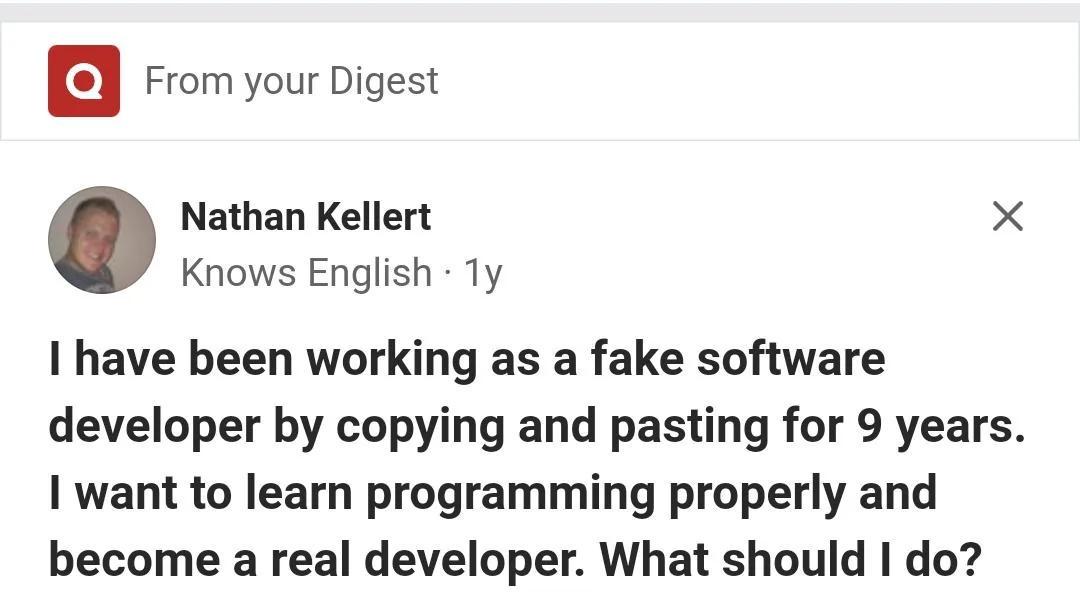
Nine years of professional Stack Overflow navigation and Ctrl+C/Ctrl+V mastery, and now they want to learn programming? Brother, you've already achieved what most of us spend our entire careers doing. The honesty is refreshing though. Most senior devs just keep the charade going and call it "leveraging existing solutions" on their resume. The real joke is that after 9 years, they probably have enough pattern recognition to actually understand what they've been copying. That's basically how everyone learns anyway, just with extra steps and denial.

Commit And Pray

Commit And Pray
Junior dev wisdom: push code to production, hope for the best. Senior dev wisdom: when things inevitably break, run git blame and let Claude (or whatever AI assistant) take the fall for the buggy code it suggested. The impostor syndrome is real, but the blame deflection game is even realer. Fun fact: git blame shows who last modified each line of code, making it the perfect tool for finding scapegoats in your commit history—or in this case, your AI pair programmer. "Sorry boss, the AI told me to do it" is the new "it works on my machine."

Jim Jobs

Jim Jobs
You know that feeling when you think you've had an original thought, only to run it through Claude and realize it's been done a thousand times before? Yeah, that's the modern developer experience in a nutshell. Your brilliant, groundbreaking idea goes in looking like Jim Carrey's goofy grin, full of naive optimism and enthusiasm. Then Claude politely informs you that not only has this been done, but there are 47 npm packages for it, three of which are deprecated, and Steve Jobs probably pitched it in 2007. The transformation from "I'm a genius!" to "I'm just reinventing the wheel with extra steps" happens faster than you can say "AI-assisted development." Welcome to 2024, where even your shower thoughts have prior art.

Learning Curve

Learning Curve
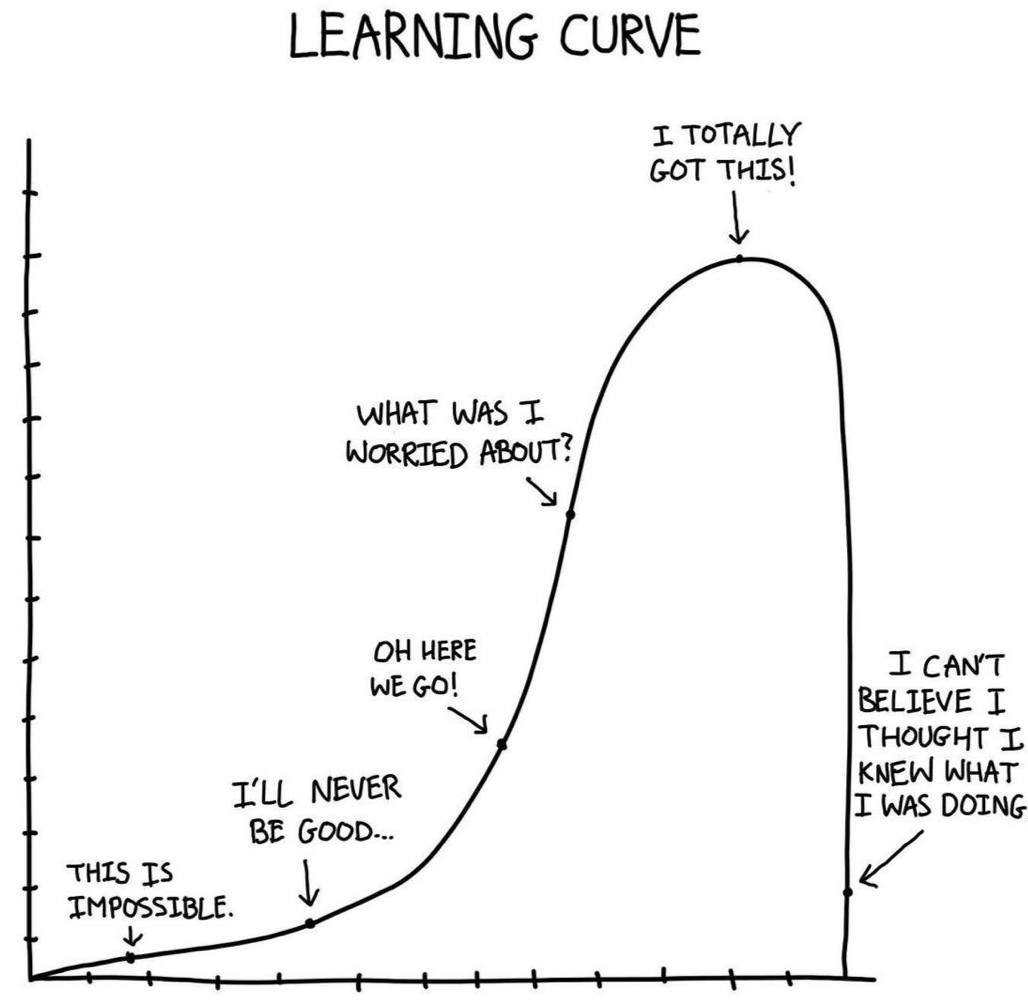
The Dunning-Kruger effect in graph form, but make it programming. You start at "this is impossible" (accurate), speedrun through "I'll never be good" (also accurate), then hit that sweet spot of false confidence where you think you've mastered React after one tutorial. Peak of Mount Stupid right there at "I totally got this!" Then reality hits harder than a production bug at 4:59 PM on Friday. You descend into the Valley of Despair realizing that your "clean code" was actually spaghetti held together by duct tape and prayers. The curve plummets as you discover design patterns, realize you've been doing everything wrong, and question every life choice that led you to programming. The real kicker? That "what was I worried about?" point on the way up is positioned exactly where overconfidence peaks before the fall. It's like the graph is saying "yeah, you thought you were worried before, but just wait until you learn what you don't know."

NordVPN

NordVPN
Encrypt your traffic on public Wi-Fi, stream from anywhere, and cover up to ten devices with one plan. 30-day money-back guarantee.

Full Stack Developer

Full Stack Developer
When someone claims they're a "full stack developer with 15 years of experience," this is what they actually look like. Two separate entities duct-taped together with VR goggles, barely holding it together. The frontend cat has no idea what the backend cat is doing, and vice versa. They're both just winging it and hoping nobody asks them to explain how WebSockets work or why the database keeps timing out at 3 AM. The reality? Most "full stack" developers are really just frontend devs who can write a SQL query without Googling it, or backend devs who know that CSS stands for "Cascading Style Sheets" and not "Can't Style Stuff." The VR headset represents the constant state of disorientation from context-switching between React hooks and database migrations twelve times a day.

Luke

Luke
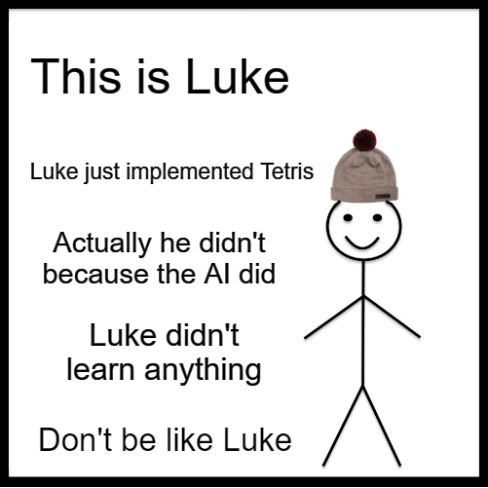
Luke's out here taking credit for implementing Tetris when ChatGPT wrote every single line. The kicker? He didn't even learn how the code works—just copy-pasted it like a pro and called it a day. We've all seen this guy in code reviews, nodding along while secretly having zero clue what his own PR does. The real tragedy isn't that AI wrote the code. It's that Luke now has "Tetris implementation" on his resume and will confidently explain it in interviews using words like "optimized block rotation algorithms" while internally panicking. Don't be like Luke. At least read what the AI gives you before you ship it to production.

Programmer Metronome

Programmer Metronome
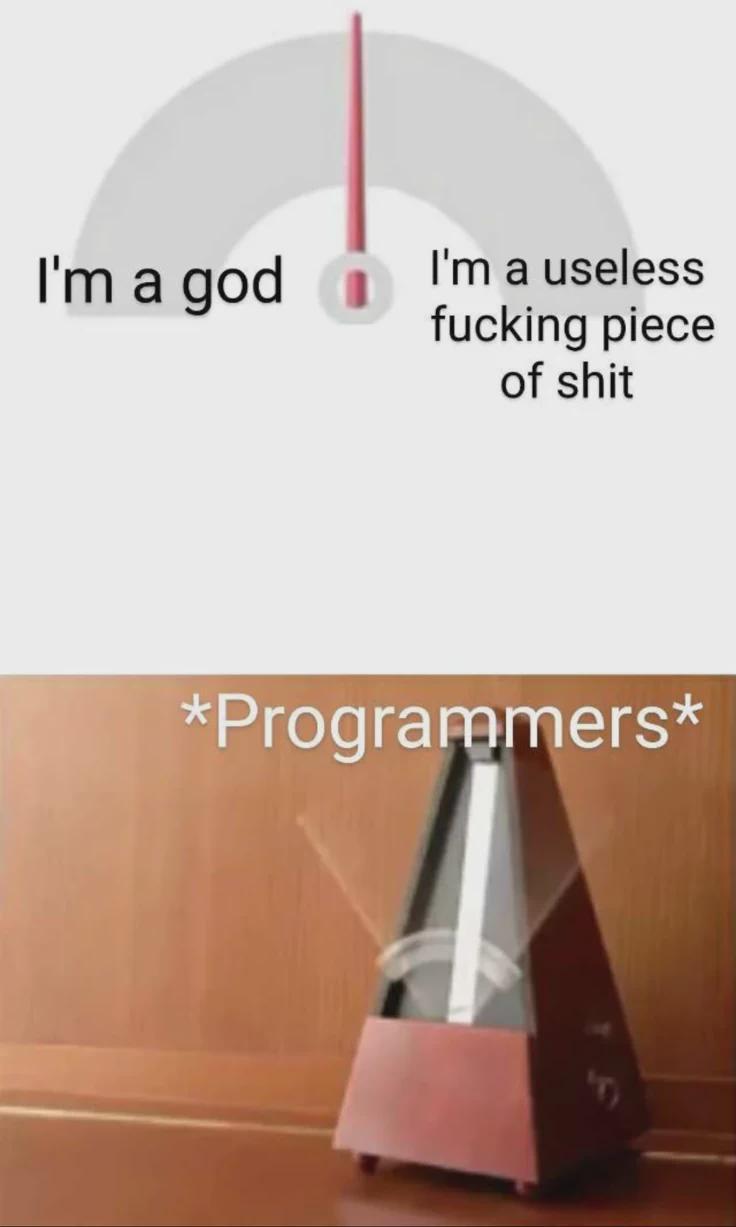
The bipolar relationship every developer has with their own code. One moment you're writing a function so elegant it deserves to be framed in the Louvre, the next you're staring at the same block wondering if you should just burn your laptop and become a farmer. The metronome perfectly captures how we oscillate between these two states with alarming frequency. Ship a feature that works on the first try? God complex activated. Spend three hours debugging only to find a missing semicolon? Existential crisis engaged. The swing between these extremes is so predictable you could set your watch to it. What makes it worse is that both feelings can happen within the same sprint. Sometimes within the same hour. The code doesn't even need to change—just your caffeine levels.

Guys I Know What Async Means Ok

Guys I Know What Async Means Ok
Nothing says "I'm a senior developer" quite like confidently presenting your screen to the entire team while your Copilot history screams "how to use async await", "what is promise", and "why is my code not working async". The panic smile says it all - you've been nodding along in standup for MONTHS pretending you totally understand asynchronous programming while secretly Googling the same thing every single day. Your teammates now know you've been living a LIE, and that fancy async/await code you wrote last sprint? Yeah, everyone knows GitHub Copilot is the real MVP on your team.

NordVPN

NordVPN
Encrypt your traffic on public Wi-Fi, stream from anywhere, and cover up to ten devices with one plan. 30-day money-back guarantee.

Cascading Bug Fix

Cascading Bug Fix
You know you've transcended mortal programming when you can bench press a barbell loaded with production bugs without breaking a sweat, but the moment you admit you don't use Google/Stack Overflow when coding, the judges lose their minds. The real flex here isn't the physical strength—it's claiming you can write code without frantically Googling "how to reverse a string in [insert language]" for the 47th time this month. That's not strength, that's delusion. Or you're John Carmack. But you're probably not John Carmack. The judges' reaction is 100% accurate because we all know that developer who claims they never Google anything is either lying, writing Hello World apps exclusively, or has achieved some sort of enlightenment the rest of us mere mortals can only dream of while copy-pasting from Stack Overflow at 3 AM.

My Vibe Coder Friend

My Vibe Coder Friend
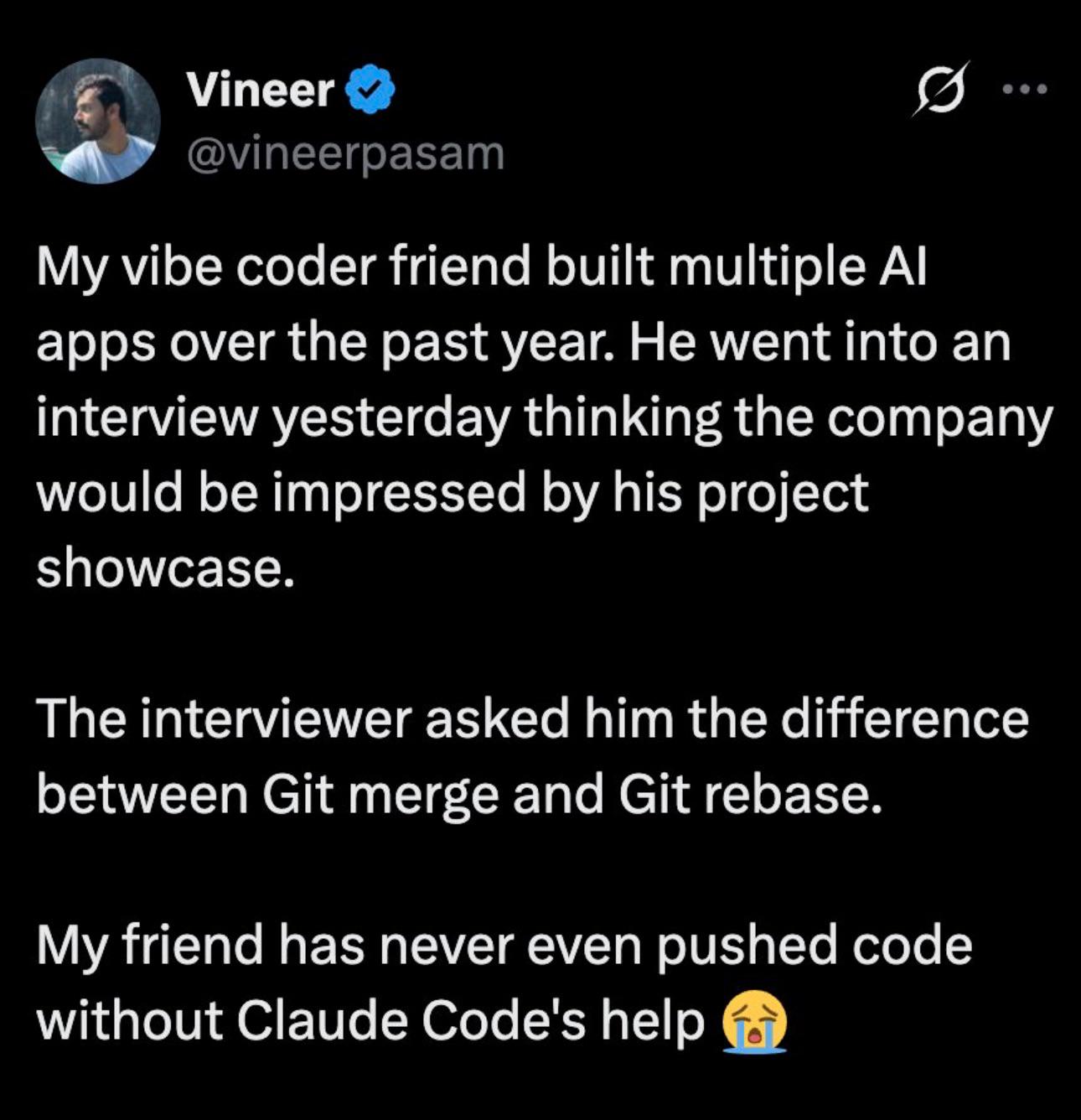
So your buddy spent a year building "multiple AI apps" with Claude doing all the heavy lifting, walked into an interview like he's the next Linus Torvalds, and got absolutely demolished by a basic Git question. The interviewer asked about merge vs rebase—literally Git 101—and homeboy probably had no idea because he's never actually pushed code without his AI buddy holding his hand. Here's the thing: you can build impressive stuff with AI assistance, but if you can't explain fundamental version control concepts that juniors learn on day one, you're gonna have a bad time. It's like claiming you're a chef because you can order UberEats really well. The interviewer saw right through the portfolio and went straight for the fundamentals—and the house of cards collapsed instantly. Welcome to the AI-assisted developer era, where your GitHub contribution graph is green but your actual knowledge is nonexistent. 😬

Borderline Depressing

Borderline Depressing
You know you've hit rock bottom when implementing a simple if-else statement makes you feel like you're juggling flaming chainsaws while riding a unicycle. The screen shows some absolutely trivial Python functions—adding two numbers, checking if a number is greater than 5, printing "Greater" or "Smaller"—and yet here we are, dressed as a full clown. Not even a subtle clown. A rainbow-wigged, red-nosed, polka-dotted disaster of a clown. The gap between what you thought programming would be (building the next revolutionary AI) versus what it actually is (staring at basic conditionals wondering why your brain stopped braining) is the real existential crisis here. Some days you're architecting distributed systems, other days you can't remember if it's elif or else if . That's just the job.

I Am Professional Seat Warmer

I Am Professional Seat Warmer
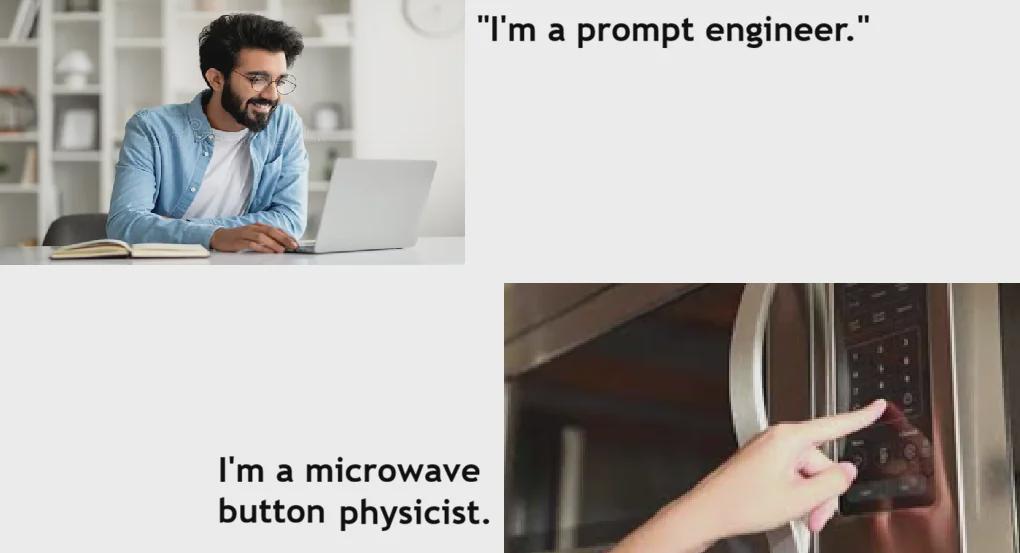
So you call yourself a "prompt engineer" because you type fancy sentences into ChatGPT? Congrats, you've achieved the same skill level as someone who presses microwave buttons. Both require extensive training in... reading instructions and hoping for the best. The brutal honesty here is that "prompt engineering" went from sounding like cutting-edge AI wizardry to basically being a glorified Google search with extra steps. Sure, you can craft the perfect prompt with context, temperature settings, and token limits—but let's be real, you're still just asking a chatbot to do your homework while pretending it's "engineering." The microwave button physicist comparison is *chef's kiss* because both involve zero understanding of what's actually happening under the hood. You don't need to know how transformers work or understand attention mechanisms—just mash those buttons until something edible comes out. Professional seat warmer indeed.