devops Memes

Dev Survival Rule No 1

Dev Survival Rule No 1
The golden rule of software development: never deploy on Friday. It's basically a Geneva Convention for developers. You push that "merge to production" button at 4 PM on a Friday and suddenly you're spending your entire weekend debugging a cascading failure while your non-tech friends are out living their best lives. The risk-reward calculation is simple: best case scenario, everything works fine and nobody notices. Worst case? You're SSH'd into production servers at 2 AM Saturday with a cold pizza and existential dread as your only companions. Friday deployments are the technical equivalent of tempting fate—sure, it might work, but do you really want to find out when the entire ops team is already halfway through their first beer?

Gentlemen A Short View Back To The Past

Gentlemen A Short View Back To The Past
Cloudflare going down has become the developer's equivalent of "my dog ate my homework" - except it's actually true about 40% of the time. The other 60% you're just on Reddit. The beautiful thing about Cloudflare outages is they're the perfect scapegoat. Your code could be burning down faster than a JavaScript framework's relevance, but if Cloudflare has even a hiccup, you've got yourself a get-out-of-jail-free card. Boss walks by? "Can't deploy, Cloudflare's down." Standup meeting? "Blocked by Cloudflare." Missed deadline? You guessed it. The manager's response of "Oh. Carry on." is peak resignation. They've heard this excuse seventeen times this quarter and honestly, they're too tired to verify. When a single CDN provider has enough market share to be a legitimate excuse for global productivity loss, we've really built ourselves into a corner haven't we?

It Happened Again

It Happened Again
When you've been riding that sweet 17-day streak of Cloudflare stability and suddenly wake up to half the internet being down. Again. Nothing quite like that sinking feeling when your perfectly working app gets blamed for being broken, but it's actually just Cloudflare taking a nap and bringing down a solid chunk of the web with it. The best part? Your non-tech manager asking "why is our site down?" and you have to explain that no, it's not your code this time—it's literally the infrastructure that's supposed to protect you from going down. The irony is chef's kiss. Pro tip: Keep a "Days Since Last Cloudflare Outage" counter in your Slack. It's like a workplace safety sign, but for the modern web.

Is Cloudflare Down

Is Cloudflare Down
The irony is chef's kiss. You're trying to check if Cloudflare is down by visiting a status page that's... served through Cloudflare. It's like asking the fire if it's burning properly. The 500 error is basically Cloudflare saying "I can't tell you if I'm down because I'm too busy being down." This is why every ops team has trust issues and keeps three different status checkers bookmarked. Because nothing says "reliable infrastructure" quite like your monitoring tool being unable to monitor itself.

Sir, Another Update Has Hit The Server Room

Sir, Another Update Has Hit The Server Room
Cloudflare updates have achieved 9/11 status in the IT world. Every time they push an update, half the internet goes down and you're just standing there watching your monitoring dashboard light up like a Christmas tree. The priest performing last rites on the server infrastructure is honestly the most accurate representation of a sysadmin's emotional state during a CDN outage. At least when your own servers crash, you can blame yourself. When Cloudflare goes down, you get to explain to your boss why the entire internet is broken and no, you can't just "restart the cloud."

Is Cloud Flare Down Again

Is Cloud Flare Down Again
You know your infrastructure is in great hands when Cloudflare goes down more often than your college roommate's commitment to leg day. The kid pointing at the 500 error is every developer frantically refreshing isitdownrightnow.com, while the teacher represents your boss who's seen this exact presentation seven weeks in a row. "It's not our code, it's Cloudflare!" becomes the most overused excuse in standup meetings. Plot twist: sometimes it actually IS Cloudflare, and you get to feel vindicated for approximately 3 minutes before realizing half the internet is down with you.

Stop Naming Services After Marvel Characters

Stop Naming Services After Marvel Characters
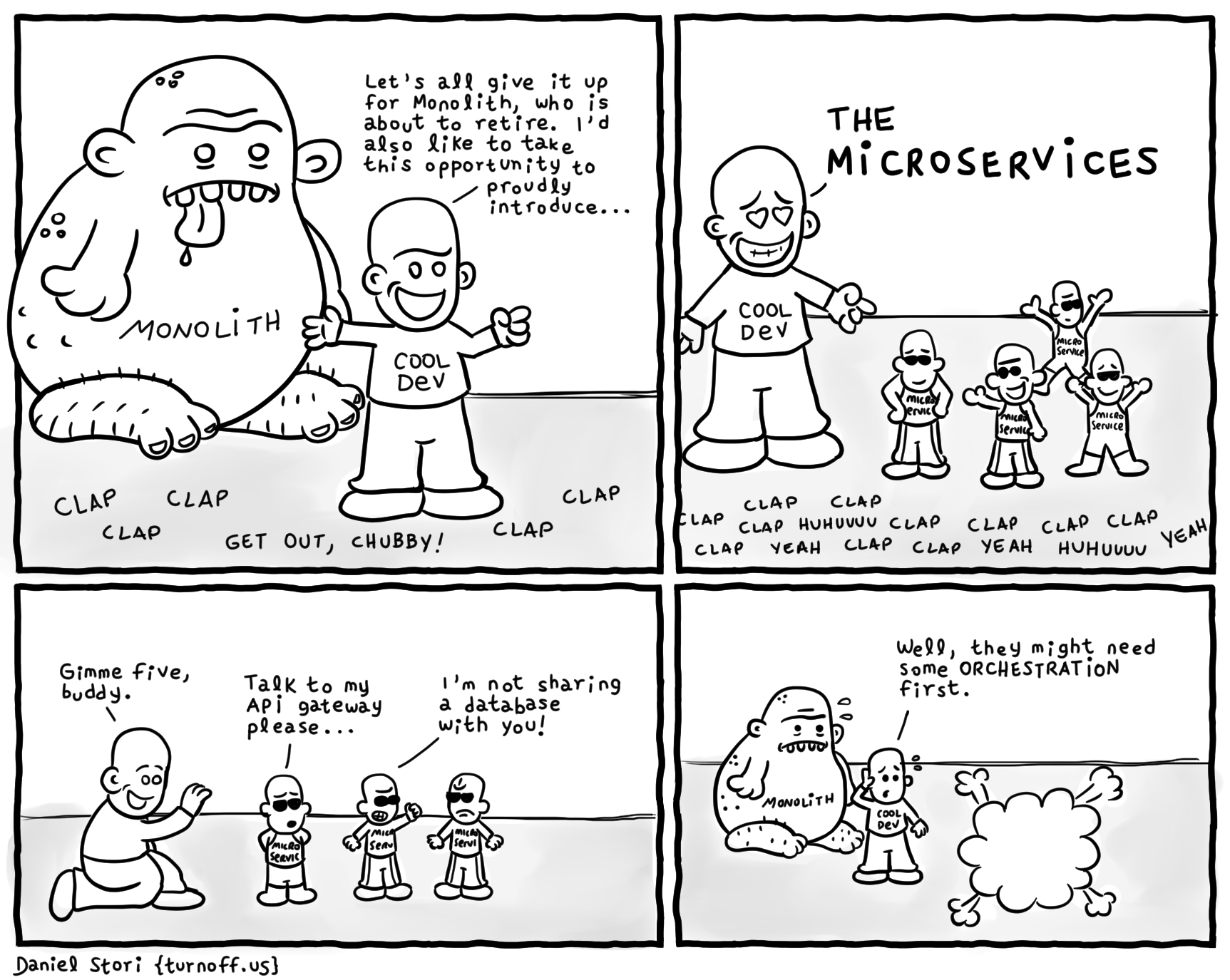
Finally! Freedom to name your microservice whatever your heart desires! No more boring "user-authentication-service" or "payment-processor-api"—nope, we're going FULL CREATIVE MODE. And what better way to exercise this newfound liberty than naming it after a disabled piglet with a wheelchair? Because nothing screams "professional enterprise architecture" quite like explaining to your CTO that the authentication service is called Chris P. Bacon. The beauty here is the sheer commitment to the bit. Your manager gives you carte blanche on naming conventions, thinking you'll choose something sensible and descriptive. Instead, you've immortalized a piglet from Clermont, Florida in your company's infrastructure. Now every standup meeting includes the phrase "Chris P. Bacon is down" and nobody can keep a straight face. The on-call rotation just got 1000% more entertaining. Bonus points: when new developers join and have to read documentation that casually references Chris P. Bacon handling critical business logic. They'll spend their first week wondering if they joined a tech company or a petting zoo.

Dave Ops Engineer

Dave Ops Engineer
You know you're in trouble when the entire company's infrastructure is basically a Jenga tower held together by one senior dev who knows where all the bodies are buried. Dave's the guy who wrote that critical bash script in 2014 that nobody dares to touch, maintains the deployment pipeline in his head, and is the only person who remembers the prod server password. He's on vacation? Good luck. He quits? Company goes down faster than a poorly configured load balancer. The best part? Management keeps saying they'll "document everything" and "reduce the bus factor," but here we are, three years later, still praying Dave doesn't get hit by that metaphorical bus. Or worse, accept that LinkedIn recruiter's message.

I'm A DevOps Engineer And This Is Deep

I'm A DevOps Engineer And This Is Deep
The DevOps pipeline journey: where you fail spectacularly through eight different stages before finally achieving a single successful deploy, only to immediately break something else and start the whole catastrophic cycle again. It's like watching someone walk through a minefield, step on every single mine, get blown back to the start, and then somehow stumble through successfully on pure luck and desperation. That top line of red X's? That's your Monday morning after someone pushed to production on Friday at 4:59 PM. The middle line? Tuesday's "quick fix" that somehow made things worse. And that beautiful bottom line of green checkmarks? That's Wednesday at 3 AM when you've finally fixed everything and your CI/CD pipeline is greener than your energy drink-fueled hallucinations. The real tragedy is that one red X on the bottom line—that's the single test that passes locally but fails in production because "it works on my machine" is the DevOps equivalent of "thoughts and prayers."

Feels Good

Feels Good
You know that rush of pure dopamine when someone finally grants you admin privileges and you can actually fix things instead of just filing tickets into the void? That's the vibe here. Being an administrator is cool and all—you get to feel important, maybe sudo your way through life. But the REAL high? Having authorization to actually push changes to production. No more begging the DevOps team, no more waiting for approval chains longer than a blockchain, no more "have you tried turning it off and on again" when you KNOW what needs to be done. It's the difference between being able to see the problem and being able to nuke it from orbit. SpongeBob gets it—that ecstatic, unhinged joy of finally having the keys to the kingdom. Now excuse me while I deploy on a Friday.

Vibe Bill

Vibe Bill
Nothing kills the startup vibes faster than your first AWS bill showing up like a final boss. You're out here "vibing" with your minimal viable product, feeling like the next unicorn, deploying with reckless abandon because cloud resources are "scalable" and "pay-as-you-go." Then reality hits harder than a null pointer exception when you realize "pay-as-you-go" means you're actually... paying. For every single thing. That auto-scaling you set up? Yeah, it scaled. Your database that you forgot to shut down in three different regions? Still running. That S3 bucket storing your cat memes for "testing purposes"? $$$. The sunglasses coming off is the perfect representation of that moment when you check your billing dashboard and suddenly understand why enterprise companies have entire teams dedicated to cloud cost optimization. Welcome to adulthood, where your code runs in the cloud but your bank account runs on fumes.

Typo

Typo
We've all been there. You send a casual "Good morning, I'm about to destroy the backend and DB" thinking you typed something else entirely, and suddenly your phone becomes a weapon of mass panic. The frantic unanswered call, the desperate "Deploy*" with an asterisk like that fixes anything, followed by "Applogies" (because you can't even spell apologies when you're spiraling). The best part? "Please take the day off! Don't do anything!" Translation: Step away from the keyboard before you nuke production. But nope, our hero insists on deploying anyway because apparently one near-death experience per morning isn't enough. Some people just want to watch the database burn.