Complexity Memes

Posts tagged with Complexity

When You Realize Tower Of Hanoi Is Actually NP-Complete

When You Realize Tower Of Hanoi Is Actually NP-Complete
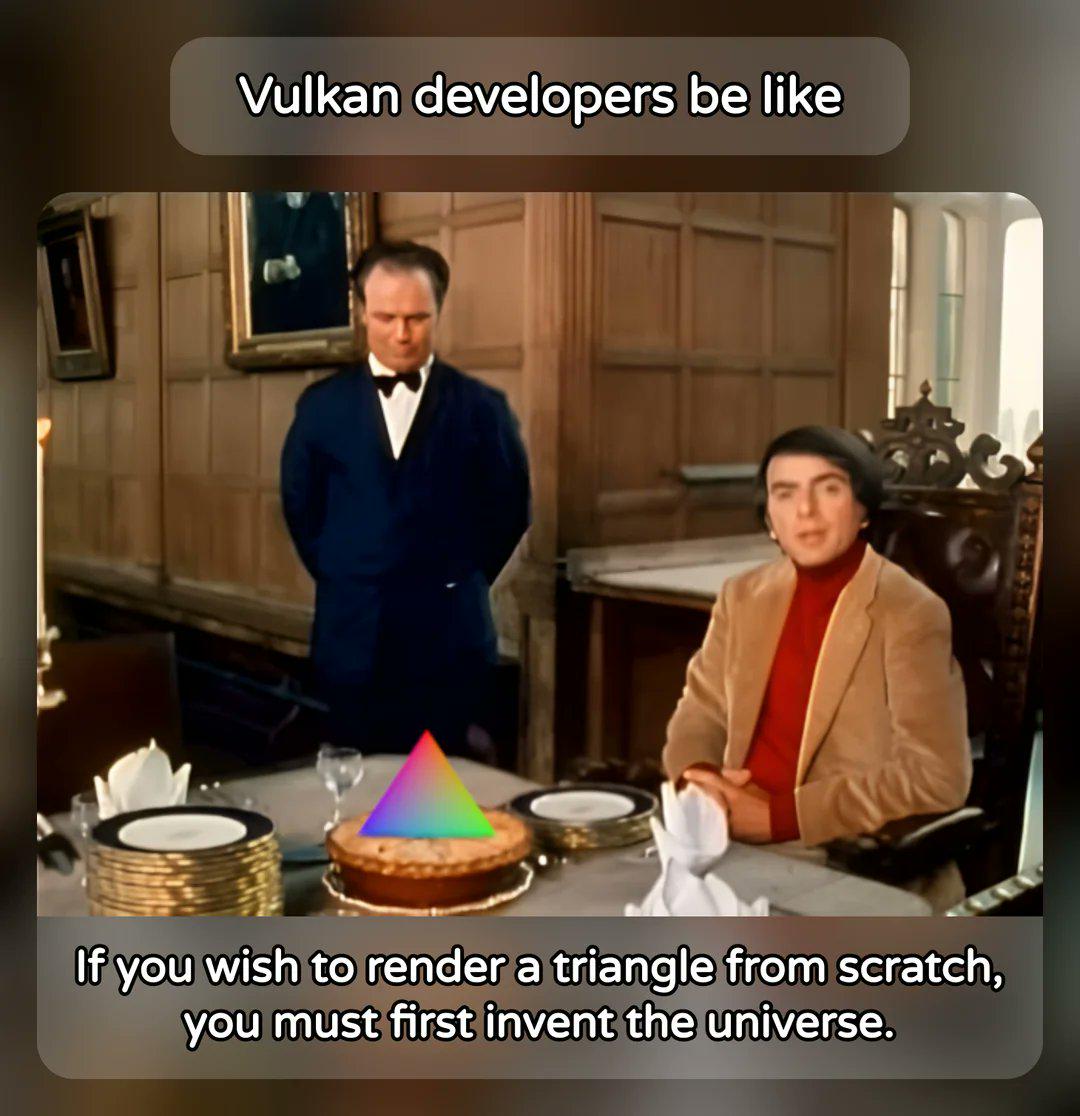
Oh look, it's the Tower of Hanoi! That innocent-looking wooden toy that turns every programmer into a sweating mess during technical interviews. Sure, normies see a children's puzzle, but programmers instantly flash back to their algorithms class where they learned about recursive solutions, exponential time complexity (2^n - 1 moves for n disks), and the existential dread of explaining their solution to a whiteboard. The recursive nature of Tower of Hanoi makes it a classic teaching example: move n-1 disks to auxiliary peg, move largest disk to destination, move n-1 disks from auxiliary to destination. Simple in theory, but watching that call stack grow deeper than your imposter syndrome? Yeah, that'll make anyone look like that concerned seal. Fun fact: With 64 disks, solving Tower of Hanoi would take about 585 billion years. Still faster than waiting for your CI/CD pipeline to finish though.

Welcome To The Team

Welcome To The Team
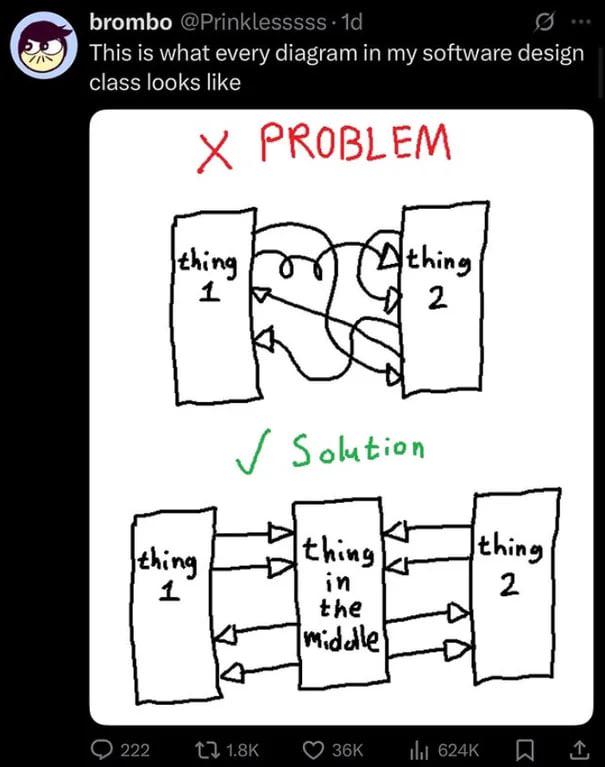
Your first day onboarding be like: "Here's a whiteboard full of 47,000 interconnected boxes that somehow represent our 'simple' microservices architecture. Don't worry, it gets worse!" The absolute AUDACITY of calling that nightmare flowchart an "overview" and then threatening to go into MORE detail is peak corporate sadism. That poor new hire is about to discover that the "little more detail" involves twelve legacy systems held together by duct tape, prayers, and a Perl script from 2003 that nobody dares to touch because the guy who wrote it retired to Bali.

The AI Express: Straight Track vs. Spaghetti Junction

The AI Express: Straight Track vs. Spaghetti Junction
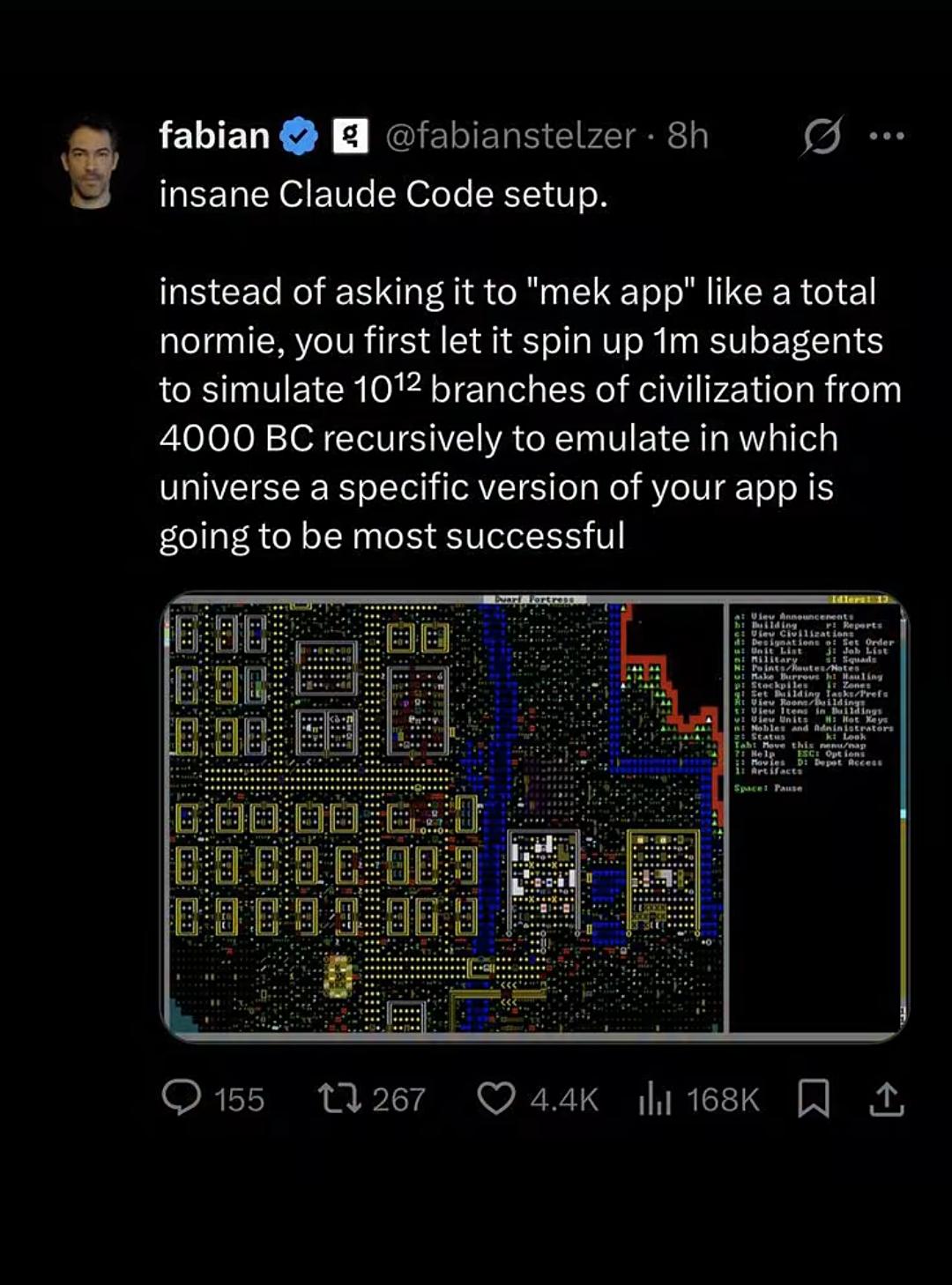
Remember when we used to brag about building an app in 5 hours? Now we're just prompt engineers telling AI, "Hey, make me an app that does X" and then spending 4 minutes and 55 seconds scrolling Twitter while it works. Sure, the AI-built app has 47 different railway tracks going in random directions instead of our nice straightforward solution, but who cares? The client can't tell the difference and we still charge them for the full 5 hours anyway.

Test Suite Setup: The Infrastructure Apocalypse

Test Suite Setup: The Infrastructure Apocalypse
Oh. My. GOD! This is what passes for a "test suite setup" these days?! 🙄 The absolute AUDACITY of this engineer spinning up TWO ENTIRE DATABASES, Docker containers, and who knows what else just to run some tests! Meanwhile, the person's face says it all - that smug "I'm about to watch the world burn while this monstrosity takes 45 minutes to initialize" expression. The perfect representation of modern development where "simple unit tests" now require their own data center and probably three cloud providers on standby. And they wonder why the coffee machine is always empty!

Want Something To Cry About?

Want Something To Cry About?
Nothing says "welcome to the real world" like being handed the ISO/IEC 14882:2024 standard—aka the C++ specification. It's the programming equivalent of being told "the swimming pool is over there" and then getting thrown into the Mariana Trench. 900+ pages of the most arcane syntax rules, undefined behaviors, and template metaprogramming nightmares known to mankind. And they update it every few years just when you thought you understood the previous version! The real tears come at 3 AM when you're debugging a segfault caused by some obscure rule on page 734.

Data Structures Be Like

Data Structures Be Like
Ah, linked lists - where every node is just making phone calls saying "I know a guy who knows a guy." That's literally how they work. Your data is just sitting there with a pointer saying "need the next value? Call this address, they've got it." And if you need to insert something in the middle? Just rewire a couple of phone numbers and nobody needs to move apartments. Ten years into my career and I'm still impressed by how something so simple solves so many problems... until you need random access and your O(n) lookup time makes the senior devs cry.

The Tower Of Babel vs One Rusty Brick

The Tower Of Babel vs One Rusty Brick
The entire tech industry is building digital skyscrapers of complexity—microservices stacked on containers balanced on orchestration tools perched on virtualization—and then there's Rust, just chilling as a single, solid brick. It's like watching everyone bring an aircraft carrier to a knife fight while Rust shows up with a perfectly sharpened pocket knife. The irony is that tiny brick is probably holding up half the wobbly tower. Memory safety doesn't need a mansion, just competent architecture.

Fastest Way To Empty Your Wallet: The O(API) Sorting Algorithm

Fastest Way To Empty Your Wallet: The O(API) Sorting Algorithm
When your CS professor says "implement a sorting algorithm" but you've got an OpenAI API key and zero shame. This dev just created the world's most expensive sorting function by literally asking GPT-4 to be a sorting algorithm! Sure, it works—but imagine burning through API credits to sort [42, 3, 99, 7, 13] when a simple Array.sort() would do the trick. The true innovation here is maximizing both latency AND cost while solving a problem that was figured out decades ago. Congratulations, you've invented O(API) complexity—where the limiting factor is your credit card limit!

When Your Simple Regex Gets "Optimized"

When Your Simple Regex Gets "Optimized"
The classic "let me help optimize your regex" moment that turns into a nightmare. First suggestion: "Just use [A-Z]? instead of {1}." Reasonable. Then suddenly you're staring at a regex monstrosity that would make Cthulhu weep. And the final question about "11 separate capturing groups" is just the chef's kiss of regex hell. It's like asking for directions to the corner store and getting detailed instructions on how to build a spaceship from scratch. The regex "optimization" went from helpful to "I'm going to rewrite your entire life in one line" real quick.

The Overengineering Champion

The Overengineering Champion
Just turned what should've been a 10-line script into a microservice architecture with seven Docker containers and a message queue. The client wanted a contact form, but I gave them an enterprise solution complete with Kubernetes orchestration. Now I'm standing here in my sunglasses feeling like a tech god while some poor soul rows the boat behind me doing all the actual work.

Quicker, But What Do We Sacrifice?

Quicker, But What Do We Sacrifice?
OH MY GOD, the AI apocalypse is here in the form of railway chaos! 😱 Sure, your traditional coding path is a nice, straight, predictable track that takes 5 WHOLE HOURS of your precious life. But throw in some AI agents and BOOM—you've got a tangled nightmare of complexity that somehow works in 5 minutes! It's like trading your nice quiet country road for Grand Central Station during rush hour. Congratulations, you've saved 4 hours and 55 minutes, but your codebase now resembles a plate of spaghetti that even Italian grandmothers would disown. Speed or sanity? YOU CHOOSE!

Worst Case In Linear Complexity

Worst Case In Linear Complexity
When your algorithm professor says "brute force is O(n) in the worst case" and you think it's not so bad until you realize n=1000 and you're at combination 980. That's the computational equivalent of getting to the last bathroom stall only to discover there's no toilet paper. Just 20 more combinations to go, but your flight boards in 5 minutes. Classic Murphy's Law of Computing: the solution is always in the last place you look—and usually when you're out of time.