

Yep ... X)

Yep ... X)
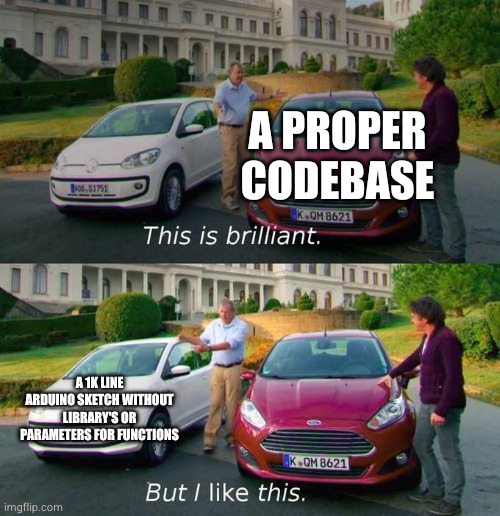
The beautiful journey of looking at your old code and thinking "what absolute maniac wrote this garbage?" only to realize it was you, six months ago, working alone on a project with no code reviews. The self-awareness hits different when you're a solo dev—there's literally nobody else to blame. No team to point fingers at, no junior dev scapegoat, just you and your past self's questionable life choices. The spaghetti code wasn't written by some mythical bad programmer... it was the call coming from inside the house all along.

Someone Send Help

Someone Send Help
Epic Games really said "Programming is hard" and then proceeded to... program a whole new launcher anyway. The beautiful irony here is that they're literally complaining about how difficult programming is while simultaneously announcing they programmed something complex. It's like saying "Running marathons is exhausting" while crossing the finish line of your third marathon this week. The best part? They're not wrong. Programming is hard. But instead of fixing bugs in the old launcher, they went full "let's rewrite everything from scratch" mode—the classic developer trap we all fall into when refactoring seems scarier than starting over. Spoiler alert: it never is.

Why Even Ask

Why Even Ask
Imagine walking into the birth registrar's office and confidently declaring you want to name your child "OR 1 = 1 --" for "family tradition" reasons. The registrar's face? Pure confusion mixed with existential dread. Because nothing says "loving parent" quite like naming your kid after a SQL injection attack that could potentially drop entire databases! For those blissfully unaware: OR 1 = 1 -- is the classic SQL injection payload that makes authentication checks go "sure buddy, come right in!" The OR 1 = 1 part always evaluates to true, and the -- comments out the rest of the query. It's basically the skeleton key of poorly secured databases. So yeah, good luck explaining to kindergarten teachers why little Bobby Tables' sibling is named after a database exploit. The family tree must be absolutely WILD.

How To Get A Job

How To Get A Job
The brutal hierarchy of job hunting in tech, ranked by actual effectiveness. Nepotism reigns supreme at S+ tier because nothing beats having daddy dial up the hiring manager directly. One tier down, knowing someone who knows someone still gets you in the door faster than your pristine resume ever will. Then there's the "come work with me" referral from a current employee, which is basically a golden ticket. Furry conventions somehow rank higher than actual recruiters, which is honestly fair because at least you're making genuine connections there. Recruiters sit in C tier doing their best. And then, occupying the absolute bottom of the barrel in F tier, we have LinkedIn, Indeed, Glassdoor, ZipRecruiter, Monster, and SimplyHired—where your application goes to die in a black hole alongside 847 other candidates, never to be seen by human eyes.

Bug Pushed Coming To Take Down Prod

Bug Pushed Coming To Take Down Prod
You know that feeling when you hit merge on a PR at 4:58 PM on Friday and suddenly realize you forgot to test that one edge case? That bug is now manifesting as a sentient entity with a singular mission: complete and utter destruction of your production environment. The menacing energy radiating from this character perfectly captures that moment when you check the deployment pipeline and realize your "quick fix" is about to become everyone's problem. Your phone's about to start buzzing with PagerDuty alerts, your boss is going to ask "what happened," and you'll be frantically typing git revert commands while sweating profusely. The bug doesn't care about your test coverage, your code reviews, or your CI/CD pipeline. It's coming, and prod is its target.

The Bell Curve Is Always Right

The Bell Curve Is Always Right
You know you've reached peak wisdom when the guy with an IQ of 70 and the genius with 145 agree on the same solution while everyone in the middle is having a mental breakdown over enterprise architecture patterns. The beginner just wants to solve the problem. The expert has seen enough disasters to know that overengineering is the real enemy. But that poor soul in the middle? They just discovered microservices, event-driven architecture, and design patterns last month, and now they're convinced every TODO app needs a multi-agentic workflow orchestrated across seventeen different services. There's a special kind of hell reserved for developers in that 68% zone—where you know just enough to make things complicated but not enough to realize you're the problem. Eventually, you either burn out or ascend to enlightenment, where you rediscover the ancient wisdom: sometimes a for-loop is all you need.

Assisting Users Be Like

Assisting Users Be Like
Every tech support person has lived through this nightmare. You give crystal clear instructions: "Click the bright red icon at the bottom right." Simple, right? Wrong. The user proceeds to click literally everything EXCEPT the red icon. They'll find buttons you didn't even know existed. They'll somehow navigate to a completely different window. "No, your other right. No, that's blue. No, not that one either." The facepalm is universal. Whether you're doing remote support, walking grandma through her email, or helping a "senior developer" with Git, the struggle is real. You start questioning your communication skills, their screen's color calibration, and eventually, your entire career choice. The best part? They're probably hovering their mouse over seventeen different icons while asking "which one?" for the fifth time. Pro tip: Next time, just send a screenshot with a giant arrow. They'll still click the wrong thing, but at least you tried.

Beelink Mini PC SER5 MAX, AMD Ryzen 7 6800U(Up to 4.7GHz), 24GB LPDDR5 RAM 500GB PCIe4.0 SSD, WiFi 6/ BT5.2/ DP+USB-C+HDMI 4K Triple Display/ USB3.2/2.5G LAN Home/Office Desktop Computer

Beelink Mini PC SER5 MAX, AMD Ryzen 7 6800U(Up to 4.7GHz), 24GB LPDDR5 RAM 500GB PCIe4.0 SSD, WiFi 6/ BT5.2/ DP+USB-C+HDMI 4K Triple Display/ USB3.2/2.5G LAN Home/Office Desktop Computer
【Powerful AMD Ryzen 7 6800U】Beelink SER5 MAX is powered by AMD Ryzen 7 6800U (8 cores 16 threads, 2.7GHz - 4.7GHz, 16M Cache), using the Zen 3+ architecture, processing performance is 18% increased c…

We Taught This Chimpanzee To Understand Data Structures And He Hanged Himself

We Taught This Chimpanzee To Understand Data Structures And He Hanged Himself
You know you've hit peak computer science education when even a chimp realizes that spending hours balancing red-black trees and implementing doubly-linked lists from scratch might not be worth the existential dread. The poor guy probably got to the part about traversing a graph using Dijkstra's algorithm and just noped out of existence. Real talk though: data structures courses have that special ability to make you question every life decision that led you to CS. One minute you're confidently coding a simple array, the next you're three levels deep in a recursive tree traversal wondering why you didn't major in art history. The chimp just speedran what every CS student experiences during their first encounter with heap memory management and pointer arithmetic.

Everything Is O(1) To God

Everything Is O(1) To God
When you're complaining about the inefficiency of 3sum being O(n²) and God's just sitting there like "what are you even talking about?" Because from an omnipotent perspective, there's no such thing as computational complexity—everything just is . No loops, no iterations, no waiting. Just instant knowledge of all states simultaneously. To God, bubble sort and quicksort take the same amount of time: zero. Searching through an unsorted array? O(1). Traveling salesman problem? O(1). Calculating the last digit of pi? Also O(1). When you have infinite processing power and exist outside of time, Big O notation becomes completely meaningless. The ultimate performance optimization is literally being omniscient. Meanwhile we're down here optimizing our hash maps and debating whether to use a binary search tree or a red-black tree, while the divine architect is probably wondering why we're so obsessed with time complexity when He can just know all the answers instantly.

I Love Edge Cases

I Love Edge Cases
You spend hours crafting what you think is a beautiful PR, your tests are green locally, you're feeling good about yourself. Then you push it and watch the CI/CD pipeline chug along. 50 minutes later (because someone decided Kubernetes health checks need to be *thorough*), the entire thing implodes in a spectacular red failure. Now you're sitting there, bloodied and bruised, staring at the failure logs like they personally insulted your family. Was it a flaky test? A race condition? Some obscure environment variable that only exists in staging? Doesn't matter—half your changes are getting yeeted because clearly the universe decided your approach was fundamentally wrong. The real kicker? You could've caught it in 30 seconds if you'd just run the integration tests locally first. But who has time for that when you're shipping features at the speed of light? 🚀💀

Oh God

Oh God
When you're flexing about having the "last gen" GPU, you're basically announcing you're one generation behind the cutting edge. Left side: blissfully unaware, feeling like a tech king. Right side: the horrifying realization that "last gen" doesn't mean "latest gen" and you've just admitted to being obsolete in GPU years (which is like dog years but more expensive). The GPU market moves so fast that bragging about last-gen hardware is like showing up to a race in yesterday's shoes. Sure, it still works, but everyone's already moved on to the next shiny thing that costs three months' rent.

How Programming Has Changed

How Programming Has Changed
Back in the day, you'd write a naive recursive Fibonacci and call yourself an idiot. Fix it with fib(n-2) instead of fib(n) and suddenly you're a genius. Simple times. Fast forward to modern Rust development: someone uses matrix exponentiation to calculate Fibonacci in O(log n) time, and AI is like "you're an idiot" because... it's too clever? Then you write proper error handling with Option types, validate inputs, and use the ternary operator because Rust doesn't have implicit returns everywhere—and the response is just "Fine." Not great, not terrible. Just... fine. The evolution here is brutal: we went from celebrating basic algorithmic improvements to being judged by AI overlords who expect production-ready, type-safe, panic-free code with proper edge case handling. The bar has been raised so high that doing things "correctly" doesn't even earn you praise anymore—it's just the baseline expectation. Also, shoutout to whoever is calculating Fibonacci with Mat2::new(1u32, 1, 1, 0).pow(n)[0, 1] . That's some galaxy brain stuff that definitely came from a LeetCode hard problem.