

I Messed Up Git So Bad It Turned Into Guitar Hero

I Messed Up Git So Bad It Turned Into Guitar Hero
When your Git branch history looks like you're about to hit a sick combo in Guitar Hero, you know you've entered a special circle of version control hell. Those colorful lines crossing over each other in increasingly chaotic patterns? That's what happens when someone discovers merge commits, rebasing, cherry-picking, and force pushing all in the same afternoon without reading the docs first. The real tragedy here is that somewhere in that spaghetti of commits lies actual work that needs to be recovered. Good luck explaining this graph to your team during code review. "Yeah, so I tried to fix a merge conflict and then I panicked and rebased on top of main while simultaneously merging feature branches and... do we have a time machine?" Pro tip: When your commit graph starts looking like a rhythm game, it's time to either git reset --hard and start over, or just burn the whole repo down and pretend it never happened. 🎸

The Moment You Say "All Bugs Fixed"

The Moment You Say "All Bugs Fixed"
That beautiful three-minute window of pure, unearned confidence between deploying to production and reality absolutely destroying your soul. The team just crunched through every bug ticket, high-fived each other, maybe even cracked open a celebratory energy drink... and then some script kiddie with too much free time decides to test if your login form remembers what input sanitization is. Spoiler: it doesn't. The "Hopefully we didn't miss anything..." is chef's kiss levels of foreshadowing. That word "hopefully" is doing more heavy lifting than your entire CI/CD pipeline. And of course, what they missed wasn't some obscure edge case in the payment processing logic—nope, it's the most basic security vulnerability that's been in the OWASP Top 10 since the dawn of time. Classic.

The Dream

The Dream
You know you're dreaming when you bang out a complex feature in a single day and it somehow works flawlessly on the first run. But then reality hits harder than a segfault—not only does it work, but it's also handling edge cases you didn't even consider. That's when you wake up in a cold sweat, realizing your actual code is probably still throwing NullPointerExceptions on line 47. In the real world, "works on first try" usually means you forgot to actually test it, and those mysterious edge cases? They're just bugs waiting to surface during the demo.

Real

Real
You know that feeling when you boot into Windows for "just one thing" and suddenly you're confronted with forced updates, driver issues, the sheer audacity of Candy Crush being pre-installed again, and a UI that can't decide if it's from 2001 or 2023? Yeah, Linux users last about 10 minutes before they're literally kissing the ground in relief to be back home. It's like leaving your perfectly configured i3wm setup with your custom dotfiles to use an OS that thinks you need Cortana. The psychological damage is immediate and severe. We tell ourselves "I'll just test this one thing in Windows" and end up speedrunning back to the terminal where everything makes sense and you don't need to restart for every single update. The grass isn't greener on the other side when you've spent years cultivating your own perfect Linux garden. Windows is just a reminder of why you left in the first place.

Too Much Stress

Too Much Stress
Scientists invent a bracelet that converts stress into electricity? Cool tech. Programmers wearing one? Congrats, you just created a portable nuclear reactor. Between production bugs, merge conflicts, legacy code that looks like it was written by a caffeinated raccoon, and meetings that could've been emails, you're basically powering the entire grid. Forget renewable energy—just hook up a dev team during sprint week and you've solved the energy crisis. That glowing figure at the end isn't just stressed, they've achieved fusion .

Like Warm Apple Pie

Like Warm Apple Pie
You know what's better than any romantic relationship? 537 passing unit tests with zero failures. That's the kind of green status that makes you feel things. The satisfaction of watching all your tests pass on the first try is criminally underrated. No red marks, no yellow warnings, just pure, unadulterated success. It's the programming equivalent of finding out your code works in production exactly like it did on your machine. Some people chase love. Real developers chase that dopamine hit from a clean test suite.

At Current RAM Prices, This Christmas Tree Is Basically An Investment

At Current RAM Prices, This Christmas Tree Is Basically An Investment
Someone built a Christmas tree out of RAM sticks and topped it with a CPU like the world's nerdiest holiday decoration. Given that RAM prices have been absolutely ridiculous lately, this festive creation probably costs more than most people's actual Christmas trees. Maybe even more than their rent. The real genius move here is calling it "holiday decor" instead of "hoarding obsolete hardware." Your spouse can't complain about the pile of old RAM in the garage if it's displayed as seasonal art. Just tell them you're diversifying your portfolio into tangible assets. Best part? When January rolls around, you can disassemble it and sell the sticks individually on eBay. That's called a liquid asset, folks. Financial advisors hate this one weird trick.

Does Volume Mount Control Sound Levels

Does Volume Mount Control Sound Levels
When you have zero clue what you're doing but AI is your new senior developer. Someone's out here treating Claude like a Docker wizard, feeding it increasingly desperate prompts hoping it'll magically spit out a working docker-compose.yml . The best part? They probably don't even know what a volume mount actually does (spoiler: it's for persisting data between containers, not adjusting your Spotify). Just vibes-based DevOps where you copy-paste whatever the LLM gives you and pray it works. The frog's expression captures that exact moment when you hit docker-compose up and watch the terminal scroll, having absolutely no idea if success or catastrophe awaits.

Is This Enough

Is This Enough
When you have 8 different code editors installed because you're still searching for "the one" that will magically make you a better programmer. Antigravity, VS Code, Void, Zed, Cursor, Trae.exe, Windsurf, and Arduino IDE all chilling on the desktop like some kind of IDE support group. The eternal developer struggle: hoarding text editors like they're Pokémon. Spoiler alert: the problem was never the editor. It was always the code. But hey, at least you're prepared for any coding scenario, from web dev to embedded systems. That Arduino IDE really ties the collection together.

Hypervisors Are Pretty Disloyal

Hypervisors Are Pretty Disloyal
Your hypervisor is out here playing the field like it's running a whole datacenter behind your back. You think you're special with your little VM setup, but nah—that hypervisor is simultaneously sweet-talking Windows Server 2019, Windows 11, and Kali Linux all at the same time. Talk about commitment issues. That's literally the job description though: running multiple operating systems concurrently while making each one think it's got exclusive access to the hardware. The ultimate player in the virtualization game, and we're all just VMs in its harem.

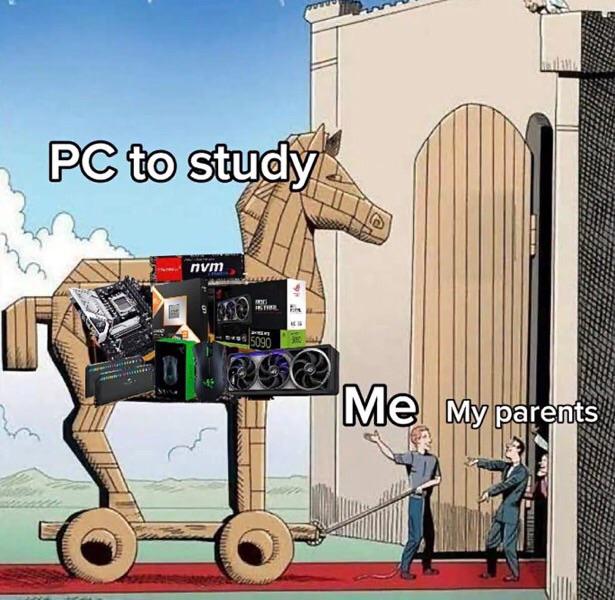
I Regret Buying AMD Instead Of Intel For The CPU

I Regret Buying AMD Instead Of Intel For The CPU
The eternal AMD vs Intel debate takes a spicy turn here. The joke is that this person "regrets" buying AMD... but look at that absolute unit of a GPU taking up half the case. That GIGABYTE GeForce RTX is so thicc it's basically a space heater with gaming capabilities. The irony? AMD CPUs have been crushing it lately with better price-to-performance ratios and lower power consumption, while Intel has been playing catch-up. But sure, blame the CPU when your GPU is probably pulling 350W and cooking your room to a toasty 85°F. The real regret should be not buying a bigger case or investing in better airflow. That GPU is literally living rent-free in there, hogging all the space and power budget. Your electricity bill called—it wants its money back.

We Read Between The Lines

We Read Between The Lines
When a Distinguished Engineer at Microsoft posts about a "research project" involving Rust and language migration tooling, the entire tech community immediately assumes Windows is getting rewritten in Rust with AI. Because obviously that's the only logical conclusion, right? The poor guy had to issue a clarification that basically reads like a panicked "GUYS NO STOP" after the internet collectively decided his innocent recruitment post was secretly announcing the death of C++ at Microsoft. He's literally just trying to hire some engineers for a multi-year research project, but developers have become so good at reading corporate tea leaves that they've evolved into full-blown conspiracy theorists. The funniest part? He had to explicitly state that Rust is NOT an endpoint. Like, imagine having to clarify that your experimental tooling project isn't going to replace the entire Windows kernel. That's the level of speculation we're dealing with here. The developer community saw "Microsoft + Rust + AI" and immediately started planning their C++ funeral arrangements. Pro tip: When your LinkedIn post needs an "Update" section longer than the original post to walk back assumptions you never made, you've successfully triggered the tech hivemind.