

Catch 22

Catch 22
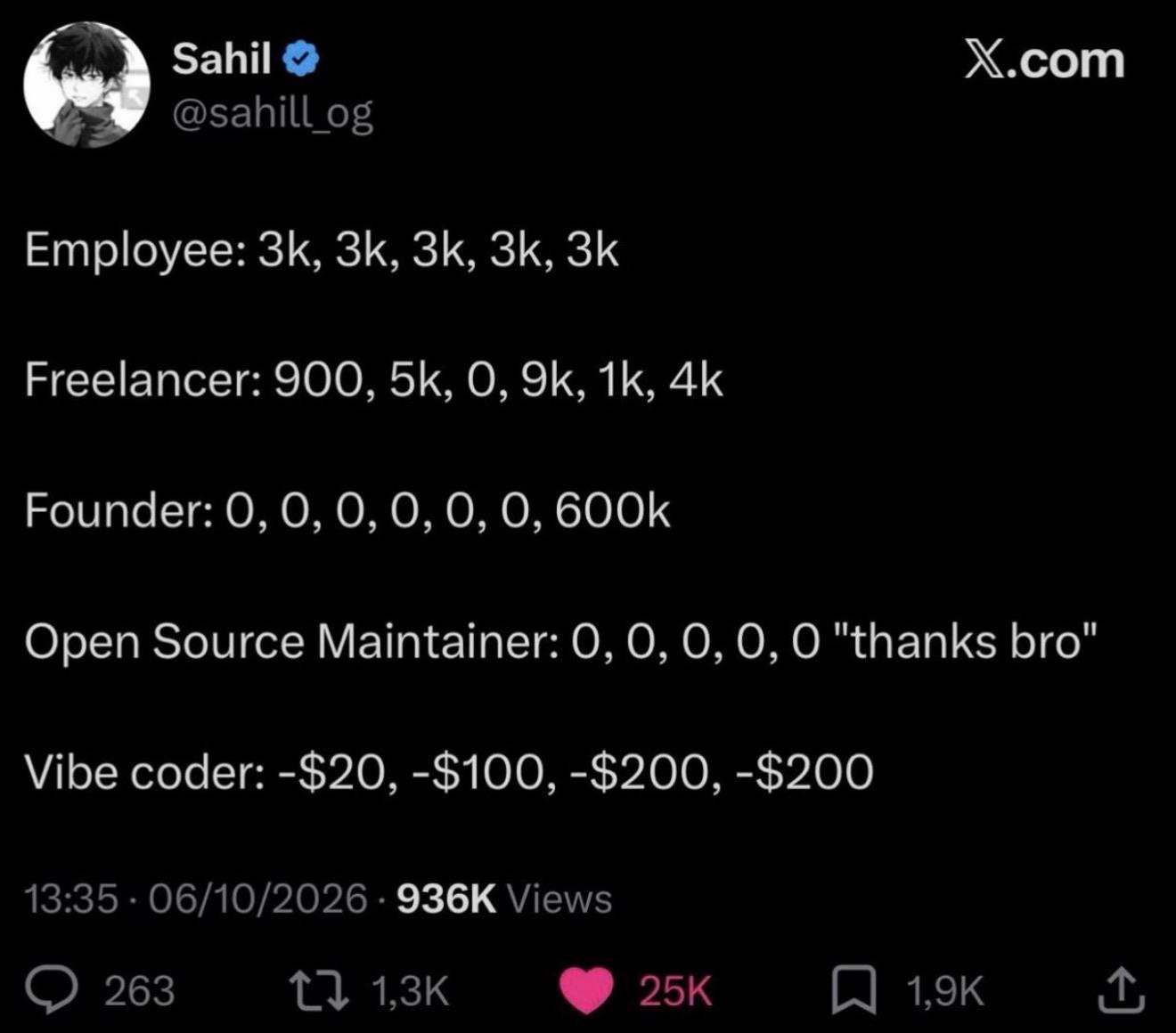
Software companies really out here asking you to stop pirating their $600 software while simultaneously demanding you buy it at full price. Like, my guy, if I had $600 lying around, I wouldn't be pirating it in the first place. The circular logic is chef's kiss. It's giving "entry-level position requiring 5 years of experience" energy. Fun fact: Studies have shown that software pirates often become paying customers once they can actually afford it. Turns out, people who learned Photoshop through "alternative means" in college tend to push for their companies to buy legitimate licenses later. But sure, keep yelling at broke students instead of offering reasonable pricing tiers.

Salty

Salty
When your password security is so bad that even the waitress knows your hashing strategy. Guy orders something at the diner and can't identify what's on his plate, but don't worry—they salted the hash. You know, for security. Salting hashes is Password Storage 101: you add random data to passwords before hashing so two identical passwords don't produce the same hash. It's literally the bare minimum you should be doing if you're storing user credentials. But here's the thing—if someone's complaining they "can't identify" what they're looking at, your security probably has bigger problems than whether you remembered to salt. The "Privacy Diner" is serving up cryptographic puns with a side of existential dread about how your data is actually being handled. Spoiler: it's probably not as secure as you think.

Maybe It's Just Brainrot

Maybe It's Just Brainrot
You know that moment when someone asks you a technical question in an interview and you freeze like a deer in headlights, desperately trying to retrieve information from the cobweb-filled corners of your brain? The thick Ray-Bans represent that false confidence we all walk in with, thinking we're hot stuff. Then boom—question hits, buffering mode activated for what feels like an eternity, and suddenly you're channeling your inner used car salesman with "Certainly!" before trailing off into the void with "The variable is—" because your brain just blue-screened. The awkward pause, the overcompensating enthusiasm, the sentence that goes nowhere—it's the technical interview equivalent of your code compiling on the first try (suspicious). That stare perfectly captures the interviewer's internal monologue: "Should I help them? Should I just end this now? Why did they put 'expert' on their resume?" Pro tip: Next time just say "let me think about that for a second" instead of pretending your neural network is still loading the weights.

Seniors Am I Doing This Correctly

Seniors Am I Doing This Correctly
Junior dev commits what looks like a security audit's worst nightmare directly to staging. We've got hardcoded API keys with "sk-proj" prefixes (looking at you, OpenAI), admin passwords literally set to "admin123", MongoDB connection strings with credentials in plain text, AWS secrets just vibing in variables, and a Stripe key that's probably already been scraped by seventeen bots. But wait, there's more! They're storing passwords in localStorage (chef's kiss for XSS attacks), setting global window credentials, fetching from a URL literally called "malicious-site.com", and my personal favorite - trying to parse "not valid json {{(" because why not test your error handling in production? The loop creating 10,000 arrays of 1,000 elements each is just the performance cherry on top of this security disaster sundae. Someone's about to learn why we have .env files, code reviews, and why the senior dev is now stress-eating in the corner.

Can't Keep Saying Fixes Everytime

Can't Keep Saying Fixes Everytime
You know you've entered dangerous territory when your commit messages have devolved into single words. "Fixes" becomes your entire vocabulary after the 47th commit of the day. The panic sets in when you realize your git history looks like: "fixes", "more fixes", "actually fixes it", "fixes for real this time", "I swear this fixes it". The git commit -m "" with an empty message is the developer equivalent of giving up on life itself. You've transcended beyond words. Beyond meaning. Beyond caring what your teammates will think when they see your commit history tomorrow. It's pure surrender in command-line form. Pro tip: Your future self reviewing the git log at 2 PM on a Tuesday will absolutely despise present you for this. But hey, at least you're consistent in your inconsistency.

580 Is The Most Important Number For GPUs

580 Is The Most Important Number For GPUs
You know that friend who always name-drops their "high-end gaming rig"? Yeah, they casually mention having "something 580" and you're immediately picturing them rendering 4K gameplay at 144fps with ray tracing maxed out. Plot twist: they're flexing an Intel ARC B580 (Intel's adorable attempt at discrete GPUs), but you're thinking they've got an AMD RX 580—a respectable mid-range card from 2017 that can still hold its own in 1080p gaming. Reality check? They're actually running a GTX 580 from 2010, a card so ancient it predates the first Avengers movie. That's Fermi architecture, folks. The thing probably doubles as a space heater. The beauty here is how GPU naming schemes have created the perfect storm of confusion. Three different manufacturers, three wildly different performance tiers, same number. It's like saying you drive "a 2024" and leaving everyone guessing whether it's a Ferrari or a golf cart.

Viber Coders When Someone Asks How Does This Code Work

Viber Coders When Someone Asks How Does This Code Work
You know that look when someone asks you to explain code you wrote six months ago? Now imagine that, but the code was written by someone who left the company three years ago, has zero documentation, and somehow still runs in production. That's Viber engineering in a nutshell. The monkey puppet meme captures that exact moment of existential dread when you realize you have no idea how any of it works, but you're too deep in to admit it. The code just... exists. It functions. Nobody touches it. Nobody questions it. It's like that load-bearing comment in the codebase—remove it and everything collapses. Props to whoever maintains Viber though. Legacy messaging apps are basically digital archaeology at this point. Every commit is like defusing a bomb while wearing oven mitts.

Bugs In Life

Bugs In Life
You know that iconic "Field of Dreams" quote? Well, turns out it applies to coding too, except instead of baseball players, you summon an entire ARMY of bugs ready to absolutely demolish your sanity. The moment you type that first line of code, they're already assembling like some kind of insect Avengers team, plotting their grand entrance into your codebase. And there you are, blissfully unaware, thinking "I'm just writing some simple logic here" while the bug migration has already begun. They don't even wait for you to hit compile—they're THAT eager to ruin your day. The developer's eternal curse: create something, anything, and watch the bugs materialize out of thin air like they've been waiting their whole lives for this exact moment.

Ads Before

Ads Before
Oh, the dystopian future we've been promised! By 2030, developers won't just be battling merge conflicts and dependency hell—they'll be sitting through UNSKIPPABLE advertisements just to install a package. Imagine needing to urgently fix a production bug at 3 AM, running npm install , and then being forced to watch a 30-second ad about cloud services you can't afford while your app burns in the background. The soul-crushing exhaustion on this character's face? That's the look of someone who's already watched 9 ads and is contemplating whether switching to Yarn or pnpm would spare them this torture. Spoiler alert: it won't. The ad overlords are coming for ALL package managers. Welcome to the monetized hellscape where even your dependencies come with commercial breaks!

Sales Guy Found Chat GPT

Sales Guy Found Chat GPT
Oh boy, someone gave the sales guy access to ChatGPT and he immediately built a "caffeine intake calculator for the world to see" running on localhost:8000. Because nothing says "global deployment" like a development server that only works on your own machine. The best part? He's proudly announcing it on LinkedIn like he just launched the next unicorn startup. Meanwhile, every developer in the comments is screaming internally because localhost literally means "only accessible on YOUR computer, buddy." It's like building a restaurant in your basement and wondering why customers aren't showing up. Pro tip for our entrepreneurial friend: before you revolutionize the world with your AI-generated app, maybe learn the difference between localhost and an actual deployed URL. But hey, at least we know he's consuming 495mg of caffeine per day—he's gonna need it when the devs explain networking basics to him.

Looking At You Overlapping Segments

Looking At You Overlapping Segments
So you discover that in 16-bit real mode, the BIOS handles hardware directly and your OS doesn't need device drivers. Sweet! Freedom from driver hell, right? Then you learn about 16-bit memory segmentation and suddenly that smile disappears faster than your will to live. For the uninitiated: in real mode, memory addresses are calculated using segment:offset pairs, and because both are 16-bit values, segments can overlap in the most cursed ways possible. You can have multiple segment:offset combinations pointing to the same physical address. It's like having 5 different street addresses for the same house, except the mailman is your CPU and it's having an existential crisis. Suddenly writing device drivers doesn't seem so bad anymore. At least those make logical sense. Overlapping segments? That's just sadism with extra steps.

Hell No!

Hell No!
You know that feeling when you change a single semicolon in a legacy codebase and suddenly the entire architecture decides to have a nervous breakdown? Yeah, that's what we're looking at here. The Simpsons house defying all laws of physics and structural integrity is basically every production system after you "just fix that one typo." Everything still technically works, but gravity stopped making sense and Homer's floating through the living room. The code passes all tests, deploys successfully, and then you check the logs. Should you rollback? Probably. Will you? Not before spending 4 hours trying to figure out what cosmic butterfly effect you just triggered.