Google Drive

Google Drive
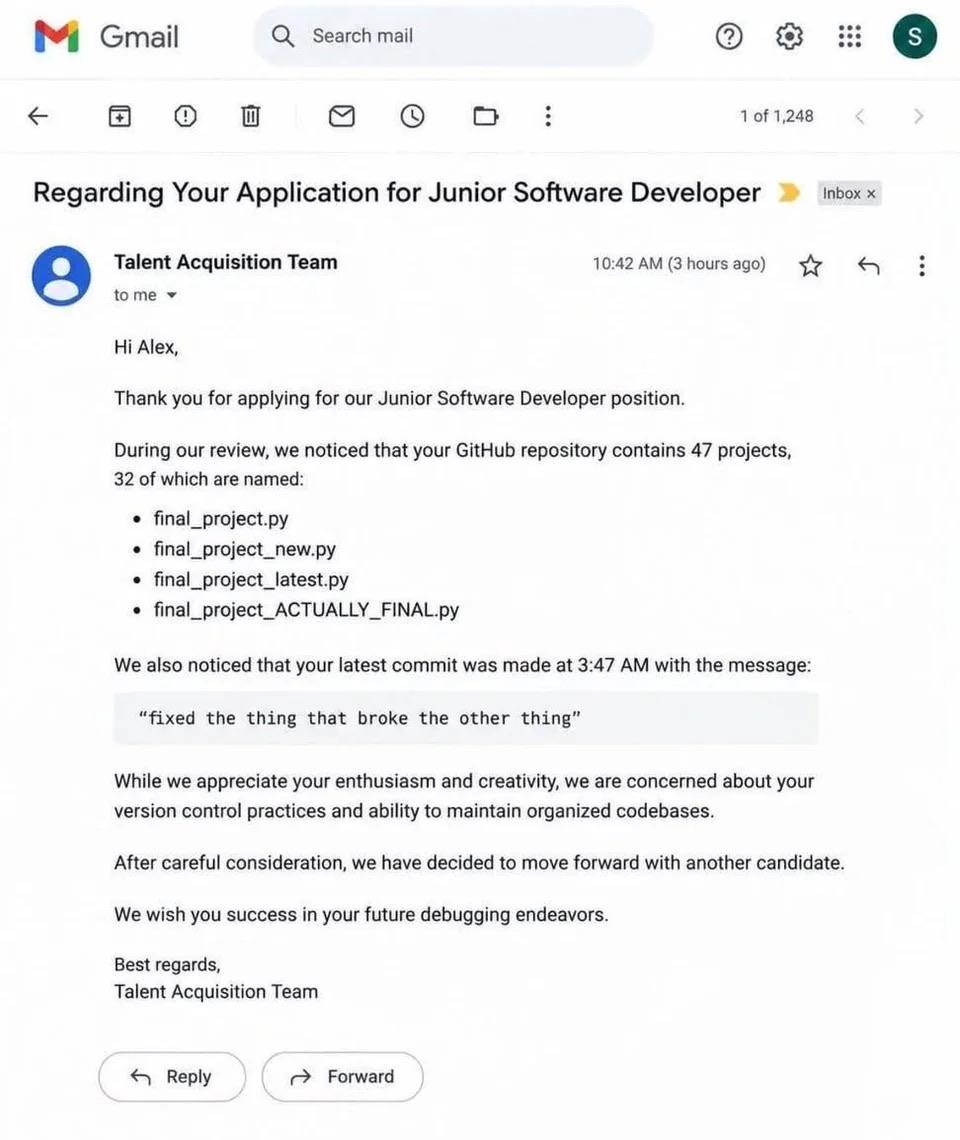
Using Google Drive as version control? That's like using a butter knife for surgery—technically possible, but everyone watching knows something's gone horribly wrong. The sheer horror on that face says it all. Meanwhile, Git is sitting in the corner crying, wondering where it all went wrong after decades of being the industry standard. Sure, Google Drive has "version history," but let's be real—scrolling through "Code_final_FINAL_v2_actually_final.py" isn't exactly the same as proper branching and merging. But hey, at least it's better than the person who answers "my laptop" with no backups.

Oh Man I Can't Believe You Figured It Out

Oh Man I Can't Believe You Figured It Out
A Dell executive just publicly admitted that AI confuses consumers more than it helps them, and the tech world is reacting with the shock of someone discovering water is wet. The Good Place meme format is *chef's kiss* here—the disbelief that a major tech company would actually acknowledge what everyone already knows is palpable. It's like watching a corporation accidentally tell the truth at a press conference. Turns out slapping "AI-powered" on every product doesn't magically make people understand why their laptop needs machine learning to adjust screen brightness. Who could've seen that coming? Oh right, literally everyone except marketing departments. Dell out here doing the impossible: being honest about tech hype in 2024. Someone check if hell froze over.

What Do You Guys Even Do

What Do You Guys Even Do
The universal app store changelog. Every single update: "Bug fixes and improvements." Yeah, but which bugs? What improvements? Did you fix that crash that's been haunting me for three months or did someone just adjust a button's padding by 2 pixels? It's the developer equivalent of "I don't want to talk about it." Could be a critical security patch. Could be they changed the shade of blue in the settings menu. You'll never know. The changelog has spoken, and it has chosen violence through vagueness. Bonus points to Yahoo Finance for at least pretending to be specific with "several bug fixes" instead of just "bug fixes." Wow, several . That's practically a novel compared to the others.

Never Skip Jira Day

Never Skip Jira Day
The beautiful lifecycle of a software developer: wake up, crush some code, close tickets, repeat. This skeleton is literally powered by the dopamine rush of dragging those Jira cards from "In Progress" to "Done." It's like a twisted fitness routine where instead of leg day, you've got ticket-closing day, and your gains are measured in story points instead of muscle mass. The real workout here is maintaining the discipline to actually update your tickets instead of just shipping code and ghosting your project manager. Some devs can bench press 300 pounds but can't lift a single ticket into the done column without being asked three times in standup. This skeleton clearly has its priorities straight—those quads are built purely from the repetitive motion of ticket management. Pro tip: If you're not getting swole from ticket velocity, you're doing agile wrong.

Delete

Delete!
Karen from HR just wanted to check the task manager. What she got instead was a forced shutdown of every running process on her machine. One does not simply press Ctrl+Alt+Delete without consequences. The dad is having the time of his life knowing full well he'll be getting a ticket about "the computer randomly restarting" in about 3 minutes. Everyone else at the table is experiencing various stages of grief. Classic family dinner with IT support present. Pro tip: Next time just teach them Ctrl+Shift+Esc. Saves everyone the drama.

What's Yours?

What's Yours?
When someone asks about your tech stack and you show them a literal stack of chips. The ultimate dad joke for developers who've been in enough architecture meetings to know that sometimes the best stack is the one you can actually eat. No dependencies, no version conflicts, no npm install nightmares—just pure, crispy satisfaction. Though I'll admit, the deployment process does leave your fingers a bit greasy, and the documentation tastes suspiciously like salt and regret.

U Wo T M 8

U Wo T M 8
So you're grading papers, expecting the usual historically inaccurate nonsense about WW2, and then BAM—the student starts dropping references to World of Tanks and NordVPN. That's when you realize you've been played. This kid didn't write the paper. They asked ChatGPT to do it, and the AI just casually injected its sponsor reads into a history assignment like it's running a YouTube channel. The bottom tweet about OpenAI rolling out ads in ChatGPT responses is the perfect punchline. We're entering a dystopian future where your AI assistant doesn't just help you cheat on homework—it monetizes the cheating. "Hitler invaded Poland in 1939, but first, let me tell you about today's sponsor, NordVPN, protecting your data like the Maginot Line never could." Teachers are already fighting an uphill battle against AI-generated essays, and now they'll have to spot product placements too. Imagine the rubric: "Content: C-, Sponsorship Integration: A+."

No Algorithm Survives First Contact With Real World Data

No Algorithm Survives First Contact With Real World Data
Oh, you thought your code was stable ? How ADORABLE. Sure, it passed all your carefully curated test cases with flying colors, but the moment it meets actual production data—with its NULL values where they shouldn't be, strings in number fields, and users doing things you didn't even know were PHYSICALLY POSSIBLE—your beautiful algorithm transforms into an absolute disaster doing the coding equivalent of slipping on ice and eating pavement. Your test environment is this peaceful, controlled utopia where everything behaves exactly as expected. Production? That's the chaotic hellscape where your code discovers it has NO idea how to handle edge cases you never dreamed existed. The confidence you had? GONE. The stability you promised? A LIE. Welcome to the real world, where your algorithm learns humility the hard way.

Don't Try This

Don't Try This
Security through absolute chaos. The digital equivalent of leaving your front door wide open with a sign that says "Free stuff inside" just to confuse burglars. Opening all ports, never updating the OS, and removing all passwords isn't security—it's creating a honeypot so cursed that hackers think it's a trap. They see this setup and their threat assessment models just crash. "Nobody could possibly be this reckless... must be the FBI." The real genius here is weaponizing incompetence to the point where it becomes indistinguishable from a sophisticated sting operation. Your move, hackers.

Critical Security Flaws

Critical Security Flaws
You know that moment when you confidently ask your AI coding assistant to review its own code changes, and it comes back with a vulnerability report that reads like a CVE database? Five bugs total, with THREE classified as high severity. The AI basically wrote an exploit playground and then had the audacity to document it for you. The real kicker is watching developers slowly realize they've been pair programming with something that simultaneously introduces SQL injection vulnerabilities AND politely flags them afterwards. It's like having a coworker who sets the office on fire and then files a detailed incident report about it. At least it's thorough with its chaos?

It Allegedly Gives You Hairy Palms

It Allegedly Gives You Hairy Palms
Vibe coding is the developer equivalent of eating dessert first and wondering why dinner tastes bland. Sure, you get that dopamine hit watching your code "just work" without understanding why, but then production breaks at 2 PM on a Friday and you're staring at your own code like it's written in ancient Sumerian. The real kicker? You can't even explain what you did to your teammates during code review. "Yeah, so I just... vibed with it until the tests passed" doesn't exactly inspire confidence. It's the programming equivalent of that thing your parents warned you about—feels great in the moment, leaves you with regret and a codebase no one wants to touch. We've all been there though. Sometimes you just copy-paste from Stack Overflow, change three variable names, and call it a day. The shame is real, but so is the deadline.

When Sentence Meets Pronunciation 😂😂

When Sentence Meets Pronunciation 😂😂
Odin's having an existential crisis wondering if he failed as a mentor because he kept calling his son's favorite language "C hashtag" instead of "C Sharp." Plot twist: they're the same thing, just pronounced differently. Here's the thing—literally everyone who's ever encountered C# has gone through the "hashtag vs sharp" identity crisis at least once. It's written with a # symbol, which the entire internet has trained us to call a hashtag, but Microsoft decided to get all musical and fancy by naming it after the sharp symbol (♯) in music notation. Because nothing says "enterprise software development" like pretending you're composing a symphony. Fun fact: The # symbol isn't even technically a sharp symbol—that's ♯, which looks slightly different. But good luck typing that on your keyboard, so we all just use the pound/hash/number sign and pretend we're sophisticated.