

Documentation: Then Vs Now

Documentation: Then Vs Now
Reading someone else's documentation? Absolute pleasure. Clear explanations, helpful examples, beautifully structured. You're nodding along like "wow, they really thought of everything." But the moment you have to write docs for your own code? Suddenly you're staring into the void, questioning every life choice that led you here. What seemed crystal clear when you wrote it at 2 AM now feels like ancient hieroglyphics. "How do I even explain this function that does... uh... things?" The existential dread sets in as you realize future-you will be cursing present-you for this half-baked README. Pro tip: If your documentation just says "it works, trust me" you're doing it wrong. But also, we've all been there.

Server Vs. Zombies

Server Vs. Zombies
When the real horror isn't the undead horde breaking down your door, it's the thought of your dev server credentials getting leaked on some sketchy forum. Because nothing says "apocalypse" quite like having your staging environment exposed to the internet with admin/admin as the login. The zombies are being oddly polite about it though—at least they're giving you a heads up instead of just dumping everything on Pastebin. Professional courtesy among the undead, I guess. Still beats getting a Shodan alert at 3 AM because someone left port 3000 open to the world. Pro tip: If zombies can find your dev server, so can hackers. Maybe rotate those credentials before the next wave hits.

The PM Is Not Gonna Like This

The PM Is Not Gonna Like This
So you're telling me the entire month's worth of "backend work" was... a login form. Not the authentication system. Not the API endpoints. Not the database schema. Just the HTML form itself. The PM is about to discover that "working on critical infrastructure" translates to copy-pasting a basic sign-in page that's been unchanged since 2003. The "Keep me Signed in" checkbox is already checked by default too, which is definitely a security feature and not laziness. Best part? That "Forgot Password?" link probably goes nowhere. Or worse, it's a TODO comment in the backend that says "implement later."

Unreachable Code Breakup

Unreachable Code Breakup
When functions break up, they just stop calling each other. Simple, clean, no drama. Unlike human relationships, there's no awkward "we can still be friends" phase—just immediate radio silence and compiler warnings about unused code. Your IDE will even helpfully gray them out like they never existed. Honestly, functions have healthier boundaries than most people. No lingering dependencies, no messy refactoring of shared state, just pure isolation. Maybe we should all take notes from our code's relationship management skills.

Sloup

Sloup
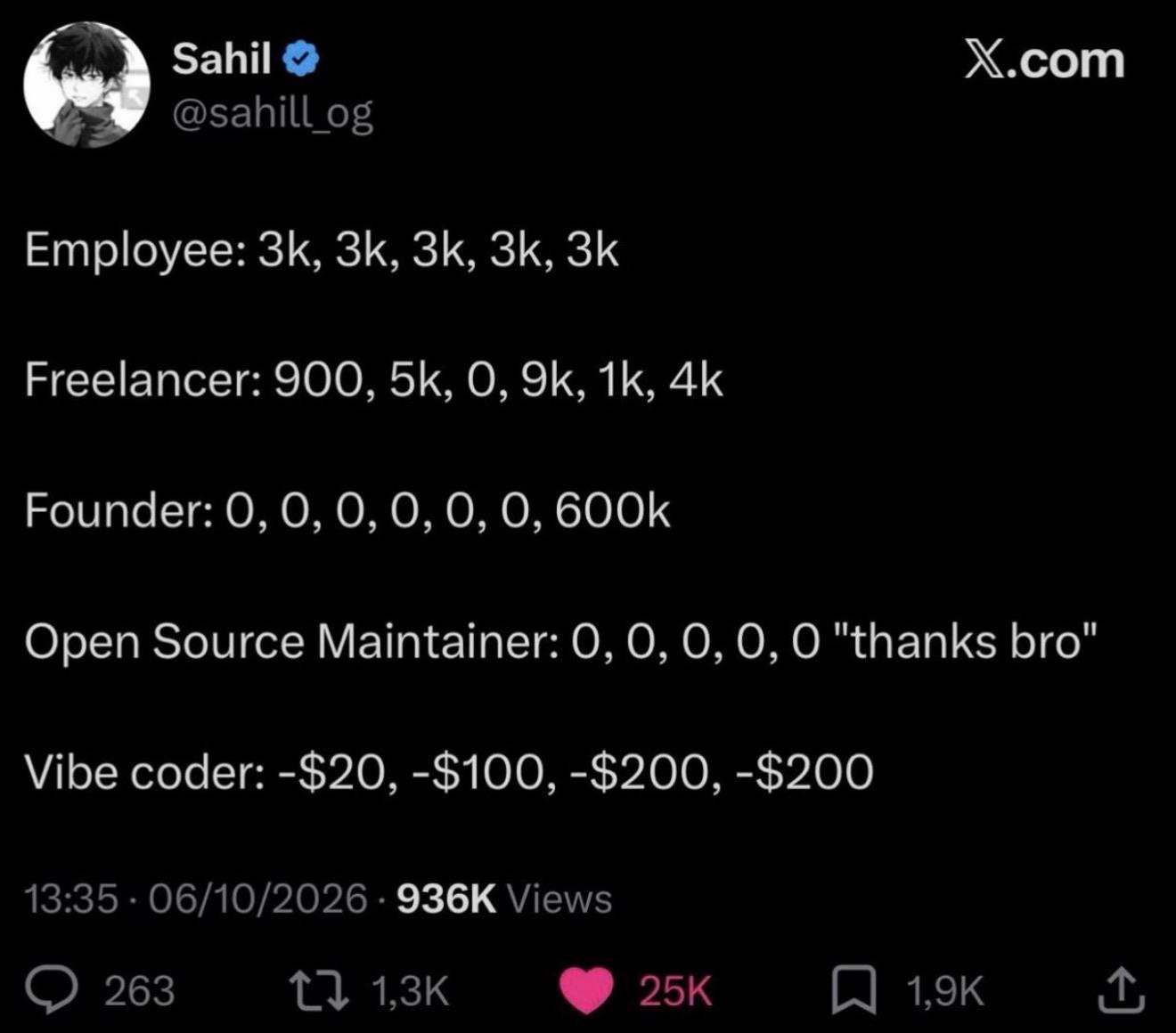
Someone really thought they had a gotcha moment with the whole "fork it or shut up" argument. Yeah, open source is free like soup for the homeless—except apparently some people think that means you're obligated to enjoy whatever gets ladled into your bowl without complaint. Just because maintainers are generous enough to release their code doesn't mean users can't have opinions about it. Constructive feedback isn't "pissing in the soup," it's literally how software improves. But sure, let's all just silently use broken features because we didn't personally write 10,000 lines of code ourselves. Solid logic there.

Dev Guys Are Not Not Sensitive

Dev Guys Are Not Not Sensitive
So apparently getting rejected for your dev skills is totally fine and you just shrug it off like a mature professional. But DARE reject someone for their data structures and algorithms knowledge? NUCLEAR MELTDOWN ENGAGED. 🚨 The double standard is absolutely *chef's kiss* here. You can tell a developer their code is garbage, their framework choice is questionable, and their tabs-vs-spaces preference is wrong, and they'll just nod politely. But the SECOND you mention they couldn't reverse a binary tree on a whiteboard, suddenly it's a personal attack on their entire existence and they'll write a 47-part Medium article about how LeetCode is destroying the tech industry. Because nothing says "I'm emotionally stable" quite like having a complete existential crisis over failing to implement a red-black tree in 45 minutes while someone watches you sweat.

Every. Time.

Every. Time.
You know that feeling where you're writing code at an ungodly hour and suddenly you're channeling Einstein, Turing, and Linus Torvalds all at once? Complex algorithms flow through your fingers like poetry, your architecture is chef's kiss, and you're convinced you've just solved P vs NP as a side effect. Fast forward a few hours. Your game crashes. Again. And again. And your brain has the processing power of a potato running Windows Vista. Suddenly you can't figure out why your loop starts at 0 or 1, and you're Googling "how to exit vim" for the 47th time. The cruel irony is that sleep deprivation somehow makes you feel like a coding god while simultaneously turning you into someone who needs 20 minutes to debug a missing semicolon. It's the programmer's paradox: maximum confidence, minimum competence.

Funny it Works on My Machine Programmer T-Shirt T-Shirt

Funny it Works on My Machine Programmer T-Shirt T-Shirt
Funny design. Programming shirt for all of the geeky engineer coders, software developers and app designers that need some simple coding humor and coffee in their life. This defines the meaning of be…

Modern Programming

Modern Programming
Welcome to 2024, where two AI assistants duke it out in a street brawl over who gets the privilege of writing your code while you sit back with popcorn watching tutorial videos you'll never finish. Copilot and Claude are out here throwing hands like it's UFC, meanwhile you're just vibing, pretending you'll actually learn something from that 4-hour React course. The real kicker? Both AIs are probably writing better code than you would anyway, so why interrupt a good thing? Just let them fight. You've got important business to attend to—like finding out why that one guy uses Vim in 2024.

Not A Child's Game

Not A Child's Game
Tower of Hanoi: the deceptively innocent-looking puzzle that seems like it belongs in a kindergarten classroom until you realize it's actually a recursive nightmare that haunts CS students in their sleep. Sure, normies see colorful rings and think "aww, cute toy!" Meanwhile, programmers are having PTSD flashbacks to their algorithms class, sweating over O(2^n) time complexity and trying to remember if they move the disk to the auxiliary peg or the destination peg first. The physical version takes like 30 seconds to solve. The recursive solution? That'll cost you 3 hours of staring at your code, 47 stack overflow tabs, and questioning every life decision that led you to computer science. The dog with sunglasses knows what's up—this puzzle is straight-up gangster when you're implementing it in code.

My Title? A Failure...

My Title? A Failure...
Nothing says "indie game developer" quite like putting on your full clown makeup before opening Unity at 9 AM. You've convinced yourself this is the one—the game that'll finally let you quit your day job. You've spent six months perfecting the jump mechanics. Your Steam wishlist count is currently at 47, and 23 of those are your alt accounts. The real kicker? You're not even wrong to feel like a clown. The indie game market is oversaturated with thousands of games releasing daily, and statistically, most make less than minimum wage. But hey, at least you're having fun, right? Right? That's what we tell ourselves while refactoring the inventory system for the third time instead of actually marketing the game.

Rubber Stamping LLM Pull Requests WCGW

Rubber Stamping LLM Pull Requests WCGW
So you've been letting ChatGPT write your code and just blindly approving those PRs without actually reading them because "the AI said it works"? Congratulations, you've officially become the weakest link in your team's code review process! Now Blue Origin's finest engineers are hunting you down like you just committed a war crime against their production environment. Nothing says "I value my career" quite like rubber-stamping AI-generated code with a casual "LGTM" and then watching the entire system burn down faster than you can say "rollback." The sheer PANIC in those eyes is the exact moment you realize that "looks good to me" should've been "let me actually read this before we all get fired."

Found The Commit That Changed Everything

Found The Commit That Changed Everything
Sam Altman announces ChatGPT to the world on November 30th, 2022. One day later, someone calls it "your worst product concept so far." Imagine being that confident in your wrongness. That's like rejecting the iPhone because flip phones were working just fine. Fast forward a bit and ChatGPT basically rewrote the entire software industry, made Stack Overflow traffic plummet, and turned every developer into a prompt engineer. But sure, worst product concept. Right up there with "the internet is just a fad." The real kicker? This tweet aged like milk left on a radiator. Sometimes the commit that changes everything looks unremarkable at first. And sometimes you're just spectacularly wrong on the internet forever.