Have You Migrated Workspace To 365 Recently

Have You Migrated Workspace To 365 Recently
Picture this: You've successfully migrated an entire company to Office 365. You're feeling pretty good about yourself. The servers are humming, the cloud is clouding, everything is *chef's kiss*. Then management casually drops "Hey, can you also migrate our 15-year-old Gmail accounts with 50GB of unorganized emails, forwarding rules from 2009, and approximately 47 different IMAP configurations?" Your soul immediately leaves your body. You've gone from hero to victim in 0.5 seconds. The sheer AUDACITY of asking someone who just performed digital open-heart surgery to do it again, but this time with Google's spaghetti code involved? Death would be a mercy at that point. Just put the poor IT person out of their misery because dealing with OAuth tokens, API limits, and "why isn't my signature showing up?" tickets for the next three months is basically a war crime.

Yeah This Happened

Yeah This Happened
Someone just asked you to "please reproduce" the bug. No context. No error message. No steps. No environment details. No logs. Just... reproduce. Like you're supposed to magically know which of the 47 bugs they're referring to, or maybe they think you have a crystal ball that shows you their exact browser configuration, network conditions, and the specific sequence of clicks they made while eating a sandwich. Sure, let me just fire up my psychic debugging toolkit real quick.

I'll See Myself Out

I'll See Myself Out
A delightfully groan-worthy pun that plays on the double meaning of "cis." In chemistry and molecular biology, "cis" refers to molecules or groups on the same side of a structure (as opposed to "trans" on opposite sides). So if there's only one non-trans person, they're technically the only one in the "cis" configuration... making them the cis-admin. Get it? System administrator? Cis-admin? *cricket sounds* The wordplay here is chef's kiss level terrible, which is exactly what makes it perfect. It's the kind of joke that makes everyone in the room simultaneously laugh and throw things at you. The "I'll see myself out" is absolutely warranted because after dropping a pun this bad, you don't wait to be escorted out—you just leave before the tomatoes start flying.

One More Compilation And I Sleep

One More Compilation And I Sleep
Your ancestors didn't fight wars and survive plagues just so you could spend 6 hours at 4am trying to fix a vibecoded mess that "worked on my machine" 20 minutes ago. But here you are anyway, with your entire family tree watching in collective disappointment from the heavens. There's something deeply spiritual about telling yourself "just one more compile" at ungodly hours while debugging code you wrote in a caffeine-induced fever dream. Your great-great-grandfather who survived two world wars is up there shaking his head while you're down here battling semicolons and race conditions. The real tragedy? You know tomorrow you'll wake up, look at the code with fresh eyes, and find the bug in 30 seconds. But tonight? Tonight we suffer for our art.

Kids Vs Adults

Kids Vs Adults
The cruel irony of life: kids have infinite free time but their allowance barely covers a pack of gum, while developers finally have disposable income for that $70 AAA game and every Steam sale known to mankind, but their free time is now measured in stolen 15-minute increments between meetings, deployments, and existential dread about technical debt. You finally bought that gaming rig you dreamed about as a teenager, installed 47 games during the last sale, and your playtime? 2.3 hours across all of them. Meanwhile, your Steam library sits there judging you harder than your code reviewer ever could. The grass is always greener, except both lawns are actually just different shades of suffering.

Number One Reason For Slacking Off

Number One Reason For Slacking Off
You know that magical moment when your database session times out and suddenly you're legally obligated to stop working? It's like the universe itself is telling you to take a break. Your boss catches you playing ping-pong in the break room, and you just casually drop the "SESSION LIMIT HIT" card like it's a Get Out of Jail Free pass. The beauty here is the instant transformation from "slacker caught red-handed" to "responsible employee waiting for technical issues to resolve." Can't access the database? Well, might as well perfect that backhand. The manager's defeated "OH. CARRY ON." is the cherry on top—they know they can't argue with technical limitations. It's the programmer's equivalent of "my dog ate my homework," except it actually works. Pro tip: Most session limits are configurable. But why would you ever change that setting?

Don't Throw Your RTX Box… It's Someone's Home

Don't Throw Your RTX Box… It's Someone's Home
Cats have a supernatural ability to find the most expensive cardboard in your house. You just dropped $800 on a GPU that can render photorealistic graphics at 4K, but your cat? Nah, it's all about that premium NVIDIA-grade packaging. The box is now worth more than the card itself because it contains a feline overlord. Fun fact: The RTX 5070 Ti hasn't even been released yet, making this either a leak, a mockup, or proof that cats exist outside the normal space-time continuum. Either way, that box is now permanently occupied. Hope you kept the receipt for a bigger case.

Eye Contact For A Second And One Is Down

Eye Contact For A Second And One Is Down
When you accidentally make eye contact with another developer in the office and suddenly it's a FULL-BLOWN STANDOFF to determine who's the superior coder. Vim users are out here playing 4D chess with their keybindings, treating every interaction like a long-range tactical operation—calm, calculated, zero mouse movement. Meanwhile, VS Code users are just vibing at point-blank range with their extensions and IntelliSense, ready to throw down with their GUI like it's a street brawl. The tension is PALPABLE, the stakes are NONEXISTENT, but somehow everyone's honor is on the line. Choose your weapon wisely, because in this IDE war, there are no winners—only people who judge each other's setup choices.

Don't You Understand?

Don't You Understand?
When you're so deep in the optimization rabbit hole that you start applying cache theory to your laundry. L1 cache for frequently accessed clothes? Genius. O(1) random access? Chef's kiss. Avoiding cache misses by making the pile bigger? Now we're talking computer architecture applied to life decisions. The best part is the desperate "Please" at the end, like mom is the code reviewer who just doesn't understand the elegant solution to the dirty clothes problem. Sorry mom, but you're thinking in O(n) closet time while I'm living in constant-time access paradise. The chair isn't messy—it's optimized . Fun fact: L1 cache is the fastest and smallest cache in your CPU hierarchy, typically 32-64KB per core. So technically, this programmer's chair probably has better storage capacity than their CPU's L1 cache. Progress!

Make No Mistakes

Make No Mistakes
The contrast is absolutely brutal. Back in 1960, Margaret Hamilton and her team wrote the Apollo Guidance Computer code with literally zero margin for error—one bug and you're explaining to NASA why astronauts are floating aimlessly in space. That stack of code she's holding? Pure assembly language, hand-woven with the precision of a neurosurgeon. Fast forward to 2026, and we've got developers who've apparently forgotten how to code entirely. The task progression is *chef's kiss*: from "Build me this feature" (reasonable) to "I don't write code anymore" (concerning) to "Change the button color to green" (trivial CSS) to the grand finale: "Go to the Moon, make no mistakes" (absolutely unhinged). The crying Wojak really sells the existential crisis of being asked to match 1960s engineering standards when your most recent commit was changing a hex value. The irony? Those Apollo programmers had 4KB of RAM and punch cards. We have Stack Overflow, GitHub Copilot, and infinite compute, yet somehow the bar has never been lower AND higher simultaneously.

Agents Before AI Agent Was A Thing

Agents Before AI Agent Was A Thing
So while everyone's burning billions on AI agents with fancy APIs and token limits, Linus Torvalds figured out the ultimate agent system in 1991: send an angry email to a mailing list and thousands of engineers worldwide just... do it. For free. No API costs, no rate limits, just pure open-source rage-driven development. The real kicker? His "agents" come with 30+ years of kernel knowledge pre-trained, don't hallucinate (much), and actually work. Meanwhile OpenAI and Anthropic are spending venture capital like it's Monopoly money trying to replicate what some Finnish dude accomplished with SMTP and a dream. No co-founder. No VC funding. No office. No team. Just vibes and contributors who apparently enjoy being yelled at via email. That's the most efficient agent orchestration system ever built and it runs on spite and passion.

True

True
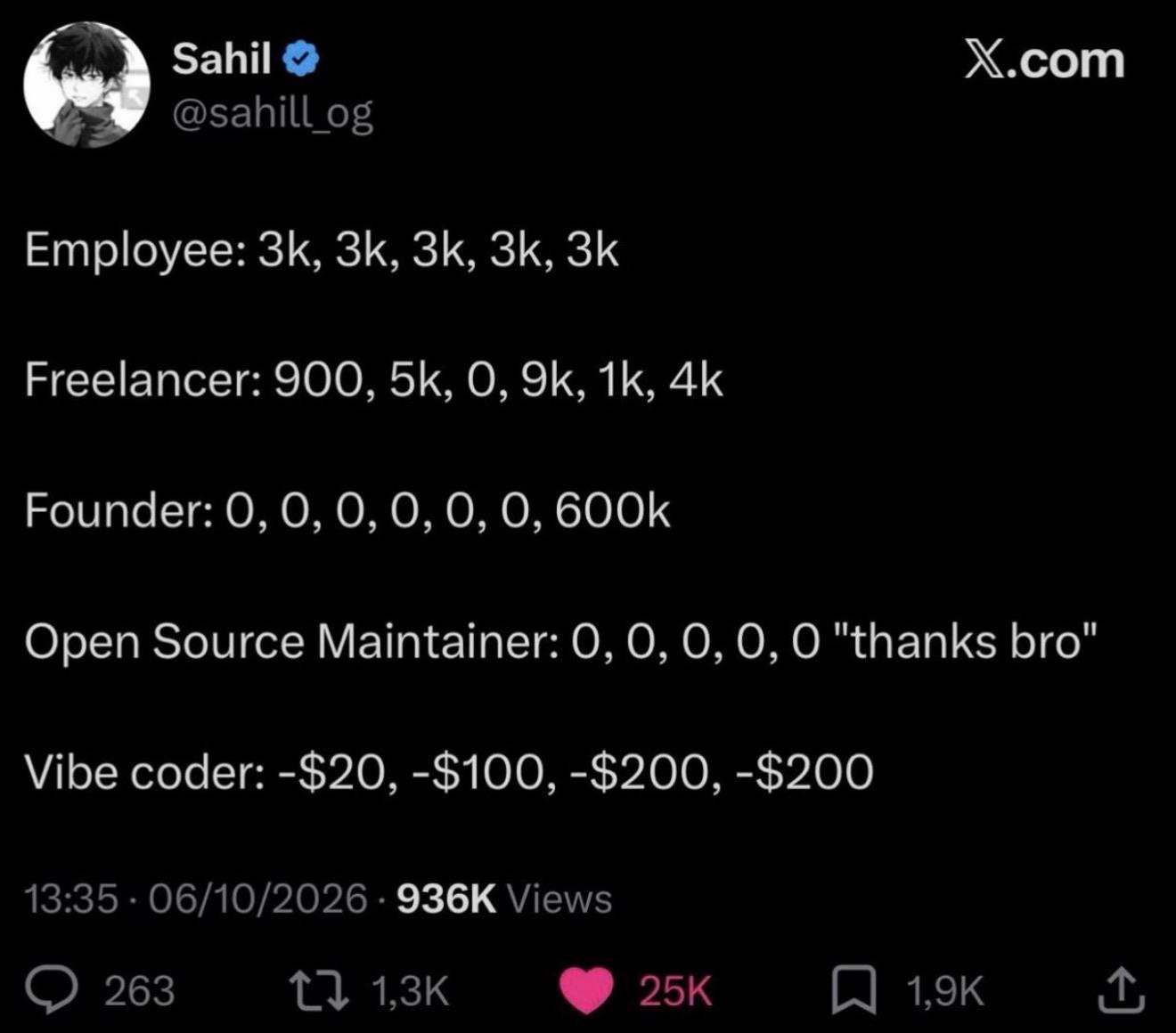
You know what's funny? We spend months building features, writing clean code, optimizing performance, fixing edge cases... and then launch day hits and exactly three people show up. Meanwhile, that intern who slapped together a landing page with a gradient background and "AI-powered" in the title somehow has a waitlist of 10,000. This is the tech industry's dirty little secret: building it doesn't mean they'll come. You can have the most elegant architecture, perfect test coverage, and documentation that would make senior devs weep with joy, but if nobody knows about it or cares, you're just screaming into the void. The real kicker? Those "vibe coders" probably spent more time on their Twitter presence than their actual product, and guess what—it worked. Sometimes I wonder if we should just replace our CI/CD pipeline with a TikTok account.