Every New Game Nowadays

Every New Game Nowadays
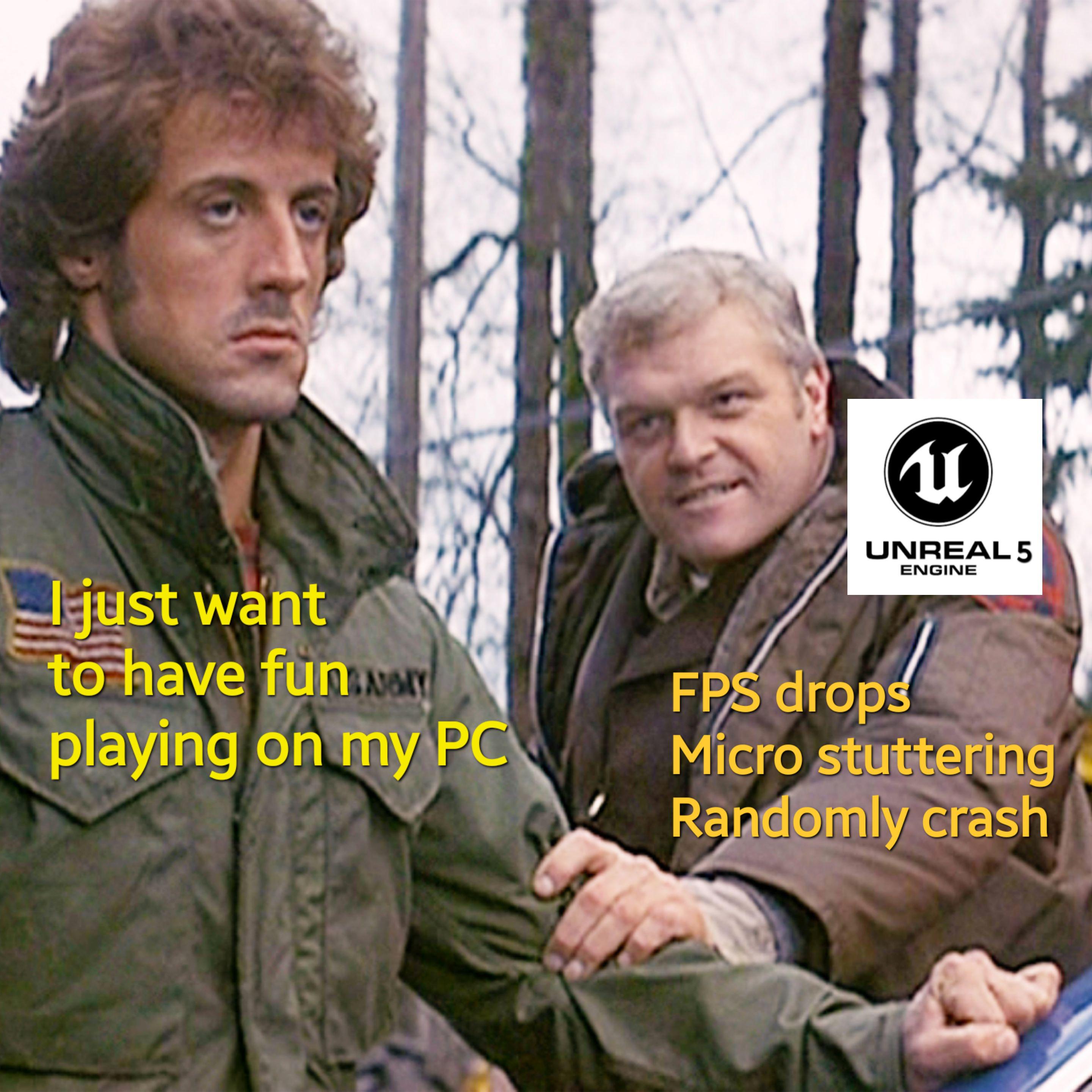
The gaming industry has discovered the cheat code to infinite money: slap "roguelike" and "soulslike" on everything and watch the sales roll in. Good price? Check. Good graphics? Check. Original gameplay? Nah, just make it punishingly difficult with permadeath and call it a day. It's like every game studio had a meeting and decided "why innovate when we can just copy Dark Souls and Hades?" The indie scene is 90% roguelikes at this point, and AAA studios are scrambling to add "souls-inspired combat" to everything from racing games to farming simulators. Next up: roguelike soulslike dating sim where you die if you pick the wrong dialogue option. Game devs realized it's easier to make players replay the same content 50 times through procedural generation than to actually create 50 hours of unique content. Brilliant cost optimization, terrible for my controller which has been thrown across the room multiple times.

Code Compiled In First Attempt

Code Compiled In First Attempt
You know something's wrong when your code compiles on the first try. Either you've ascended to a higher plane of existence, or you're about to discover a runtime error so catastrophic it'll make you wish for the comfort of syntax errors. That moment of "inner peace" lasts exactly 3 seconds before the paranoia kicks in and you start frantically checking if you accidentally commented out half your codebase. Spoiler: it runs perfectly, which means it's definitely cursed.

Develop Once Debug Everywhere

Develop Once Debug Everywhere
Cross-platform development promised us sleek futuristic vehicles gliding smoothly across Linux, macOS, and Windows. Instead, we got a post-apocalyptic convoy hauling PyInstaller, DLLs, .NET runtime, Chromium (because why NOT bundle an entire browser?), Unity runtime, inpackage, and Node.js like they're essential survival supplies in Mad Max. The expectation: Write once, run anywhere! The reality: Write once, spend three weeks figuring out why it works on your machine but explodes on literally every other platform. Bonus points for the 500MB "lightweight" app that's basically Electron wearing a trench coat pretending to be native. Nothing says "cross-platform efficiency" quite like shipping half the internet just to display a button. Beautiful.

This Is Why We Can't Have Nice Things

This Is Why We Can't Have Nice Things
Self-hosting enthusiasts watching cloud providers rain down their "enshittification" on the masses. Meanwhile, Arduino—the beloved open-source hardware platform that powered countless DIY projects—just updated their ToS to prohibit reverse engineering. You know, the exact thing their entire ecosystem was built on. Nothing says "we're getting acquired by a massive corporation" quite like suddenly caring about IP protection after years of encouraging hackers to tinker with your stuff. Qualcomm's lawyers must've had a field day drafting that one. The self-hosted crowd is sitting pretty smug right now, and honestly? Can't blame them. When your Arduino board starts requiring a subscription service, at least you'll know where to find them—in their basement server room, running everything on a Raspberry Pi.

Investment, As One Might Say

Investment, As One Might Say
When your dad had the galaxy brain move to stockpile 128GB of DDR5 RAM back in September 2025, treating memory modules like they're Bitcoin at $100. The joke here is that DDR5 prices have been on a wild rollercoaster since launch—initially expensive, then dropping, then spiking again due to supply constraints. Buying in bulk when prices dip is basically the tech equivalent of buying the dip in crypto, except this actually has utility and won't tank because Elon tweeted something. The future-dated September 2025 timestamp adds another layer—it's either prophetic speculation about an upcoming price crash, or the meme creator is a time traveler warning us about the next RAM shortage. Either way, dad's sitting on a goldmine of memory sticks while Chrome tabs multiply like rabbits. Smart investment strategy: forget stocks, buy RAM when it's cheap and resell it when the next generation of memory-hungry AI models drops.

That's Correct 👍

That's Correct 👍
Switching from C++ to Python is like going from manually managing your entire life with spreadsheets and alarm clocks to just asking Alexa to do everything. You're saying goodbye to pointers (the bane of every C++ developer's existence), manual memory management with ++ operators, semicolons that you WILL forget, curly braces everywhere, and that intimidating main() function boilerplate. Python just lets you write code without all the ceremony. No more segmentation faults at 2 AM because you dereferenced a null pointer. No more wondering if you should use delete or delete[] . Just pure, clean, indentation-based bliss where everything is a reference and garbage collection is someone else's problem. The relief is real. It's like taking off tight shoes after a 12-hour shift of fighting with template metaprogramming and undefined behavior.

We Used To Own Things

We Used To Own Things
Remember when you bought software and it just... worked? No phoning home, no "verify your license," no mandatory updates that brick your workflow. Now your $2000 Adobe subscription needs to check in with the mothership before letting you edit a PNG. Your smart fridge won't dispense ice without WiFi. Your car's heated seats are locked behind a monthly paywall. The shift from ownership to perpetual rental is real. You're not buying products anymore—you're leasing access to features that physically exist in hardware you paid for, but are artificially gated by DRM and always-online requirements. It's the SaaS-ification of everything, where companies realized they can extract infinite revenue from finite purchases. The kicker? When their servers go down or they decide to discontinue the service, your "purchase" evaporates into the cloud. You don't own your games, your music, your tools—you're just renting them until the company decides otherwise. Welcome to the future, where everything is a service and nothing truly belongs to you.

Eight Giga Ram Is Minimum

Eight Giga Ram Is Minimum
So apparently launching a text editor in 2014 triggered a decade-long domino effect that's now DEVOURING all our RAM like some kind of Chrome-powered black hole. Thanks, Electron! Who knew that wrapping every single app in an entire Chromium browser would have consequences? Remember when 8GB was considered "enthusiast tier"? Now it's barely enough to run Slack, VS Code, and maybe—MAYBE—a browser with three tabs open before your computer starts making sounds like a jet engine preparing for takeoff. The prophecy has been fulfilled: every app is now secretly a web browser in a trench coat, and your RAM is paying the price. The real tragedy? We can't even be mad because these Electron apps are genuinely useful. We're just... stuck watching our memory usage climb while muttering "it was better in the terminal days" like grumpy old devs.

Real

Real
Oh, the AUDACITY of modern gaming rigs with their instant boot times and RGB everything! Meanwhile, that beige tower from 2003 is out here taking a full coffee break just to POST. You could literally make a sandwich, contemplate your life choices, AND question why you're still keeping that ancient machine in the closet before it even shows you the Windows XP logo. But hey, at least it gave you time to mentally prepare for the underground racing glory that awaited. Those were the days when "fast boot" meant anything under 5 minutes and you genuinely had to schedule your gaming sessions around boot time. The newer generation will NEVER understand the character-building experience of watching that loading bar crawl across the screen like a sloth on sedatives.

It's 2032 And You Have Unlicensed Local Compute

It's 2032 And You Have Unlicensed Local Compute
Welcome to the dystopian future where Big Tech has finally achieved their ultimate dream: making you pay a subscription fee just to use your OWN computer! OpenAI and Samsung are now the RAM police, hunting down anyone who dares to run calculations on their own hardware without a monthly license. Got 32GB of DDR5 hidden under your floorboards like it's Prohibition-era moonshine? BUSTED. They're literally treating local compute like contraband now. Next thing you know, they'll be kicking down doors asking "Where's the GPU, punk?" while you're desperately trying to explain that you just wanted to run a Python script offline. The cloud overlords have won, and your CPU is now considered a controlled substance. Rent, don't own—it's the Silicon Valley way!

Just Let Me Finish

Just Let Me Finish
You're in the zone, fingers flying across the keyboard at superhuman speed, crafting what you're absolutely certain is going to be the most elegant solution ever written. Then your IDE starts having an absolute meltdown, throwing red squiggly lines everywhere like confetti at a syntax error party. Every incomplete variable declaration, every missing semicolon, every unclosed bracket is screaming at you simultaneously. But here's the thing: you KNOW where you're going with this. You've got the entire architecture mapped out in your head. That variable you're using? You're literally about to declare it three lines down. That function call? The implementation is coming right after you finish this thought. Your IDE just needs to chill and trust the process. It's like trying to write a sentence while someone keeps interrupting you after every word to tell you it's grammatically incorrect. Yes, I KNOW it doesn't compile yet, I'm not done! The real power move is completely ignoring that error count climbing into double digits while you maintain your flow state.

Real Flex

Real Flex
We've all been there. You're 14, discovered right-click on the desktop, and suddenly you're a tech wizard in front of your non-tech friends. Refreshing the desktop like you're performing some arcane ritual that mere mortals couldn't comprehend. "Yeah, I'm basically a hacker," you think, as your friends watch in awe while you demonstrate the mystical powers of... F5. The confidence was unmatched. You probably also showed them how to open Task Manager and acted like you were defusing a bomb. Those were simpler times when knowing keyboard shortcuts made you the neighborhood tech support.