

When You Know What You Need AI Works Well Or The Power Of Hindsight

When You Know What You Need AI Works Well Or The Power Of Hindsight
Google engineer spends a year building distributed agent orchestrators, probably through countless architecture meetings, design docs, code reviews, and debugging sessions. Then Claude Code recreates it in an hour because someone finally knew how to describe what they actually wanted. The brutal truth: AI coding assistants are incredible when you already know the solution architecture. It's like having a junior dev who codes at 10x speed but needs crystal-clear requirements. The year-long project? That was figuring out what to build. The one-hour recreation? That was just typing it out with extra steps. Turns out the hard part of software engineering was never the coding—it was always the "what the hell are we actually building and why" part. AI just made that painfully obvious.

Rust Moment

Rust Moment
Rust evangelists really said "we're the best programming language" and then proceeded to deliver the most SPECTACULAR roast of themselves. Zero jobs? Check. Zero need to rewrite anything? Double check. Seven unfinished buggy crates masquerading as production-ready? TRIPLE CHECK. But wait, there's more! They'll gaslight you into believing YOUR brain is broken because you find the syntax confusing. "It's not ugly, you just lack the skill issue badge of honor!" Meanwhile, the code looks like someone spilled alphabet soup on a keyboard and called it memory safety. The Patrick Henry reference at the bottom is *chef's kiss* though—"Give me liberty, give me fire, give me TUI apps or I retire" perfectly captures the Rust community's obsession with rewriting every single terminal application in existence. Because apparently htop wasn't good enough until it was oxidized. The brutal honesty here is that Rust solves memory problems by introducing lifetime annotation problems, borrow checker rage-quit problems, and "why won't this compile" existential crisis problems. But hey, at least it's not experimental in the Linux kernel anymore! 🎉

Token Resellers

Token Resellers
Brutal honesty right here. Everyone's building "AI-powered apps" but let's be real—most of them are just fancy UI layers slapping a markup on OpenAI API calls. You're not doing machine learning, you're not training models, you're literally just buying tokens wholesale and reselling them retail with some prompt engineering sprinkled on top. It's like calling yourself a chef because you microwave Hot Pockets and put them on a nice plate. The term "wrapper" at least had some dignity to it, but "Token Resellers" cuts straight to the bone—you're basically a middleman in the AI supply chain. No shade though, margins are margins, and someone's gotta make those API calls look pretty.

Nvidia To Bring Back The GeForce RTX 3060 To Help Tackle Current-Gen GPU & Memory Shortages

Nvidia To Bring Back The GeForce RTX 3060 To Help Tackle Current-Gen GPU & Memory Shortages
So Nvidia's solution to the AI-driven GPU shortage is bringing back the RTX 3060... but here's the kicker: they're conveniently bringing back the gimped 12GB version instead of something actually useful. It's like your manager saying "we're addressing the workload crisis" and then hiring an intern who can only work Tuesdays. The 12GB RTX 3060 was already the budget option that got nerfed to prevent crypto mining, and now it's being resurrected as the hero we supposedly need? Meanwhile, everyone running LLMs locally is sitting there needing 24GB+ VRAM minimum. The meme format captures the corporate gaslighting perfectly. Nvidia's out here acting like they're doing us a favor while the AI bros are burning through 80GB A100s like they're Tic Tacs. Sure, bring back a card from 2021 with barely enough memory to run a decent Stable Diffusion model. That'll fix everything. Classic Nvidia move: create artificial scarcity, charge premium prices, then "solve" the problem with yesterday's hardware at today's prices.

Cloud Native

Cloud Native
CTO proudly announces they've migrated 95% of their infrastructure to the cloud, throwing around buzzwords like "resilient," "scalable," and "modern" to a room full of impressed stakeholders. Then someone asks the uncomfortable question: "Doesn't that mean we're entirely dependent on—" but gets cut off by the true believer shouting about best practices and industry standards. Nothing can go wrong when you follow the herd, right? Cut to: Cloudflare goes down and the entire internet breaks. Major outage. Good luck! Boss nervously asks how much of their infrastructure is affected. The answer? That 95% they were bragging about. But don't worry! The good news is they're only down when everyone else is down too. Misery loves company, and so does vendor lock-in. Who needs redundancy across multiple providers when you can just... hope really hard that AWS/Azure/GCP stays up? Turns out "cloud-native" sometimes just means "native to someone else's problems."

Microslop Windoze

Microslop Windoze
The ancient art of insulting Microsoft Windows by misspelling it has been passed down through generations of sysadmins like some kind of sacred tradition. "Microslop Windoze" is the preferred nomenclature among those who've spent too many hours troubleshooting driver issues at 3 AM. Drake knows what's up. Using the proper corporate names? Boring. Childish. But breaking out the leetspeak-adjacent insults that your Linux-loving coworker has been using since 1998? Now that's culture. That's heritage. That's the kind of petty energy that keeps IT departments running. Fun fact: These nicknames peaked during the Windows Vista era when they were actually justified. Now we just use them out of muscle memory and spite.

Sharing Awesome Web App

Sharing Awesome Web App
The eternal disconnect between "sharing" and what you're actually sharing. Someone just discovered Claude can write code and thinks they've built the next Facebook, but they're literally sharing localhost:3000—a URL that only exists on their own machine. It's like inviting everyone to your house party but giving them directions to your bedroom mirror. For the uninitiated: localhost is your computer's way of talking to itself. Port 3000 is typically where dev servers run. So this person is excitedly telling the internet to check out a website that... only they can see. The confidence-to-competence ratio here is *chef's kiss*. Zero coding knowledge, fully functioning delusion.

Get Ready It's Time For 150% Percent Increase

Get Ready It's Time For 150% Percent Increase
NVIDIA's pricing strategy has become so predatory that developers and gamers alike are genuinely considering selling organs on the black market. The joke here is that GPU prices have gotten so astronomical that you've already sold one kidney for your last card, and now NVIDIA's back for round two. The poor soul on the ground is begging for mercy because they literally have no more kidneys to give, but NVIDIA—depicted as an intimidating figure—doesn't care about your financial or biological limitations. They've got new silicon to sell, and your remaining organs are looking mighty profitable. Fun fact: The RTX 4090 launched at $1,599, which is roughly the street value of... well, let's just say NVIDIA's marketing team knows their target demographic's net worth down to the organ.

Only Two Stories I Hear About The 5090

Only Two Stories I Hear About The 5090
The RTX 5090 discourse has exactly two flavors: either you're mourning the death of affordable PC gaming because it costs more than a used car, or you're refreshing tech news waiting for the next "GPU spontaneously combusts and takes entire house with it" headline. Meanwhile, the rest of us are just standing here with our perfectly functional cards, watching this drama unfold like it's a reality TV show we never asked for but can't look away from. We're not buying it, we were NEVER buying it, but somehow we're still emotionally invested in this trainwreck.

That's Why I Suck At Coding

That's Why I Suck At Coding
The ultimate career paradox: you grind LeetCode, master design patterns, and optimize algorithms until you can code in your sleep. Then you get promoted to senior, and suddenly your IDE collects dust while you're stuck in back-to-back sprint planning, stakeholder syncs, and architecture reviews. It's the cruel irony of software engineering—the better you get at solving problems with code, the less time you actually spend coding. Instead, you're translating business requirements, mentoring juniors, and explaining why "just make it work like Uber" isn't a valid technical specification. Your keyboard misses you, but Zoom definitely doesn't. The real skill ceiling isn't writing elegant code—it's surviving 8 hours of meetings without your soul leaving your body.

Sweating While Thinking Which Button To Deploy

Sweating While Thinking Which Button To Deploy
Two equally terrible choices, and you're about to ship one of them to production. On one hand, you could be the corporate drone who removes all personality from your code because management thinks comments should be "professional." On the other, you could embrace the chaos and name your StringBuilder "bobTheBuilder" like the absolute legend you are. The real tragedy? Both options are going to haunt you during the next code review. Your boss will passive-aggressively ask why you're wasting time on "clever" naming, while your fellow devs will judge you for having a StringBuilder that isn't called "bobTheBuilder." There's no winning here. At least bobTheBuilder builds things. Unlike most of our code.

Is This Programming In The 2026 🤔

Is This Programming In The 2026 🤔
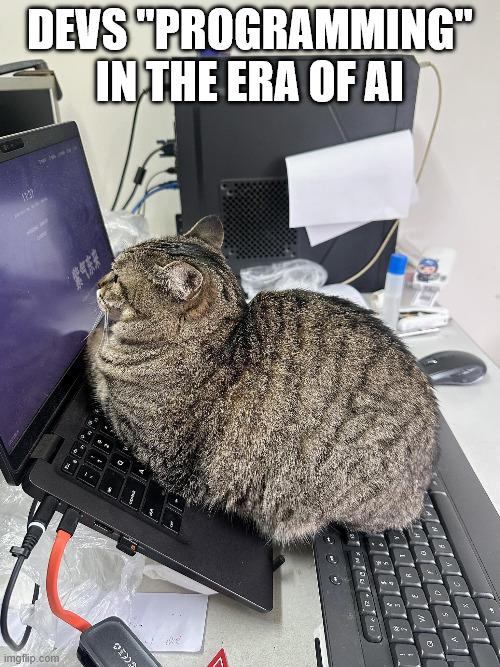
Welcome to the dystopian future where your job isn't writing code anymore—it's being a therapist to AI-generated spaghetti code. The AI confidently spits out a module that "works" but nobody understands why, and now you're stuck maintaining it like some cursed artifact. The real kicker? You can't just rewrite it because management loves their shiny AI tool, and explaining that the AI created an unmaintainable mess is like explaining to your cat why it shouldn't knock things off the table. So you sit there, debugging code that has the structural integrity of a house of cards, wondering if your CS degree was just preparation for this exact moment of existential dread. Plot twist: The AI probably trained on Stack Overflow answers, so you're essentially maintaining code written by a neural network that learned from copy-pasted solutions. The circle of life is complete.