When You Think You Finished

When You Think You Finished
You've spent hours carefully building your feature, tested it locally, got it reviewed, pushed it up, and it's sitting there all nice and organized ready to merge. Then some maniac on your team merges their branch first and suddenly your pristine PR looks like a Lego explosion at a daycare. Now you're untangling merge conflicts that make no sense because they touched the same file you did for "unrelated" changes. The worst part? Half the time it's formatting changes or someone reorganizing imports. You went from "ship it" to "git merge --abort" real quick. Welcome to collaborative development, where your perfectly stacked blocks become chaos the moment you look away.

Guys Figure Out How Can We Store Dreams

Guys Figure Out How Can We Store Dreams
Oh, the TRAGEDY of volatile memory! Your dreams are basically that data you forgot to persist to disk before the power went out. They exist in RAM for like 2.5 seconds, feeling all important and vivid, and then *POOF* - garbage collected into the void the moment you open your eyes. Just like that variable you swore you'd save but the app crashed and took all your unsaved work with it to the shadow realm. The operating system of your brain is basically running on the world's worst database with zero redundancy and NO backup strategy whatsoever. Sweet dreams are made of volatile storage, apparently!

Hide Code

Hide Code
That moment when you're pair programming and your teammate is absolutely crushing it—clean logic, elegant solutions, the works. But then you glance at their screen and realize they've got their code minimized, collapsed, or straight-up hidden behind another window. Like, dude, I KNOW you're cooking something beautiful over there, why are you protecting it like it's the nuclear launch codes? Either you're writing the next Linux kernel or you've got variable names like fart_counter and yeet() . The suspicion is real.

Oop For The Win

Oop For The Win
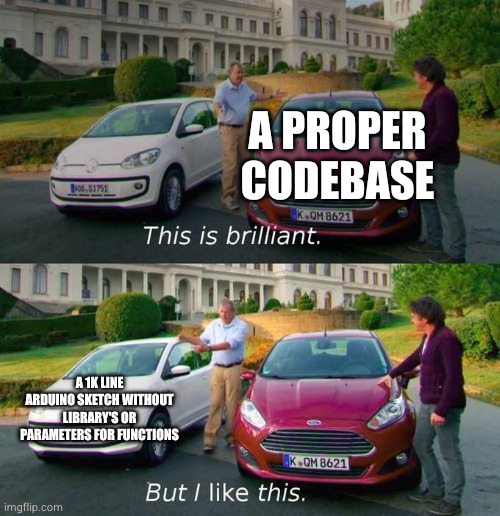
You know you're doing something right when your entire script is a massive tome of spaghetti code, while your main function is just a tiny pamphlet that says "run everything." Classic procedural programming where you dump 3000 lines into one file and then have a main() that's basically just "yep, do the thing." Meanwhile, OOP developers are over here with their 47 classes, 12 interfaces, 3 abstract factories, and a main function that's somehow even smaller because it just instantiates one god object that does everything anyway. Different approach, same energy. The real joke? Both camps think they're doing it the "right way" while the functional programming folks are laughing in pure functions.

I'd Like To Own My Games Thank You Very Much

I'd Like To Own My Games Thank You Very Much
Ubisoft out here telling gamers to "get comfortable with not owning your games" while casually watching their stock price nosedive like it's speedrunning bankruptcy. Turns out when you tell customers they're basically renting everything forever, they respond by... not buying anything. Who could've predicted that treating your paying customers like subscription serfs would tank your market value? The irony is chef's kiss: a company that doesn't want you to own games is now owned by plummeting investor confidence. Maybe next they'll tell shareholders to "get comfortable with not owning profitable stock."

Only Squash Merge Allowed

Only Squash Merge Allowed
When your team enforces squash-only merge policies, every single commit in your feature branch gets obliterated into one bland, generic message. All those carefully crafted commit messages documenting your thought process? Gone. That commit where you finally fixed the bug at 3 AM? Erased from history. The one where you admitted "I have no idea why this works"? Vanished. Sure, it keeps the main branch "clean," but at what cost? Your entire development journey compressed into "feat: implemented user authentication" while the git history becomes as emotionally sterile as a corporate mission statement. Roy Batty would understand—he's seen things you people wouldn't believe, just like your commit history that nobody will ever see again.

And Fucked Up The Merge Too

And Fucked Up The Merge Too
Nothing says "group project chaos" quite like that one teammate who swore they'd code everything manually, only to secretly let ChatGPT rewrite the entire codebase... three times in one day. The best part? They somehow managed to create merge conflicts that would make even Linus Torvalds weep. You know it's bad when the commit history looks like a crime scene and everyone's just staring at the PR like "what fresh hell is this?" The guy probably force-pushed to main too, because why stop at just one war crime?

Eslint After One Line Of Code

Eslint After One Line Of Code
You literally just declared a class. You haven't even written a constructor yet. But ESLint is already throwing hands like you committed a war crime against code quality. The audacity to complain about unused variables when the ink isn't even dry on your first line is peak linter energy. It's like having a backseat driver who starts screaming before you've even left the driveway. Yes, ESLint, I know it's unused—I just created it 0.2 seconds ago. Let me breathe. Let me live. Let me at least finish my thought before you judge my entire architectural decision. The best part? You're probably going to use it in the next line, but ESLint doesn't care about your future plans. It lives in the eternal now, where every unused declaration is a personal attack on its existence.

My Team Overseas Knows February Has Two Rs

My Team Overseas Knows February Has Two Rs
Nothing says "global collaboration" quite like watching someone suggest DD-MM-YYYY or MM-DD-YYYY in a meeting and watching the entire room descend into chaos. There's always that one person who thinks their regional date format is the hill worth dying on, completely oblivious to the fact that ISO 8601 exists specifically to prevent these meetings from happening. YYYY-MM-DD sorts correctly, avoids ambiguity, and doesn't make your database cry. But sure, let's spend 45 minutes debating whether 02/03/2024 is February 3rd or March 2nd while the backend silently judges everyone involved. Fun fact: ISO 8601 was published in 1988. We've had nearly four decades to get this right, yet here we are, still having the same conversation in every international standup.

Delivering Value Worth Every Datacenter

Delivering Value Worth Every Datacenter
Your latest AI model requires the computational power of a small country just to tell someone how to center a div. Meanwhile, the energy bill could fund a small nation's GDP, but hey, at least it can write "Hello World" in 47 different coding styles. The model literally needs to pause and contemplate its existence before tackling one of the most googled questions in web development history. We've reached peak efficiency: burning through kilowatts to solve problems that a single line of CSS has been handling since 1998. Nothing says "technological progress" quite like needing three datacenters worth of GPUs to answer what flexbox was invented for.

Creativity Not Found

Creativity Not Found
AI evangelists love to pitch that you can now build apps without knowing how to code. Just prompt your way to success, they say. Ship features with vibes alone. But here's the thing: AI can't fix the fact that your brain is a barren wasteland of unoriginal thoughts. You still need something worth building. Turns out the bottleneck was never the coding—it was having a single interesting idea in the first place. So congrats, you've automated the easy part and still can't ship because you're stuck staring at a blank canvas wondering what the 47th todo app should look like.

1990s Gamers Vs. 2020s Gamers

1990s Gamers Vs. 2020s Gamers
The evolution of gaming expectations in a nutshell. Back in the '90s, gamers were just happy if the cartridge actually loaded without blowing into it three times. "The game runs? Amazing! 10/10 would play again." Fast forward to 2020s where we've got RGB-lit gaming rigs that could probably run NASA simulations, and gamers are having existential crises because their FPS dropped from 167 to 165—a difference literally imperceptible to the human eye. The contrast is beautiful: a chunky CRT monitor on a wooden desk versus a curved ultrawide with a glass panel PC showing off its RGB fans. We went from "it works!" to obsessively monitoring frame times and getting tilted over 2 FPS drops. The hardware got exponentially better, but somehow our tolerance for imperfection got exponentially worse. Welcome to the future, where your $3000 setup still isn't good enough for your anxiety.