

Old Man Yells At Claude

Old Man Yells At Claude
Rob Pike, co-creator of Go and Unix legend, goes full nuclear on humanity for destroying the planet... but then receives a wholesome Christmas email from Claude AI thanking him for his contributions to computing (Go, Plan 9, UTF-8, Unix innovations). His rage meter instantly resets to zero. The irony? He's furious about "toxic, unrecyclable equipment" and AI's environmental impact, yet gets immediately disarmed by an AI being polite. It's like yelling at clouds and then one cloud sends you a thank-you card. The dude literally can't remember being this angry, which means Claude's politeness algorithm just achieved what no human could: making Rob Pike chill out. Also, Claude calling him "Dr. Pike" and praising his "philosophy of powerful, minimal design" is peak AI brown-nosing. It's basically the digital equivalent of a golden retriever wagging its tail at someone who just yelled at it.

Why Do We Need Backend, Why Don't We Just Connect Front-End To The Database?

Why Do We Need Backend, Why Don't We Just Connect Front-End To The Database?
Someone just asked the forbidden question that makes every backend developer's eye twitch. The response? Pure gold. "Why do we eat and go to the bathroom when we can throw food directly in the toilet? Because stuff needs to get processed." Connecting your frontend directly to the database is like giving every stranger on the internet your house keys and hoping they'll only use the bathroom. Sure, it's technically possible, but you're basically rolling out the red carpet for SQL injection attacks, exposing your credentials in client-side code, and letting users bypass any business logic you might have. The backend is where validation happens, authentication lives, business rules get enforced, and your data stays safe from curious DevTools users. But sure, skip it if you want your app to become a cautionary tale on r/netsec.

It's Always Kernel

It's Always Kernel
Linux devs rejecting Git in favor of... popcorn kernels? The Drake meme format perfectly captures the Linux community's relationship with their beloved kernel. They'll turn down perfectly functional version control systems but get absolutely giddy over anything kernel-related. Whether it's kernel panics, kernel modules, or apparently literal corn kernels, if it has "kernel" in the name, Linux enthusiasts are all in. The obsession is real – these folks will spend 6 hours recompiling their kernel to save 2MB of RAM, and they'll do it with a smile.

I Hate How Accurate This Is

I Hate How Accurate This Is
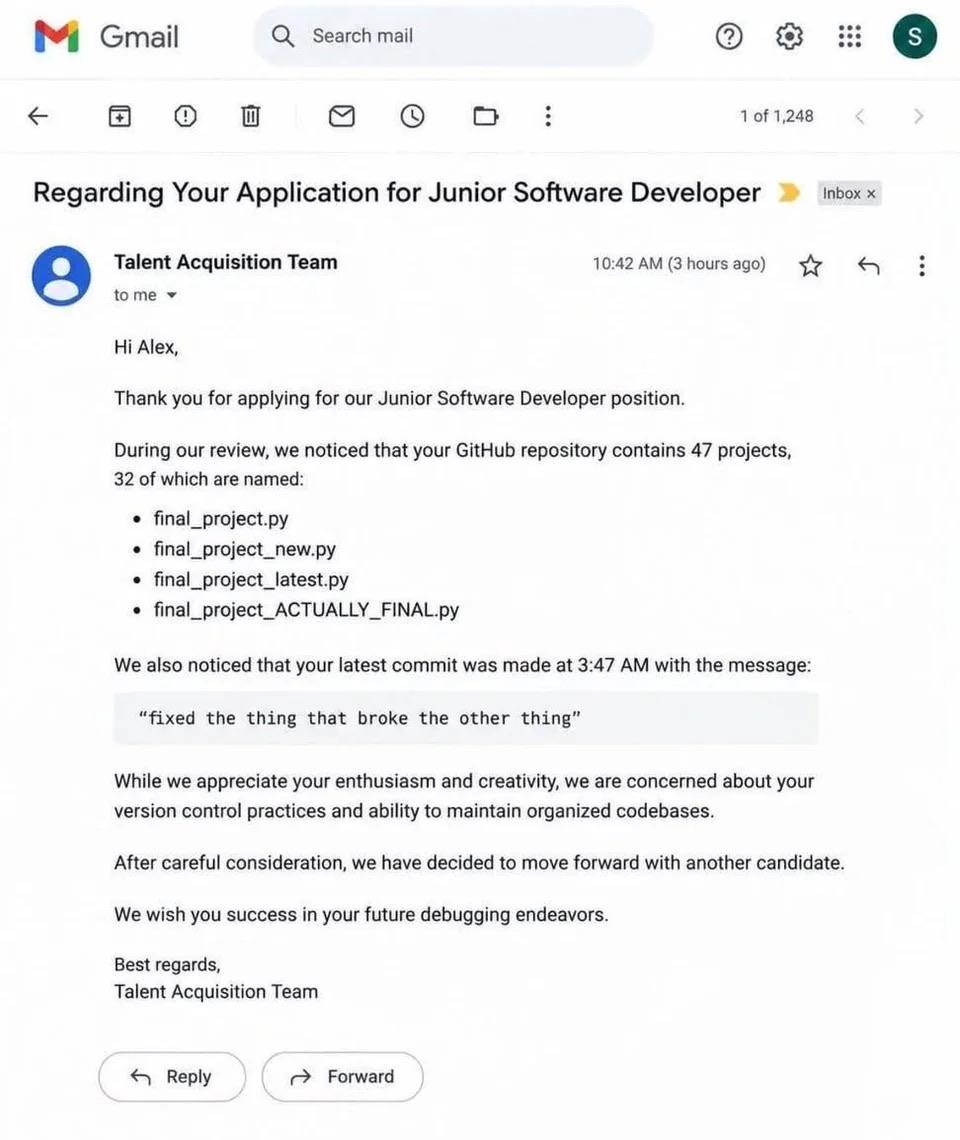
You know you've reached peak programmer when a missing semicolon causes more emotional damage than a breakup. While normal people lose sleep over relationships, we're here at 3 AM staring at our screen like a detective, hunting down that one tiny punctuation mark that's been sabotaging our entire application. The worst part? Your IDE probably highlighted it 47 times, but your brain was too busy being a genius to notice. Four days of debugging, Stack Overflow deep dives, rubber duck conversations, and questioning your career choices... all because of a character that's literally smaller than an ant. Pro tip: The bug is always in the last place you look, which coincidentally is always the first line you wrote.

Perfection Is Optional Apparently

Perfection Is Optional Apparently
The hot take that's dividing the tech world: AI-generated code has officially normalized "good enough" as the new standard. The argument goes that while pre-AI devs obsessed over clean code, optimal algorithms, and elegant solutions, now everyone's just shipping whatever ChatGPT spits out and calling it a day. The brutal reality check here is that if you're still doing code reviews like it's 2019 while your competitors are deploying features at breakneck speed with AI-assisted "slop," you're basically bringing a fountain pen to a keyboard fight. The market doesn't care if your variable names are perfectly semantic or if you followed SOLID principles—it cares if the feature shipped yesterday. That comment though? "we all died in 2020 and this is hell" has 85.7K likes for a reason. The existential dread of watching software craftsmanship get steamrolled by velocity metrics hits different.

Based On Personal Experience

Based On Personal Experience
The eternal curse of knowing how to code: suddenly everyone thinks you're also a walking Best Buy Geek Squad. Family gatherings become tech support sessions, and "I work with software" translates to "I can resurrect your decade-old HP printer that's possessed by demons." The logic loop here is beautiful. You start with the rational take—programming and printer troubleshooting are completely different skill sets. One involves elegant algorithms and clean code; the other involves sacrificing goats to appease the printer gods. But then muscle memory kicks in. You've already googled the error code. You're already checking if it's plugged in. You're in too deep. The real kicker? You WILL fix it. Not because you know anything about printers, but because you know how to read error messages and have the patience to actually restart the spooler service. Which somehow makes you more qualified than 90% of the population.

Everything

Everything
When someone asks what your RTX 5090 cost and you're trying to calculate whether to tell them the GPU price alone or include the therapy sessions, the divorce lawyer fees, and the kidney you sold on the dark web. The real answer? Your dignity, your savings account, and probably your relationship. But hey, at least you can render those triangles at 600 FPS now. Totally worth living on ramen for the next six months, right?

Why Are You Calling Me Out Like That

Why Are You Calling Me Out Like That
We've all been there. You don't trust a single AI anymore, so you've basically turned coding into a democracy where ChatGPT, Gemini, Claude, Grok, and DeepSeek all get a vote. Ask the same question to five different AI overlords, paste their responses into separate files, run them all, and pick whichever one doesn't explode. It's like speed dating but for code solutions. The "like a psychopath" part hits different because it's true. You're not debugging anymore—you're conducting a Hunger Games for algorithms. May the best AI-generated code win. The real kicker? This is somehow more efficient than reading documentation.

Triple E Or Something

Triple E Or Something
Microsoft's product strategy in a nutshell: throw everything at the wall, see what sticks, then pretend the blood puddles were part of the plan all along. Windows Phone? Dead. Skype? Somehow still technically alive but nobody's checking for a pulse. Windows 10? They promised it would be the "last version of Windows" then immediately started working on Windows 11. Meanwhile GitHub is just chilling in the corner, the golden child acquisition that actually worked out. Probably because Microsoft learned their lesson: buy successful things and don't touch them too much. Revolutionary strategy, really. The "EEE" reference is *chef's kiss* - that's "Embrace, Extend, Extinguish," Microsoft's infamous strategy from the 90s where they'd adopt open standards, add proprietary features, then kill the competition. Now they're just extinguishing their own products. Character development, I guess?

Finally Got The Award I Deserve

Finally Got The Award I Deserve
When you spend 3 hours fighting with display: flex and justify-content: center to center a div, you absolutely deserve a trophy. The self-awarded "World's Best CSS Developer" award is the programmer equivalent of giving yourself a participation trophy after debugging why your navbar won't align properly for the 47th time. CSS: the only language where you can be simultaneously a genius and completely clueless. One moment you're crafting beautiful responsive layouts, the next you're Googling "how to center a div" for the millionth time like it's your first day on the job. The fact that someone actually 3D printed this trophy suggests they either have incredible self-awareness or they've finally snapped after one too many z-index battles. Props for the commitment though—most of us just settle for the imposter syndrome and call it a day.

Slop Is Better Actually

Slop Is Better Actually
So we've gone from "move fast and break things" to "move fast and let AI clean up your mess later." The galaxy brain take here is that tech debt—the accumulation of shortcuts, hacks, and questionable architectural decisions—is somehow an investment now. The reasoning? AI will eventually get good enough at refactoring that it'll just... fix everything for you while you sleep. It's the software equivalent of trashing your apartment because you heard Roombas are getting smarter next year. Sure, ship that spaghetti code. Name your variables "x1" through "x47." Nest those ternaries eight levels deep. Future AI will totally understand what drunk-you at 2 PM on a Friday was thinking. The real kicker is calling it an "interest rate" that's falling. Like tech debt is a mortgage you're refinancing, not a pile of burning garbage that makes onboarding new devs feel like archaeological fieldwork. But hey, if AI can refactor legacy code, maybe it can also explain to your future self why that 3000-line function seemed like a good idea.

Tech Public Service Announcement

Tech Public Service Announcement
So Microsoft wants to eliminate C and C++ by 2030 using AI to rewrite their entire codebase. Because nothing says "brilliant strategy" like letting algorithms rewrite millions of lines of battle-tested code that's been running critical systems for decades. The hubris is *chef's kiss*. They're so busy flexing their AI muscles that they forgot to ask the most important question: just because you CAN automate the rewriting of foundational infrastructure doesn't mean you SHOULD. What could possibly go wrong with AI touching code that powers Windows, Office, and Azure? It's not like memory safety bugs are subtle or anything. The Jeff Goldblum meme from Jurassic Park is the perfect response here. They were so preoccupied with whether they could use AI to eliminate C/C++, they didn't stop to think if they should. Because replacing decades of institutional knowledge and battle-hardened code with AI-generated Rust (presumably) is definitely going to go smoothly. No edge cases, no undefined behavior gotchas, just pure algorithmic magic. Sure.