Workflow Memes

Posts tagged with Workflow
Time Changes

Time Changes
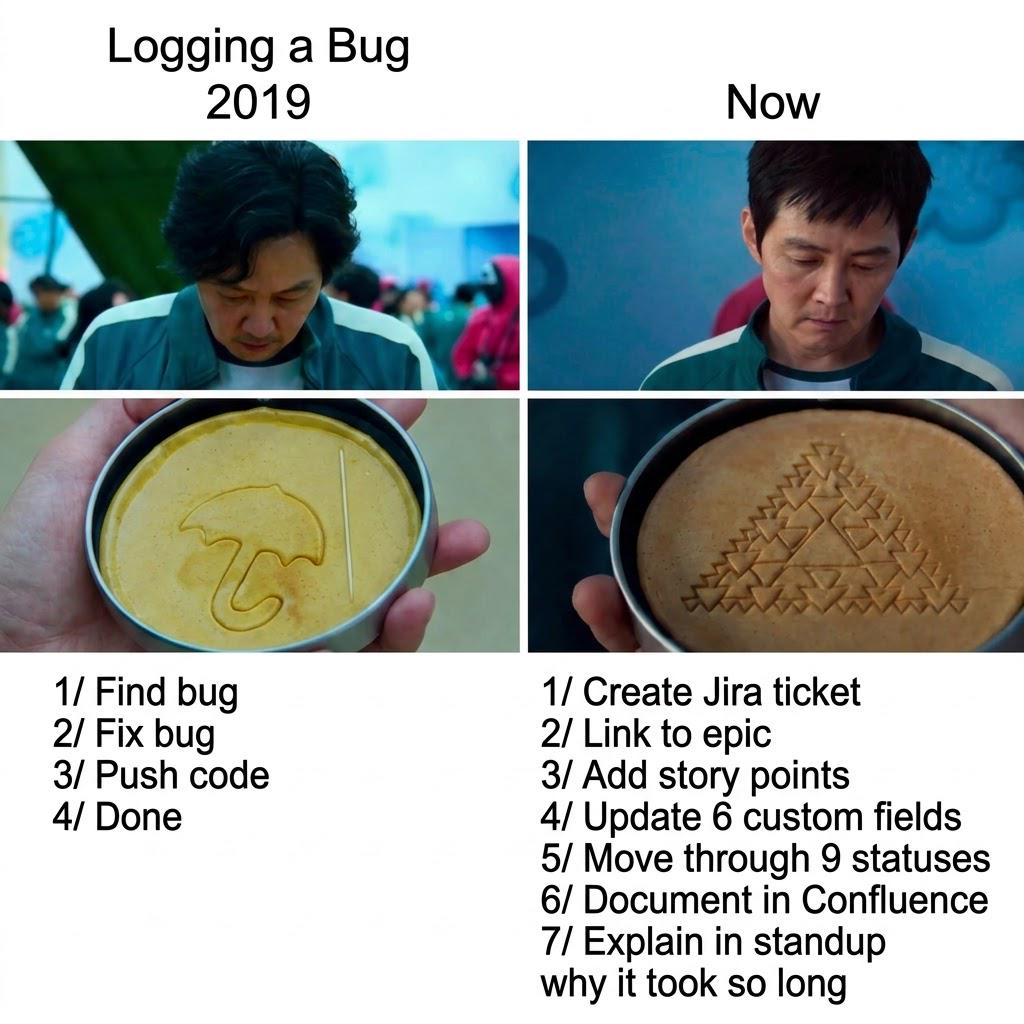
Back in 2019, you could actually fix bugs. Just find it, patch it, commit, done. Simple times. Beautiful times. Now? You've got to create a Jira ticket, link it to an epic that's been sitting in the backlog since Q2 2022, add story points (which everyone knows are completely made up), update 6 custom fields that nobody reads, move through 9 different statuses because someone thought "In Progress" wasn't granular enough, document everything in Confluence where it'll never be found again, and then explain in standup why a one-line fix took three days. The bug fix itself? Still takes 5 minutes. The bureaucracy around it? That's your entire sprint.

Move Fast Break Main

Move Fast Break Main
The classic developer workflow: Design → Code → Bug Fix. Clean, linear, predictable. You knock out features one by one, ship to main, everyone's happy. Total time investment? Reasonable. But then some well-meaning senior dev suggests "refactoring" and suddenly you're in the Upside Down. Now it's Design → Code → Refactor → Bug → Fix → Bug → Fix in an endless recursive nightmare. The timeline explodes into a Gantt chart from hell with more bars than a prison complex. What was supposed to make the code "cleaner" just spawned seventeen new edge cases and broke three unrelated features. The refactor that was meant to take "just a few hours" has now consumed your entire sprint, your sanity, and possibly your will to live. You've touched files you didn't even know existed. The PR has 47 comments. CI/CD is red. Production is on fire. But hey, at least that function name is more semantic now, right?

Action Hell

Action Hell
You know you've reached a special level of developer purgatory when you spend 6 hours debugging YAML indentation in your CI/CD pipeline instead of, you know, writing actual features. GitHub Actions promised us automation bliss, but instead delivered a world where you're googling "how to pass environment variables between jobs" for the thousandth time while your actual code sits there lonely and untouched. The real kicker? You'll spend more time wrestling with needs: , if: conditions, and matrix strategies than actually solving the problem your software was meant to address. And don't even get me started on when the runner decides to cache something it shouldn't or refuses to cache what it should. Welcome to modern development, where the meta-work has consumed the actual work. At least your CI/CD pipeline looks pretty in that workflow visualization graph, right?

Bug Fixed In 5 Minutes Jira Updated In 3 Hours

Bug Fixed In 5 Minutes Jira Updated In 3 Hours
You know you're living the dream when the actual bug fix is a one-line change but updating Jira becomes a full-blown odyssey through bureaucratic hell. The evolution from 2019's simple "find, fix, push, done" workflow to today's 7-step Jira ritual is basically a documentary on how we've optimized ourselves into oblivion. The meme nails it with the Squid Game dalgona candy comparison—back then, logging a bug was as simple as drawing a squiggly line. Now? You're carving out the entire Korean alphabet while navigating custom fields that nobody understands, story points that mean nothing, and 9 different statuses including "Ready for QA Review Pending Approval In Progress." And let's not forget explaining in standup why your 5-minute fix took "3 hours" according to the ticket timestamp. Pro tip: The actual work-to-documentation ratio has inverted so hard that some devs just leave bugs unfixed because the Jira overhead isn't worth it. Agile was supposed to free us, but instead we're spending more time managing tickets than writing code.

A Good Engineer

A Good Engineer
The industry just speedran from "make pretty slides" to "write everything in markdown and shove it in git" in four months. Engineers went from sitting through PowerPoint marathons to actually shipping code as documentation. PMs now track customer issues in real-time with actual logs instead of relying on vibes and quarterly surveys. And the cherry on top? PMs are expected to fix their own typos in the repo instead of filing a ticket with engineering. The definition of "good engineer" shifted faster than a JavaScript framework. Yesterday it was "writes clean code," today it's "treats documentation like code, monitors production like a hawk, and doesn't need a PM to proofread their commit messages." Welcome to the future where everyone's expected to be full-stack... including the product managers.

Git Status

Git Status
The compulsive need to run git status after literally every command is the developer equivalent of checking if you locked the door three times before leaving the house. You just pushed your changes? Better check the status again to make sure the universe didn't spontaneously create new uncommitted files in the 0.2 seconds since your last check. The sequence here is chef's kiss: status → add → status (just to be sure) → commit → push → status (because what if the push created local changes somehow???). It's pure paranoia mixed with muscle memory, and the guy staring at the screen waiting for that sweet "working tree clean" message is all of us.

We Got Laid Off And Don't Care Anymore

We Got Laid Off And Don't Care Anymore
John Goblikon is speedrunning the entire git workflow like his severance package depends on it. Merged a PR 44 seconds ago, approved another one minute ago, and opened yet another PR one minute ago. That's three different stages of the development lifecycle happening in under two minutes. Either this guy discovered time travel or he's operating on pure "I already got the pink slip" energy. When you're already laid off, suddenly all those careful code reviews, thoughtful testing, and "let's wait for CI/CD to finish" concerns just evaporate. Why wait for the test suite when you're not even waiting for your next paycheck? The beautiful chaos of someone who's achieved true enlightenment: zero consequences mode activated. The real power move here is being the person who merges, approves, AND opens PRs all at once. That's the kind of efficiency that only comes from complete detachment from outcomes. Tomorrow's production issues? Not his problem anymore.

Agent Prompts Have Evolved

Agent Prompts Have Evolved
We've reached peak meta: using AI agents to write the instructions for other AI agents. Why spend 10 minutes crafting the perfect prompt when you can spend 3 hours building an agent that writes prompts for agents that write prompts? It's like that scene where you automate your job so well that your automation needs its own documentation, except now the documentation writes itself. And honestly? It's beautiful. We've gone full circle from "learn to code" to "learn to prompt" to "prompt the prompter." Next up: agents that review other agents' prompt-writing abilities and leave passive-aggressive comments in the PR. The real galaxy brain move is when the agent starts optimizing its own prompts and you realize you're just a middleman in a recursive AI feedback loop. Welcome to 2024, where even laziness requires automation.

Not Patient

Not Patient
You know that compilation progress bar is lying to you, right? It says 22 seconds remaining, but your brain refuses to accept this as reality. Instead of waiting like a normal human being, you immediately alt-tab to check Slack, browse Reddit, reorganize your desktop icons, refactor a completely unrelated function, or start a philosophical debate about tabs vs spaces. Four minutes later, you realize the build finished 3 minutes and 38 seconds ago and now you've completely forgotten what you were even testing. The worst part? If the build actually took 4 minutes upfront, you'd grab coffee and feel productive. But those 22 seconds? They trigger some primal impatience that makes waiting physically impossible.

Never Skip Jira Day

Never Skip Jira Day
The beautiful lifecycle of a software developer: wake up, crush some code, close tickets, repeat. This skeleton is literally powered by the dopamine rush of dragging those Jira cards from "In Progress" to "Done." It's like a twisted fitness routine where instead of leg day, you've got ticket-closing day, and your gains are measured in story points instead of muscle mass. The real workout here is maintaining the discipline to actually update your tickets instead of just shipping code and ghosting your project manager. Some devs can bench press 300 pounds but can't lift a single ticket into the done column without being asked three times in standup. This skeleton clearly has its priorities straight—those quads are built purely from the repetitive motion of ticket management. Pro tip: If you're not getting swole from ticket velocity, you're doing agile wrong.

Galatians Four Sixteen

Galatians Four Sixteen
The beautiful irony of our times: programmers clutching their pearls over AI generating sprites and icons, while artists are out here speedrunning Python tutorials to automate their workflows. Turns out everyone just wants to skip the part they're bad at. Programmers can't draw stick figures to save their lives, and artists would rather learn regex than manually process 10,000 files. It's like watching two people swap problems and both thinking they got the better deal.

Really Enjoying My New Stream Deck

Really Enjoying My New Stream Deck
Someone configured their Stream Deck with the essentials: eight different adult entertainment sites and four volume knobs for... precision audio control, presumably. The productivity gains are immeasurable. You know you've reached peak efficiency when your workflow automation includes one-click access to your entire browser history. The XNX button being highlighted is a nice touch—clearly the most frequently used macro. Stream Deck was designed for streamers to switch scenes and control OBS. Instead, it's become a $150 bookmark manager for sites you definitely wouldn't want appearing in your work presentation. HR would like a word about your "productivity tools."